The Time We Have Left

11th hourLast Christmas, I was given the documentary The 11th Hour as a gift. I admit that I was somewhat skeptical of its legitamacy – as much as we all loved Leonardo DiCaprio in Titanic, I wasn’t sure how credible a documentary created by a movie star would be. It was also wrapped in something called BioFilm that sounded kind of sketchy (admittedly, I don’t know what the plastic was made of, but chances are that it’s corn ethanol – not the greatest of fossil fuel replacements).

However, when I watched the film, I was utterly engrossed. My favourite thing about the 11th hour is that most of the dialogue and narration comes from interviews with incredibly articulate experts. This film featured scientists, authors, First Nations leaders, CEOs of green businesses, and national security officials. David Suzuki, Stephen Schneider, Paul Hawken, and Stephen Hawking were just a few of those interviewed.

The 11th Hour dicusses many different aspects of environmental depletion, sociology, and solutions. It opened with a sort of celebration of life and the beauty of nature. I believe it was Paul Hawken that said something along the lines of, “In your body, right this very second, there are three (something with a lot of billions and trillions) things happening at once. That’s a three with twenty-four zeros after it. Right this second. And in the next second, as you sit there on the couch, one hundred times more things are happening than there are stars and planets in the universe. And that is what we call life.”

The section on climate change was brief, but quite well done. Most of the time was devoted to talking about possible impacts – how warming would affect our water security, food security…..However, Stephen Schneider delivered a fantastic quote that’s quite relevant to this blog:

“Some scientists are amazed that in the media debate and in Congress there are people who stand up and say, “I believe” or “I don’t believe in global warming,” as if it were some sort of object of religion, instead of based in evidence.”

(Check out the post Making Up Your Own Science for more on that topic.)

Following the climate change discussion were small sections devoted to forestry, aquatics, biodiversity, and hyperconsumerism. However, the discussion on extinction was so compelling to me that it dwarfed all the previous discussions. The film explored how extinction is inevitable to a species, that the demise of an entire species is as natural as the death of a single organism. It’s no secret that humans will eventually become extinct. The question is how our actions today are affecting when that extinction will happen, and how many other species we are taking down with us.

The last third of the movie was devoted to possible solutions. I applaud the filmmakers in this decision. The first part of the film was pretty darn scary, and ending on an optimistic note made me feel more motivated for action. And what an optimistic note it was! The film discussed how our current system of economics discourages environmental action, and how we could reinvent our economy so that it is more in tune with sustainability and quality of life. It discussed biomimicry, a principle of design which mimics nature, such as the incredibly strong spider’s silk, the structural (rather than pigmented) colour of the blue morpho butterfly, and self-cleaning leaves. “The generations alive today,” Paul Hawken said, “will have to reinvent everything…..what a great time to be born, what an opportunity.”

Happy things

The 11th Hour ended on such a hopeful note that I felt myself becoming more optimistic. There is time to solve the problem of climate change. If our global carbon emissions drop to zero by the middle of this century, we will never pass the 2 C warming which is estimated to be a tipping point. Some warming is inevitable, but we still have time to stop it getting out of control.

In the Discover article on climate change this June, the panel of scientists was asked how hopeful they were that humanity could solve the problem of climate change. Most of them answered that they felt very sure that we had the resources and technology to drastically reduce, or even eliminate, carbon emissions. But they weren’t so sure that we had the will. The world has known about this problem for over 40 years, but little has been done.

But to think that we still have a chance…..no matter how small….it makes me want to grab on to that chance and run with it and do all that I can to make it come true.

If it clashes with the economy, we’ll reinvent the economy. If the oil executives get mad, we’ll pay them a lot of money to develop wind power and geothermal. If the skeptics continue to argue, we’ll say to them, as we should be saying now, “The stakes are too high to base our actions on the best possible scenario.”

The fact that there still is a tangible chance, however small, that we could fix the problem of climate change altogether, is so exciting that I feel obliged to pursue it.
Why Al Gore Doesn’t Matter

The first of many reviews planned for ClimateSight!

Climate change skeptics like to imply that Al Gore’s word is all we have going for us. That our faith in the theory is upheld simply because he supports it. That he’s brainwashed us all and we should think for ourselves. If it sounds like I’m exaggerating, go check out some YouTube comments – and even entire videos – dedicated to these concepts.

But the truth is, Al Gore could have never existed and the scientific theory of anthropogenic climate change would be the same as it is today.

Let’s take some time for historical context. The greenhouse effect began to be studied in the late 1800s by Svante Arrhenius. The current theory that anthropogenic CO2 emissions are causing the Earth’s temperature to rise was hypothesized by Guy Callendar in the 1930s. A great historical account of climate science is available to read online here.

The beginnings of the modern-day scientific view were present before Al Gore was even born. The idea that he thought up the whole conspiracy theory quickly falls apart. (But if you’d like a good laugh, check out this April Fool’s article. It made my day.)

Al Gore was educated at Harvard. He was fascinated by courses from Roger Revelle, another climatology pioneer. Before long, though, Gore became interested in politics. He graduated with a BA in government.

Try swaying the minds of every major scientific establishment in the world when the only formal education you have in climatology is a couple of undergraduate courses.

I’m sure Al Gore understands climate change better than most members of the general public. I’m also sure that the folks at national academies of science and organizations such as NASA, all at the top of our credibility spectrum, understand climate change a heck of a lot better than Al Gore. Check out what they’re saying here (thanks to Logical Science, who cited all of the statements so well).

It’s clear that, under our credibility spectrum, Al Gore would fall under the professional. He keeps well up to date with the scientific literature, but is not a scientist himself. He is only slightly more credible than the average person.

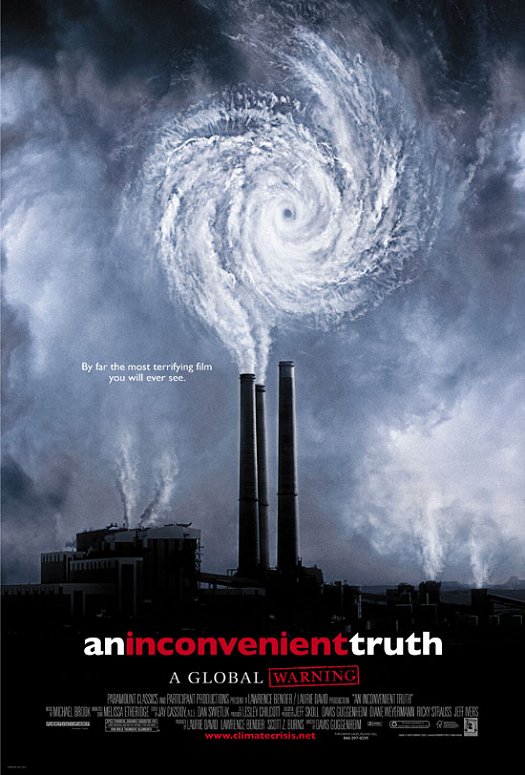
And with this context, let’s take a look at An Inconvenient Truth.

An Inconvenient Truth (2006) – Review

inconvenient truth

This is definitely not an example of scientific literature. It was not intended to be, and should not be taken as such. This is not to say that Gore’s statements about climate change are wrong. His overall message is greatly supported by the scientific community. However, it’s not the kind of text you’d want to cite in a research paper.

It’s clear that the purpose of this documentary was to increase public awareness, not to imitate a science textbook. Taken in that context, An Inconvenient Truth fulfills its purpose tremendously – almost too well, I’d say, as the first thing that comes to most people’s minds when they hear about the theory of climate change is not the IPCC, national academies of science, or university professors, but Al Gore. A lot of people think it’s Al Gore’s problem, and not much else.

And, sadly, if you wanted to take down the scientific side of Gore’s argument, it wouldn’t be too hard.

Early in the film, Al Gore says that we are adding to the greenhouse effect by “thickening” the atmosphere. This is more than just oversimplification. Burning fossil fuels not only increases CO2 concentrations in the atmosphere, it decreases O2 concentrations, by attaching one carbon atom to each molecule of oxygen in the combustion process. Read more about this concept here.

We are not “thickening” the atmosphere at all. But someone who watched An Inconvenient Truth could come away with that impression. That person would be very vulnerable to claims such as “Carbon dioxide only makes up 0.04% of the atmosphere.” The relative abundance of a gas in the atmosphere would seem important for its radiative properties, while basic laws of chemistry indicate that it is not.

Luckily, the major misconceptions ended there. However, Al Gore used anecdotal evidence, rather than citing cumulative studies, almost exclusively. For example, he showed pictures of a dozen or so glaciers across the world that were retreating. It couldn’t be too hard to find the same amount of glaciers that were advancing and present them as proof that Gore was wrong. What would be considered appropriate evidence would be a study that examined every major glacier in the world and determined the percentage that were retreating vs advancing.

Al Gore used similar tactics with evidence such as heat waves, hurricanes, and tornadoes. He referred to specific events and/or regional records rather than looking at the processes on a global scale. However, anecdotal evidence is much more compelling to an audience than a bunch of graphs. For the purpose of his documentary, we can probably forgive Gore for that misstep.

There were points in the documentary where it was unclear whether Gore was using a historical event as evidence or as an example of how bad the future could be. For example, when the film examined Hurricane Katrina, it was hard to tell if Gore’s message was, “This was caused by climate change” – which is almost impossible to determine for a specific event; you can’t really prove that it wouldn’t have happened anyway – or “Look at how devastating hurricanes can be – and they could become more frequent.”

The last scientific complaint I have to make against An Inconvenient Truth is the lack of time scale provided. When Al Gore showed how a sea level rise of 20 feet (~7 m) would affect coastlines across the world, he failed to mention that such an event is not expected for another few centuries. In the IPCC 4th report, a rise of 18 to 59 cm is expected by 2100. If we keep going at our current pace, we’ll eventually hit 7 m, but it won’t be in the next few decades, as he seems to imply. I don’t see what the harm would be in telling the audience when the 7 m rise would happen – if anything, it would increas his credibility. The idea of such a catastrophe being 200 years away doesn’t make it any less scary to me. 

That’s the science stuff out of the way. Now let’s look at the real purpose of the film – the implications for policy. Al Gore is probably one of the most experienced people in the world on climate change legislation. He is, after all, a politician, and spent a great deal of his career trying to pass emission targets. Gore provided an especially good argument as to why we don’t have to choose between the environment and the economy; how environmental action could actually foster economic growth. Of course, he took as many stabs at the Republican party as he could in this part of the film.

I also enjoyed the “frog in boiling water” metaphor, regarding how a slow change can go unnoticed by the human brain until it’s too late. The psychology of fear and how it relates to climate change is fascinating to me. I’d recommend that you all read this editorial, written by psychologist Dr Daniel Gilbert. (Don’t be put off by the title – it makes more sense after you read the article!)

And, of course, as major climate change legislation has yet to be passed in the States, Gore ended on the note of individual action. The things we’ve all heard before – ride your bike, insulate your attic, get a low-flow showerhead. As important actions as these are to take, realistically, they will not be enough. We need major policy changes if we hope to make any difference in our total emissions. As Thomas Homer-Dixon said, “We’re not going to get there by changing our lightbulbs.”

Overall, I think An Inconvenient Truth fulfilled its purpose, which was to increase public awareness and encourage action. We just need to remember that it was never intended to be a solid source of scientific data.

After all, we have much more than Al Gore on our side.