Lightbulbs Aren’t Enough

When you read about climate change in magazines, the articles almost invariably conclude with a list entitled “10 Ways to Reduce Your Carbon Footprint”, or something similar.

Instead of driving, ride your bike, walk, or use public transit. When you do drive, avoid idling and make sure your tires are properly inflated. Insulate your home. Use compact fluorescent lightbulbs. Recycle and compost. Buy local food from farmer’s markets. We’ve heard it all before.

These are important actions to take. They can go a long way to improve local air quality and save you some money. Local food is yummy, and composting is fun to watch. But will they really help fight climate change?

Dr James Hansen, a climatology pioneer with an incredible track record, believes that atmospheric CO2 needs to be reduced to “at most 350 ppm” from the current 389 ppm. Kyoto required an average reduction of 5% below 1990 levels. The Waxman-Markey climate change bill that just passed the US Congress is aiming for an 80% cut by 2050.

It’s an incredible feat in today’s fossil-fuel dependent world for a country to even stabilize their emissions, let alone decrease them, let alone decrease them enough so that CO2 concentrations will stabilize, let alone decrease them enough so that CO2 concentrations will also decrease.

Is it enough just for the government to run a series of ads which encourage bike riding? Is it enough for them to give a tax credit on compost bins? Will that alone cut our global CO2 emissions the drastic amount that is needed? And most importantly, will enough people even make an effort?

Personally, I believe that governments need to take two different kinds of action against climate change.

1) Improve and expand on infrastructure to support a sustainable lifestyle. Basically, make it easy for everyone to follow the “10 Ways to Reduce Your Carbon Footprint” list. Create a public transit system which is even more convenient than driving – in Ottawa, where I recently traveled, their rapid-transit buses are so efficient that most (or at least a good chunk of) people ride them to and from work each day. Build bike paths so cyclists don’t have to ride in traffic. Provide a curbside composting and recycling system. Make sustainability so easy for citizens that it won’t seem like an inconvenience.

2) Create legislation and financial incentives, including an emissions target, for industries to move away from fossil fuels and start using clean energies. Citizens and industries tend to care about money more than anything else. If cap-and-trade is designed correctly, it will be in a company’s best financial interests to reduce their emissions. CSS plants will be gold mines. If a carbon tax works correctly, clean energies will cost less than carbon-dense fossil fuels, so people will be more willing to choose them. Their demand will increase and they will become more present in the market.

If you make it easy for people to reduce their carbon footprint, and then it make it more expensive for them not to do so, they will change. If you introduce the freedom to pollute as a currency to industries, they will do what industries like to do, which is to make money and save money.

But simple encouragement will only work on the most ethical of people. And even then it doesn’t go far enough. I would live a far greener lifestyle if transit was better and farmer’s markets were easy to get to.

Until then, commercials encouraging bike riding and energy-efficient lightbulbs are nothing but a facade that make the government look like it’s doing something to support sustainability.

Bookmark and Share

The Average Person

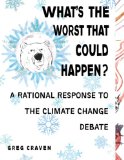
craven I first watched the Manpollo videos about a year and a half ago, when I had the flu, and ended up watching the entire six hours over two days. I don’t remember when it was that I discovered Greg Craven was writing a book based on the videos, but I’ve been excited to read it ever since.

The Manpollo videos have inspired my view on climate change and transformed my way of talking about it more than anything else I’ve read or watched. In a nutshell, Greg Craven’s process of risk management takes the pressure off us to be amateur scientists. It doesn’t require that we assess the statistical methods of people with PhDs when we only have a high school knowledge of science. Instead, it shows us how to use logic, assess credibility, and weigh the benefits and consequences of taking action vs not taking action on an uncertain threat.

I suppose I sort of expected that Greg Craven’s book would be a step up from the videos, would contain even more ideas, anecdotes and talking points that I could really sink my teeth into, would tell me more that I hadn’t already heard in the six hours of Manpollo.

But his book wasn’t like that. Greg Craven disappointed me.

And I’m grateful for that.

See, the book was not aimed at people like me who have an interest in climate change that borders on obsession. It was not aimed at the people who already know which sources are skeptical of anthropogenic climate change and which are worried about it. It was not aimed at those of us who can rattle off the current concentration of atmospheric CO2 without a second thought.

The book was aimed at the average person, who basically knows what climate change is but hears so much shouting in the media that they have no idea of its level of agreement. Who knows there are two sides and doesn’t want to offend anyone. Who has never heard of Milankovitch cycles, methane hydrates or the Goddard Institute of Space Studies.

If the average person stumbled upon most climate change blogs, most of the terms would be foreign to them. I hope they’d be able to understand most of what I write here on ClimateSight (as I try to stay away from analysing hard data) but they’d probably still need a bit of background information.

The average person, with little to no background information on climate science and policy, needs somewhere to start. They need the tools to assess the credibility of a source. They need to know where to go for more information about a topic. They need a basic knowledge of risk management, logic, and bias.

What’s the Worst that Could Happen? provides exactly that. It seems like a more concise version of the Manpollo videos, all the topics outlined in a simple process without the need for much background reading. If I were to recommend a book to start with for this anonymous average person we’re discussing, it would be hard to find one better than this one.

Instead of telling you stuff, Greg Craven tells you how to find stuff out for yourself. He doesn’t tell you how much agreement there is on climate change, he introduces you to a credibility spectrum instead. And even then, he doesn’t just give you his credibility spectrum, he shows you how to make your own.

He doesn’t tell you that oil executives are denialist trolls, he explains possible biases that could lead a person to a hasty conclusion. He gives one of the best basic explanations of the mechanics of anthropogenic climate change that I’ve ever read. Craven is possibly the least offensive, but most helpful, writer I’ve ever encountered.

My only complaint about the book was how he handled the “individual professional” and “individual layperson” sections in the chapters about statements. On the Skeptic’s side, he listed every individual prominent skeptic he could think of, I believe it was about a dozen. On the Warmer’s side, he had Hansen, Oreskes, and Gore. That was it. He explained that this was because he filled his credibility spectrum from the top down, and the statements at the top were almost exclusively weighted to the Warmer’s side. But there is something personal about an individual’s work that makes a person trust them and put faith in their arguments, rather than a report like the IPCC which is dry and anonymous. I wish that Craven had put some kind of indication, perhaps the Doran and Zimmerman report, that the opinion of individual scientists was also weighted towards the Warmer’s side. Otherwise it seems like the masses are not in agreement with the authority, which is supposed to be the source you listen to.

And because I agree with this concept so wholeheartedly, I feel compelled to share with my readers my answer to the question Craven asks at the very beginning – what would make you change your mind?

I would change my mind about dangerous anthropogenic climate change if a new discovery was made, if some new explanation came forward that gained as much agreement as the current theory holds now. If the national scientific bodies of the world, the peer-reviewed journals, and university textbooks had a complete overhaul because scientists discovered that humans were not changing the climate. If some new explanation surfaced that proved Arrhenius and Callendar wrong. It would be a discovery akin to the theory of relativity. As George Monboit said, “If you can prove these statements wrong, you should apply for a Nobel Prize. You will have turned science on its head.”

I listen to the scientists. I’m not surrending my rights and freedoms as an individual to them. I just trust their analysis more than I trust my own.

To conclude

If you already know a fair bit about climate change, and want some really fascinating dicussion points that will keep you going for literally years, watch the Manpollo videos. If you’re a really hardcore skeptic who thinks climate change is a global conspiracy, Manpollo was made especially for you.

But if you’re new to this topic, start with What’s the Worst that Could Happen? I assure you that there is no better place to begin.

A Story Worth Hearing

I found a great article on one of the blogs I read a few days ago. It was the first time I’d heard of the story, and it made me so mad that I knew I had to share it on ClimateSight. But this article was so well-written that I doubted I could come up with anything better.

In a nutshell…..an old paper that didn’t pass through the peer-review process of the EPA contained all sorts of climate-denial “evidence” which has been proven wrong countless times. The peer-review panel wasn’t trying to suppress contradictory evidence – in fact, publishing contradictory evidence would be great for the journal and the advancement of science – the paper was just utter nonsense!

But the Republicans threw a fit when they discovered that a paper questioning anthropogenic climate change was deliberately suppressed so the EPA could begin a communist takeover….or something like that. They want a criminal investigation. As David from Through a Green Lens writes,

“The irony is that these people watched calmly as the Bush-Cheney Administration suppressed global warming science.  Now, the party that supposedly promotes “fiscal responsibility” would like to spend millions of dollars on an investigation into why faulty science was not included in an EPA decision.”

Read the rest of his post here.

PS: A number of you have brought it to my attention that the ever-narrowing nested comments get very hard to read. I went to go check it out (I usually view comments from my WordPress dashboard) and my goodness, one word per line…..no wonder you were complaining!

I played around with the discussion settings, and I think I’ve fixed it as much as I can. Replies to comments will no longer appear indented below the original comment, but I’ve placed the oldest first, instead of the newest first, so that it makes more chronological sense. Unless there’s multiple discussions going on at once, I think it’s okay.

Let me know what you think, and if you have any more suggestions.

The Last Minority

Over the past century, our society has significantly expanded its definition of “citizen”. It wasn’t too long ago that the only people who were allowed to vote were white males.

In Canada, where I live, women with close relatives away at war could vote in federal elections beginning in 1917. By 1919, the right to vote was extended to all women.

As we were an enormously racist country until Trudeau came into power in 1968, Chinese Canadians were not allowed to vote until 1947. It was even worse for the First Nations peoples – their right to vote was not granted until 1960.

In 2002, prisoners were granted the right to vote. Today, you can even vote if you are a Canadian citizen living overseas, or are homeless and don’t have an address to verify on your Voter Identification card.

It took us a long time to get here, but now, every Canadian citizen has the right to vote, regardless of gender, ethnicity, personal circumstances, or religion.

Or do they?

What about young people?

“They’re not mature enough,” you may object. “Teenagers are rebellious troublemakers who can’t understand their own decisions.”  But I have witnessed a fair few rousing discussions in geo and history classes, and can personally attest to the fact that there are many teenagers out there who are more politically aware than most adults.

Probably the reason that Canadian citizens under 18 aren’t allowed to vote is that a lot of the legislation being voted on only applies to those 18 and older. Prison sentences, insurance, property taxes…..a great deal of it only kicks in once you’re old enough to get a library card without a parent signature.

However, not all legislation is only applicable to legal adults. Some is actually more applicable to youth than any other segment of the population.

Climate change is a long-term problem. Due to the lag time between atmospheric carbon dioxide concentration and temperature, whatever changes we make in our emissions won’t be noticeable for another 50-60 years. You can bet that most of the politicians debating Waxman-Marley and Copenhagen won’t be around to experience the results of their actions, or lack thereof.

Maybe I’m just being cynical, but it seems a lot easier to care about a problem when it’s your future in jeopardy. When it’s your chance to go to university and travel the world, to have a family, to own property. When you might be left in a world where travelling is impossible due to sea level rise and environmental refugees, where the chances of your family being injured in a natural disaster or infected by a vector-borne disease increase, where cashing out your insurance on your new property looks a heck of a lot more likely.

We, the youth, haven’t experienced any of the milestones that our parents have. It’s our future that’s threatened. But we have no say in it. Instead, the decision is being made for us by people who won’t be around to experience most of the consequences. Youth are some of the only people that have a vested interest in the long-term consequences of society’s actions. So why is it that we are the only ones prohibited to vote?

Finally, I was really touched by this commercial from Australia. Most of it is the normal “use clean energy! ratify Kyoto!” propaganda, but then the narrator says, “I’ll do everything in my power to make it happen. The only thing I can’t do is vote.”

A quick housekeeping note: I have purchased a domain name from WordPress and the URL for my blog is now http://climatesight.org! Shorter and catchier. The old URL, https://climatesight.wordpress.com, will still work. No links to this site will be broken. I just thought that a more obvious URL would help the blog reach more people.

It’s Everyone’s World

A nation’s policies usually only affect its citizens. Take health care, crime, or taxes. These policies could affect the rest of the world indirectly – through the economy, for example – but the benefits and consequences of the policies’ effectiveness, or lack thereof, will be present first and foremost in the nation in which they were created.

Climate change legislation doesn’t work the same way.

Firstly, the mechanism of climate change is just not fair. If it was, the countries which had caused the problem would suffer the greatest consequences, and those which had had no hand in causing the problem would go on as normal. Unfortunately, the areas which will suffer the most from a warming climate are affected due to their physical geography – such as latitude, ocean and wind currents, and topography – not due to the amount they contributed to the problem. This means that a lot of developing nations, whose per capita carbon emissions are virtually nil, will suffer greatly from climate change.

Additionally, developed nations are undoubtedly the best equipped to deal with the consequences they do suffer. Here in Canada, for example, we have floodways, free health care, food reserves, and insurance. But look at somewhere like sub-Saharan Africa. What backup plans do they have for natural disasters?

I am not suggesting that I want the developed nations to experience the drastic consequences of their actions. Conversely, I am suggesting that the developed nations have a global responsibility to repair their actions, as the consequences will affect many who are innocent and unequipped.

We should stop looking at climate change legislation, or lack thereof, as “How will this help or hurt me?” and start looking at it as “How will this affect the rest of the world?”

An interlude of Canadian politics

Prime Minister Stephen Harper, head of our minority government (for our American friends – read up on Canada’s governmental system here if you’re lost) hasn’t done a lot about climate change. When he came into power several years ago, he got rid of the previous government’s emission plan and got rid of our Kyoto agreement. Then he created a “20% emission reduction by 2020” plan which looked pretty decent. But then the economy went downhill and he got rid of that plan as well. Now he’s pledged to not take any action against climate change until the US plan is fully underway – 2016 or so.

Luckily, here in Canada, we can call elections whenever we want (not just every four years), so he may be out as early as September, depending on how angry the opposition gets with him.

Regardless, it’s pretty obvious that Canada isn’t going to take any action until the United States does.

Why I care about US policy

I am not a citizen of the United States. I’ve only ever travelled there, I believe, three times. I assume that the US culture is quite similar to Canada’s, but I don’t know for sure. I’m perplexed at the lack of recycling in the States.

But I care a lot about what the US does in terms of climate change policy. I care what American citizens think about climate change. I believe that when the US takes significant action, the rest of the world will follow. As an economic superpower, the US has the biggest potential to be a leader in climate change action. As the largest per-capita emitter in the world, it also has the biggest potential to make climate change worse if it doesn’t take action.

“Why do you care about US policy?” you may ask me. “It’s not even your country.”

No, it’s not my country.

But it is my world. It’s everyone’s world. And what the United States does about climate change will affect everyone.

In All Honesty

An interesting theory as to why so many people reject climate change is that they don’t want to take action. Whether they work in the fossil fuel industry or are vehemently opposed to government regulation, they feel that the consequences of taking action will be worse than not taking action.

This is a legitimate opinion, even though I disagree with it. It involves policy (what we should do about the problem) instead of science (deciding if there even is a problem). Stating that we shouldn’t take action at all is, in a way, deciding what action we should take. It’s a personal opinion. You don’t need a PhD for it to be respected.

However, it’s fairly obvious that accepting the problem of climate change but refusing to take any action would make the public very angry. Here in Canada, many environmental advocates aren’t too happy with Stephen Harper (our prime minister) as he’s scrapped yet another emissions legislation plan – the third one, I believe. He’s now decided to not take any action against climate change until the American legislation is completely implemented. If Harper gets his way, it’ll be about 2016 before Canada starts regulating emissions. I’ve never seen David Suzuki so mad.

The aforementioned theory goes on to say that, instead of accepting the problem but refusing action, the regulation-wary people deliberately create confusion around the science supporting the idea of climate change. Their purpose is not to win the debate, but to prolong the debate. The longer they can keep the public wondering if climate change is a problem or not, the longer it will take for action to begin. This goal is mainly achieved by opinion editorials, credible-looking websites, and interviews with the media, all of which contradict as much of the prevailing scientific opinion as possible.

This strategy is not new, or exclusive to climate change. Suspicion has arised that it has been used before when products such as tobacco or CFCs began to be regulated. Some great sources dealing with this theory are this lecture by scientific historian Naomi Oreskes and this documentary by a Canadian televison network (sorry if it’s not available to American viewers). I say “suspicion” because there is no solid way to prove this theory, it is only speculation.

If there is anyone reading this who is using the strategy of confusing the public on the science in effort to delay action, please reconsider your actions. If you’re worried about the potential costs of action against climate change, tell us your worries. We may be able to find a way around them. We’ll work as hard as necessary to avoid excessive regulation and counteract economic harm. The economy is a human-created system; we can manipulate it to fit our needs. The sooner we start working to fix this problem, the easier it will be.

Please don’t try to delay action by debating the science. If you’re open and honest about your worries, we may be able to solve them – no deception, confusion, or aggression necessary.

Why Al Gore Doesn’t Matter

The first of many reviews planned for ClimateSight!

Climate change skeptics like to imply that Al Gore’s word is all we have going for us. That our faith in the theory is upheld simply because he supports it. That he’s brainwashed us all and we should think for ourselves. If it sounds like I’m exaggerating, go check out some YouTube comments – and even entire videos – dedicated to these concepts.

But the truth is, Al Gore could have never existed and the scientific theory of anthropogenic climate change would be the same as it is today.

Let’s take some time for historical context. The greenhouse effect began to be studied in the late 1800s by Svante Arrhenius. The current theory that anthropogenic CO2 emissions are causing the Earth’s temperature to rise was hypothesized by Guy Callendar in the 1930s. A great historical account of climate science is available to read online here.

The beginnings of the modern-day scientific view were present before Al Gore was even born. The idea that he thought up the whole conspiracy theory quickly falls apart. (But if you’d like a good laugh, check out this April Fool’s article. It made my day.)

Al Gore was educated at Harvard. He was fascinated by courses from Roger Revelle, another climatology pioneer. Before long, though, Gore became interested in politics. He graduated with a BA in government.

Try swaying the minds of every major scientific establishment in the world when the only formal education you have in climatology is a couple of undergraduate courses.

I’m sure Al Gore understands climate change better than most members of the general public. I’m also sure that the folks at national academies of science and organizations such as NASA, all at the top of our credibility spectrum, understand climate change a heck of a lot better than Al Gore. Check out what they’re saying here (thanks to Logical Science, who cited all of the statements so well).

It’s clear that, under our credibility spectrum, Al Gore would fall under the professional. He keeps well up to date with the scientific literature, but is not a scientist himself. He is only slightly more credible than the average person.

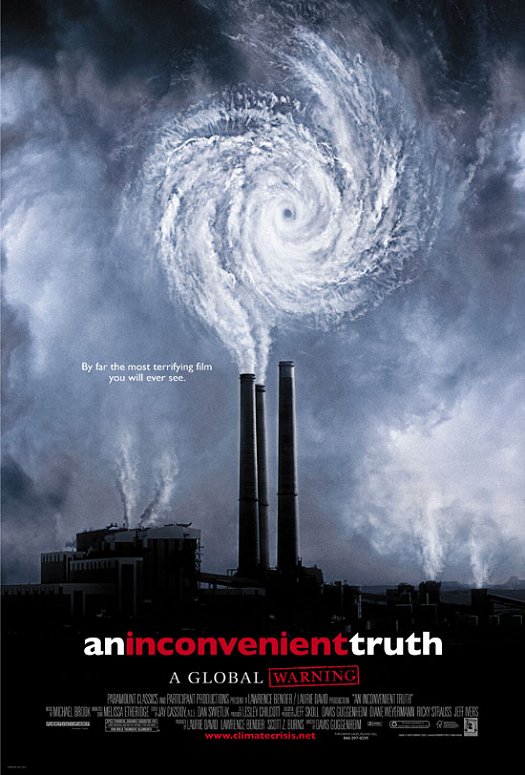
And with this context, let’s take a look at An Inconvenient Truth.

An Inconvenient Truth (2006) – Review
inconvenient truth

This is definitely not an example of scientific literature. It was not intended to be, and should not be taken as such. This is not to say that Gore’s statements about climate change are wrong. His overall message is greatly supported by the scientific community. However, it’s not the kind of text you’d want to cite in a research paper.

It’s clear that the purpose of this documentary was to increase public awareness, not to imitate a science textbook. Taken in that context, An Inconvenient Truth fulfills its purpose tremendously – almost too well, I’d say, as the first thing that comes to most people’s minds when they hear about the theory of climate change is not the IPCC, national academies of science, or university professors, but Al Gore. A lot of people think it’s Al Gore’s problem, and not much else.

And, sadly, if you wanted to take down the scientific side of Gore’s argument, it wouldn’t be too hard.

Early in the film, Al Gore says that we are adding to the greenhouse effect by “thickening” the atmosphere. This is more than just oversimplification. Burning fossil fuels not only increases CO2 concentrations in the atmosphere, it decreases O2 concentrations, by attaching one carbon atom to each molecule of oxygen in the combustion process. Read more about this concept here.

We are not “thickening” the atmosphere at all. But someone who watched An Inconvenient Truth could come away with that impression. That person would be very vulnerable to claims such as “Carbon dioxide only makes up 0.04% of the atmosphere.” The relative abundance of a gas in the atmosphere would seem important for its radiative properties, while basic laws of chemistry indicate that it is not.

Luckily, the major misconceptions ended there. However, Al Gore used anecdotal evidence, rather than citing cumulative studies, almost exclusively. For example, he showed pictures of a dozen or so glaciers across the world that were retreating. It couldn’t be too hard to find the same amount of glaciers that were advancing and present them as proof that Gore was wrong. What would be considered appropriate evidence would be a study that examined every major glacier in the world and determined the percentage that were retreating vs advancing.

Al Gore used similar tactics with evidence such as heat waves, hurricanes, and tornadoes. He referred to specific events and/or regional records rather than looking at the processes on a global scale. However, anecdotal evidence is much more compelling to an audience than a bunch of graphs. For the purpose of his documentary, we can probably forgive Gore for that misstep.

There were points in the documentary where it was unclear whether Gore was using a historical event as evidence or as an example of how bad the future could be. For example, when the film examined Hurricane Katrina, it was hard to tell if Gore’s message was, “This was caused by climate change” – which is almost impossible to determine for a specific event; you can’t really prove that it wouldn’t have happened anyway – or “Look at how devastating hurricanes can be – and they could become more frequent.”

The last scientific complaint I have to make against An Inconvenient Truth is the lack of time scale provided. When Al Gore showed how a sea level rise of 20 feet (~7 m) would affect coastlines across the world, he failed to mention that such an event is not expected for another few centuries. In the IPCC 4th report, a rise of 18 to 59 cm is expected by 2100. If we keep going at our current pace, we’ll eventually hit 7 m, but it won’t be in the next few decades, as he seems to imply. I don’t see what the harm would be in telling the audience when the 7 m rise would happen – if anything, it would increas his credibility. The idea of such a catastrophe being 200 years away doesn’t make it any less scary to me. 

That’s the science stuff out of the way. Now let’s look at the real purpose of the film – the implications for policy. Al Gore is probably one of the most experienced people in the world on climate change legislation. He is, after all, a politician, and spent a great deal of his career trying to pass emission targets. Gore provided an especially good argument as to why we don’t have to choose between the environment and the economy; how environmental action could actually foster economic growth. Of course, he took as many stabs at the Republican party as he could in this part of the film.

I also enjoyed the “frog in boiling water” metaphor, regarding how a slow change can go unnoticed by the human brain until it’s too late. The psychology of fear and how it relates to climate change is fascinating to me. I’d recommend that you all read this editorial, written by psychologist Dr Daniel Gilbert. (Don’t be put off by the title – it makes more sense after you read the article!)

And, of course, as major climate change legislation has yet to be passed in the States, Gore ended on the note of individual action. The things we’ve all heard before – ride your bike, insulate your attic, get a low-flow showerhead. As important actions as these are to take, realistically, they will not be enough. We need major policy changes if we hope to make any difference in our total emissions. As Thomas Homer-Dixon said, “We’re not going to get there by changing our lightbulbs.”

Overall, I think An Inconvenient Truth fulfilled its purpose, which was to increase public awareness and encourage action. We just need to remember that it was never intended to be a solid source of scientific data.

After all, we have much more than Al Gore on our side.
The Third Side of the Debate

We know about the majority of scientists  who have stated that 1) the Earth has been warming since post-industrial times, 2) the driving force is human activity, 3) it’s going to have major consequences for human civilization, and 4) action is necessary as soon as possible to fix it.

We also know about the minority group that gets a disproportional amount of air time and, at least in part, appear to be actively trying to disprove every conclusion the scientists come to. This minority group has been able to publish little to no peer-reviewed science supporting their theories. Their ideas have not been accepted in the scientific community, so they spend their time in the media instead.

But there are also some people, with more noble motives, who simply know “climate change is a problem and we need to fix it” and don’t really know much about the science behind it. That much is fine. But then they go around telling people oversimplified or totally wrong pieces of data that they make up on the spot. That CO2 levels are now around 600 ppm. That the warming will lead us into another ice age. That the world will end.

Or then there’s the Al Gore phenomenon, where their scientific explanation, even if largely correct, is so grossly oversimplified that they are shot down by the first critic and the observers go back to disregarding the problem. (Keep your eyes open for a post all about the Al Gore phenomenon – I’m just waiting until I can find a copy of An Inconvenient Truth.)

I admire the cause of these lobbyists. But, as they are calling for action just like the scientific community is, the weakness of their scientific arguements ends up hurting their cause.

We can’t afford any more confusion on this topic. We can’t afford public distrust towards the organizations at the top of the credibility spectrum.

Leave the science to the scientists. As citizens and voters, let’s use our efforts to look at action and risk management instead, which you don’t need a PhD to understand.

Why They Don’t Debate on TV

I read an interesting article not long ago that claimed that scientists were not debating climate change enough. It said that they were refusing to debate skeptics on television and in the media, as they “knew they would lose”. Examples of “believers” who apparently refused such debates were Al Gore, David Suzuki, and well-known climatologists such as Hansen and Weaver.

Could it be that these advocates are refusing debates not because they “know they will lose”, but because they know that such a media-ravaged spectacle will have no scientific value?

If you look at these people, two – Gore and Suzuki – do not specialize in climatology. They are purely lobbyists and media figures (Suzuki is also a geneticist). For the purpose of determining how much debate goes into creating working conclusions on climate change, we should look at  the top of the credibility spectrum. Let’s exclude An Inconvenient Truth, editorials, films, and narrative non-fiction (such as Keeping Our Cool by Dr Weaver). These have not been peer-reviewed. They are (hopefully) based upon scientific conclusions, but would not be acceptable to cite in a research paper about climate change. They were created purely to reach the general public and to relay a certain political or ethical message.

What we will include are the documents which drive government policy, which have been peer-reviewed (or are peer-reviewed compilations of peer-reviewed science, such as the IPCC reports) and which have been created by sources at the top of our credibility spectrum. NASA is a good source. So is the IPCC. So are the 32 national academies of science that have approved the IPCC. Peer-reviewed scientific journals such as Nature, Science, or EOS are also credible.

This is where it all starts. This is where climate change theory began. It wasn’t cooked up by the government, the media, or someone like Al Gore. These are the people that objectively study details of global warming that you or I can’t even understand.

Back to the debate thing

There would be no point in Al Gore facing down a skeptical journalist in a “scientific debate” on prime-time TV. One of two scenarios would occur:

1) The debate would be of a true scientific nature (which would be surprising as neither of the sources are even climatologists). They would be talking about things like Dansgaard-Oeschger events, Milankovitch cycles, and the solubility of carbonic acid in water as a function of temperature. To the average viewer, it would be really boring. They wouldn’t understand a word of it. Nobody would watch. The television station would declare it a failure.

2) The debate would resort to name-calling and ridiculous claims. The journalist would go on about it all being a liberal conspiracy. Al Gore would go on about ethical responsibilities. The journalist would take advantage of the audience’s lack of scientific knowledge and claim that, as CO2 levels often lag behind temperature, climate change wasn’t real at all. Al Gore would take advantage of the audience’s lack of scientific knowledge and claim that Hurricane Katrina could be directly attributed to a warming planet. Scientists all over the world would shake their heads. The public would get even more confused.

You can have a scientific discussion. You can have a debate that becomes a media spectacle. It’s much harder to do both at once.

Scientists aren’t lawyers. They don’t each try to prove opposing arguments. Scientists aren’t politicians. They don’t try to make their ideas interesting for the general public. Scientists are seekers of truth, or the closest to truth humans can get, regarding the physical world.

Getting closer to that truth requires a lot of second-guessing, a lot of checking and revising and admitting that you’re wrong. It requires looking at every possible outcome and deciding which is the most probable. It requires inspecting new evidence whenever it comes up. It is “debating” in a gentler, more objective, more dry sense of the word.

So yes, scientists do debate in their own way. It’s called peer-review. It involves all that second-guessing, checking, and revising we just mentioned. It involves considering every objection. It involves addressing every objection that is deemed relevant. The sources we listed above – NAS, IPCC, Nature – peer-review all of their publications.

If this skeptical journalist had a new idea about climate change, he or she should get a degree, study their idea meticulously, write it up in the form of an article and submit it to a peer-review institution. That’s the normal scientific practice. Spreading their scientific hypotheses around the media without first passing their work through a peer-review process shows that they’re trying to influence the public, not educate them.

Go do some reading about how claims like “climate change is caused by the sun” or “it’s a natural cycle” have stood up to peer-review. Go see what the qualified, credible, objective scientific theories have found. Go see just how much research the scientific community has done about solar activity or natural cycles.

Yes, scientists do debate about climate change.

They just don’t do it on TV.

The Worrisome Stuff

I’m not actually interested in changing the minds of climate skeptics.

If they’re stubborn enough that the work of NASA, 32 national academies of science, the IPCC, the World Meterological Society, and every other professional scientific organization on the planet can’t change their minds, the chance of a mere student like me having any influence on them isn’t really worth the time.

What I’m worried about is the average person.

The average person, reading the newspaper, who sees dozens of editorials every year that claim climate change is nonexistent/natural/a hoax. Editorials written by scientists who, in the extreme minority, have a hard time publishing anything peer-reviewed, so they spend their time with the media instead. Scientists who seem credible until you read up a little on their background.

I worry that the average person will get the impression that the existence of anthropogenic climate change is still under scientific debate. I worry that they’ll think the two sides are equal. I worry that, having little to no background in climate science, they’ll buy claims like “temperature drives carbon dioxide, not the other way around” or “the data is skewed by the urban heat island effect” or “global warming is caused by the sun”.

I worry that this discrepancy in the media will begin to change the public opinion. I worry that, eventually, the majority of people will begin to disregard climate change. I worry that this majority will use their voting power to suppress any climate change legislation. I worry that we’ll never be able to act against this problem because most people don’t think it’s a problem at all.

And the consequences of not acting against this problem are so dire that I can’t even let myself worry about them.

I’m not jumping on any kind of green bandwagon. I’m not trying to control people with government taxes and regulation. As far as I know, I’m not part of a global scientific conspiracy.

I’m just worried about my future, and the future of the people I love.