Climate Change and Heat Waves

One of the most dangerous effects of climate change is its impact on extreme events. The extra energy that’s present on a warmer world doesn’t distribute itself uniformly – it can come out in large bursts, manifesting itself as heat waves, floods, droughts, hurricanes, and tornadoes, to name a few. Consequently, warming the world by an average of 2 degrees is a lot more complicated than adding 2 to every weather station reading around the world.

Scientists have a difficult time studying the impacts of climate change on extreme events, because all these events could happen anyway – how can you tell if Hurricane Something is a direct result of warming, or just a fluke? Indeed, for events involving precipitation, like hurricanes or droughts, it’s not possible to answer this question. However, research is advancing to the point where we can begin to attribute individual heat waves to climate change with fairly high levels of confidence. For example, the recent extended heat wave in Texas, which was particularly devastating for farmers, probably wouldn’t have happened if it weren’t for global warming.

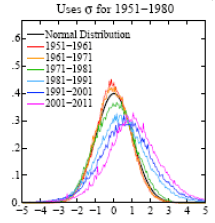
Extreme heat is arguably the easiest event for scientists to model. Temperature is one-dimensional and more or less follows a normal distribution for a given region. As climate change continues, temperatures increase (shifting the bell curve to the right) and become more variable (flattening the bell curve). The end result, as shown in part (c) of the figure below, is a significant increase in extremely hot weather:

Now, imagine that you get a bunch of weather station data from all across the world in 1951-1980, back before the climate had really started to warm. For every single record, find the temperature anomaly (difference from the average value in that place and on that day of the year). Plot the results, and you will get a normal distribution centred at 0. So values in the middle of the bell curve – i.e., temperatures close to the average – are the most likely, and temperatures on the far tails of the bell curve – i.e. much warmer or much colder than the average – are far less likely.

As any statistics student knows, 99.7% of the Earth’s surface should have temperatures within three standard deviations of the mean (this is just an interval, with length dependent on how flat the bell curve is) at any given time. So if we still had the same climate we did between 1951 and 1980, temperatures more than three standard deviations above the mean would cover 0.15% of the Earth’s surface.

However, in the past few years, temperatures three standard deviations above average have covered more like 10% of the Earth’s surface. Even some individual heat waves – like the ones in Texas and Russia over the past few years – have covered so much of the Earth’s surface on their own that they blow the 0.15% statistic right out of the water. Under the “old” climate, they almost certainly wouldn’t have happened. You can only explain them by shifting the bell curve to the right and flattening it. For this reason, we can say that these heat waves were caused by global warming.

Here’s a graph of the bell curves we’re talking about, in this case for the months of June, July, and August. The red, yellow and green lines are the old climate; the blue and purple lines are the new climate. Look at the area under the curve to the right of x = 3: it’s almost nothing beneath the old climate, but quite significant beneath the new climate.

Using basic statistical methods, it’s very exciting that we can now attribute specific heat waves to climate change. On the other hand, it’s very depressing, because it goes to show that such events will become far more likely as the climate continues to change, and the bell curve shifts inexorably to the right.

References:

March Migration Data

In my life outside of climate science, I am an avid fan of birdwatching, and am always eager to connect the two. Today I’m going to share some citizen science data I collected.

Last year, I started taking notes during the spring migration. Every time I saw a species for the first time that year, I made a note of the date. I planned to repeat this process year after year, mainly so I would know when to expect new arrivals at our bird feeders, but also in an attempt to track changes in migration. Of course, this process is imperfect (it simply provides an upper bound for when the species arrives, because it’s unlikely that I witness the very first arrival in the city) but it’s better than nothing.

Like much of the Prairies and American Midwest, we’ve just had our warmest March on record, a whopping 8 C above normal. Additionally, every single bird arrival I recorded in March was earlier than last year, sometimes by over 30 days.

I don’t think this is a coincidence. I haven’t been any more observant than last year – I’ve spent roughly the same amount of time outside in roughly the same places. It also seems unlikely for such a systemic change to be a product of chance, although I would need much more data to figure that out for sure. Also, some birds migrate based on hours of daylight rather than temperature. However, I find it very interesting that, so far, not a single species has been late.

Because I feel compelled to graph everything, I typed all this data into Excel and made a little scatterplot. The mean arrival date was 20.6 days earlier than last year, with a standard deviation of 8.9 days.

My Earth Hour Story

Tonight is Earth Hour, when people across the world turn off all their lights and electronic devices (except the necessary ones – I don’t think you’re required to unplug the freezer) from 8:30 to 9:30 local time. This is meant to generate awareness about climate change and conservation. It’s really more of a symbolic action, to my understanding – I doubt it adds up to a significant dip in carbon emissions – but I take part anyway. I find that a lot of interesting conversations begin when there’s nothing to do but sit in the dark.

It was during the second official Earth Hour, when I was sixteen years old, that I agreed to babysit for friends of the family. Great, I thought, how am I going to get a five-year-old boy and a two-year-old girl to sit in the dark for an hour? I ended up turning it into a camping game, which was really fun. We made a tent out of chairs and blankets, ate popcorn, and played with a flashlight powered by a hand crank.

The girl was too young to understand the purpose of sitting in the dark – she just liked waving the flashlight around – but I talked to the boy a bit about why we were doing this. I told him how we needed to take care of nature, because it can be damaged if we don’t treat it well, and that can come back to bite us. I explained the purpose of recycling: “You can make paper out of trees, but you can also make paper out of old paper, and that way you don’t have to cut down any trees.” His face just lit up, and he said, “Oh! I get it now! Well, we should do more of that!” which was really great to hear.

Halfway through the hour, the kids went to bed, and I sat in the dark on my own until 9:30, when I turned the lights on and started to do homework. And that was the end of it…or so I thought.

Apparently, at some point during that hour, a neighbour had noticed that the house was in darkness and flashlights were waving around. He thought there was something wrong with that situation, and came over to knock on the door, but we were in the basement in our tent and didn’t hear him. So then he called the police.

It was 11 pm by the time they showed up. Suddenly someone was pounding on the door, and I, convinced that someone was trying to break in, was terrified. I froze in my seat, and contemplated hiding under the desk, but whoever was at the door refused to go away. Eventually I crept over to a side window and looked outside, where I saw a police car.

My first thought when I opened to the door to two police officers was, “Who got in a car accident? My family, or the kids’ parents?” The concept of police coming to investigate a house that had its lights off was completely foreign to me.

“It’s Earth Hour,” I said when they told me why they were there. They replied, “Yeah, we know, but we have to answer all our calls.” They took my name and my birth date, so this incident must be mentioned somewhere in the city police records. I imagine there is a note next to my name saying, “Attempted to indoctrinate children with environmentalism.”

Luckily the kids didn’t wake up, but they heard about the incident later from their parents. I still babysit these kids, albeit less frequently now that I’m in university, and the boy often asks, “Can we turn off all the lights again? I want the police to come. That would be fun.”

An Open Letter to the Future

To the citizens of the world in the year 5000:

It’s 2012, and nobody is thinking about you.

These days, Long Term Thinking means planning for 2050, and even that is unusual. Thoughts of Future Generations don’t go beyond grandchildren. If my government knew I was thinking about people three thousand years in the future, they would probably call me a “radical”.

However, three thousand years isn’t such a long time. The ancient Greeks flourished about three thousand years ago now, and we think about them all the time. Not just historians, but people in all walks of life – scientists, policymakers, teachers, and lawyers all acknowledge the contributions of this ancient civilization to today’s culture. Our society is, in many ways, modelled after the Greeks.

I was walking outside today, at the tail end of the warmest winter anyone can remember in central Canada, and thought to myself: What if the ancient Greeks had caused global climate change back in their day? What if they had not only caused it, but understood what was happening, and had actively chosen to ignore it? The effects would still be apparent today. Global temperature might have stabilized, but the biosphere would still be struggling to adapt, and the seas would still be gradually rising. What would we think of the ancient Greeks if they had bestowed this legacy upon us? Would we still look upon their civilization so favourably?

The Golden Rule is usually applied to individuals living in the same time and place, but I think we should extend it across continents and through millennia so it applies to all of human civilization. Before we make a major societal decision, like where to get our energy, we should ask ourselves: If the ancient Greeks had gone down this path, would we care?

The future is a very long time. Thinking about the future is like contemplating the size of the universe: it’s disturbing, and too abstract to fully comprehend. Time and space are analogues in this manner. 2050 is like Mars, and the year 5000 is more like Andromeda.

I can handle Andromeda. And I can handle the concept of 5000 A.D., so I think about it when I’m outside walking. My first thoughts are those of scientific curiosity. Tell me, people in 5000 – how bad did the climate get? What happened to the amphibians and the boreal forest? Did the methane hydrates give way, and if so, at what point? How much did the oceans rise?

Soon scientific curiosity gives way to societal questions. Were we smart enough to leave some coal in the ground, or did we burn it all? Did we open our doors to environmental refugees, or did we shut the borders tight and guard the food supply? How long did it take for Western civilization to collapse? What did you do then? What is life like now?

And then the inevitable guilt sets in, as I imagine what you must think of us, of this horrible thoughtless period of history that I am a part of. But with the guilt comes a desperate plea for you to understand that not everyone ignored the problem. A few of us dedicated our lives to combating denial and apathy, in a sort of Climate Change Resistance. I was one of them; I am one of them. With the guilt comes a burning desire to say that I tried.

Tar Sands vs. Coal

The term “fossil fuels” is a very large umbrella. Coal, oil, and natural gas are the usual distinctions, but there’s also unconventional oil (such as the Alberta tar sands) and unconventional gas (such as shale gas from fracking). “Unconventional” means that the fuel is produced in a roundabout way that’s less efficient and takes more energy than regular fuel. For example, oil in northern Alberta is mixed with sand and tar that’s difficult to remove. As global supplies of conventional oil and gas decline, unconventional fuels are making up a growing segment of the petroleum market.

The different types of fossil fuels are present in different amounts in the ground. Also, for each unit of energy we get from burning them, they will release different amounts of carbon emissions. Given these variables, here’s an interesting question: how much global warming would each type of fuel cause if we burned every last bit of it?

A few weeks ago, a new study addressed this question in one of the world’s top scientific journals. Neil Swart, a Ph.D. student from the University of Victoria, as well as his supervisor Andrew Weaver, one of Canada’s top climate scientists, used existing data to quantify the warming potential for each kind of fossil fuel. Observations show the relationship between carbon emissions and temperature change to be approximately linear, so they didn’t need to use a climate model – a back-of-the-envelope calculation was sufficient. Also, since both of the authors are Canadian, they were particularly interested in how burning the Alberta tar sands would contribute to global warming.

Swart and Weaver calculated that, if we burned every last drop of the tar sands, the planet would warm by about 0.36°C. This is about half of the warming that’s been observed so far. If we only burned the parts of the tar sands proven to be economically viable, that number drops to 0.03°C. If we don’t expand drilling any further, and stick to the wells that already exist, the world would only warm by 0.01°C, which is virtually undetectable.

Conventional oil and natural gas would each cause similarly small amounts of warming, if the respective global supplies were burned completely. Unconventional natural gas would cause several times more warming – even though it’s cleaner-burning than coal and oil, there’s a lot of it in the ground.

The real game-changer, though, is coal. If we burned all the coal in the ground, the world would warm by a staggering 15°C. There’s a large uncertainty range around this number, though, because the linear relationship between carbon emissions and temperature change breaks down under super-high emission levels. The warming could be anywhere from 8°C to 25°C. In the context of previous climate changes, it’s hard to overemphasize just how dramatic a double-digit rise in average temperatures would be.

The main reason why the warming potential of coal is so high is because there’s so much of it. The Alberta tar sands are a huge resource base, but they’re tiny in comparison to global coal deposits. Also, coal is more polluting than any kind of oil: if you powered a lightbulb for one hour using coal, you would produce about 30% more CO2 emissions than if you ran it using conventional oil.

The tar sands are more polluting than regular oil, but exactly how much more is a very difficult question to answer. The end product that goes into your car at the gas station is essentially the same, but the refining process takes more energy. You can supply the extra energy in many different ways, though: if you use coal, tar sands become much more polluting than regular oil; if you use renewable energy that doesn’t emit carbon, tar sands are about the same. The authors didn’t include these extra emissions in their study, but they did discuss them in a supplementary document, which estimated that, in an average case, tar sands cause 17% more emissions than regular oil. Taking this into account, the tar sands would cause 0.42°C of warming if they were burned completely, rather than 0.36°C.

Therefore, headlines like “Canada’s oil sands: Not so dirty after all” are misleading. Canada’s oil sands are still very dirty. There just isn’t very much of them. If we decide to go ahead and burn all the tar sands because they only cause a little bit of warming, the same argument could be used for every individual coal plant across the world. Small numbers add up quickly.

The authors still don’t support expansion of the tar sands, or construction of pipelines like the Keystone XL. “While coal is the greatest threat to the climate globally,” Andrew Weaver writes, “the tarsands remain the largest source of greenhouse gas emission growth in Canada and are the single largest reason Canada is failing to meet its international climate commitments and failing to be a climate leader.” Nationally, tar sands are a major climate issue, because they enable our addiction to fossil fuels and create infrastructure that locks us into a future of dirty energy. Also, a myriad of other environmental and social problems are associated with the tar sands – health impacts on nearby First Nations communities, threats to iconic species such as the woodland caribou, and toxic chemicals being released into the air and water.

Tar sands are slightly preferable to coal, but clean energy is hugely preferable to both. In order to keep the climate crisis under control, we need to transition to a clean energy economy as soon as possible. From this viewpoint, further development of the tar sands is a step in the wrong direction.

Denial in the Classroom

At one of Canada’s top comprehensive universities, a well-known climate change denier was recently discovered “educating” a class of undergraduate students about global warming.

The Instructor

Tom Harris spent much of his career acting as a PR consultant for fossil fuel companies. Today he directs the International Climate Science Coalition (ICSC), an advocacy group closely tied to the Heartland Institute. In fact, Harris is listed as a Global Warming Expert on Heartland’s website, and spoke at their 2008 conference. However, with a background in mechanical engineering, Tom Harris is hardly qualified to comment on climate science.

The ICSC’s position on climate change is, unsurprisingly, similar to Heartland’s. Their list of Core Principles includes the following gems:

  • Science is rapidly evolving away from the view that humanity’s emissions of carbon dioxide and other ‘greenhouse gases’ are a cause of dangerous climate change.
  • Climate models used by the IPCC fail to reproduce known past climates without manipulation and therefore lack the scientific integrity needed for use in climate prediction and related policy decision-making.
  • Carbon dioxide is not a pollutant – it is a necessary reactant in plant photosynthesis and so is essential for life on Earth.
  • Since science and observation have failed to substantiate the human-caused climate change hypothesis, it is premature to damage national economies with ‘carbon’ taxes, emissions trading or other schemes to control ‘greenhouse gas’ emissions.

More recently, Harris began teaching at Carleton University, an Ottawa institution that Maclean’s magazine ranks as the 7th best comprehensive university in Canada. Climate Change: An Earth Sciences Perspective looks innocuous enough, claiming to teach “the history of earth climates, geological causes of climate change and impact that rapid climate change has had on the biosphere”. As we’ll see, the real content of the course was not so benign.

The Watchdog

The Committee for the Advancement of Scientific Skepticism (CASS) is a Canadian society dedicated to scrutinizing scientific claims made in advertisements, classrooms, and the media. As part of the skeptic movement, they mainly address paranormal phenomena and alternative medicine, but have recently broadened their interests to include climate change denial.

Four members of CASS living in the Ottawa area became aware of Tom Harris’ teaching activities at Carleton, and requested access to videotapes made of his lectures. Earlier today, they published their findings in a disturbing report.

As Heard in University Lectures…

“We can’t even forecast how these clouds are going to move in the next week,” Harris remarked in the first lecture. “Our understanding of the physics is so bad that we can’t even do that. So to think that we could do a whole planet for 50 years in the future…” This kind of misconception, conflating weather and climate predictions, is understandable among laypeople whose only experience with atmospheric modelling is the 5-day forecast presented on the news each night. For a university instructor teaching a course dedicated to climate change, however, such an error is simply unacceptable.

But the next lecture, it got worse. At the time, sunspots were the lowest on record, and some scientists speculated that the Sun might return to Maunder Minimum conditions. However, this slight negative forcing would cancel out less than ten percent of global warming from greenhouse gases, were it to even occur. The numbers, though, didn’t stop Harris, who claimed that “we’re in for some real cooling come around 2030 because we’re going back to the conditions that existed at the time of Napoleon. So cold weather is coming.” Forget about global warming, his message was – global cooling is the real threat.

The misconceptions, oversimplifications, half-truths, and flat-out nonsense continued throughout every single lecture, leading to a whopping 142 “incorrect or equivocal claims” as tallied by the CASS report, which quoted and rebutted every single one. It’s as if Tom Harris was actively trying to hit every argument on the Skeptical Science list.

In the last lecture, the students were presented with “take-away slogans”:

  • The only constant about climate is change.
  • Carbon dioxide is plant food.
  • There is no scientific consensus about climate change causes.
  • Prepare for global cooling.
  • Climate science is changing quickly.

This clear exercise in creating young climate change deniers seems to have influenced some, as shown by the RateMyProfessors reviews of the course. “Interesting course,” wrote one student. “Nice to have some fresh perspectives on global warming rather than the dramatized fear mongering versions. Harris really loves to indulge in the facts and presents some pretty compelling evidence.”

Crossing the Line

There is a line between ensuring academic freedom and providing unqualified individuals with a platform for disseminating nonsense. It is clear to me that Carleton University crossed this line long ago. I am astounded that such material is being taught at a respectable Canadian university. If the Heartland Institute’s proposed curriculum comes through, similar material might be taught in select K-12 classrooms all over the world. As an undergraduate student, the same age as many of the students in the course, I am particularly disturbed.

I have encountered climate change misinformation in my university lectures, both times in the form of false balance, a strategy that I feel many professors fall back to when an area of science is debated in the media and they want to be seen to respect all viewpoints. In both cases, I printed out some articles from Science, Nature, PNAS, and the IPCC, and went to see the prof in their office hours. We had a great conversation and we both learned something from the experience. However, it took an incredible amount of courage for me to talk to my professors like this, not only because teenage girls are naturally insecure creatures, but also because a student telling their science teacher that they’ve got the science wrong just isn’t usually done.

Even by the time they reach university, most students seem to unconditionally trust what a science teacher tells them, and will not stop to question the concepts they are being taught. Although many of my professors have encouraged us to do research outside of class and read primary literature on the topic, nearly all of my peers are content to simply copy down every word of the lecture notes and memorize it all for the final exam.

By allowing Tom Harris to teach the anti-science messages of climate change denial, Carleton University is doing a great disservice to its students. They paid for a qualified instructor to teach them accurate scientific knowledge, and instead they were taken advantage of by a powerful industry seeking to indoctrinate citizens with misinformation. This should not be permitted to continue.

Recent Developments at the Heartland Institute

This Valentine’s Day, one of the most vocal lobby groups attacking the science of climate change had its internal documents leaked to the public – exposing its sources of funding, secret projects, strategies, and goals for the world to see.

Manufacturing Doubt

You’re probably aware of the influences of corporate-funded lobby groups on social issues. They seek to bring down public health insurance, lower taxes for the wealthy, and prevent environmental regulation. They publish advertisements, print op-eds, and meet with politicians, all in an attempt to advance a free-market agenda. More often than not, they’re backed by corporate interests – pharmaceutical companies, tobacco firms, and the oil industry, to name a few.

You might question the fairness of allowing certain people to amplify their voices simply because they have more money, but at least these lobby groups are spreading around legitimate ideas. Everyone’s entitled to their own opinion on matters of public policy, and nobody can be “right” or “wrong”. However, on matters of science, there is a physical reality out there, so people can be wrong. Try arguing that your incorrect answer on a physics assignment deserves full marks, because it represents your personal opinion on the photoelectric effect. You probably won’t get very far.

Unfortunately, certain lobby groups have a long history of promoting blatant falsehoods about areas of science that threaten their free-market fundamentalism. Everything from the harmful health effects of smoking to the causes of acid rain to the consequences of the pesticide DDT has been attacked by these groups. The strategy has been the same every time: repeat long-debunked myths ad nauseum, overemphasize uncertainty, and question the integrity of scientists studying the issue.

Human-caused climate change is currently the most fashionable scientific phenomenon to deny. Although 97-98% of climate scientists agree that humans are causing the Earth to warm, public acceptance lags far behind, and is heavily split along political lines. Scientists have investigated and ruled out every conceivable alternative hypothesis for global warming – so why aren’t their conclusions reaching the public? The answer is that other influences are getting in the way, muddying the message for their own financial and ideological benefit.

The Front-Runner

In recent years, the Chicago-based Heartland Institute has led the way in this crusade against climate science. Their communication style seems to be “quantity, not quality”: whatever rumour currently claims to disprove global warming will be picked up and amplified by the Heartland Institute, whether or not it contradicts previous statements from the organization. For example, they will frequently claim in the same document that 1) the world is cooling and 2) global warming is caused by the sun. Logically, you can’t have it both ways. However, doubt, not logic, is the goal here – if a message casts doubt on the scientific consensus, it qualifies for the Heartland newsletter.

This lobby group’s extreme conservative agenda is apparent in paranoid overtones about socialist conspiracies and bigger government. “If AGW [anthropogenic global warming] is true,” they write, “then stopping or preventing it requires higher taxes, more income redistribution, more wilderness preservation, more regulations on corporations, ‘smart growth,’ subsidies for renewable energy, and on and on…[we] ‘looked under the hood’ and concluded concern over the possibility of catastrophic global warming was being manufactured to advance a political agenda.”

Heartland has accepted thousands of dollars in funding from oil companies, such as ExxonMobil, and industrial giants, such as the Koch brothers. However, most of the funding for their climate change projects now comes from a single individual, who is obviously extremely wealthy, and currently anonymous.

A Scientist Steps In

Enter Dr. Peter Gleick, a prominent climate scientist and president of the Pacific Institute for Studies in Development, Environment, and Security. He has had run-ins with the Heartland Institute before, and – like many scientists in the field – is deeply disturbed by their disinformation campaigns. So when he received an anonymous package in the mail in 2012, containing a confidential memo that appeared to be from the Heartland Institute, he was intrigued.

The memo, entitled “Heartland Climate Strategy”, contained many phrases that would later raise eyebrows. Perhaps most distressingly, Heartland was planning to bring denial into the classroom, by developing a school curriculum “that shows that the topic of climate change is controversial and uncertain – two key points that are effective at dissuading teachers from teaching science”. They were also hoping to pursue funding from “corporations whose interests are threatened by climate policies” – presumably the fossil fuel industry – and to continue sponsoring the NIPCC reports, whose purpose was “to undermine the official United Nation’s IPCC reports” (widely considered to be the most authoritative reviews of climate science in existence).

Finally, Heartland discussed its “funding for high-profile individuals who regularly and publicly counter the alarmist AGW message”, and more general coordination with “groups capable of rapidly mobilizing responses to new scientific findings, news stories, or unfavorable blog posts”. To those familiar with who’s who in the world of climate denial, the list of people and groups Heartland mentioned supporting were extremely enlightening. At the end of the document, Dr. Gleick discovered why the memo had been sent to him in particular – Heartland was bemoaning the fact that Gleick had published articles in Forbes magazine. “This influential audience has usually been reliably anti-climate and it is important to keep opposing voices out,” wrote Heartland – a rather hypocritical statement from an organization that regularly accuses the mainstream media of censoring their views.

This memo was certainly very interesting, but was it authentic? It could have been faked by someone seeking to discredit Heartland. Gleick wasn’t willing to spread around the document unless and until he thought it was legitimate. And out of frustration, he went one step too far: in what he now describes as “a serious lapse of my own and professional judgment and ethics”, he pretended to be a Heartland board member, and requested that Heartland send several other documents to his “new email address”, which they did.

These actions were unethical, and possibly illegal, but they raise some interesting moral questions. Is it acceptable to lie in order to expose a bigger lie? Where does investigative journalism end and unjustified dishonesty begin? Since Gleick identified himself and apologized for his actions, he has been demonized by Heartland and its allies, but others have described him as a “whistleblower” who put his reputation on the line in order to uncover the truth. We must also consider whether scientists are being judged more harshly than lobby groups. As activist Naomi Klein tweeted, “What about the fact the Heartland Institute impersonates a scientific organization every day?”

Release and Reactions

The documents that Dr. Gleick obtained by email, including a budget, a fundraising plan, and minutes from board meetings, confirmed many of the contents of the Climate Strategy memo. Names, monetary figures, and project descriptions all matched up – with the exception of one figure that may have been a typo. Satisfied that the Climate Strategy memo was legitimate, he scanned it, and sent all the documents anonymously to DeSmogBlog, a Vancouver-based website composed of journalists that seek to expose the financial and ideological motivations behind the climate change denial movement. DeSmogBlog published the documents on Valentine’s Day, and they went viral within hours.

The Heartland Institute was outraged. They insisted that the Climate Strategy document was fake, a claim for which they provided no evidence and which has since been contested. They threatened legal action against anyone who dared report, link to, or comment on the leaked documents – an obvious scare tactic to prevent the story spreading. (Such threats have no legal basis, otherwise the media would not have been able to write about governmental memos from Wikileaks, which were illegally obtained.)

It’s interesting to note Heartland’s hypocrisy in this situation. Several years ago, when emails from climate scientists were stolen and published online, the Heartland Institute was of the first and loudest voices to report, link to, and comment on the emails (in this case, completely out of context), in a blatant attempt to discredit climate science right before the Copenhagen Summit. Where is that attitude of freedom of speech and information now?

The Fallout

Whether or not the Climate Strategy memo was faked, the contents of the other documents have spurred a public pushback against Heartland. There have been calls for federal hearings regarding the flow of money in the organization, and complaints to the IRS to revoke Heartland’s tax-free status as a charitable foundation.

Does this incident matter, in the grand scheme of things? Not really. Climate science will continue to show that the Earth is warming, humans are the cause, and the consequences will be severe. Lobby groups will continue to attack these conclusions. However, it’s high time that we looked at these lobby groups a little more closely.

The Hockey Stick and the Climate Wars

Throughout all the years of public disputes about climate change, arguably no scientist has taken as much flak as Dr. Michael Mann. This mild-mannered paleoclimatologist is frequently accused of fraud, incompetence, scientific malpractice, Communism, and orchestrating a New World Order. These charges have been proven baseless time and time again, but the accusations continue. Dr. Mann’s research on climate change is inconvenient for those who wish to deny that current global temperatures are unusual, so he has become the bulls-eye target in a fierce game of “shoot the messenger”. In “The Hockey Stick and the Climate Wars: Dispatches from the Front Lines”, a memoir of his experiences, Michael Mann finally speaks out.

The story begins quite harmlessly: an account of how he became a scientist, from childhood curiosity to graduate work in theoretical physics to choosing climate science on a whim out of the university course calendar. For those who have followed Dr. Mann’s research over the years, there is some great backstory – how he met his coauthors Ray Bradley and Malcolm Hughes, the formation of the IPCC TAR chapter about paleoclimate, and how the RealClimate blog operates. This book also filled in some more technical gaps in my understanding with a reasonably accessible explanation of principal component ananlysis, a summary of millennial paleoclimate research before 1998, and an explanation of exactly how Mann, Bradley and Hughes’ 2008 paper built on their previous work.

Dr. Mann’s 1998 paper – the “hockey stick” – was a breakthrough because it was the first millennial reconstruction of temperature that had global coverage and an annual resolution. He considered the recent dramatic rise in temperatures to be the least interesting part of their work, because it was already known from instrumental data, but that part of the paper got the most public attention.

It seems odd for a scientist to downplay the importance of his own work, but that’s what Dr. Mann does: he stresses that, without the hockey stick, the case for climate change wouldn’t be any weaker. Unfortunately, his work was overemphasized on all sides. It was never his idea to display the hockey stick graph so prominently in the IPCC TAR, or for activists to publicize his results the way they did. Soon the hockey stick became the holy grail of graphs for contrarians to destroy. As Ben Santer says, “There are people who believe that if they can bring down Mike Mann, they can bring down the IPCC,” and the entire field of climate science as a result.

Michael Mann is an eloquent writer, and does a fabulous job of building up tension. Most readers will know that he was the target of countless attacks from climate change deniers, but he withholds these experiences until halfway through the book, choosing instead to present more context to the story. The narrative keeps you on your toes, though, with frequent allusions to future events.

Then, when the full story comes out, it hits hard. Death threats, and a letter full of suspicious white powder. Lobby groups organizing student rallies against Mann on his own campus, and publishing daily attack ads in the campus newspaper. Discovering that his photo was posted as a “target” on a neo-Nazi website that insisted climate change was a Jewish conspiracy. A state politician from the education committee threatening to cut off funding to the entire university until they fired Mann.

Throughout these attacks, Dr. Mann consistently found trails to the energy industry-funded Scaife Foundation. However, I think he needs to be a bit more careful when he talks about the links between oil companies and climate change denial – the relationship is well-known, but it’s easy to come off sounding like a conspiracy theorist. Naomi Oreskes does a better job of communicating this area, in my opinion.

Despite his experiences, Michael Mann seems optimistic, and manages to end the book on a hopeful note about improvements in climate science communication. He is remarkably well-adjusted to the attacks against him, and seems willing to sacrifice his reputation for the greater good. “I can continue to live with the cynical assaults against my integrity and character by the corporate-funded denial machine,” he writes. “What I could not live with is knowing that I stood by silently as my fellow human beings, confused and misled by industry-funded propaganda, were unwittingly led down a tragic path that would mortgage future generations.”

“The Hockey Stick and the Climate Wars” leaves me with a tremendous empathy for Dr. Mann and all that he has gone through, as well as a far better understanding of the shouting match that dominates certain areas of the Internet and the media. It is among the best-written books on climate science I have read, and I would highly recommend it to all scientists and science enthusiasts.

“The Hockey Stick and the Climate Wars” will be released on March 6th, and the Kindle version is already available.

Apparently, I’m an enemy of Canada

A big story in Canada these days is oil pipelines. The federal government wants to ramp up the tar sands industry through international exports. The easiest way to transport crude is through pipelines stretching across the country, and several such projects have been proposed during the past year.

First there was the Keystone XL pipeline, which would stretch from Alberta to Texas and provide the United States with oil. Despite enormous pressure to approve the project immediately, American president Obama is refusing to make a decision until a more thorough environmental review can be conducted. This announcement left the Canadian government fuming and stomping off to look for other trading partners.

Now the Northern Gateway pipeline is on the table, which would transport oil across British Columbia to the West Coast, where tankers would transport it to Asia. I don’t personally know anyone who supports this project, and there is organized opposition from many First Nations tribes and environmental groups. Much of the opposition seems to hinge on local environmental impacts, such as oil spills or disruption to wildlife. I think it’s possible, if we’re very careful about it, to build a pipeline that more or less eliminates these risks.

I am still opposed to the Northern Gateway project, though, due to its climate impacts. Tar sands are even more carbon-intensive than regular oil, and there is no way to mitigate their emissions the way we can mitigate their effects on wildlife. I realize that it’s unreasonable to shut down the entire industry, but expanding it to massive new markets such as Asia is a mistake that my generation will have to pay for. The short-term economic benefits of building a pipeline will be overwhelmed by the long-term financial costs and human suffering due to the climate change it causes. My country is pushing the world down a path towards a worst-case climate scenario, and it makes me ashamed to call myself a Canadian.

According to our Natural Resources Minister, Joe Oliver, anyone who opposes the pipeline is “threaten[ing] to hijack our regulatory system to achieve their radical ideological agenda”. Apparently, the goal of people like me is to ensure there is “no forestry. No mining. No oil. No gas. No more hydro-electric dams”. Prime Minister Stephen Harper seems to agree, as he plans to change the public consultation process for such projects so they can’t get “hijacked” by opponents.

In case anyone needs this spelled out, I am not a radical ideologue. I am a fan of capitalism. I vote for mainstream political parties. Among 19-year-old females, it doesn’t get much more moderate than me.

I have no problem with forestry, mining, and hydro, as long as they are conducted carefully and sustainably. It’s the oil and gas I have trouble with, and that’s due to my education in climate science, a field which developed out of very conservative disciplines such as physics and applied math.

I can’t understand why Joe Oliver thinks that referring to First Nations as a “radical group” is acceptable. I also fail to see the logic in shutting down opposition to a matter of public policy in a democratic society.

If Canada’s economy, one of the most stable in the world throughout the recent recession, really needs such a boost, let’s not do it through an unethical and unsustainable industry. How about, instead of building pipelines, we build a massive grid of low-carbon energy sources? That would create at least as many jobs, and would improve the future rather than detract from it. Between wind power in Ontario, tidal power in the Maritimes, hydroelectric power throughout the boreal forest, and even uranium mining in Saskatchewan, the opportunities are in no short supply. Despite what the government might tell us, pipelines are not our only option.

Breaching the Mainstream

It’s hard to overestimate the influence of John and Hank Green on the Internet, particularly among people my age. John (who writes books for teenagers) and Hank (who maintains the website EcoGeek and sings songs about particle physics) run a YouTube channel that celebrates nerdiness. This Internet community is now a huge part of pop culture among self-professed teenage nerds.

Hank’s new spin-off channel SciShow, which publishes videos about popular science topics, has only being going for a month but already has 90 000 subscribers and 1 million views. So I was very excited when Hank created this entertaining, polished, and wonderfully accurate video about climate change. He discusses sea level rise, anoxic events, and even the psychology of denial: