Unknown's avatar

About climatesight

Kaitlin Naughten is an ocean-ice modeller at the British Antarctic Survey in Cambridge.

Recommendations?

I’m interested in finding out how and why climate change action became a partisan issue. As Stephen Schneider says in his new book, there’s a reason that “conservation” sounds so much like “conservatism”.

The fiscal conservative school of thought is to save money for a rainy day, and to minimize spending so the economy is more sustainable in the long run – so why does this only apply to money? Money, after all, is only a representation of wealth, which – more often than not – ends up representing resources and ecosystem services, which depend on a stable climate. Conservatism, at least in our society, also tends to be more aggressive to national security threats such as terrorism. Why is climate change exempt yet again? Is it somehow any less threatening?

It seems dubious that climate change action really conflicts with conservative ideologies. How and why did it begin to be framed this way? At some point along the line, conservative media and politicians began to repeat it, to the point where it became accepted as the “party line” of the ideology, and citizens who were conservative on most other issues accepted this addition to the party line automatically.

This is why I would ideally prefer a direct democracy, as it allows citizens to vote directly on each issue, rather than just choose the party that hits the most of their requirements. We can’t just categorize people by ideology and assume that all of their opinions will fit neatly into one box. (Or three boxes at once – several flagged comments accused me of being “a Communist and a socialist and a Marxist” – is it even possible to be all three of those things at once? Don’t they have some inherent contradictions?)

I’ve stated before that my opinions on policy tend to be more social, but I’m beginning to wonder more and more how much this reflects my character and how much reflects my age. In world issues class, everyone took the Political Compass quiz, and plotted their results anonymously on a single graph so we could look at the class as a whole. Virtually everyone was in the bottom left quadrant – social libertarian. I was somewhere in the middle of those dots. Unless my class was a hotbed of radicals, it seems that ideology tends to correspond to age. Maybe it’s not because I’m a social libertarian. Maybe it’s just part of being seventeen, and as I grow older, I’ll remain somewhere near the centre of my society’s political spectrum, wherever it may fall.

Right now, at least, my opinions regarding many matters of policy fall to the left on Canada’s political spectrum. However, I view my work on climate change communication to be very separate to ideology. It began as a bid for a secure future for my generation, which is looking less and less likely. However, as the anti-action campaigns began to attack scientists and the scientific process, rather than (or in addition to) the theories and statistics themselves, I have begun to defend the nature of science, specificially climate science, instead.

I think I have the mind of a scientist, and I really want to be a scientist. Not to be a doctor/dentist/pharmacist, which is often the automatic course for high school students who are good at science and math, but to be a researcher and conduct studies and publish in journals and discover things. I feel more and more sure about this as I get older. I think this deep connection to the scientific process has given me some elements of conservatism. I am quite conservative about the process of peer-review, resist change to its structure, and hold tightly to fundamental discoveries in the field of climate science, rather than blowing off Arrhenius just because of something written in Energy & Environment.

I am not writing this blog, or pushing for climate change action and communication, for any ideology or party or political belief. I am defending both science and the future, two parties that get very little say in the political system. I am defending the mountain of evidence that many seem willing to discount entirely.  I am defending the millions of unborn citizens who have the right to a world just as good, if not better, than the one we have today.

This post has become a ramble I didn’t expect to go on – it’s late, after all, and I’m a teenager who needs her sleep. So I’ll bring it back to the beginning. Are there any recommendations as to which sources I should look at for research into how and why this became a partisan issue? Books, US politics backgrounders, Spencer Weart posts? I’d appreciate your input.

The Antithesis to Nitpicking

Sometimes we have to step back and look at the big picture. We have to remember that not everyone has heard or believed the one about global warming stopping in 1998. Denialists centre around nitpicking and ideas that global warming is a “house of cards”, so we respond the same way: countering all the “mistakes” they claim to have found.

In reality, climate change is an incredibly robust phenomenon that we’ve known about for decades – and the basic physics behind it, for over a century. It’s not some new, shaky discovery. It’s not going to be overturned because scientists at CRU do not always say nice things about their critics.

So I was very pleased when I opened up YouTube today to see that Peter Sinclair’s latest video was all about this big picture. If I had to choose just one of his videos to share with everyone I knew, this would certainly be it. This is the kind of message we need to get out there; this is the kind of angle we need to take.

IPCC Reform

The IPCC is far from ideal, and we knew this even before word got out that WG2 had made several minor mistakes. I’ve written about this before – here I discuss how the IPCC is naturally biased towards understating climate change: being too optimistic in its results. And here I discuss the difference in public attention when the IPCC understated central claims (such as sea level rise, Arctic sea ice melt, and emission scenarios) to when they overstated a detail that didn’t even make it into the technical summary – exactly how fast the Himalayan glaciers would melt.

Several British journalists have managed to construct several other “scandals” in the IPCC claims, which have little to no merit. Tim Lambert has spent the past few weeks investigating the legitimacy of these allegations, and one thing stands out above all others: facts do not matter in the way the media reports alleged IPCC mistakes or misconduct. One journalist in a minor British paper can make an erroneous claim that shouts “IPCC scandal”, and even after scientists have patiently explained, multiple times, why it is untrue, the claim is repeated in every major newspaper in the world. Consequently, even though virtually all of these “scandals” have to do with the WG2, the opinion pages use it as an excuse to vehemently question the idea that humans are causing the Earth to warm. This is obviously WG1 material, which is based on the laws of physics and decades of peer-reviewed science – but that doesn’t matter to the media, does it?

For people like us, who are so intent on scientific accuracy, it is incredibly frightening when accuracy becomes irrelevant in the sources that virtually everyone else relies on for climate change information. Even after factual errors that fundamentally change the message of the story are pointed out, no retraction is printed, and the authors are dealt no consequences. As scientists and concerned citizens, our greatest weapon is truth. But that can no longer be enough – not when our fourth estate drops its responsibility to truth, at least for this issue.

The IPCC was formed in the late 80s, and the relationship between climate science and the rest of the world has changed fundamentally since then. We have gained much more understanding of what climate change could mean for the world, so creating a document that encompasses absolutely everything we know is longer and more tedious. Governments fearful of climate change action have abused their powers of IPCC editing and review, as Stephen Schneider describes in his excellent book Science as a Contact Sport. Special interests muddled the lines of communication between scientists and the public, and when, due to the Internet, this communication became impossible to stop, the special interests decided to smear the reputations of scientists, scientific organizations, and science itself. The media and the public fell willingly to this muddling and smearing, so these special interests have gained far more influence than truth should allow them.

Is it necessary, or even desirable, to reform the structure of the IPCC to better suit its communication with the public? In terms of producing the most accurate science, I feel that it’s doing just fine the way it is, with the exception of needing some new WG2 review editors, and a delayed deadline for the WG2 and WG3 publications (instead of having all three reports released simultaneously).

Nature recently published recommendations from five diverse climatologists as to how to reform the IPCC. Subscription or payment is needed to read the full article, so I’ll give a quick summary here:

Mike Hulme wants to split the IPCC into three – a Global Science Panel that frequently publishes smaller reports about WG1 topics, five or ten Regional Evaluation Panels that report on region-specific WG2 topics, and a Policy Analysis Panel that frequently publishes examinations of different policy options.

Eduardo Zorita wants the IPCC to employ full-time scientists, instead of doing all the work on a volunteer basis.

Thomas Stocker wants the IPCC to stay the way it is, but to pay extra attention to following their self-imposed rules.

Jeff Price wants to select more lead authors to produce “short, rapidly prepared, peer-reviewed reports” instead of a set of massive ones every six years.

John Christy wants the IPCC to be removed from UN oversight and adopt an open, continually updating “Wikipedia” structure. I think a more accurate allusion to Christy’s proposition is the Encyclopedia of Earth, which has lead authors and a basic review system.

Personally, I agree with Jeff Price’s proposal. Mike Hulme’s seems to be very similar, and I like the way he separates and organizes the different panels. John Christy’s idea of a continually updating report intrigues me, but the more open approach to peer-review and a policy to “hear all sides” could easily be abused through artificial balance – equality over accuracy.

Any thoughts, further suggestions, background information to share? What changes, if any, should be made to the IPCC? And how can we possibly immunize the public to this incredible excuse to be misled?

Bookmark and Share

How to Prove Global Warming Wrong

Over the past twenty years, vested interests and political lobby groups have done a fantastic job confusing the public about anthropogenic climate change. To many, they seem to have proven the whole theory wrong.

But how could you actually prove global warming wrong – not just in the minds of the public, but through the established scientific process? What scientific discoveries – if they held up through peer-review, further criticism, and replication – would render climate change a non-problem?

One of the surest ways to stop all this cap-and-trade discussion would be to disprove the greenhouse effect itself – the mechanism by which the Earth absorbs and emits the same energy multiple times, due to the presence of greenhouse gas molecules that “bounce it back”. This keeps the Earth substantially warmer than it would be otherwise. Additionally, if the concentrations of greenhouse gases increase, so will the temperature of the Earth. This process was first hypothesized by Joseph Fourier in 1824, and was experimentally confirmed by John Tyndall in 1856. The first prediction of eventual man-made global warming came from Svante Arrhenius, in 1896. It wasn’t a theory as much as a logical result of a theory, one that was deeply rooted in physics and chemistry.

Unless our understanding of entire fields of physical science is totally off base, we can be sure that our greenhouse gas emissions will cause climate change eventually. But hey, if you could overturn all of thermodynamics, you wouldn’t have to worry about carbon taxes.

  • Cheap-out option: Svante Arrhenius was Swedish, but his name sounds sort of Russian, and 1896 wasn’t very long before the Russian Revolution. Therefore, Arrhenius was a Communist, and none of his scientific work can be trusted.

Knowing that something is sure to happen eventually, though, is different from knowing that it is happening right now with substantial speed. We know that the Earth is warming – even if you found some statistical way to disprove three separate temperature records, the physical and biological systems of our planet still stand: 90% of observed changes in the natural world, like the blooming of flowers, the peak flows of rivers, and the spawning of fish, are in the direction expected with warming (Rosenzweig et al, 2008).

But how do we know that the warming is caused by us? Climate change has been caused many times in the past by factors unrelated to greenhouse gases – like solar influences, whether they’re direct (a change in solar output) or indirect (a change in the Earth’s orbit). How do we know that’s not happening now?

If the warming was caused by the sun, the atmosphere would warm uniformly at all levels. However, if the Earth was warming from greenhouse gases, the troposphere (the layer of the atmosphere closest to the planet) would warm while the stratosphere (the next level up) would cool. This is because more heat is getting bounced back to the surface by greenhouse gases, and is subsequently prevented from reaching the stratosphere.

A cooling stratosphere has been described as the “fingerprint” evidence of greenhouse-induced warming. And, in fact, the stratosphere has been cooling over the past 30 years (Randel et al, 2009). Therefore, if you could somehow show that something else was causing this pattern of a warming troposphere and a cooling stratosphere, and that the significant, anthropogenic rise in greenhouse gases was somehow not affecting it, you would have a case for global warming being natural.

Update (18/2/10): About half of this cooling can be attributed to ozone depletion, and the other half can be attributed to greenhouse gases (NOAA, 2006). The flat trend in stratospheric temperatures from 1995-2005 (see the Randel citation above) can be explained by the recovery of ozone, which is temporarily offsetting the greenhouse gases. Interesting how the temperature of the stratosphere has just as many factors as the temperature of the troposphere…..but in both cases, you can’t explain the temperature trends without including human activity. Scott Mandia has a great explanation here.

  • Cheap-out option: Omit the explanation of why greenhouse warming causes stratospheric cooling. Just point to the graph that goes down and say, “The atmosphere is cooling! Therefore, the IPCC is a hoax!”

Finally, even if you couldn’t disprove that global warming is expected, observed, and anthropogenic, you could still show that it isn’t very significant. The way to do this would be to show that climate sensitivity is less than 2 C. Climate sensitivity refers to the amount of warming that would result from a doubling of carbon dioxide equivalent, and 2 C is generally accepted as the maximum amount of warming that our society could endure without too much trouble. The current estimates for climate sensitivity, in contrast, average around 3 C (a range of 2-4.5), and it is very unlikely to be less than 1.5 C (IPCC AR4).

However, a climate sensitivity of less than 2 C only means that climate change isn’t a problem if our greenhouse gases stop at a doubling of carbon dioxide equivalent from pre-industrial levels. Even without taking methane and other greenhouse gases into account, this brings us to a CO2 concentration of 560 ppm, which we are well on track to surpass, even with cap-and-trade. So you’d have to argue for a climate sensitivity of even less. Seeing as we’ve already warmed 0.8 C, it doesn’t leave you with a lot of wiggle room.

  • Cheap-out option: Build a climate model that does what you want it to, without any regard for the laws of physics. ExxonMobil will probably sponsor the supercomputers. Widely publicize the results and avoid peer-review at all costs.

Daunting tasks, certainly. But if you really believe that global warming is natural/nonexistent/a global conspiracy, this is the way to prove it. If you managed to prove it, and change the collective mind of the scientific community (not just the public), you’d probably win a Nobel Prize. So it’s certainly worth your time and effort.

All the Gates Explained

RealClimate just posted a very comprehensive and well-cited analysis of Glaciergate/Seagate/Africagate/Amazongate/whatever else Jonathan Leake has come up with.

They conclude that the only real error discovered in the IPCC AR4 was the Himalayan glacier screw-up. The claim that 55% of the Netherlands is below sea level (when only 26% is below sea level, but a further 29% is susceptible to river flooding) is incorrect, but as it “has no bearing on any IPCC conclusions and has nothing to do with climate science…it is questionable whether it should even be counted as an IPCC error.”

Beyond that, it’s all the work of one or two British journalists really hoping that they can ruin the IPCC’s credibility if they try hard enough. A valiant effort, but not legitimate.

Read the full post here.

Salvaging Science Journalism

Yesterday, I felt depressed about the state of the world – as if we were walking blindly into heavy traffic without bothering to stop or even open our eyes. I think it was this Globe and Mail editorial that put me over the edge. It claimed that the original 2035 Himalayan glacier claim was “reported around the world“, that Rajendra Pachauri “shrugged it off“, and that the 40% Amazon reduction claim was “a mess” (just like Leake, this article doesn’t mention that the statistic itself was correct, it was just cited incorrectly).

And that’s just in the first few paragraphs. I could go on and on about the inaccuracies and unsubstantiated claims, especially once it gets going on ClimateGate. If the author had bothered to read the primary sources for the Amazon claim, to read the supposedly-nefarious emails in full context (as well as the results of the first inquiry), or to read the IPCC’s actual response to the Himalayan glacier screw-up, her proclamation of “scientific scandals” would have fallen apart.

We see this all the time, everywhere, and it’s doubtlessly gotten worse in the past few months. The line of attack has switched from the science to the scientists. It’s just as unsubstantiated as the claim that global warming stopped in 1998, but that doesn’t matter. Science journalism, as it pertains to climate change, doesn’t seem to care about the facts any more. Fox News is one thing, but really – the Globe and Mail?

So what do we do to fix it? I can’t just sit around anymore and wait for it to pass. Many of us reading this blog have largely given up on the mass media as a source for climate change information, passing it off as a lost cause. But most of the public doesn’t know that it’s a lost cause. I think fixing it is better than ignoring it.

I have a few preliminary ideas that I’d like to open up for discussion:

1) Good old letter writing campaigns. Once a week, say, we could choose an article that’s particularly devoid of accuracy and citations, but written by a generally responsible journalist (eg not Glenn Beck). We could each write a unique letter to the author/the paper/the editor of the paper expressing the problems with the article. We can rant a bit about the media’s responsibility to provide people with accurate journalism.

2) Lobby for a citation policy. I got some great responses from my last post about the importance of a comment policy to promote better discussion that doesn’t turn into a food fight. What if we pushed to enact a similar policy in mainstream media outlets? The policy would be different for each outlet, obviously, but the basic rule would be that all articles/letters to the editor that dealt with science had to include peer-reviewed citations when appropriate. Let’s stop treating science like opinion, and start getting people to back up their arguments before we give them space.

3) Volunteer ourselves as research tools. By the time most of us read articles about climate change in the mainstream media, we’ll have heard about the particular issue in question for several days, and we’ll be able to point to two or three credible sources pertaining to it. We could help journalists and newspapers do their research more quickly and accurately.

4) Become a part of the mass media. I know a lot of great science journalists, but none of them are regulars in the mainstream media. I know Michael Tobis, and Tim Lambert, and Coby Beck, and James Hrynyshyn. (Tamino and the RC folks are great too, but geared toward a more technical audience.) These guys back up every statement they make, provide citations, correct their mistakes, and follow the “means justify the ends” approach. As part of our outreach for accurate journalism, why don’t some of us try to get columns in the mainstream media outlets?

Let me know what you think.

A Good Batch of News

Today’s batch of news feeds was great. I have not one, but two, posts to comment on from elsewhere in the climate blogosphere.

Firstly, James from The Island of Doubt has written a fantastic article on the new line of denialist attack. This is the best bit:

“Here’s IPCC author Phil Duffy, whose thoughts on the subject inspired mine:

Things happen, but let’s react appropriately. Medical doctors make mistakes every day. (In fact, medical errors in the US alone kill hundreds of people daily–the equivalent of a jumbo-jet crash.) And no doubt many of these errors happen because established procedures are ignored, sometimes knowingly. Does this mean the entire edifice of western medicine is wrong, or prejudiced, or the product of a conspiracy, and should be rejected? Of course not. Furthermore, the medical profession as a whole is still held in high regard, as it should be.

No one worth listening to is calling for a massive inquiry into the science underpinning modern medicine, or the engineering foundations of the car industry. But pseudoskeptics argue that the IPCC is systematically fraudulent simply because a couple of statements among thousands of pages of heavily edited and re-editing (and re-re-edited) documents cite gray literature instead of the peer-reviewed literature that supplied the science in the first place.

Is it controversial among those study such things that 40% of the Amazon is susceptible to drought? No. Is it controversial that Himalayan glaciers are receding? No. Only the way in which that science was presented and attributed was found faulty. To thrown out anthropogenic global warming because of such missteps is the climatological analog of dismissing an entire faculty of medicine because someone correctly diagnosed a patient because of a story they read in New Scientist instead of the medical journal article on which the story was based. Bad judgment? Yes. Fatal error? No.”

And one more:

“This isn’t about censorship. Thanks to the Internet, everyone can find a way to spread their point of view. It’s about applying the same standards to coverage of climate change that “respectable” media apply to fields like sports, business and other fields. Sports bloggers and journalists for major news organizations couldn’t get away with making up baseball statistics for long. They’d be laughed out of the office. Business reporters can’t supply false stock market numbers because that would be a violation of very essence of what they’re supposed to be doing. And yet climate science is somehow different. If you work for theDaily Mail or Telegraph in the UK, or Fox News (or the Washington Post‘s op-ed section) in the U.S., you can say or print anything you want about climatology, without regard for the facts. That should not be tolerated.”

Read the rest of the article here. While you’re at it, see if you can get the New York Times to print it.

James’ last point about censorship leads nicely into the second post I want to discuss. DeSmogBlog is having some problems in the comment section, and plans to tightly moderate comments in the future.

I certainly sympathize with the DeSmogBlog writers. I find that the vast majority of Internet discussions regarding climate change turn into such a food fight that reasonable and insightful discussion falls through the cracks. Well-meaning and fact-checking people are so busy responding to the same old objections, or are so intimidated by trolling commenters (quick poll – who here has been called a Nazi for explaining basic atmospheric science?), that they do not post the wonderfully thought-provoking things that they have to say.

Keeping comments completely open and unmoderated, therefore, is catering to those who wish to waste others’ time, hold nothing back in their criticisms of individuals, and can’t be bothered to check citations before spreading something around. I don’t think it’s necessary to give that kind of discussion any more space. Instead, I wish to cater to those who have insightful (and accurate!) things to say, by providing a supportive community for them to do so. RealClimate sums up my feelings on this topic quite well:

“Comments that accuse as of bad faith, fraud and dishonesty are not ways to move forward any conversation – how can you have a dialog with people who don’t believe a word you say? We choose to try and create a space for genuine conversation, which means weeding out the trolls and the noise. This is an imperfect process, but the alternative is a free-for-all that quickly deteriorates into a food fight. There are plenty of places to indulge in that kind of crap. There are only a few places where it’s not and we are not embarrassed to try to make this site one of them.”

By the sounds of things, DeSmogBlog’s comment policy is going to be much more stringent than mine. I don’t “tightly” moderate comments – on the contrary, there are many remarks that, in retrospect, I realize should never have passed moderation. But I do have two basic rules that I try to adhere to: 1) provide legitimate peer-reviewed citations for your claims (unless they’re common knowledge – I won’t make you cite Fourier and Arrhenius), and 2) refrain from personal attacks, aggression, etc. I like to show when a person’s comment has been deleted, and give a brief explanation why, so readers can see what’s going on without having to go through the agony of actually reading it.

The first complaint when a policy like this is enacted is invariably “censorship!!!!”, and, almost six months later, I still get those complaints. But “censorship” is not an accurate term for such policies. You can still go and say whatever you want about climate change elsewhere – on your own blog, on YouTube, in a national news release. There are infinite other ways to make unsupported claims and spread rumours about people, so filtering them out of my own blog (or RealClimate, or DeSmogBlog) in effort to promote a decent discussion is by no means totalitarian.

DeSmogBlog on the Road

Richard Littlemore, a regular writer for DeSmogBlog and contributor to the excellent book Climate Cover-Up, is touring across the Prairies – and I was able to attend one of his presentations!

If you have a chance to hear anyone from DeSmogBlog speak – I’m told that Jim Hoggan has a very similar presentation – you should definitely go. The presentation was very well put together, had some great opportunities for audience involvement (including a “pop quiz” on quotes from surprising people) and addressed many of the current attempts to discredit scientists. Richard was a great communicator, very relaxed and honest, who answered all of our questions and made all of us laugh.

If you’ve read Climate Cover-Up and follow DeSmogBlog, however, don’t expect anything new. The content of the presentation was a mix of the main narratives from Climate Cover-Up (like TASSC, ICE, and Frank Luntz) and recent significant posts on DeSmogBlog. That’s to be expected, though, for a public presentation.

During the question period, someone asked Richard how he thought we should address climate change politically. He described himself as a “die-hard capitalist” and proceeded to give the best quote of the night, which was, “If you don’t find a way for people to make money saving the world, the world’s not going to get saved.” I totally agreed with him, and it helped me better understand my own political leanings. I’ll save that for an upcoming post before I get too far off topic.

I chatted briefly with Richard after the presentation, which was nice. He apologized, on behalf of his generation, for leaving this massive problem to my generation. I really didn’t know what to say to that.

Why Canada Is the Way it Is

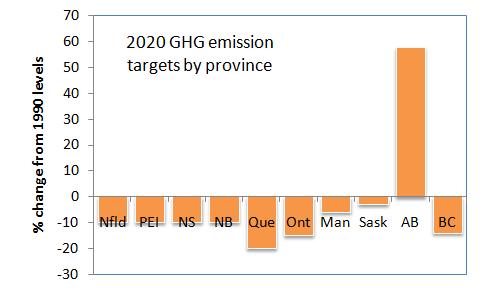
The Canadian government has decided that their meager 20% emission cut from 2006 levels by 2020 (equivalent to 3% cut from the standard base year of 1990) is tenuous – it all depends on what the US decides to do. (Why even bother having a separate Canadian government if they’re just going to follow all US decisions?)

Wondering why they’re still wasting time? This is why (courtesy of the  Globe and Mail):

Luckily, Canada now has its hands tied, as Obama just announced a target that’s slightly stronger – a 28% cut from 2005 levels by 2020, up from the previous target of 17%.

Funny how these things work out, isn’t it?