Unknown's avatar

About climatesight

Kaitlin Naughten is an ocean-ice modeller at the British Antarctic Survey in Cambridge.

The Average Person

craven I first watched the Manpollo videos about a year and a half ago, when I had the flu, and ended up watching the entire six hours over two days. I don’t remember when it was that I discovered Greg Craven was writing a book based on the videos, but I’ve been excited to read it ever since.

The Manpollo videos have inspired my view on climate change and transformed my way of talking about it more than anything else I’ve read or watched. In a nutshell, Greg Craven’s process of risk management takes the pressure off us to be amateur scientists. It doesn’t require that we assess the statistical methods of people with PhDs when we only have a high school knowledge of science. Instead, it shows us how to use logic, assess credibility, and weigh the benefits and consequences of taking action vs not taking action on an uncertain threat.

I suppose I sort of expected that Greg Craven’s book would be a step up from the videos, would contain even more ideas, anecdotes and talking points that I could really sink my teeth into, would tell me more that I hadn’t already heard in the six hours of Manpollo.

But his book wasn’t like that. Greg Craven disappointed me.

And I’m grateful for that.

See, the book was not aimed at people like me who have an interest in climate change that borders on obsession. It was not aimed at the people who already know which sources are skeptical of anthropogenic climate change and which are worried about it. It was not aimed at those of us who can rattle off the current concentration of atmospheric CO2 without a second thought.

The book was aimed at the average person, who basically knows what climate change is but hears so much shouting in the media that they have no idea of its level of agreement. Who knows there are two sides and doesn’t want to offend anyone. Who has never heard of Milankovitch cycles, methane hydrates or the Goddard Institute of Space Studies.

If the average person stumbled upon most climate change blogs, most of the terms would be foreign to them. I hope they’d be able to understand most of what I write here on ClimateSight (as I try to stay away from analysing hard data) but they’d probably still need a bit of background information.

The average person, with little to no background information on climate science and policy, needs somewhere to start. They need the tools to assess the credibility of a source. They need to know where to go for more information about a topic. They need a basic knowledge of risk management, logic, and bias.

What’s the Worst that Could Happen? provides exactly that. It seems like a more concise version of the Manpollo videos, all the topics outlined in a simple process without the need for much background reading. If I were to recommend a book to start with for this anonymous average person we’re discussing, it would be hard to find one better than this one.

Instead of telling you stuff, Greg Craven tells you how to find stuff out for yourself. He doesn’t tell you how much agreement there is on climate change, he introduces you to a credibility spectrum instead. And even then, he doesn’t just give you his credibility spectrum, he shows you how to make your own.

He doesn’t tell you that oil executives are denialist trolls, he explains possible biases that could lead a person to a hasty conclusion. He gives one of the best basic explanations of the mechanics of anthropogenic climate change that I’ve ever read. Craven is possibly the least offensive, but most helpful, writer I’ve ever encountered.

My only complaint about the book was how he handled the “individual professional” and “individual layperson” sections in the chapters about statements. On the Skeptic’s side, he listed every individual prominent skeptic he could think of, I believe it was about a dozen. On the Warmer’s side, he had Hansen, Oreskes, and Gore. That was it. He explained that this was because he filled his credibility spectrum from the top down, and the statements at the top were almost exclusively weighted to the Warmer’s side. But there is something personal about an individual’s work that makes a person trust them and put faith in their arguments, rather than a report like the IPCC which is dry and anonymous. I wish that Craven had put some kind of indication, perhaps the Doran and Zimmerman report, that the opinion of individual scientists was also weighted towards the Warmer’s side. Otherwise it seems like the masses are not in agreement with the authority, which is supposed to be the source you listen to.

And because I agree with this concept so wholeheartedly, I feel compelled to share with my readers my answer to the question Craven asks at the very beginning – what would make you change your mind?

I would change my mind about dangerous anthropogenic climate change if a new discovery was made, if some new explanation came forward that gained as much agreement as the current theory holds now. If the national scientific bodies of the world, the peer-reviewed journals, and university textbooks had a complete overhaul because scientists discovered that humans were not changing the climate. If some new explanation surfaced that proved Arrhenius and Callendar wrong. It would be a discovery akin to the theory of relativity. As George Monboit said, “If you can prove these statements wrong, you should apply for a Nobel Prize. You will have turned science on its head.”

I listen to the scientists. I’m not surrending my rights and freedoms as an individual to them. I just trust their analysis more than I trust my own.

To conclude

If you already know a fair bit about climate change, and want some really fascinating dicussion points that will keep you going for literally years, watch the Manpollo videos. If you’re a really hardcore skeptic who thinks climate change is a global conspiracy, Manpollo was made especially for you.

But if you’re new to this topic, start with What’s the Worst that Could Happen? I assure you that there is no better place to begin.

A Few Moments of Brilliance

heatI just finished reading one of the many climate change books on my reading list, “Heat: How to Stop the Planet from Burning” by George Monbiot. I have to say that the subtitle really annoys me. Fossil fuels are burning, yes, but the planet isn’t burning. It isn’t combining with oxygen and disintegrating.

Most of the book was a fairly dry account of possible ways to create a low-carbon economy – carbon capture and storage, building efficiency standards, reducing reliance on air travel. It was well researched and carefully planned, but not really my cup of tea.

However, there were several quotes, at the beginning and end of the book, which I found absolutely brilliant, for their style and word choice as well as their content.

“We can determine, for example, that the financial costs of Hurricane Katrina…..amount to some $75 billion…..But does it capture the suffering of the people whose homes were destroyed? Does it capture the partial destruction, in New Orleans, of one of the quirkiest and most creative communities on earth? Does it, most importantly, capture the value of the lives of those who drowned?” -page 50

“This must, in other words, be a moral decision, not an economic one. Either we decide that it is right to spend a lot of money seeking to prevent catastrophic climate change or we decide that it isn’t, but we must make that decision on the grounds of how much we value people and places as people and places, rather than as figures in a ledger.” -page 51

“But this baby, this strange little creature, closer to the ecosystem than a fully grown human being, part pixie, part frog, part small furry animal, now sixteen days old and curled up on my lap like a bean waiting to sprout, changes everything. I am no longer writing about what might happen to “people” in this country in thirty years’ time. I am writing about her. As she trembles on the threshold of life, the evidence of her mortality is undeniable. It seems far more real than mine…..Global warming is no longer a generalized phenomenon, its victims no longer abstractions. Among them might be my child. Or yours. Or you. Or even  me. Of all the complex matters encapsulated in this subject, this, until now, has been the hardest to grasp.” -page 206

Among these quotes runs a common thread: the idea that money is imaginary, numbers are imaginary, but people are real. People are the basis of the very real, tangible world of the human species. And now this species seems willing to destroy itself in favour of imaginary topics such as math and the economy.

I’m not sure if I’d recommend this book to others. If you’re interested in the real nitty-gritty of sustainable energy, it’s very thorough. But otherwise, I found the parts of the book that were most worth reading are the quotes listed above.

If you’ve read this book, I’d love to hear your opinion of it. Feel free to leave a comment if you’re so inclined.

Global (not Regional) Temperature

Throughout most of central Canada, where I live, as well as the north-central  US (west of the Great Lakes), we’ve had a very cool spring and summer. It feels like we’ve only had a few days of actual summer. My shorts are sitting at the bottom of my closet wondering why I’ve rejected them.

The media has been all over this. Skeptical websites are thrilled. I’ve heard way too many  “So much for global warming!” comments for my comfort and sanity. There are only so many times that I can patiently explain the difference between weather and climate, regional and global change before I go a little nuts.

I made an uneducated assumption that the world was still around 2008 temperatures. Perhaps it was due to a solar minimum, the last dregs of La Nina, or just statistical noise. I didn’t think too much about it.

It was a bit of surprise yesterday, then, when I read a blog post that suggested that the southern US was experiencing above-average summer temperatures. I was quite intrigued. I went on a search for a global temperate anomaly map for this spring and/or summer. Here is a map from the National Climatic Data Center (part of NOAA).

noaaAs you can see, north-central North America did have below average June temperatures (not too surprising to me – the jet stream almost reached Chicago the other day). So did parts of Asia, Europe, and South America. But it’s clear that these cooler areas are the minority. Almost everywhere else on our planet (including the southern US) had a warmer than average June.
The NCDC states that the global land-and-ocean temperature for June 2009 (basically the map you see above) “was the second warmest on record”. They also note that, during June, an El Niño began. As the global temperature increases during an El Niño event, due to a change in heat exchange between the ocean and the atmosphere, the NCDC predicts that “global temperatures are likely to continue to threaten previous record highs”.

There’s a good chance that it won’t be long before we stop hearing that global warming stopped in 1998. In a way, that makes me happy – no other claim annoys me quite so much, can you say statistical misrepresentation – but it also makes me worry about the state of the world.

I wish I was wrong about this. I wish that global warming had really stopped in 1998.

To conclude

June 2009 alone can’t prove a warming trend – it doesn’t even come close to the classical 30-year climate period. But it really makes the “so much for global warming” hypothesis in my area fall apart. That claim was unscientific even before we knew the stats for the whole world. How can you possibly discern an idea of global climate from a few months in a single area?

There’s a reason it’s called global warming, not regional warming.

There’s a reason it’s called climate change, not weather change.

And hooray for scientific data that is readily available to the public, so we don’t have to rely on personal experience of our own little corner of the world to try to figure out the whole planet.

CO2 Levels for June

389.42 ppm

(From CO2 Now, an advocacy group, but they appear to get their data from the Mauna Loa Observatory, so we can establish sufficient credibility.)

Worse than even I expected. Remember the good old days when An Inconvenient Truth had just been released and CO2 was still at 380 ppm?

Nothing in science changes quite as fast as climatology data these days. My school chemistry handouts are outdated only in that sense; they keep saying that CO2 is at 350 ppm.

Science

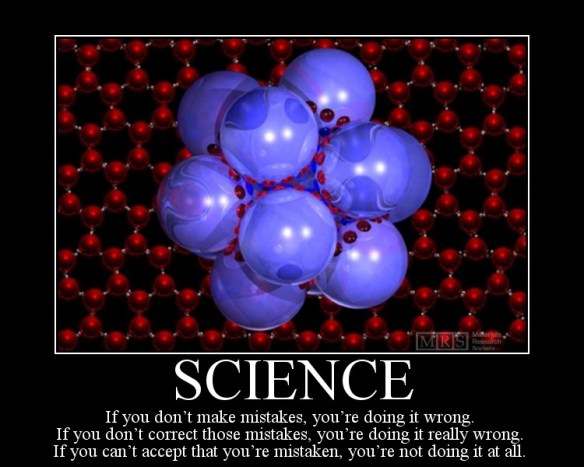
From this website I was introduced to one of the best explanations of how science works. Thanks to Brian for the link.

science

Science is an area of study where the means justify the ends. You shouldn’t start with a conclusion that you like, and then form an argument around it (that’s why I’ve never liked literary analysis). The scientifically correct procedure is to follow approved and tested methods, and see what conclusion comes out of that.

Apply this idea to your assessment of credibility. In addition to investigating the expertise and relevant education of the source, ask yourself whether they’re following the scientifically accurate method of gathering evidence first, or if they’ve started by choosing a politically acceptable conclusion to stick to no matter what.

Practice questions:

Does the National Academy of Sciences study science by starting with hard data and evidence, or by starting with a conclusion that they like?

What about the Heartland Institute?

A Story Worth Hearing

I found a great article on one of the blogs I read a few days ago. It was the first time I’d heard of the story, and it made me so mad that I knew I had to share it on ClimateSight. But this article was so well-written that I doubted I could come up with anything better.

In a nutshell…..an old paper that didn’t pass through the peer-review process of the EPA contained all sorts of climate-denial “evidence” which has been proven wrong countless times. The peer-review panel wasn’t trying to suppress contradictory evidence – in fact, publishing contradictory evidence would be great for the journal and the advancement of science – the paper was just utter nonsense!

But the Republicans threw a fit when they discovered that a paper questioning anthropogenic climate change was deliberately suppressed so the EPA could begin a communist takeover….or something like that. They want a criminal investigation. As David from Through a Green Lens writes,

“The irony is that these people watched calmly as the Bush-Cheney Administration suppressed global warming science.  Now, the party that supposedly promotes “fiscal responsibility” would like to spend millions of dollars on an investigation into why faulty science was not included in an EPA decision.”

Read the rest of his post here.

PS: A number of you have brought it to my attention that the ever-narrowing nested comments get very hard to read. I went to go check it out (I usually view comments from my WordPress dashboard) and my goodness, one word per line…..no wonder you were complaining!

I played around with the discussion settings, and I think I’ve fixed it as much as I can. Replies to comments will no longer appear indented below the original comment, but I’ve placed the oldest first, instead of the newest first, so that it makes more chronological sense. Unless there’s multiple discussions going on at once, I think it’s okay.

Let me know what you think, and if you have any more suggestions.

The Last Minority

Over the past century, our society has significantly expanded its definition of “citizen”. It wasn’t too long ago that the only people who were allowed to vote were white males.

In Canada, where I live, women with close relatives away at war could vote in federal elections beginning in 1917. By 1919, the right to vote was extended to all women.

As we were an enormously racist country until Trudeau came into power in 1968, Chinese Canadians were not allowed to vote until 1947. It was even worse for the First Nations peoples – their right to vote was not granted until 1960.

In 2002, prisoners were granted the right to vote. Today, you can even vote if you are a Canadian citizen living overseas, or are homeless and don’t have an address to verify on your Voter Identification card.

It took us a long time to get here, but now, every Canadian citizen has the right to vote, regardless of gender, ethnicity, personal circumstances, or religion.

Or do they?

What about young people?

“They’re not mature enough,” you may object. “Teenagers are rebellious troublemakers who can’t understand their own decisions.”  But I have witnessed a fair few rousing discussions in geo and history classes, and can personally attest to the fact that there are many teenagers out there who are more politically aware than most adults.

Probably the reason that Canadian citizens under 18 aren’t allowed to vote is that a lot of the legislation being voted on only applies to those 18 and older. Prison sentences, insurance, property taxes…..a great deal of it only kicks in once you’re old enough to get a library card without a parent signature.

However, not all legislation is only applicable to legal adults. Some is actually more applicable to youth than any other segment of the population.

Climate change is a long-term problem. Due to the lag time between atmospheric carbon dioxide concentration and temperature, whatever changes we make in our emissions won’t be noticeable for another 50-60 years. You can bet that most of the politicians debating Waxman-Marley and Copenhagen won’t be around to experience the results of their actions, or lack thereof.

Maybe I’m just being cynical, but it seems a lot easier to care about a problem when it’s your future in jeopardy. When it’s your chance to go to university and travel the world, to have a family, to own property. When you might be left in a world where travelling is impossible due to sea level rise and environmental refugees, where the chances of your family being injured in a natural disaster or infected by a vector-borne disease increase, where cashing out your insurance on your new property looks a heck of a lot more likely.

We, the youth, haven’t experienced any of the milestones that our parents have. It’s our future that’s threatened. But we have no say in it. Instead, the decision is being made for us by people who won’t be around to experience most of the consequences. Youth are some of the only people that have a vested interest in the long-term consequences of society’s actions. So why is it that we are the only ones prohibited to vote?

Finally, I was really touched by this commercial from Australia. Most of it is the normal “use clean energy! ratify Kyoto!” propaganda, but then the narrator says, “I’ll do everything in my power to make it happen. The only thing I can’t do is vote.”

A quick housekeeping note: I have purchased a domain name from WordPress and the URL for my blog is now http://climatesight.org! Shorter and catchier. The old URL, https://climatesight.wordpress.com, will still work. No links to this site will be broken. I just thought that a more obvious URL would help the blog reach more people.

Paul Krugman Says it Best

“[Climate change deniers] don’t like the political and policy implications of climate change, so they’ve decided not to believe in it — and they’ll grab any argument, no matter how disreputable, that feeds their denial.

Indeed, if there was a defining moment in Friday’s debate, it was the declaration by Representative Paul Broun of Georgia that climate change is nothing but a “hoax” that has been “perpetrated out of the scientific community.” I’d call this a crazy conspiracy theory, but doing so would actually be unfair to crazy conspiracy theorists. After all, to believe that global warming is a hoax you have to believe in a vast cabal consisting of thousands of scientists — a cabal so powerful that it has managed to create false records on everything from global temperatures to Arctic sea ice.

Yet Mr. Broun’s declaration was met with applause.”

Paul Krugman, New York Times

Being Wrong

I have had very little scientific training, and no formal education in climatology. If you’ve read my About the Author page, you’ll know that I’m a student and aspiring climatologist. You might think I’m a university student, probably in my undergrad.

I’m not. I’m going into my last year of high school. Many of my classmates don’t even know that the theory of anthropogenic global climate change has been endorsed by anyone other than Al Gore. They’re too wrapped up in regular high school drama. Here I am spending my spare time urging political action against climate change, and I can’t even vote yet.

All of my education in climate change has been informal and independent. I stay up late reading IPCC reports. I borrow university chem textbooks so I can understand how greenhouse gases work. I direct all my questions to a climatology prof I know. In a few years, I will have the opportunity for formal training that begins to specialize in climatology. But I’m too impatient. I want to do all I can now.

If credibility is “expertise + objectivity”, my expertise is limited by my circumstances. However, I can still spend time increasing my objectivity. I check my sources. I separate science from policy. I ask myself, “What if I was wrong?”

Since I started this blog, I’ve learned that one of the best ways to pinpoint your mistakes and fix them is to collaborate with others. A lot of you have been fantastic in the comments section, helping to improve the accuracy of my posts. Because of you, I’ve learned that Anthony Watts does not have a PhD, that the same band of radiation can only be absorbed by carbon dioxide once, and that the category of “publishing climatologists”, which is more credible than scientists from other areas on the topic of climate change, should really include atmospheric physicists and radiative physicists.

Without people telling me that I was wrong, I would never have known that I was making mistakes. Without admitting that I was making mistakes, my posts would remain inaccurate.

I believe that admitting your mistakes and fixing them is one of the best ways to increase your credibility. It lets people know that you are willing to change your mind when new evidence warrants it. Basically, it shows that your quest for accurate information surpasses your ego.

Peer-reviewed journals use this tactic all the time. If one of their publications is proven erroneous, they print a retraction. Accurate, up-to-date information is their greatest priority. What else could you ask of a journal?

We all make mistakes, as Big Bird told us when we were small. Nobody is infallible, not even the folks at NASA. Since we can’t escape making mistakes, the best thing we can do is to admit to them and fix them. In a world demanding scientific accuracy, there is no room for egos.