Unknown's avatar

About climatesight

Kaitlin Naughten is an ocean-ice modeller at the British Antarctic Survey in Cambridge.

It’s Everyone’s World

A nation’s policies usually only affect its citizens. Take health care, crime, or taxes. These policies could affect the rest of the world indirectly – through the economy, for example – but the benefits and consequences of the policies’ effectiveness, or lack thereof, will be present first and foremost in the nation in which they were created.

Climate change legislation doesn’t work the same way.

Firstly, the mechanism of climate change is just not fair. If it was, the countries which had caused the problem would suffer the greatest consequences, and those which had had no hand in causing the problem would go on as normal. Unfortunately, the areas which will suffer the most from a warming climate are affected due to their physical geography – such as latitude, ocean and wind currents, and topography – not due to the amount they contributed to the problem. This means that a lot of developing nations, whose per capita carbon emissions are virtually nil, will suffer greatly from climate change.

Additionally, developed nations are undoubtedly the best equipped to deal with the consequences they do suffer. Here in Canada, for example, we have floodways, free health care, food reserves, and insurance. But look at somewhere like sub-Saharan Africa. What backup plans do they have for natural disasters?

I am not suggesting that I want the developed nations to experience the drastic consequences of their actions. Conversely, I am suggesting that the developed nations have a global responsibility to repair their actions, as the consequences will affect many who are innocent and unequipped.

We should stop looking at climate change legislation, or lack thereof, as “How will this help or hurt me?” and start looking at it as “How will this affect the rest of the world?”

An interlude of Canadian politics

Prime Minister Stephen Harper, head of our minority government (for our American friends – read up on Canada’s governmental system here if you’re lost) hasn’t done a lot about climate change. When he came into power several years ago, he got rid of the previous government’s emission plan and got rid of our Kyoto agreement. Then he created a “20% emission reduction by 2020” plan which looked pretty decent. But then the economy went downhill and he got rid of that plan as well. Now he’s pledged to not take any action against climate change until the US plan is fully underway – 2016 or so.

Luckily, here in Canada, we can call elections whenever we want (not just every four years), so he may be out as early as September, depending on how angry the opposition gets with him.

Regardless, it’s pretty obvious that Canada isn’t going to take any action until the United States does.

Why I care about US policy

I am not a citizen of the United States. I’ve only ever travelled there, I believe, three times. I assume that the US culture is quite similar to Canada’s, but I don’t know for sure. I’m perplexed at the lack of recycling in the States.

But I care a lot about what the US does in terms of climate change policy. I care what American citizens think about climate change. I believe that when the US takes significant action, the rest of the world will follow. As an economic superpower, the US has the biggest potential to be a leader in climate change action. As the largest per-capita emitter in the world, it also has the biggest potential to make climate change worse if it doesn’t take action.

“Why do you care about US policy?” you may ask me. “It’s not even your country.”

No, it’s not my country.

But it is my world. It’s everyone’s world. And what the United States does about climate change will affect everyone.

The Time We Have Left

11th hourLast Christmas, I was given the documentary The 11th Hour as a gift. I admit that I was somewhat skeptical of its legitamacy – as much as we all loved Leonardo DiCaprio in Titanic, I wasn’t sure how credible a documentary created by a movie star would be. It was also wrapped in something called BioFilm that sounded kind of sketchy (admittedly, I don’t know what the plastic was made of, but chances are that it’s corn ethanol – not the greatest of fossil fuel replacements).

However, when I watched the film, I was utterly engrossed. My favourite thing about the 11th hour is that most of the dialogue and narration comes from interviews with incredibly articulate experts. This film featured scientists, authors, First Nations leaders, CEOs of green businesses, and national security officials. David Suzuki, Stephen Schneider, Paul Hawken, and Stephen Hawking were just a few of those interviewed.

The 11th Hour dicusses many different aspects of environmental depletion, sociology, and solutions. It opened with a sort of celebration of life and the beauty of nature. I believe it was Paul Hawken that said something along the lines of, “In your body, right this very second, there are three (something with a lot of billions and trillions) things happening at once. That’s a three with twenty-four zeros after it. Right this second. And in the next second, as you sit there on the couch, one hundred times more things are happening than there are stars and planets in the universe. And that is what we call life.”

The section on climate change was brief, but quite well done. Most of the time was devoted to talking about possible impacts – how warming would affect our water security, food security…..However, Stephen Schneider delivered a fantastic quote that’s quite relevant to this blog:

“Some scientists are amazed that in the media debate and in Congress there are people who stand up and say, “I believe” or “I don’t believe in global warming,” as if it were some sort of object of religion, instead of based in evidence.”

(Check out the post Making Up Your Own Science for more on that topic.)

Following the climate change discussion were small sections devoted to forestry, aquatics, biodiversity, and hyperconsumerism. However, the discussion on extinction was so compelling to me that it dwarfed all the previous discussions. The film explored how extinction is inevitable to a species, that the demise of an entire species is as natural as the death of a single organism. It’s no secret that humans will eventually become extinct. The question is how our actions today are affecting when that extinction will happen, and how many other species we are taking down with us.

The last third of the movie was devoted to possible solutions. I applaud the filmmakers in this decision. The first part of the film was pretty darn scary, and ending on an optimistic note made me feel more motivated for action. And what an optimistic note it was! The film discussed how our current system of economics discourages environmental action, and how we could reinvent our economy so that it is more in tune with sustainability and quality of life. It discussed biomimicry, a principle of design which mimics nature, such as the incredibly strong spider’s silk, the structural (rather than pigmented) colour of the blue morpho butterfly, and self-cleaning leaves. “The generations alive today,” Paul Hawken said, “will have to reinvent everything…..what a great time to be born, what an opportunity.”

Happy things

The 11th Hour ended on such a hopeful note that I felt myself becoming more optimistic. There is time to solve the problem of climate change. If our global carbon emissions drop to zero by the middle of this century, we will never pass the 2 C warming which is estimated to be a tipping point. Some warming is inevitable, but we still have time to stop it getting out of control.

In the Discover article on climate change this June, the panel of scientists was asked how hopeful they were that humanity could solve the problem of climate change. Most of them answered that they felt very sure that we had the resources and technology to drastically reduce, or even eliminate, carbon emissions. But they weren’t so sure that we had the will. The world has known about this problem for over 40 years, but little has been done.

But to think that we still have a chance…..no matter how small….it makes me want to grab on to that chance and run with it and do all that I can to make it come true.

If it clashes with the economy, we’ll reinvent the economy. If the oil executives get mad, we’ll pay them a lot of money to develop wind power and geothermal. If the skeptics continue to argue, we’ll say to them, as we should be saying now, “The stakes are too high to base our actions on the best possible scenario.”

The fact that there still is a tangible chance, however small, that we could fix the problem of climate change altogether, is so exciting that I feel obliged to pursue it.

In All Honesty

An interesting theory as to why so many people reject climate change is that they don’t want to take action. Whether they work in the fossil fuel industry or are vehemently opposed to government regulation, they feel that the consequences of taking action will be worse than not taking action.

This is a legitimate opinion, even though I disagree with it. It involves policy (what we should do about the problem) instead of science (deciding if there even is a problem). Stating that we shouldn’t take action at all is, in a way, deciding what action we should take. It’s a personal opinion. You don’t need a PhD for it to be respected.

However, it’s fairly obvious that accepting the problem of climate change but refusing to take any action would make the public very angry. Here in Canada, many environmental advocates aren’t too happy with Stephen Harper (our prime minister) as he’s scrapped yet another emissions legislation plan – the third one, I believe. He’s now decided to not take any action against climate change until the American legislation is completely implemented. If Harper gets his way, it’ll be about 2016 before Canada starts regulating emissions. I’ve never seen David Suzuki so mad.

The aforementioned theory goes on to say that, instead of accepting the problem but refusing action, the regulation-wary people deliberately create confusion around the science supporting the idea of climate change. Their purpose is not to win the debate, but to prolong the debate. The longer they can keep the public wondering if climate change is a problem or not, the longer it will take for action to begin. This goal is mainly achieved by opinion editorials, credible-looking websites, and interviews with the media, all of which contradict as much of the prevailing scientific opinion as possible.

This strategy is not new, or exclusive to climate change. Suspicion has arised that it has been used before when products such as tobacco or CFCs began to be regulated. Some great sources dealing with this theory are this lecture by scientific historian Naomi Oreskes and this documentary by a Canadian televison network (sorry if it’s not available to American viewers). I say “suspicion” because there is no solid way to prove this theory, it is only speculation.

If there is anyone reading this who is using the strategy of confusing the public on the science in effort to delay action, please reconsider your actions. If you’re worried about the potential costs of action against climate change, tell us your worries. We may be able to find a way around them. We’ll work as hard as necessary to avoid excessive regulation and counteract economic harm. The economy is a human-created system; we can manipulate it to fit our needs. The sooner we start working to fix this problem, the easier it will be.

Please don’t try to delay action by debating the science. If you’re open and honest about your worries, we may be able to solve them – no deception, confusion, or aggression necessary.

Normal Scientific Practice

Scientists debate each other’s work all the time. In fact, they’re encouraged to do so. The peer-review process was set up so that every misconception, assumption, or source of error in a scientific article could be nailed down and corrected. Scientists look for mistakes. It’s practically in their job description.

Normal scientific practice states that, should a scientist find a mistake in someone else’s work, they approach them about it, either directly or through the journal which published the article. If the criticism is deemed to be valid, the author will make any necessary changes and/or the journal will publish a retraction.

That’s what happened when the “hockey stick graph” attracted some criticism. The graph was sent to the National Academy of Sciences, who had some concerns about the way the graph was used, but generally found it to be legitimate. The IPCC revised its data, and came out with a new graph – a whole hockey team. The criticism lead to revision which led to further advancement of knowledge and data.

Directing concerns to the authors is probably the best way to fix any scientific errors as it leads to superior data. It is accepted and encouraged.

So, then, why do so many climate change skeptics turn to the media or the Internet instead?

It’s hard to watch Fox News, visit the website of a conservative think tank, or browse the blogosphere without finding someone who claims that climate change is false and they can prove it.

If you really can prove it, I’d like to say to these people, tell the scientists about it. Find specific mistakes in their methods and ask them to change them. If they don’t, it doesn’t necessarily mean that they’re biased against any data that contradicts their theory. You might just not fully understand climatology and why the scientists use the methods they do – especially if you’re not trained in climate science.

Ranting about the inaccuracies of climatology online or to a journalist isn’t going to fix those inaccuracies. All it’s going to do is confuse the public. If confusing the public is your goal, please stop, because our children’s lives are at stake here. If you really do believe that you can prove that climate change is false, direct it to the people who study this issue. For the betterment of human knowledge, please approach the scientists, not the media.

The Source of the Ice Age Claim

An all-too-common claim people use to justify ignoring the widespread scientific agreement on climate change is, “The scientists were all predicting an ice age in the 70s, and that didn’t happen.”

Last year, a publishing climatologist, the highest category for an individual on our credibility spectrum, decided to investigate just how valid this claim was.

Dr Andrew Weaver is a Canadian climatology professor at the University of Victoria, the chief editor of the peer-reviewed Journal of Climate, a lead author on the 2nd, 3rd, and 4th IPCC reports,and the Canada Research Chair in Climate Modelling and Analysis. I think we can establish strong credibility for Dr Weaver’s statements.

In a 2008 article in the Ottawa Citizen, Dr Weaver explains how he searched through the enormous ISI Web of Science database for peer-reviewed studies claiming the world was heading into an ice age. He discovered that “there is not a single peer-reviewed original scientific study that argued this to be the case.” Only one paper mentioned the idea at all.

“The only paper that came close was one written by NASA scientists Ichtiaque Rasool and Stephen Schneider in 1971. A throwaway sentence at the end of their abstract noted:  “An increase by only a factor of 4 in global aerosol background concentration may be sufficient to reduce the surface temperature by as much as 3.5° K. If sustained over a period of several years, such a temperature decrease over the whole globe is believed to be sufficient to trigger an ice age.” Of course this statement is riddled with weasel words, assumptions and the hypothetical. Nevertheless, its scientific shelf life was only a few months before the assumptions underpinning the study were shown to be questionable.”

The peer-review process worked. The insufficient study was retracted. The idea of an ice age held hardly any agreement whatsoever in the scientific community, compared to the widespread agreement regarding the current climate change. Read the rest of Dr Weaver’s article if you’re interested in how scientists determined the cause of the slight drop in global temperatures post-WWII, despite the increasing levels of greenhouse gases.

Sadly, sources such as Time magazine, Newsweek, and the Globe and Mail (a major Canadian newspaper) got a hold of the recently discredited study. They liked the idea of controversial, attention-grabbing headlines that would engage their readers and, ultimately, bring money and attention to their writers. They published stories with titles such as, “Does man trigger trouble in the world’s climate cycle?” and “Another Ice Age?”

The public ate it right up. And now, 30 years later, this media-induced theory still persists.

At the same time that climatologists were studying the drop in temperatures, many of them were worried that the positive forcing of greenhouse gases would eventually outweigh the negative forcing of aerosols, volcanoes, and the solar minimum. Sources such as the National Academy of Sciences and science advisory committees to the President of the United States held this opinion. Check out this video by Peter Sinclair to see their exact statements (as well as a great clip from a 1958 Bill Nye-esque science show!). Dr Weaver’s article also mentions a 1975 article in the journal Science by Wally Broecker of the Lamont Doherty Earth Observatory.

With the ISI search tool, Dr Weaver was able to find one discredited study that mentioned an aerosol-induced ice age. When he searched the phrases “climate change” and “global warming”, he found 30 913 studies from the period 1965-2008. He speculates,

“That’s a lot of science and you can bet that if there were an Achilles heel to the theory of global warming it would have been discovered long ago.”

The 70s theory of an ice age simply cannot be compared to the current theory of anthropogenic warming. Their levels of support are completely opposite. The ice age theory was held by the extreme minority of publishing climatologists; the current climate change theory is held by the extreme majority.

In the 70s, the media misrepresented the science by overstating an almost non-existent theory. Currently, they are misrepresenting the science by suppressing an overwhelming theory and overplaying the opposition to it.

Personally, I’m going to refrain from basing my knowledge of climate change on the popular press. I suggest you do the same.

Why Al Gore Doesn’t Matter

The first of many reviews planned for ClimateSight!

Climate change skeptics like to imply that Al Gore’s word is all we have going for us. That our faith in the theory is upheld simply because he supports it. That he’s brainwashed us all and we should think for ourselves. If it sounds like I’m exaggerating, go check out some YouTube comments – and even entire videos – dedicated to these concepts.

But the truth is, Al Gore could have never existed and the scientific theory of anthropogenic climate change would be the same as it is today.

Let’s take some time for historical context. The greenhouse effect began to be studied in the late 1800s by Svante Arrhenius. The current theory that anthropogenic CO2 emissions are causing the Earth’s temperature to rise was hypothesized by Guy Callendar in the 1930s. A great historical account of climate science is available to read online here.

The beginnings of the modern-day scientific view were present before Al Gore was even born. The idea that he thought up the whole conspiracy theory quickly falls apart. (But if you’d like a good laugh, check out this April Fool’s article. It made my day.)

Al Gore was educated at Harvard. He was fascinated by courses from Roger Revelle, another climatology pioneer. Before long, though, Gore became interested in politics. He graduated with a BA in government.

Try swaying the minds of every major scientific establishment in the world when the only formal education you have in climatology is a couple of undergraduate courses.

I’m sure Al Gore understands climate change better than most members of the general public. I’m also sure that the folks at national academies of science and organizations such as NASA, all at the top of our credibility spectrum, understand climate change a heck of a lot better than Al Gore. Check out what they’re saying here (thanks to Logical Science, who cited all of the statements so well).

It’s clear that, under our credibility spectrum, Al Gore would fall under the professional. He keeps well up to date with the scientific literature, but is not a scientist himself. He is only slightly more credible than the average person.

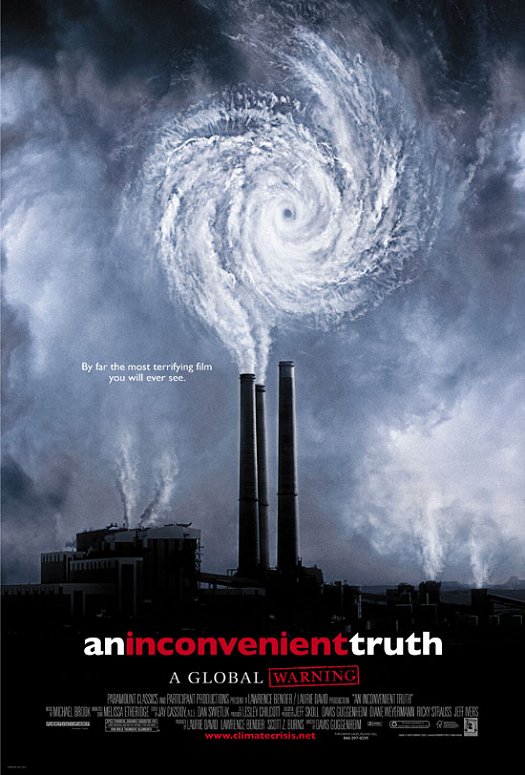
And with this context, let’s take a look at An Inconvenient Truth.

An Inconvenient Truth (2006) – Review
inconvenient truth

This is definitely not an example of scientific literature. It was not intended to be, and should not be taken as such. This is not to say that Gore’s statements about climate change are wrong. His overall message is greatly supported by the scientific community. However, it’s not the kind of text you’d want to cite in a research paper.

It’s clear that the purpose of this documentary was to increase public awareness, not to imitate a science textbook. Taken in that context, An Inconvenient Truth fulfills its purpose tremendously – almost too well, I’d say, as the first thing that comes to most people’s minds when they hear about the theory of climate change is not the IPCC, national academies of science, or university professors, but Al Gore. A lot of people think it’s Al Gore’s problem, and not much else.

And, sadly, if you wanted to take down the scientific side of Gore’s argument, it wouldn’t be too hard.

Early in the film, Al Gore says that we are adding to the greenhouse effect by “thickening” the atmosphere. This is more than just oversimplification. Burning fossil fuels not only increases CO2 concentrations in the atmosphere, it decreases O2 concentrations, by attaching one carbon atom to each molecule of oxygen in the combustion process. Read more about this concept here.

We are not “thickening” the atmosphere at all. But someone who watched An Inconvenient Truth could come away with that impression. That person would be very vulnerable to claims such as “Carbon dioxide only makes up 0.04% of the atmosphere.” The relative abundance of a gas in the atmosphere would seem important for its radiative properties, while basic laws of chemistry indicate that it is not.

Luckily, the major misconceptions ended there. However, Al Gore used anecdotal evidence, rather than citing cumulative studies, almost exclusively. For example, he showed pictures of a dozen or so glaciers across the world that were retreating. It couldn’t be too hard to find the same amount of glaciers that were advancing and present them as proof that Gore was wrong. What would be considered appropriate evidence would be a study that examined every major glacier in the world and determined the percentage that were retreating vs advancing.

Al Gore used similar tactics with evidence such as heat waves, hurricanes, and tornadoes. He referred to specific events and/or regional records rather than looking at the processes on a global scale. However, anecdotal evidence is much more compelling to an audience than a bunch of graphs. For the purpose of his documentary, we can probably forgive Gore for that misstep.

There were points in the documentary where it was unclear whether Gore was using a historical event as evidence or as an example of how bad the future could be. For example, when the film examined Hurricane Katrina, it was hard to tell if Gore’s message was, “This was caused by climate change” – which is almost impossible to determine for a specific event; you can’t really prove that it wouldn’t have happened anyway – or “Look at how devastating hurricanes can be – and they could become more frequent.”

The last scientific complaint I have to make against An Inconvenient Truth is the lack of time scale provided. When Al Gore showed how a sea level rise of 20 feet (~7 m) would affect coastlines across the world, he failed to mention that such an event is not expected for another few centuries. In the IPCC 4th report, a rise of 18 to 59 cm is expected by 2100. If we keep going at our current pace, we’ll eventually hit 7 m, but it won’t be in the next few decades, as he seems to imply. I don’t see what the harm would be in telling the audience when the 7 m rise would happen – if anything, it would increas his credibility. The idea of such a catastrophe being 200 years away doesn’t make it any less scary to me. 

That’s the science stuff out of the way. Now let’s look at the real purpose of the film – the implications for policy. Al Gore is probably one of the most experienced people in the world on climate change legislation. He is, after all, a politician, and spent a great deal of his career trying to pass emission targets. Gore provided an especially good argument as to why we don’t have to choose between the environment and the economy; how environmental action could actually foster economic growth. Of course, he took as many stabs at the Republican party as he could in this part of the film.

I also enjoyed the “frog in boiling water” metaphor, regarding how a slow change can go unnoticed by the human brain until it’s too late. The psychology of fear and how it relates to climate change is fascinating to me. I’d recommend that you all read this editorial, written by psychologist Dr Daniel Gilbert. (Don’t be put off by the title – it makes more sense after you read the article!)

And, of course, as major climate change legislation has yet to be passed in the States, Gore ended on the note of individual action. The things we’ve all heard before – ride your bike, insulate your attic, get a low-flow showerhead. As important actions as these are to take, realistically, they will not be enough. We need major policy changes if we hope to make any difference in our total emissions. As Thomas Homer-Dixon said, “We’re not going to get there by changing our lightbulbs.”

Overall, I think An Inconvenient Truth fulfilled its purpose, which was to increase public awareness and encourage action. We just need to remember that it was never intended to be a solid source of scientific data.

After all, we have much more than Al Gore on our side.
The Third Side of the Debate

We know about the majority of scientists  who have stated that 1) the Earth has been warming since post-industrial times, 2) the driving force is human activity, 3) it’s going to have major consequences for human civilization, and 4) action is necessary as soon as possible to fix it.

We also know about the minority group that gets a disproportional amount of air time and, at least in part, appear to be actively trying to disprove every conclusion the scientists come to. This minority group has been able to publish little to no peer-reviewed science supporting their theories. Their ideas have not been accepted in the scientific community, so they spend their time in the media instead.

But there are also some people, with more noble motives, who simply know “climate change is a problem and we need to fix it” and don’t really know much about the science behind it. That much is fine. But then they go around telling people oversimplified or totally wrong pieces of data that they make up on the spot. That CO2 levels are now around 600 ppm. That the warming will lead us into another ice age. That the world will end.

Or then there’s the Al Gore phenomenon, where their scientific explanation, even if largely correct, is so grossly oversimplified that they are shot down by the first critic and the observers go back to disregarding the problem. (Keep your eyes open for a post all about the Al Gore phenomenon – I’m just waiting until I can find a copy of An Inconvenient Truth.)

I admire the cause of these lobbyists. But, as they are calling for action just like the scientific community is, the weakness of their scientific arguements ends up hurting their cause.

We can’t afford any more confusion on this topic. We can’t afford public distrust towards the organizations at the top of the credibility spectrum.

Leave the science to the scientists. As citizens and voters, let’s use our efforts to look at action and risk management instead, which you don’t need a PhD to understand.

Climate Denial Crock of the Week

In the popular media, Youtube, and the blogosphere, you get an awful lot of compelling documentaries of why climate change is nonexistent/natural/a global conspiracy. You don’t get as many grassroots projects from the advocates, at least not as many as you’d expect given the scientific distribution on the theory.

I recently came across a fantastic video series by Peter Sinclair, an American journalist. Keep in mind our credibility spectrum – Mr Sinclair is only a professional individual – but it appears that he cites the professional scientific organizations at the top of the spectrum almost exclusively.

Each of his videos deals with a common objection to the mainstream scientific view on climate change. Here’s his most recent, and my favourite, which addresses the all-too-common-claim that “Global warming stopped in 1998.”

If you enjoyed that, here are links to all his videos to date. Watch whichever ones strike your fancy.

“The Antarctic isn’t warming, so the planet, overall, isn’t changing at all.”

“It’s cold. So there’s no climate change.”

“The Arctic ice is growing, not declining.”

“Global warming is caused by the sun.”

“Climate change is a natural, unstoppable, 1500-year cycle.”

“The scientists were all warning of an ice age in the 70s, so why should we trust them now?”

“The urban heat island effect is skewing the data.”

“Every other planet in our solar system is also warming, so we can’t be causing it.”

“But lots of scientists signed the Oregon Petition saying climate change was false!”

“It was warmer during the Medeival Warm Period.”

“Al Gore said the ocean was going to rise more than the IPCC did.”

“Temperature determines carbon dioxide level, not the other way around.”

“Global warming stopped in 1998.”

Have fun and spread it around to your friends.

Discover Magazine, June 2009

I just read the most recent (June 2009) issue of Discover magazine, which is not peer-revewied but generally writes about stuff that is. There was a fantastic article you all should read, entitled “The Big Heat”. It was an interview with three publishing climatologists – Robin BellBill Easterling, and Stephen Schneider (please, people, stop it with that seemingly scandolous quote of his) – and one publishing Earth scientist, Ken Caldeira.

The article covered common questions such as “is it natural?”, “what problems will it cause?”, and “what do we do about it?” in a more in-depth, cited fashion than your average middle-school science unit. They talk about things like D-O events, rate of warming, credibility, and risk management. Fascinating stuff. I danced around a little as I read it.

A small excerpt:

“When we entered into the computer all the various things that forced the climate to change, we were able to faithfully reproduce the temperature record of the past 100 years globally. When you take out the component of human-generated carbon dioxide, the models don’t work at all. There are all these people who say, “Well, what about the sun? Why don’t they think about solar variability?” Of course we think about the sun. The models think about all these things, but the models work only if you put all the components in, and one of the big components is us.” – Bill Easterling

I’d expect that Discover would be available at most libraries in North America. Definitely worth a read.