Making Up Your Own Science

Why do so many people believe they’re more qualified on the topic of climate change than the climatologists themselves?

Visit Youtube, the editorial page of a newspaper, or even the blogosphere. All over places like these, where opinions can be expressed freely, there are countless people who

1) have little to no scientific training,

2) rely solely on the popular media for information on climate change,

3) are obviously unfamiliar with elementary principles of climatology, such as the Milankovitch cycles, El Nino and La Nina, or the importance of long trend lines in graphical measurements. (Sorry, not all of these sources are that high up on our credibility spectrum, but their citations are great.)

But, most importantly,

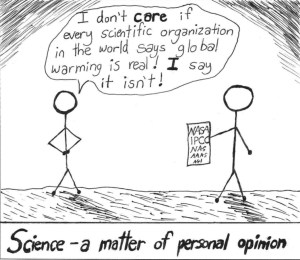
4) They seem to believe that their opinion of the forcings and mechanisms of a complex system such as climate, as well as its basis in physics and chemistry, is more noteworthy than the opinions of the professional scientific organizations at the top of our credibility spectrum.

In simpler terms, “It doesn’t matter what the scientists say. I’m smarter than all of them put together.”

Why you need science

Climatology is not as simple as you might expect after watching An Inconvenient Truth. The folks at NASA don’t just look at two graphs that are both going up and automatically assume that they’re correlated.

Climatology is every bit as complicated, thorough, and dry as any other area of science. In fact, it is deeply entrenched in the physical sciences. As an over-eager student who is trying to understand more aspects of climatology than I have the scientific foundation for, I continually run into this entrenchment.

For example, the exact process of how a CO2 or CH4 molecule absorbs infrared energy and thus acts as a greenhouse gas involves quantum chemistry that I haven’t learned yet. I’m still puzzling over the difference between the direct cooling effect of aerosols versus the cloud albedo effect. I hear all the time that climate change is based on the Laws of Thermodynamics, but I have yet to find out what those laws are.

It’s not easy stuff. It’s not something just anyone could grasp entirely in an afternoon. It’s something that requires years of study.

If I told you that parts of the Greenland and Antarctica ice sheets were thickening, chances are that you’d think, “More ice = cooling, therefore the world is not warming.”

In fact, these thickening ice sheets are a sign of warming. The thickening areas were previously so cold that the air could not hold enough moisture for significant precipitation. With warming, the air has more capacity for humidity, and precipitation falls in the form of snow. But it’s still too cold for that snow to melt, so it builds up and thickens the ice sheet.

It’s not as simple as temperature = climate. You have to look at changes in humidity and precipitation over time. You have to use a lot of maps. You have to factor in wind and ocean currents.

You have to know what you’re doing to make an accurate analysis of climate data. If you haven’t studied physical geography, atmospheric physics, or climate modelling at the post-secondary level, chances are that you hold misconceptions and assumptions that are skewing your interpretation.

I know this is true for me. I don’t pretend to know everything about climate change. I have an awfully long way to go. I’m just a student.

The more I learn about climatology, the more I realize how little I know.

So please, have some humility. Realize that it might be wiser to trust the experts than to try to analyze it all yourself. Don’t automatically assume that NASA, IPCC, the 32 national academies of science that endorsed the IPCC, and every other professional scientific organization on the planet are completely wrong just because somebody said they were.

Chances are, there are satisfactory explanations for whatever objections you may hold to their methods. Yes, they are making sure the sun is not responsible. No, they weren’t all saying an ice age was coming in the 70s. Yes, they are aware carbon dioxide is plant food. These are smart people. Accept that they might know more about climate change than you do. It’s not such a terrible thing.

To conclude, there are many things in life, such as fashion, political beliefs, and spirituality, where all opinions are equal, and nobody is justified to tell anybody what they should believe.

Science isn’t one of them.
Artificial Balance

All issues have two (or more) sides. We can probably all agree on that. But are they always two equal sides?

Journalists are trained to always present both sides of an issue with equal weight. This works well for matters of politics. Got the Conservative? Get the Liberal. (That’s Republican and Democrat, respectively, for our American friends.) It works for policy – reporting the pros and cons of building a new bridge vs not building a new bridge. Journalistic balance is appropriate for matters which concern personal opinion, where everyone’s view is as credible as anyone else’s, and you don’t need a PhD to understand the stuff.

But what about matters of science?

Remember high school science class? Did they present both sides of absolutely every topic with equal weight? Did they say to you, “This is the evidence for and against the existence of photosynthesis. You can form your own personal opinion”? Did they do the same with Newton’s Laws, chemical reactions, or the idea of a heliocentric universe? Of course not. It would just confuse you further, and it was unnecessary as the ideas being taught were widely accepted in the scientific community.

So why should climate change be any different?

“Climate change is still being debated,” you might say. “Scientists are split over whether or not it’s happening, and whether or not we’re causing it.”

And that, my friends, is where the media comes back into the story.

Let’s hear what Ross Gelbspan has to say in his book The Heat is On.

“The professional canon of journalistic fairness requires reporters who write about a controversy to present points of view. When the issue is of a political of social nature, fairness – presenting the most compelling arguments of both sides with equal weight – is a fundamental check on biased reporting. But this canon causes problems when it is applied to the issue of science. It seems to demand that journalists present competing points of view on a scientific question as though they had equal weight, when actually they do not.”

We’ve previously discussed how there is wide agreement over the existence of anthropogenic climate change among individual scientists. Among professional scientific organizations, the numbers are even higher. As soon as you tune into the discussions of scientists, instead of only what you hear in the media, it’s clear that climate change was accepted long ago. Right now, they’re debating technicalities such as when the Arctic will be free of summer ice, how quickly feedback mechanisms will work, and how much emission reduction is necessary.

But the media hasn’t caught onto this. The media likes a controversy, and they don’t want to be accused of only presenting one side. So they present the opinions of climate scientists as 50-50, instead of the 97-3 that Doran and Zimmerman determined.

What kind of balance is this, when the fringe opinions are hugely over-represented, and the vast majority are hugely under-represented? Does that not cause more bias than we were trying to avoid?

*Further reading: Misguided “Balance” in Science Journalism by Chris Mooney*

Scientific Agreement Quantified

You hear the term “scientific consensus” thrown around all the time in climate change. Al Gore claims absolute consensus. Many skeptics claim none at all. Earlier this year, Peter Doran and his student Maggie Zimmerman, from the University of Illinois, published the results of a poll aimed at quantifying the degree of scientific agreement on climate change.

Peter Doran is a publishing climatologist, so he falls into the most credible category of individuals on our credibility spectrum. The poll was published in EOS, a publication of the American Geophysical Union. EOS is a peer-reviewed journal, which falls even higher on our credibility spectrum than a publishing climatologist. I think we can establish strong credibility for this poll.

Examining the Scientific Consensus on Climate Change (click on the link for the most complete summary you can get without an EOS account) polled 3146 Earth scientists on their opinion on climate change. The summary describes the details of how the poll was carried out, for anyone who is questioning objectivity.

First, the poll asked, “When compared with pre-1800s levels, do you think that mean global temperatures have risen, fallen, or remained relatively constant?” Overall, 90% of participants answered “risen”, as did 96.2% of actively publishing climatologists, the highest level of specialization categorized in the study.

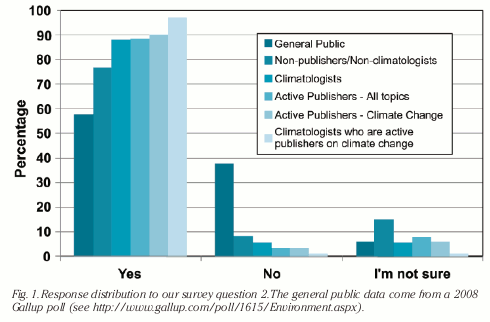
The second question asked, “Do you think human activity is a significant contributing factor in changing mean global temperatures?” As seen below, 82% of participants answered “yes”, as did 97.4% of actively publishing climatologists. Note that the darkest blue bar represents the general public, as seen in a recent Gallup poll.

Do you think human activity is a significant contributing factor in chaning global mean temperatures?

Do you think human activity is a significant contributing factor in changing mean global temperatures?

The poll noted that the level of agreement on anthropogenic global warming increased with the level of specialization. They also noted that the public perception of debate was, obviously, largely unfounded. We’ll be talking a lot more about perceived debate in the weeks to come here at ClimateSight.

The results of this poll are not surprising to me. In a way they make me happy, as they confirm that my previous perception of scientific agreement was well founded. But they also make me sad. 97% of the world’s most qualified individuals on this topic agree that we’re affecting the climate – something which is generally very negative as, with climate, stability is best. As David Suzuki said, “We are playing a crap game with the only home we have.”