
Now We’re Talking!

Another batch of private emails from climate scientists has been leaked/hacked/stolen/whatever. These ones, though, are very different than the last.

It’s a thread of emails from the NAS, and these guys are mad. They are mad about vested interests skewing the discussion. They are mad that journalists have sat and lapped it right up without checking their facts. They are mad that the public is suddenly more confused than ever about a field of science that is more united than ever.

They want to get hundreds of scientists to sign a declaration that yes, the anthropogenic combustion of fossil fuels is still causing the Earth to warm, and print it in newspapers like the New York Times, using only NAS money. They want to start a prime time science program on PBS. They want to have dozens of public lectures communicating climate science. They want a concise assessment report by the NAS written in layman’s terms. They want a nonprofit group to bridge communication between scientists and the public. They want “nothing short of a massive publicity campaign to educate the citizenry about what our best science is saying and why.”

“We will need funds to make something happen,” says Paul Falkowski, and by February 27th, about 15 NAS scientists had pledged $1000 each, out of their own pockets.

“How can we sit back while many of our colleagues and science as a whole is under attack?” writes Paul Ehrlich.

William Jury describes public presentations he’s given since the CRU hack, and how a common question is, “If the recent charges by anti-warming people aren’t true, why is nobody coming forth to prove it to us?”

And why not? All of us here have done our part, but it’s still not enough. I’m sure I’m not the only one who’s felt pretty powerless over the past few months. It’s incredibly obvious, to those who have all the context, that the theory of AGW is as rock-solid as ever. But truth is not enough, not when we’re up against the most effective spin machine in history. I feel like no matter how much work I put into the communication of real science, this machine will always be ten steps ahead.

Reading this string of emails gave me the most hope I’ve felt in months that we might actually be able to steer public opinion in a more accurate direction, so that we can get to work on fixing this problem. It was exhilarating to read that so many scientists are ready and willing to mobilize public communication when we need it the most. I wanted to jump up from the computer and wave my arms around and shout in joy. If I hadn’t been in the school library, I probably would have.

There has long been a stigma against communication in science – for example, Stephen Schneider faced demeaning remarks from his colleagues in the 70s for even speaking to the newspapers about his work. Couple this with the big difference between these two sides fighting for public opinion: one academic, the other political/industrial. When our academic institutions get money, they’ll spend it on research, not on public communication……while the lobby groups and oil companies are hard at work on advertising like this. (Worth a watch, it’s hilarious.)

The amount of public communication and education proposed by the NAS scientists is enormous, but it’s never been more justified than now.
The Antithesis to Nitpicking

Sometimes we have to step back and look at the big picture. We have to remember that not everyone has heard or believed the one about global warming stopping in 1998. Denialists centre around nitpicking and ideas that global warming is a “house of cards”, so we respond the same way: countering all the “mistakes” they claim to have found.

In reality, climate change is an incredibly robust phenomenon that we’ve known about for decades – and the basic physics behind it, for over a century. It’s not some new, shaky discovery. It’s not going to be overturned because scientists at CRU do not always say nice things about their critics.

So I was very pleased when I opened up YouTube today to see that Peter Sinclair’s latest video was all about this big picture. If I had to choose just one of his videos to share with everyone I knew, this would certainly be it. This is the kind of message we need to get out there; this is the kind of angle we need to take.

How to Prove Global Warming Wrong

Over the past twenty years, vested interests and political lobby groups have done a fantastic job confusing the public about anthropogenic climate change. To many, they seem to have proven the whole theory wrong.

But how could you actually prove global warming wrong – not just in the minds of the public, but through the established scientific process? What scientific discoveries – if they held up through peer-review, further criticism, and replication – would render climate change a non-problem?

One of the surest ways to stop all this cap-and-trade discussion would be to disprove the greenhouse effect itself – the mechanism by which the Earth absorbs and emits the same energy multiple times, due to the presence of greenhouse gas molecules that “bounce it back”. This keeps the Earth substantially warmer than it would be otherwise. Additionally, if the concentrations of greenhouse gases increase, so will the temperature of the Earth. This process was first hypothesized by Joseph Fourier in 1824, and was experimentally confirmed by John Tyndall in 1856. The first prediction of eventual man-made global warming came from Svante Arrhenius, in 1896. It wasn’t a theory as much as a logical result of a theory, one that was deeply rooted in physics and chemistry.

Unless our understanding of entire fields of physical science is totally off base, we can be sure that our greenhouse gas emissions will cause climate change eventually. But hey, if you could overturn all of thermodynamics, you wouldn’t have to worry about carbon taxes.

  • Cheap-out option: Svante Arrhenius was Swedish, but his name sounds sort of Russian, and 1896 wasn’t very long before the Russian Revolution. Therefore, Arrhenius was a Communist, and none of his scientific work can be trusted.

Knowing that something is sure to happen eventually, though, is different from knowing that it is happening right now with substantial speed. We know that the Earth is warming – even if you found some statistical way to disprove three separate temperature records, the physical and biological systems of our planet still stand: 90% of observed changes in the natural world, like the blooming of flowers, the peak flows of rivers, and the spawning of fish, are in the direction expected with warming (Rosenzweig et al, 2008).

But how do we know that the warming is caused by us? Climate change has been caused many times in the past by factors unrelated to greenhouse gases – like solar influences, whether they’re direct (a change in solar output) or indirect (a change in the Earth’s orbit). How do we know that’s not happening now?

If the warming was caused by the sun, the atmosphere would warm uniformly at all levels. However, if the Earth was warming from greenhouse gases, the troposphere (the layer of the atmosphere closest to the planet) would warm while the stratosphere (the next level up) would cool. This is because more heat is getting bounced back to the surface by greenhouse gases, and is subsequently prevented from reaching the stratosphere.

A cooling stratosphere has been described as the “fingerprint” evidence of greenhouse-induced warming. And, in fact, the stratosphere has been cooling over the past 30 years (Randel et al, 2009). Therefore, if you could somehow show that something else was causing this pattern of a warming troposphere and a cooling stratosphere, and that the significant, anthropogenic rise in greenhouse gases was somehow not affecting it, you would have a case for global warming being natural.

Update (18/2/10): About half of this cooling can be attributed to ozone depletion, and the other half can be attributed to greenhouse gases (NOAA, 2006). The flat trend in stratospheric temperatures from 1995-2005 (see the Randel citation above) can be explained by the recovery of ozone, which is temporarily offsetting the greenhouse gases. Interesting how the temperature of the stratosphere has just as many factors as the temperature of the troposphere…..but in both cases, you can’t explain the temperature trends without including human activity. Scott Mandia has a great explanation here.

  • Cheap-out option: Omit the explanation of why greenhouse warming causes stratospheric cooling. Just point to the graph that goes down and say, “The atmosphere is cooling! Therefore, the IPCC is a hoax!”

Finally, even if you couldn’t disprove that global warming is expected, observed, and anthropogenic, you could still show that it isn’t very significant. The way to do this would be to show that climate sensitivity is less than 2 C. Climate sensitivity refers to the amount of warming that would result from a doubling of carbon dioxide equivalent, and 2 C is generally accepted as the maximum amount of warming that our society could endure without too much trouble. The current estimates for climate sensitivity, in contrast, average around 3 C (a range of 2-4.5), and it is very unlikely to be less than 1.5 C (IPCC AR4).

However, a climate sensitivity of less than 2 C only means that climate change isn’t a problem if our greenhouse gases stop at a doubling of carbon dioxide equivalent from pre-industrial levels. Even without taking methane and other greenhouse gases into account, this brings us to a CO2 concentration of 560 ppm, which we are well on track to surpass, even with cap-and-trade. So you’d have to argue for a climate sensitivity of even less. Seeing as we’ve already warmed 0.8 C, it doesn’t leave you with a lot of wiggle room.

  • Cheap-out option: Build a climate model that does what you want it to, without any regard for the laws of physics. ExxonMobil will probably sponsor the supercomputers. Widely publicize the results and avoid peer-review at all costs.

Daunting tasks, certainly. But if you really believe that global warming is natural/nonexistent/a global conspiracy, this is the way to prove it. If you managed to prove it, and change the collective mind of the scientific community (not just the public), you’d probably win a Nobel Prize. So it’s certainly worth your time and effort.

Why Canada Is the Way it Is

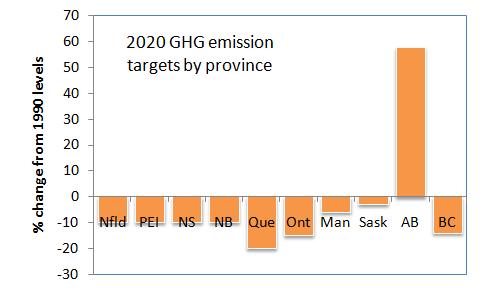
The Canadian government has decided that their meager 20% emission cut from 2006 levels by 2020 (equivalent to 3% cut from the standard base year of 1990) is tenuous – it all depends on what the US decides to do. (Why even bother having a separate Canadian government if they’re just going to follow all US decisions?)

Wondering why they’re still wasting time? This is why (courtesy of the  Globe and Mail):

Luckily, Canada now has its hands tied, as Obama just announced a target that’s slightly stronger – a 28% cut from 2005 levels by 2020, up from the previous target of 17%.

Funny how these things work out, isn’t it?

Mistakes

I have watched with interest the coverage of the IPCC’s screw-up over the Himalayan glaciers.

“Screw-up” is really the best way to describe it. It really shouldn’t have happened. WG2 cited a secondary source that cited something else that cited something else that turned out to be an erroneous New Scientist article. The reviewers of WG2 did realize that something was wrong with the citation, but the editor didn’t bother to take the statement out while they investigated it, and then their deadline passed. Long story short, the Himalayan glaciers are definitely not going to disappear by 2035.

However, what the mainstream media considers “the IPCC report” is generally only WG1, and more specifically the WG1 Summary for Policymakers. This Himalayan glacier claim was in the lower-profile WG2, and it didn’t even make it into any of the WG2 summaries. If it had, the chances of it slipping through would have decreased dramatically. As it was, the mistake was present in one paragraph of the 938-page WG2 which is one of three sections of the fourth edition of the IPCC report. Not very high-profile, as these things go.

It’s strange, though, to watch the media coverage of this screw-up. It ended up in my BBC News feed, and according to one of my teachers, in the Globe and Mail as well as the local newspaper I just gave up on. That’s fine, as I didn’t see the kind of blatant misquotes and jumps in logic as during the CRU reporting. However, it makes me wonder – why weren’t all the other IPCC mistakes reported?

The IPCC tries to be centrist, and to report the median opinion of the climate science community. The more extreme claims on either end of the spectrum are given minimal attention. Therefore, the IPCC is bound to make some mistakes. However, with the exception of this screw-up, virtually all the mistakes have been on the side of “oops, it’s going to be worse than we thought”.

Take the Copenhagen Diagnosis, a 2009 report written by a dozen or so top climate scientists around the world. Its purpose was to update policymakers, in time for Copenhagen, on what had been learned since the AR4. Here are the major discrepancies they found:

  • From 2007-2009, there was about 40% less Arctic summer sea ice than the IPCC predicted, far exceeding its worst-case scenarios.
  • Recent global average sea-level rise is about 80% more than the IPCC predicted.
  • By 2100, global sea level is expected to rise at least twice as much as the IPCC predicted.
  • Global CO2 emissions are around the highest scenarios considered by the IPCC.

Hmmm, these areas of discrepancy – emissions, Arctic ice, sea level rise – are a lot higher-profile than one paragraph about the Himalayan glaciers in WG2. But I don’t remember reading about the Copenhagen Diagnosis anywhere other than the climate science blogs I follow. None of the mainstream media outlets I follow covered it. Did anyone else see it somewhere?

I encourage the reporting of scientific mistakes, as long as the journalism is accurate. Doesn’t it seem strange, though, that the findings of the Copenhagen Diagnosis went virtually unnoticed – while the Himalayan glacier screw-up was covered in every major newspaper in the world? Who is choosing to frame the IPCC as alarmist – rather than its true centrist position – and why?

ClimateSight/CCC Movies!

Here is a re-upload of some public education videos (aimed at students) I created in the summer, in association with Climate Change Connection.

Read the citations, and take the survey if you’re feeling brave.

Enjoy!

Where to Go for Answers

To all of our new readers, thanks to CBC and StumbleUpon, this is for you!

Most of us don’t read scientific journals. We read the newspaper instead. We read our news feeds. We watch CNN.

These sources, as we know, are fairly low on the credibility spectrum. But how are people like you and I supposed to understand the more credible sources? Scientists don’t seem to speak plain English. And you can’t even read most of their studies without a subscription.

Usually this isn’t much of a problem, because the popular press and the scientific journals say basically the same things – that there’s going to be a lunar eclipse on a certain date, that red meat increases your risk of a heart attack, that a new kind of dinosaur was just discovered.

However, when you start reading about climate change, the newspapers start going crazy.

The world is warming. The warming is caused from the world coming out of an ice age. The warming stopped in 1998. Glaciers are melting. The warming is caused by human activity. The warming is caused by sunspots. The warming is inconsequential. The warming is catastrophic and is going to kill us all. New York is going to be underwater. Scientists faked the whole thing.

As someone who keeps up-to-date with the scientific literature – that is, sources from the top few tiers of the credibility spectrum – I can tell you that it is not under the same confusion as the mass media. There are a lot of myths about climate change that go around the newspapers and the Internet, but were never in any sort of legitimate scientific study. I cannot stress this point enough.

For example, have you heard the one about NASA getting the Y2K bug, and later discovering that the warmest year on record wasn’t 1998, but in fact – whoops – 1934? Global warming must be fake!

Actually, that’s not correct at all. NASA discovered that 1934 was the warmest year on record in the United States. And that “United States” part got dropped in translation somewhere in the blogosphere. Contrary to what American media would have you believe, the United States is not the whole world. It makes up less than 2% of the Earth’s surface. And the warmest year on record globally is either 1998 or 2005, depending on how you measure the Arctic temperatures.

There are dozens of stories like that. So many of the explanations you hear for global warming being natural/nonexistent/a global conspiracy are based on misconceptions, miscommunications, discredited data, or flat-out lies. They were never in the scientific literature. They are not endorsed by the sources at the top of our credibility spectrum. They are, shall we say, urban myths.

But how are we, humble non-scientists, scanning through the newspaper on the way to work each morning, supposed to know that? We need some kind of a link between the scientists and the public. Some journalist who actually knows what they’re talking about, and cites all of their claims with credible sources. Some sort of encyclopedia that will dispel all the myths about climate change.

Luckily, there are many of these encyclopedias. There are a lot of people out there trying to fulfill this very purpose.

One of my favourites is Peter Sinclair’s Climate Denial Crock of the Week video series on YouTube. He debunks common claims like “global warming stopped in 1998”, “global warming is caused by the sun”, and “temperature leads CO2 in the ice cores”. Sinclair is a professional journalist, so all of the videos are well explained, easy to understand, and fun to watch.

Another great source is Coby Beck’s How to Talk to a Climate Skeptic series. These articles cover just about every objection out there. Equally comprehensive is Skeptical Science. They’ve even compressed their explanations into “sound bites”, so you can answer your uncle’s objections in just a few sentences over Thanksgiving dinner.

Some of the sources from the top of our credibility spectrum have also chimed in. Environment Canada has created a fantastic FAQ document about climate change. It covers everything you need to know to wade through YouTube comments or online debates, along with citations you can actually trust.

Finally, Scott Mandia, a regular reader here at ClimateSight and a meteorology professor in New York, has just posted a copy of his presentation to the public about climate change. What I like about this document is that it’s very up-to-date. All of the graphs are the most recent of their kind. It also provides some philosophical perspectives to really sink your teeth into, like an analogy about medical advice, and some memorable quotes at the end.

We shouldn’t have to double-check everything the newspaper says about climate change. But the objections to anthropogenic global warming have such an awful track record that we really should, at least before we go and spread them around. These sources will cover just about everything you need to know.

CO2 Levels for June

389.42 ppm

(From CO2 Now, an advocacy group, but they appear to get their data from the Mauna Loa Observatory, so we can establish sufficient credibility.)

Worse than even I expected. Remember the good old days when An Inconvenient Truth had just been released and CO2 was still at 380 ppm?

Nothing in science changes quite as fast as climatology data these days. My school chemistry handouts are outdated only in that sense; they keep saying that CO2 is at 350 ppm.

The Greenhouse Effect

It always helps to have some background scientific knowledge on climate change – it makes it easier to sort credibility and call people’s bluffs. I thought I’d give a brief explanation of the Earth’s energy balance, something that confused me for a long time.

All substances can absorb a certain amount of radiation – they must then emit or radiate it back out, usually in the form of long-wave radiation (heat). Some molecules, however, possess certain chemical properties which allow them to absorb (and therefore emit) an extremely large amount of radiation relative to their size. These molecules are called greenhouse gases. I recently asked a chem major exactly which properties determined this amount of absorption. They replied, “You don’t know enough quantum chemistry yet.”

When solar radiation, in the form of short-wave radiation (light), approaches our atmosphere, about 30% is reflected right off. The remaining 70% reaches the atmosphere and the Earth’s surface.

The surface of the Earth absorbs some of the radiation. It can’t hold onto this energy indefinitely (it wants to have room to absorb the next rays of light), so it emits it back out. Even though it received the radiation in the form of light, it emits it in the form of heat. It is this emission that determines the temperature of the Earth.

Greenhouse gases allow short-wave light to pass straight through the atmosphere, but they do absorb some of the long-wave heat that the Earth just emitted. The more greenhouse gases present, the more radiation the atmosphere, as a whole, can absorb. When atmospheric particles (greenhouse gases, in this case) emit this radiation back out, it goes uniformly in all directions. Some goes up and escapes out to space. But some goes down and hits the Earth’s surface again.

Therefore, the Earth has to absorb and emit some of the radiation twice. This increases the temperature of the Earth.