Free Speech

It hasn’t been long since I changed my comment policy, and already I’m getting complaints of censorship. I’m obviously not too concerned about the validity of these sources, but I thought I should address the issue regardless.

There are two reasons I will moderate a comment:

1) If you make a scientific claim which isn’t common knowledge (ie, you don’t have to cite “humans are causing climate change” or “the stratosphere is cooling while the troposphere is warming”), and don’t provide a citation from a legitimate peer-reviewed source to back up your statement, I will replace your comment with [citations needed].

For example, I would moderate comments such as these (all of which I just made up – nobody actually posted these):

Humans cannot be causing global warming. Volcanoes emit more CO2 than humans, and there have always been volcanoes and they have never changed the climate. The warming is obviously caused by the sun.

Climate sensitivity is very low – about 0.5 C. Read this post by Joanne Nova.

As Sallie Baliunas found, the medieval warm period was much warmer than today. This was very good for the Vikings and their grapes so we shouldn’t be worried about global warming.

The regular readers and commenters of ClimateSight will spend so much time debunking these common claims, which have been repeated endless times, that we won’t be able to move forward in our discussion. For example, compare the level of useful discussion on this post to this post. Whether or not you’re trying to, if you’re posting statements which claim to invalidate anthropogenic global climate change, with no scientific backing, you’re wasting our time. If you’re deliberatly wasting our time, of course we’re not going to include you in the discussion. If you’re genuinely interested and have heard these statements and want to know more, refer to Coby Beck’s How to Talk to a Climate Skeptic. It’s by far the most comprehensive list of common misconceptions on the web. We’d just be repeating similar arguments anyway….

If you’re getting into more complicated arguments with lots of math, you still have to cite your basic conclusions. Keep in mind that I am just a lowly high school student who doesn’t know any calculus. I can’t possibly assess people’s arguments on their content – so I trust the “peer-reviewed” credential more than any amount of logic.

2) If you post something which is inflammatory, aggressive, insulting, politically extreme, a personal attack on a respected scientist, a random grumble about Al Gore, etc, your comment will be replaced with [inflammatory]. Here are some examples (again, made up):

Al Gore is EVIL and he just wants to tax us all!!!!!!!!!!!! What about the ice ages where it warmed without anyone driving hummers!!!!!!!! That’s his INCONVENIENT TRUTH!!!!!!!!!!!!!!

Any form of liberal government will never, ever, work, and regulations should never be allowed, no matter what the threat is. All regulations should be suspected as government influence on our lives and incomes.

You are an alarmist and a quasi-religious zealot. You’re just believing what Hansen says because it fits with your preconceived conclusion. Did you know that Hansen adjusts all the temperature data before he graphs it? There’s good reason to suspect that GISS is committing fraud.

When I encounter comments like these, it’s pretty obvious that you’re not interested in having a useful discussion, and just want to yell at people. You’re not helping the quality of the discussion one bit.

There’s a difference between deleting comments like these – which waste everyone’s time and patience – and participating in what we call “censorship”. Censorship is the practice of suppressing ideas and free speech by eliminating someone’s form of communication to the world. I am in no way practicing or endorsing this. You are more than welcome to start your own blog and yell about Al Gore all you want, or to go and comment about CO2 lagging temperature on any other blog you find. A better example of censorship would be how Watts removed Peter Sinclair’s video from Youtube – how else was Sinclair supposed to get his videos out to the world?

There are lots of places to say what you want elsewhere. But here I am the editor, and I am not going to publish comments which will sabotage our discussion. I am going to cater to the requests of those who respect this blog and wish to further the discussion, not those who wish to delay it.

Inflammatory statements are quite obviously inappropriate in a useful discussion. Additionally, keep in mind that science is not built around the pillars of completely free and unrestrained speech, as Brian pointed out. If it was, Nature and Science would have to publish absolutely every submission they received, whether or not it was correct or legitimate. In the real world, however, if a study were to make unusual claims without appropriate evidence or citation, it would go right out the window.

You can say whatever you want. But if it’s inflammatory or lacks citations, and you try to publish it here, don’t complain if it gets deleted.

(Making up all those moderation-worthy comments was kind of fun, though!)

Update: RealClimate has a great quote which sums up my feelings on this issue:

“Comments that accuse as of bad faith, fraud and dishonesty are not ways to move forward any conversation – how can you have a dialog with people who don’t believe a word you say? We choose to try and create a space for genuine conversation, which means weeding out the trolls and the noise. This is an imperfect process, but the alternative is a free-for-all that quickly deteriorates into a food fight. There are plenty of places to indulge in that kind of crap. There are only a few places where it’s not and we are not embarrassed to try to make this site one of them.”

Logic

Background information is important.

This is what I was thinking while I was reading “The Twenty Three (and Growing) Smoking Guns of Global Warming” on the Heartland Institute website, while researching for quotes to use in my post A Well-Documented Strategy. The introduction reads,

“Before you read this essay, I ask you to forget everything you have learned about global warming…..Your job is to review the study with unbiased eyes, and grade the project based upon how sound the science is in supporting the conclusion.”

Robert Wagner, the author, seems to equate background information and expertise with bias, as “[climatologists’] funding depends on carbon being the cause of global warming.” He does not trust climatologists, or any sort of expert in this issue, as their salary seemingly depends on AGW.

If you read the article while “forgetting everything you have learned about global warming”, it has an internal logical flow. If you rely upon your background information and expertise – even if you’re not a scientist, just a nerdy volunteer blogger like me – their conclusions fall apart.

This is most obvious when the article pulls out the old “CO2 lags Temperature” crock. It makes perfect sense – how can carbon change temperature if it’s actually the other way around? – until you read a little further into other sources.

Then they go on about Christy’s satellite data. Which seems to support their conclusion, until you find out that it’s been discredited multiple times and Christy has now retracted his data.

They have a throwback to the early days of climatology when everyone believed that the bands of radiation CO2 absorbed overlapped so much with water vapour that extra CO2 wouldn’t make a difference. They phrase this in a way that makes it seem like this is the current theory.

They take the correction that GISS made, where 1934, not 1998, was found to be the warmest year in the US, and conveniently remove “in the US”, implying that 1934 was the warmest year globally.

All of this works…..as long as you don’t read anywhere else. The author says to you, “Forget everything you know, and only accept what I tell you, as well as the blog posts and newspaper articles that I cite.” Knowledge from anywhere else is seen as “biased” because climatologists are just out for grant money to increase their personal wealth. Yes, the only credible source out there is the Heartland Institute. So of course their articles have an internal logical flow…..as long as you obey their instructions to only believe their articles.

What a creepy form of censorship. What an underhanded way to manipulate the reader. How is the Heartland Institute allowed to exist without some sort of disclaimer? How does anyone take them seriously?

Two Good Books

The Heat is On by Ross Gelbspan was an enjoyable book. It didn’t take much effort to keep reading, and I whipped through it in a couple of days.
Much of the book was devoted to the politics of climate change, most notably the PR attempts by skeptics to delay action. There were some well-placed but infuriating examples, especially the story of Benjamin Santer, and how he was suddenly charged with fraud in the 1995 IPCC report by the folks from SEPP and the Marshall Institute. This was obviously an underhanded attempt to damage the IPCC’s credibility to the public, and it lives on today. I was trying to find a decent link from a respectable source that explained this story in more detail, but I got tired of sifting through results from Climate Depot and the SEPP website.

The book also explored how climate change will affect businesses and the economy. “The laws of supply and demand,” writes Gelbspan, “do not supersede the laws of nature – and when those two sets collide, the physical planet is the court of highest appeal.” The last chapter was devoted to possible solutions. There was nothing that set this book apart from others of its kind, but I enjoyed it nonetheless.

However, I felt that The Heat is On was a little dated, as it was written in 1997 – before the record-breaking years of 1998 and 2005, before Katrina, before Exxon stopped funding the skeptics. I felt this last point is quite important, as the skeptics were constantly referred to as “industry representatives” or “fossil fuel funded” in the book, while today the skeptics are more representatives of the extreme right-wing community, such as the Heartland Institute. The skeptical community seems more and more like a resistance to regulation, rather than a resistance to getting rid of fossil fuels. Naomi Oreskes refers to this phenomenon as “free market fundamentalism” in her excellent lecture (but resist the urge to read the comments – they’ll annoy you to no end).

Bottom line – there was nothing much that was new or spectacular in this book, but I enjoyed it anyway, and would recommend it to all.

I enjoyed Hell and High Water by Joseph Romm even more. It seemed more structured, more comprehensive, and more solution-oriented. The first half of the book was devoted to climate change impacts, especially hurricanes and sea-level rise. It was quite terrifying, even though I read this sort of stuff all the time.

The second half of the book discussed politics and solutions. Skeptics were referred to as “Denyers and Delayers”, a title I found quite fitting. There was a lot of Bush-bashing.

I found the solutions to be very well thought out and organized. Romm explained how we can’t rely on “new technology” to save us – we need to start now with what we have, which will buy us the time to develop this new technology. He told the success story of California’s energy efficiency program, which amazed me, and which I will likely devote a post to in the near future. I know there are a fair few Californians who read this blog – anyone want to leave their opinions, info, links, etc in the comments?

He discussed why peak oil won’t happen soon enough to save us from global warming, and why hydrogen power is not a viable solution unless and until we can find a way to get hydrogen from something other than fossil fuels. He explored the touchy subject of how to share emission reductions between developed countries and developing countries.

Romm also discussed media, one of my favourite facets of climate change to study. He noted that climate change, when it is reported in the popular press, is subject to a great deal of artificial balance, as “the media has the misguided belief that the pursuit of balance is superior to the pursuit of truth – even in science journalism.” He measured up the two sides of the scientific debate and claimed that the skeptics “remain a group small enough to fit into a typical home bathroom.” He quoted an anonymous editor at a major televison network, who replied to the question, “Why don’t you make the link between violent weather and global warming?” with, “We did that. Once. But it triggered a barrage of complaints from the Global Climate Coalition.” He mentioned a 2006 poll in Time magazine which found that 64% of Americans think there is a lot of scientific disagreement about climate change.

It’s like the media chapter was designed especially for me. I love reading about new topics – but I also love learning more about the topics I already know and love.

I think everyone should read Hell and High Water. It’s an up-to-date, far-reaching, well-cited account of global warming in the physical world and society.

As always, if you’ve read these books, you’re welcome to leave your own thoughts about them in the comments.

The Average Person

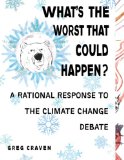
craven I first watched the Manpollo videos about a year and a half ago, when I had the flu, and ended up watching the entire six hours over two days. I don’t remember when it was that I discovered Greg Craven was writing a book based on the videos, but I’ve been excited to read it ever since.

The Manpollo videos have inspired my view on climate change and transformed my way of talking about it more than anything else I’ve read or watched. In a nutshell, Greg Craven’s process of risk management takes the pressure off us to be amateur scientists. It doesn’t require that we assess the statistical methods of people with PhDs when we only have a high school knowledge of science. Instead, it shows us how to use logic, assess credibility, and weigh the benefits and consequences of taking action vs not taking action on an uncertain threat.

I suppose I sort of expected that Greg Craven’s book would be a step up from the videos, would contain even more ideas, anecdotes and talking points that I could really sink my teeth into, would tell me more that I hadn’t already heard in the six hours of Manpollo.

But his book wasn’t like that. Greg Craven disappointed me.

And I’m grateful for that.

See, the book was not aimed at people like me who have an interest in climate change that borders on obsession. It was not aimed at the people who already know which sources are skeptical of anthropogenic climate change and which are worried about it. It was not aimed at those of us who can rattle off the current concentration of atmospheric CO2 without a second thought.

The book was aimed at the average person, who basically knows what climate change is but hears so much shouting in the media that they have no idea of its level of agreement. Who knows there are two sides and doesn’t want to offend anyone. Who has never heard of Milankovitch cycles, methane hydrates or the Goddard Institute of Space Studies.

If the average person stumbled upon most climate change blogs, most of the terms would be foreign to them. I hope they’d be able to understand most of what I write here on ClimateSight (as I try to stay away from analysing hard data) but they’d probably still need a bit of background information.

The average person, with little to no background information on climate science and policy, needs somewhere to start. They need the tools to assess the credibility of a source. They need to know where to go for more information about a topic. They need a basic knowledge of risk management, logic, and bias.

What’s the Worst that Could Happen? provides exactly that. It seems like a more concise version of the Manpollo videos, all the topics outlined in a simple process without the need for much background reading. If I were to recommend a book to start with for this anonymous average person we’re discussing, it would be hard to find one better than this one.

Instead of telling you stuff, Greg Craven tells you how to find stuff out for yourself. He doesn’t tell you how much agreement there is on climate change, he introduces you to a credibility spectrum instead. And even then, he doesn’t just give you his credibility spectrum, he shows you how to make your own.

He doesn’t tell you that oil executives are denialist trolls, he explains possible biases that could lead a person to a hasty conclusion. He gives one of the best basic explanations of the mechanics of anthropogenic climate change that I’ve ever read. Craven is possibly the least offensive, but most helpful, writer I’ve ever encountered.

My only complaint about the book was how he handled the “individual professional” and “individual layperson” sections in the chapters about statements. On the Skeptic’s side, he listed every individual prominent skeptic he could think of, I believe it was about a dozen. On the Warmer’s side, he had Hansen, Oreskes, and Gore. That was it. He explained that this was because he filled his credibility spectrum from the top down, and the statements at the top were almost exclusively weighted to the Warmer’s side. But there is something personal about an individual’s work that makes a person trust them and put faith in their arguments, rather than a report like the IPCC which is dry and anonymous. I wish that Craven had put some kind of indication, perhaps the Doran and Zimmerman report, that the opinion of individual scientists was also weighted towards the Warmer’s side. Otherwise it seems like the masses are not in agreement with the authority, which is supposed to be the source you listen to.

And because I agree with this concept so wholeheartedly, I feel compelled to share with my readers my answer to the question Craven asks at the very beginning – what would make you change your mind?

I would change my mind about dangerous anthropogenic climate change if a new discovery was made, if some new explanation came forward that gained as much agreement as the current theory holds now. If the national scientific bodies of the world, the peer-reviewed journals, and university textbooks had a complete overhaul because scientists discovered that humans were not changing the climate. If some new explanation surfaced that proved Arrhenius and Callendar wrong. It would be a discovery akin to the theory of relativity. As George Monboit said, “If you can prove these statements wrong, you should apply for a Nobel Prize. You will have turned science on its head.”

I listen to the scientists. I’m not surrending my rights and freedoms as an individual to them. I just trust their analysis more than I trust my own.

To conclude

If you already know a fair bit about climate change, and want some really fascinating dicussion points that will keep you going for literally years, watch the Manpollo videos. If you’re a really hardcore skeptic who thinks climate change is a global conspiracy, Manpollo was made especially for you.

But if you’re new to this topic, start with What’s the Worst that Could Happen? I assure you that there is no better place to begin.

A Story Worth Hearing

I found a great article on one of the blogs I read a few days ago. It was the first time I’d heard of the story, and it made me so mad that I knew I had to share it on ClimateSight. But this article was so well-written that I doubted I could come up with anything better.

In a nutshell…..an old paper that didn’t pass through the peer-review process of the EPA contained all sorts of climate-denial “evidence” which has been proven wrong countless times. The peer-review panel wasn’t trying to suppress contradictory evidence – in fact, publishing contradictory evidence would be great for the journal and the advancement of science – the paper was just utter nonsense!

But the Republicans threw a fit when they discovered that a paper questioning anthropogenic climate change was deliberately suppressed so the EPA could begin a communist takeover….or something like that. They want a criminal investigation. As David from Through a Green Lens writes,

“The irony is that these people watched calmly as the Bush-Cheney Administration suppressed global warming science.  Now, the party that supposedly promotes “fiscal responsibility” would like to spend millions of dollars on an investigation into why faulty science was not included in an EPA decision.”

Read the rest of his post here.

PS: A number of you have brought it to my attention that the ever-narrowing nested comments get very hard to read. I went to go check it out (I usually view comments from my WordPress dashboard) and my goodness, one word per line…..no wonder you were complaining!

I played around with the discussion settings, and I think I’ve fixed it as much as I can. Replies to comments will no longer appear indented below the original comment, but I’ve placed the oldest first, instead of the newest first, so that it makes more chronological sense. Unless there’s multiple discussions going on at once, I think it’s okay.

Let me know what you think, and if you have any more suggestions.

Paul Krugman Says it Best

“[Climate change deniers] don’t like the political and policy implications of climate change, so they’ve decided not to believe in it — and they’ll grab any argument, no matter how disreputable, that feeds their denial.

Indeed, if there was a defining moment in Friday’s debate, it was the declaration by Representative Paul Broun of Georgia that climate change is nothing but a “hoax” that has been “perpetrated out of the scientific community.” I’d call this a crazy conspiracy theory, but doing so would actually be unfair to crazy conspiracy theorists. After all, to believe that global warming is a hoax you have to believe in a vast cabal consisting of thousands of scientists — a cabal so powerful that it has managed to create false records on everything from global temperatures to Arctic sea ice.

Yet Mr. Broun’s declaration was met with applause.”

Paul Krugman, New York Times

Being Wrong

I have had very little scientific training, and no formal education in climatology. If you’ve read my About the Author page, you’ll know that I’m a student and aspiring climatologist. You might think I’m a university student, probably in my undergrad.

I’m not. I’m going into my last year of high school. Many of my classmates don’t even know that the theory of anthropogenic global climate change has been endorsed by anyone other than Al Gore. They’re too wrapped up in regular high school drama. Here I am spending my spare time urging political action against climate change, and I can’t even vote yet.

All of my education in climate change has been informal and independent. I stay up late reading IPCC reports. I borrow university chem textbooks so I can understand how greenhouse gases work. I direct all my questions to a climatology prof I know. In a few years, I will have the opportunity for formal training that begins to specialize in climatology. But I’m too impatient. I want to do all I can now.

If credibility is “expertise + objectivity”, my expertise is limited by my circumstances. However, I can still spend time increasing my objectivity. I check my sources. I separate science from policy. I ask myself, “What if I was wrong?”

Since I started this blog, I’ve learned that one of the best ways to pinpoint your mistakes and fix them is to collaborate with others. A lot of you have been fantastic in the comments section, helping to improve the accuracy of my posts. Because of you, I’ve learned that Anthony Watts does not have a PhD, that the same band of radiation can only be absorbed by carbon dioxide once, and that the category of “publishing climatologists”, which is more credible than scientists from other areas on the topic of climate change, should really include atmospheric physicists and radiative physicists.

Without people telling me that I was wrong, I would never have known that I was making mistakes. Without admitting that I was making mistakes, my posts would remain inaccurate.

I believe that admitting your mistakes and fixing them is one of the best ways to increase your credibility. It lets people know that you are willing to change your mind when new evidence warrants it. Basically, it shows that your quest for accurate information surpasses your ego.

Peer-reviewed journals use this tactic all the time. If one of their publications is proven erroneous, they print a retraction. Accurate, up-to-date information is their greatest priority. What else could you ask of a journal?

We all make mistakes, as Big Bird told us when we were small. Nobody is infallible, not even the folks at NASA. Since we can’t escape making mistakes, the best thing we can do is to admit to them and fix them. In a world demanding scientific accuracy, there is no room for egos.

Context

Most long-time readers are familiar with the story of Stephen Schneider’s misquoting, which I discussed in one of my earliest posts. Read that post if you haven’t already, otherwise the rest of this post won’t make a lot of sense.

So imagine my surprise and disgust when I received a “pingback” (a message that someone else on WordPress has linked to your site) from a post entitled “Environmental Hoax Proof”. The post on WordPress looked like it was republished from somewhere else, and I believe this is the original.

The part of the post which links to me is as follows:

“We need to get some broad based support, to capture the public’s imagination. So we have to offer up scary scenarios, make simplified, dramatic statements and make little mention of any doubts. Each of us has to decide what the right balance is between being effective and being honest.” – Stephen Schneider, Stanford Professor of Climatology, lead author of many IPCC reports

https://climatesight.wordpress.com/2009/04/12/the-schneider-quote/

The author must have read my post before linking to me. Yet they printed the widely-circulated, out-of-context quote anyway.

A lot of people use that particular quote without knowing the backstory. But the author of this post must have known the backstory (unless they didn’t even bother to read what they were providing as a source), and chose to print the seemingly scandolous quote anwyay.

Dishonesty. Fundamental dishonesty. And a real strong faith in the readers that they won’t actually click on the links.

The rest of the post included a lot of similar quotes from climatologists and environmentalists. I could tell without even looking further into any of them that they were similarly out of context.

What does this say about the credibility of some of our opponents?

All Over the Map

The climate change debate is usually categorized into two sides. One side claims that humans are causing the Earth to warm. The other claims that they are not.

But does the second side have an alternate scientific explanation for why humans are not causing climate change? When they are the extreme minority of scientific opinion, the burden of proof is really on them. So let’s look at the scientific theories of some of the more prominent skeptics.

Dr S. Fred Singer

Dr S. Fred Singer

Dr S. Fred Singer is an atmospheric physicist and a professor of environmental science at the University of Virginia. He is widely known for his opposition to the mainstream opinion regarding climate change, and has a history of being funded by oil companies and conservative think-tanks to promote this skepticism. (He was similarly funded for his opposition to the theory of tobacco causing cancer, as well as the theory of CFCs depleting ozone.)
Dr Singer claims that the observed warming is a natural phenomenon that occurs every 1500 years. He uses data from the Greenland ice core to support this theory. The data illustrates repeating D-O events, a well-known phenomenon from the last ice age, in which ocean currents caused the Greenland ice cap to warm while the Antarctic ice cap cooled. There was no change in the energy balance of the Earth, and little, if any, change in average global temperatures. Peter Sinclair created a fantastic video about Dr Singer’s D-O theory which you should all check out here.
With the training and knowledge he has, you’d hope Dr Singer would know to always use data from both poles when addressing issues of paleoclimatology. But, given his track record, there’s a good chance he’s deliberately trying to deceive us.
Dr Richard Lindzen

Dr Richard Lindzen

Dr Richard Lindzen is an atmospheric physicist and professor of meteorology at MIT. He was one of the many lead authors of the third IPCC report. His scientific work seems to follow the mainstream opinion……but he seems like a skeptic in the media. He is just as prominent as Dr Singer – between the two of them they’ve probably written most of the skeptical newspaper editorials out there. Like Dr Singer, Dr Lindzen is known to have been paid by the oil industry to promote his views on climate change.

But what are those views? It’s hard to know. Given his publications and participation in IPCC, it seems like he agrees with the basic physical processes of climate change. In an interview with Canadian climatologist Andrew Weaver, he seemed to acknowledge that humans were changing the climate, but didn’t think the consequences would be too bad. But he also likes to claim that there is little agreement or confidence, regarding anthropogenic climate change, in the scientific community. He told the Boston News that the Greenland ice sheet was thickening, indicating cooling – while it is well known that the thickening is due to an increase in snow from warmer temperatures. He’s also claimed that climatologists made up global warming so they would get more grant money.

Richard Lindzen says so many different things – it’s hard to tell whether or not he has a consistent opinion. Again, in scientific circles, he’s working just fine with the mainstream opinion. But then he goes to the media and spews out all the contrary arguments he can think of. My best guess is that Dr Lindzen is trying to confuse the public on climate change, because he doesn’t want action to be taken. But who knows?

Dr Anthony Watts

Anthony Watts

Anthony Watts is a weather forecaster, but now spends most of his time running the websites Watt’s Up With That? and Surface Stations. He believes that temperature data stations are producing flawed data, showing a false warming trend. He spends a lot of time trying to explain how observed signs of warming, such as melting ice sheets, are irrelevant.
However, we could forget the temperature data altogether, throwing out all the GISS graphs of temperature changes. We could instead look at changes in the timing of physical and biological events, such as when birds migrate, when snow melts, or when flowers bloom. NASA recently conducted such a study, and found that 90% of the 29,500 data sets studied indicated warming temperatures.
These are three of the most prominent skeptics who are actually qualified to understand climate change. If this small community – perhaps no more than a few dozen scientists worldwide – had a consistent scientific theory to explain why humans are not causing climate change, perhaps we’d pay more attention to them.
But they’re all saying different things. Their ideas are all over the map. I don’t think I’ve even seen two skeptics who share the same theory.
They’re working as hard as they can to disprove climate change, but they can’t even agree on an alternate explanation.

A Retraction?

A recent comment by a long-time reader brought a new piece of information to my attention. “What about the JSER?” they asked. “[Someone claimed] that it was a Japanese scientific society that endorsed the falsity of global warming…..What do you think?”

Did this bring the absense of disagreement among professional scientific organizations, at the top of our credibility spectrum, to a close?

I mulled it over and decided to do what seemed to be the most honest course of action. I would research this claim as thoroughly as my resources allowed, and if it turned out to be true, I would publish a retraction of my former statement regarding organizations.

First, however, I needed to get more information. I researched with the following questions in mind:

1) Is the JSER a professional scientific organization? This part of the claim appeared to be true – according to the English section of their website, they published a scientific journal, held conferences and seminars, and boasted over 1500 members.

However, the JSER – the Japan Society of Energy and Resources – likely has a high chance of bias. Its goal is “to promote the science and technology concerning energy and resources and thus to facilitate cooperation among industry academia and governmental sectors for coping with the problems in this field.” With today’s fossil-fuel dependent economy, the JSER likely has a lot of members representing the oil and gas industry. Oil and gas officials can easily fall prey to confirmation bias – their jobs depend on a resource which is causing dire problems for our planet. In their situation, it’s often easiest to deny such problems. In fact, the final scientific organization to change its statement from “humans aren’t affecting the climate” to “oops, yes they are” was the American Association of Petroleum Geologists.

2) Did the JSER officially state that humans aren’t affecting the climate? I found no evidence for an official statement.

3) So where did the claim come from? It started with a written discussion between five JSER representatives. One, the only climatologist of the five, defended the mainstream opinion that humans are causing climate change. One was undecided. The remaining three rejected the theory.

However, this discussion was mistakenly perceived as a “report” by The Register, a British media news source. I found no evidence that this so-called “report” was peer-reviewed (and how could it possibly have passed peer-review – it claimed that global warming stopped in 1998!). For example, the Register article noted, “Remarkably, the subtle and nuanced language typical in such reports has been set aside.” One of the authors is alleged to have compared climatology to ancient astrology.

I think we can safely leave this source as an email debate between colleagues. I cannot imagine how it could be a peer-reviewed document worthy of consideration.

However, as always, I could be wrong. There is little on the Internet regarding the JSER and its report. If any readers have additional information, please comment.

Update: Thanks to John for pointing me to the website of James Annan, a climatologist living in Japan. He knows the authors of the document personally and says, “The “report” is simply the collation of one of these popular-but-pointless sceptic-vs-scientist debates, and has no official status.”