Making Up Your Own Science

Why do so many people believe they’re more qualified on the topic of climate change than the climatologists themselves?

Visit Youtube, the editorial page of a newspaper, or even the blogosphere. All over places like these, where opinions can be expressed freely, there are countless people who

1) have little to no scientific training,

2) rely solely on the popular media for information on climate change,

3) are obviously unfamiliar with elementary principles of climatology, such as the Milankovitch cycles, El Nino and La Nina, or the importance of long trend lines in graphical measurements. (Sorry, not all of these sources are that high up on our credibility spectrum, but their citations are great.)

But, most importantly,

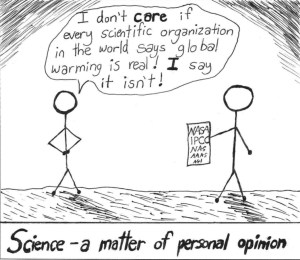
4) They seem to believe that their opinion of the forcings and mechanisms of a complex system such as climate, as well as its basis in physics and chemistry, is more noteworthy than the opinions of the professional scientific organizations at the top of our credibility spectrum.

In simpler terms, “It doesn’t matter what the scientists say. I’m smarter than all of them put together.”

Why you need science

Climatology is not as simple as you might expect after watching An Inconvenient Truth. The folks at NASA don’t just look at two graphs that are both going up and automatically assume that they’re correlated.

Climatology is every bit as complicated, thorough, and dry as any other area of science. In fact, it is deeply entrenched in the physical sciences. As an over-eager student who is trying to understand more aspects of climatology than I have the scientific foundation for, I continually run into this entrenchment.

For example, the exact process of how a CO2 or CH4 molecule absorbs infrared energy and thus acts as a greenhouse gas involves quantum chemistry that I haven’t learned yet. I’m still puzzling over the difference between the direct cooling effect of aerosols versus the cloud albedo effect. I hear all the time that climate change is based on the Laws of Thermodynamics, but I have yet to find out what those laws are.

It’s not easy stuff. It’s not something just anyone could grasp entirely in an afternoon. It’s something that requires years of study.

If I told you that parts of the Greenland and Antarctica ice sheets were thickening, chances are that you’d think, “More ice = cooling, therefore the world is not warming.”

In fact, these thickening ice sheets are a sign of warming. The thickening areas were previously so cold that the air could not hold enough moisture for significant precipitation. With warming, the air has more capacity for humidity, and precipitation falls in the form of snow. But it’s still too cold for that snow to melt, so it builds up and thickens the ice sheet.

It’s not as simple as temperature = climate. You have to look at changes in humidity and precipitation over time. You have to use a lot of maps. You have to factor in wind and ocean currents.

You have to know what you’re doing to make an accurate analysis of climate data. If you haven’t studied physical geography, atmospheric physics, or climate modelling at the post-secondary level, chances are that you hold misconceptions and assumptions that are skewing your interpretation.

I know this is true for me. I don’t pretend to know everything about climate change. I have an awfully long way to go. I’m just a student.

The more I learn about climatology, the more I realize how little I know.

So please, have some humility. Realize that it might be wiser to trust the experts than to try to analyze it all yourself. Don’t automatically assume that NASA, IPCC, the 32 national academies of science that endorsed the IPCC, and every other professional scientific organization on the planet are completely wrong just because somebody said they were.

Chances are, there are satisfactory explanations for whatever objections you may hold to their methods. Yes, they are making sure the sun is not responsible. No, they weren’t all saying an ice age was coming in the 70s. Yes, they are aware carbon dioxide is plant food. These are smart people. Accept that they might know more about climate change than you do. It’s not such a terrible thing.

To conclude, there are many things in life, such as fashion, political beliefs, and spirituality, where all opinions are equal, and nobody is justified to tell anybody what they should believe.

Science isn’t one of them.
Why They Don’t Debate on TV

I read an interesting article not long ago that claimed that scientists were not debating climate change enough. It said that they were refusing to debate skeptics on television and in the media, as they “knew they would lose”. Examples of “believers” who apparently refused such debates were Al Gore, David Suzuki, and well-known climatologists such as Hansen and Weaver.

Could it be that these advocates are refusing debates not because they “know they will lose”, but because they know that such a media-ravaged spectacle will have no scientific value?

If you look at these people, two – Gore and Suzuki – do not specialize in climatology. They are purely lobbyists and media figures (Suzuki is also a geneticist). For the purpose of determining how much debate goes into creating working conclusions on climate change, we should look at  the top of the credibility spectrum. Let’s exclude An Inconvenient Truth, editorials, films, and narrative non-fiction (such as Keeping Our Cool by Dr Weaver). These have not been peer-reviewed. They are (hopefully) based upon scientific conclusions, but would not be acceptable to cite in a research paper about climate change. They were created purely to reach the general public and to relay a certain political or ethical message.

What we will include are the documents which drive government policy, which have been peer-reviewed (or are peer-reviewed compilations of peer-reviewed science, such as the IPCC reports) and which have been created by sources at the top of our credibility spectrum. NASA is a good source. So is the IPCC. So are the 32 national academies of science that have approved the IPCC. Peer-reviewed scientific journals such as Nature, Science, or EOS are also credible.

This is where it all starts. This is where climate change theory began. It wasn’t cooked up by the government, the media, or someone like Al Gore. These are the people that objectively study details of global warming that you or I can’t even understand.

Back to the debate thing

There would be no point in Al Gore facing down a skeptical journalist in a “scientific debate” on prime-time TV. One of two scenarios would occur:

1) The debate would be of a true scientific nature (which would be surprising as neither of the sources are even climatologists). They would be talking about things like Dansgaard-Oeschger events, Milankovitch cycles, and the solubility of carbonic acid in water as a function of temperature. To the average viewer, it would be really boring. They wouldn’t understand a word of it. Nobody would watch. The television station would declare it a failure.

2) The debate would resort to name-calling and ridiculous claims. The journalist would go on about it all being a liberal conspiracy. Al Gore would go on about ethical responsibilities. The journalist would take advantage of the audience’s lack of scientific knowledge and claim that, as CO2 levels often lag behind temperature, climate change wasn’t real at all. Al Gore would take advantage of the audience’s lack of scientific knowledge and claim that Hurricane Katrina could be directly attributed to a warming planet. Scientists all over the world would shake their heads. The public would get even more confused.

You can have a scientific discussion. You can have a debate that becomes a media spectacle. It’s much harder to do both at once.

Scientists aren’t lawyers. They don’t each try to prove opposing arguments. Scientists aren’t politicians. They don’t try to make their ideas interesting for the general public. Scientists are seekers of truth, or the closest to truth humans can get, regarding the physical world.

Getting closer to that truth requires a lot of second-guessing, a lot of checking and revising and admitting that you’re wrong. It requires looking at every possible outcome and deciding which is the most probable. It requires inspecting new evidence whenever it comes up. It is “debating” in a gentler, more objective, more dry sense of the word.

So yes, scientists do debate in their own way. It’s called peer-review. It involves all that second-guessing, checking, and revising we just mentioned. It involves considering every objection. It involves addressing every objection that is deemed relevant. The sources we listed above – NAS, IPCC, Nature – peer-review all of their publications.

If this skeptical journalist had a new idea about climate change, he or she should get a degree, study their idea meticulously, write it up in the form of an article and submit it to a peer-review institution. That’s the normal scientific practice. Spreading their scientific hypotheses around the media without first passing their work through a peer-review process shows that they’re trying to influence the public, not educate them.

Go do some reading about how claims like “climate change is caused by the sun” or “it’s a natural cycle” have stood up to peer-review. Go see what the qualified, credible, objective scientific theories have found. Go see just how much research the scientific community has done about solar activity or natural cycles.

Yes, scientists do debate about climate change.

They just don’t do it on TV.

The Importance of Error Statements

Scientific error is unavoidable. There is a very good chance that whatever measurements we take will be slightly off. There is even a small chance that our conclusions are completely wrong. We accept that we don’t know everything. We live with it. We do the best we can.

Stating error and uncertainty is required in peer-reviewed science. Quite simply, it increases the author’s credibility. When you admit that you might be wrong, people feel more inclined to trust you. You seem like the kind of person that would admit to mistakes, and continually revise your findings to improve them as much as possible.

Something you hear a lot from climate change skeptics is something along the lines of, “We’re not completely sure if humans are changing the climate. Therefore, we shouldn’t waste money on reducing our emissions.” To me, it often seems like the people making these statements are exploiting the natural uncertainty of science, doing everything they can to make the uncertainty of climatology seem unusual. My favourite example of this can be read here.

If you go and read a peer-reviewed scientific report on any topic at all, you’ll see that the uncertainty over anthropogenic climate change isn’t really that unusual. We’re not completely sure about how gravity works. We’re not sure if light is a particle or a wave (or a particle that’s a wave, or a wave that’s a particle, etc). In fact, there are no conclusions in scientific articles that claim to be infallible.

This doesn’t mean there are two equal sides fighting over every topic you can imagine. In a lot of the cases, scientists have pretty much made up their mind. But they must, and always do, remain open to the possibility that they could be completely wrong.

Let’s look at the quantitative explanation of some terms of likelihood used by the IPCC. Extremely unlikely refers to a <5% chance. Virtually certain refers to a >99% chance. The numbers 0% and 100% are non-existent. They never say that something will definitely happen, or definitely not happen.

Check out the claims from the scientific organizations at the top of our credibility spectrum. Read the statements on climate change from the national academies of science of every major industrialized nation. Read what the folks at NASA have to say. Watch for the error measurements, and uncertain words like “evidence for” or “reason to believe”.

The important part

And then, more often than not, a lot of the people who said “Climate change is too uncertain” then turn around and make claims with no acknowledgement that they could be wrong. Let’s find some of the most extreme examples of this phenomenon….anonymous YouTube comments.

“The Earth has been heating up for thousands of years at a steady rate and it has nothing to do with people.”

“If these findings were anywhere near accurate, then I would see changes on at least a weekly basis. But nothing.”

“Nothing is significantly wrong that Mother Nature cannot put right.”

“I don’t think CO2 causes global warming, not at all.”

When I see comments like these – which are, sadly, extremely common – I wish I could say to every one of them, “What if you were wrong?”

I realize I could be wrong. It’s something I came to terms with long ago. I could be totally wrong about all this climate change stuff (in fact, I’d love to be). That’s why I support multi-benefit policies, that will help areas like the economy or health. If climate change turns out to be nonexistent/natural/a global conspiracy, at least our action will have brought us some good.

But what if all these anonymous YouTubers were wrong?

All those people who are so certain that we’re causing no change in the climate.

What if they were wrong? Can you imagine what the consequences could be?

Is this really something worth questioning, when there is so much agreement, and the stakes are so high?

Is this really a gamble worth taking?

Scientific Agreement Quantified

You hear the term “scientific consensus” thrown around all the time in climate change. Al Gore claims absolute consensus. Many skeptics claim none at all. Earlier this year, Peter Doran and his student Maggie Zimmerman, from the University of Illinois, published the results of a poll aimed at quantifying the degree of scientific agreement on climate change.

Peter Doran is a publishing climatologist, so he falls into the most credible category of individuals on our credibility spectrum. The poll was published in EOS, a publication of the American Geophysical Union. EOS is a peer-reviewed journal, which falls even higher on our credibility spectrum than a publishing climatologist. I think we can establish strong credibility for this poll.

Examining the Scientific Consensus on Climate Change (click on the link for the most complete summary you can get without an EOS account) polled 3146 Earth scientists on their opinion on climate change. The summary describes the details of how the poll was carried out, for anyone who is questioning objectivity.

First, the poll asked, “When compared with pre-1800s levels, do you think that mean global temperatures have risen, fallen, or remained relatively constant?” Overall, 90% of participants answered “risen”, as did 96.2% of actively publishing climatologists, the highest level of specialization categorized in the study.

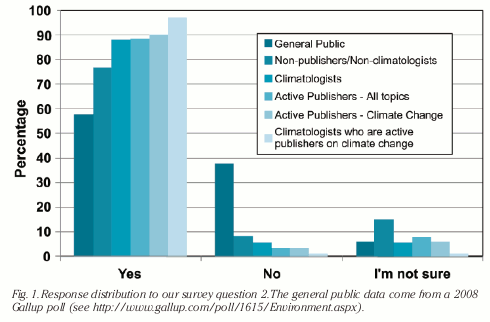
The second question asked, “Do you think human activity is a significant contributing factor in changing mean global temperatures?” As seen below, 82% of participants answered “yes”, as did 97.4% of actively publishing climatologists. Note that the darkest blue bar represents the general public, as seen in a recent Gallup poll.

Do you think human activity is a significant contributing factor in chaning global mean temperatures?

Do you think human activity is a significant contributing factor in changing mean global temperatures?

The poll noted that the level of agreement on anthropogenic global warming increased with the level of specialization. They also noted that the public perception of debate was, obviously, largely unfounded. We’ll be talking a lot more about perceived debate in the weeks to come here at ClimateSight.

The results of this poll are not surprising to me. In a way they make me happy, as they confirm that my previous perception of scientific agreement was well founded. But they also make me sad. 97% of the world’s most qualified individuals on this topic agree that we’re affecting the climate – something which is generally very negative as, with climate, stability is best. As David Suzuki said, “We are playing a crap game with the only home we have.”

How it All Ends

For anyone who hasn’t yet heard of these video series –

Greg Craven is a high school teacher from the States who put together six hours of video explaining why we should act on climate change. Don’t be scared by the “six hour” thing – all his arguments are condensed into the first, 10-minute long video.

Still skeptical? Chances are, whatever you’re thinking of is covered in the other five hours and fifty minutes. Check out the rest of the videos here.

The Credibility Spectrum

Let’s face it, there’s a lot of “climate science” out there that’s absolute rubbish.

Whichever side of the debate you’re on. Whether you believe global warming is a political hoax or that all skeptics are funded by Exxon. No matter what your opinions are, chances are that you’ve seen or read claims that you dismiss as outlandish.

Type “climate change” into Google. Within seconds you can find statements that the Earth is warming or that its temperatue is stable (or cooling since 1998!). You can find “proof” that the warming is caused by the sun, volcanoes, flaws in the temperature data, or fossil fuel burning. You can read that the Hockey Stick graph is broadly accurate, or that it was manipulated by the IPCC to agree with a predetermined conclusion.

Whatever you read about climate change, chances are that there’s another source saying the opposite thing. It’s not like we’re all climatologists who can see straight through misinformation. So how do you possibly sort out what to believe?

When people ask me this question, I invariably respond with, “Assess the credibility.”

The “climate change analysis” you read could be from a national academy of science, or from a blogger. It could be from an atmospheric physicist or a economist. It could be from a scientific journal or a political think-tank. If we calculate credibility to be “expertise + objectivity”, it’s obvious that some sources merit more weight than others.

I’ve put together a climate change credibility spectrum, inspired by Greg Craven from the Manpollo Project. This is a basic way to assess credibility and assign weight to a source. Keep in mind that this is only a guideline. The sources in the middle, especially, could be shuffled around based on the situation. The spectrum is also only used for scientific statements, such as “the Arctic is losing sea ice”. Matters of policy, such as “cap-and-trade is our best bet”, are much more a personal opinion.  

  • At the bottom of the spectrum we have the individual. This is someone with no formal education in the field of climate science. Bloggers generally fall into this category, which is why I plan to refrain from creating my own “expert analysis” of data on this blog.
  • Above that we have the professional. This is someone who is not a scientist, but is in an occupation that requires them to keep up to date with science. High school teachers are a good example, as well as politicians or CEOs.
  • Then we have the non-publishing scientist. Someone with a scientific background, but who is not currently publishing peer-reviewed literature, does not necessarily follow methods which are accepted by the scientific community. They have a good knowledge of science, but lack the “peer-reviewed” credential.
  • Above that is the publishing scientist in any area, such as medicine, physics, or chemistry. Even if they do not study climate change, they have the basic scientific background to understand it, as well as the “peer-reviewed” check on their scientific methods.
  • The publishing Earth scientist specializes in areas closer to climate science, such as geography, geology, or environmental science. They have a more in-depth knowledge of the way the biogeochemical systems of the Earth work.
  • The publishing climatologist (or atmospheric physicist/radiative physicist/any other area that’s so relevant to climatology that we can basically classify it as climatology) is the best you can get in terms of the individual professional. They understand more about climate change, and have more widely approved methods, than any other scientist.
  • Above the individuals come groups. Universities are generally quite up-to-date in their scientific knowledge, as they are training scientists-to-be, and have a large number of scientific professors behind their statements.
  • Peer-reviewed scientific articles are often written by more than one scientist, and have undergone an extensive review process. These articles minimize bias or misconceptions as much as science possibly can.
  • Finally, professional scientific organizations employ thousands of publishing scientists, have massive reputations to uphold, and often publish their own peer-reviewed journals. Their statements carry more weight than any others.

This isn’t to say that the NAS is infallible, or that the blogger is always wrong. The credibility spectrum is simply a tool used to decide how much weight to give a statement.

So go do some reading. Do some searching and reading and watching. See what individuals, professionals, groups and scientific bodies are saying about climate change. Assess their credentials. Decide who you’re going to believe.