A great quote that sums up the ideas of credibility and error statements quite well.
“The whole problem with the world is that fools and fanatics are always so certain of themselves, and wiser people so full of doubts.”
– Bertrand Russell
A great quote that sums up the ideas of credibility and error statements quite well.
“The whole problem with the world is that fools and fanatics are always so certain of themselves, and wiser people so full of doubts.”
– Bertrand Russell
We know about the majority of scientists who have stated that 1) the Earth has been warming since post-industrial times, 2) the driving force is human activity, 3) it’s going to have major consequences for human civilization, and 4) action is necessary as soon as possible to fix it.
We also know about the minority group that gets a disproportional amount of air time and, at least in part, appear to be actively trying to disprove every conclusion the scientists come to. This minority group has been able to publish little to no peer-reviewed science supporting their theories. Their ideas have not been accepted in the scientific community, so they spend their time in the media instead.
But there are also some people, with more noble motives, who simply know “climate change is a problem and we need to fix it” and don’t really know much about the science behind it. That much is fine. But then they go around telling people oversimplified or totally wrong pieces of data that they make up on the spot. That CO2 levels are now around 600 ppm. That the warming will lead us into another ice age. That the world will end.
Or then there’s the Al Gore phenomenon, where their scientific explanation, even if largely correct, is so grossly oversimplified that they are shot down by the first critic and the observers go back to disregarding the problem. (Keep your eyes open for a post all about the Al Gore phenomenon – I’m just waiting until I can find a copy of An Inconvenient Truth.)
I admire the cause of these lobbyists. But, as they are calling for action just like the scientific community is, the weakness of their scientific arguements ends up hurting their cause.
We can’t afford any more confusion on this topic. We can’t afford public distrust towards the organizations at the top of the credibility spectrum.
Leave the science to the scientists. As citizens and voters, let’s use our efforts to look at action and risk management instead, which you don’t need a PhD to understand.
In the popular media, Youtube, and the blogosphere, you get an awful lot of compelling documentaries of why climate change is nonexistent/natural/a global conspiracy. You don’t get as many grassroots projects from the advocates, at least not as many as you’d expect given the scientific distribution on the theory.
I recently came across a fantastic video series by Peter Sinclair, an American journalist. Keep in mind our credibility spectrum – Mr Sinclair is only a professional individual – but it appears that he cites the professional scientific organizations at the top of the spectrum almost exclusively.
Each of his videos deals with a common objection to the mainstream scientific view on climate change. Here’s his most recent, and my favourite, which addresses the all-too-common-claim that “Global warming stopped in 1998.”
If you enjoyed that, here are links to all his videos to date. Watch whichever ones strike your fancy.
“The Antarctic isn’t warming, so the planet, overall, isn’t changing at all.”
“It’s cold. So there’s no climate change.”
“The Arctic ice is growing, not declining.”
“Global warming is caused by the sun.”
“Climate change is a natural, unstoppable, 1500-year cycle.”
“The scientists were all warning of an ice age in the 70s, so why should we trust them now?”
“The urban heat island effect is skewing the data.”
“Every other planet in our solar system is also warming, so we can’t be causing it.”
“But lots of scientists signed the Oregon Petition saying climate change was false!”
“It was warmer during the Medeival Warm Period.”
“Al Gore said the ocean was going to rise more than the IPCC did.”
“Temperature determines carbon dioxide level, not the other way around.”
“Global warming stopped in 1998.”
Have fun and spread it around to your friends.
I just read the most recent (June 2009) issue of Discover magazine, which is not peer-revewied but generally writes about stuff that is. There was a fantastic article you all should read, entitled “The Big Heat”. It was an interview with three publishing climatologists – Robin Bell, Bill Easterling, and Stephen Schneider (please, people, stop it with that seemingly scandolous quote of his) – and one publishing Earth scientist, Ken Caldeira.
The article covered common questions such as “is it natural?”, “what problems will it cause?”, and “what do we do about it?” in a more in-depth, cited fashion than your average middle-school science unit. They talk about things like D-O events, rate of warming, credibility, and risk management. Fascinating stuff. I danced around a little as I read it.
A small excerpt:
“When we entered into the computer all the various things that forced the climate to change, we were able to faithfully reproduce the temperature record of the past 100 years globally. When you take out the component of human-generated carbon dioxide, the models don’t work at all. There are all these people who say, “Well, what about the sun? Why don’t they think about solar variability?” Of course we think about the sun. The models think about all these things, but the models work only if you put all the components in, and one of the big components is us.” – Bill Easterling
I’d expect that Discover would be available at most libraries in North America. Definitely worth a read.
Here’s the last cartoon in my series of five. But you never know – I might draw some more one day.

Why do so many people believe they’re more qualified on the topic of climate change than the climatologists themselves?
Visit Youtube, the editorial page of a newspaper, or even the blogosphere. All over places like these, where opinions can be expressed freely, there are countless people who
1) have little to no scientific training,
2) rely solely on the popular media for information on climate change,
3) are obviously unfamiliar with elementary principles of climatology, such as the Milankovitch cycles, El Nino and La Nina, or the importance of long trend lines in graphical measurements. (Sorry, not all of these sources are that high up on our credibility spectrum, but their citations are great.)
But, most importantly,
4) They seem to believe that their opinion of the forcings and mechanisms of a complex system such as climate, as well as its basis in physics and chemistry, is more noteworthy than the opinions of the professional scientific organizations at the top of our credibility spectrum.
In simpler terms, “It doesn’t matter what the scientists say. I’m smarter than all of them put together.”
Why you need science
Climatology is not as simple as you might expect after watching An Inconvenient Truth. The folks at NASA don’t just look at two graphs that are both going up and automatically assume that they’re correlated.
Climatology is every bit as complicated, thorough, and dry as any other area of science. In fact, it is deeply entrenched in the physical sciences. As an over-eager student who is trying to understand more aspects of climatology than I have the scientific foundation for, I continually run into this entrenchment.
For example, the exact process of how a CO2 or CH4 molecule absorbs infrared energy and thus acts as a greenhouse gas involves quantum chemistry that I haven’t learned yet. I’m still puzzling over the difference between the direct cooling effect of aerosols versus the cloud albedo effect. I hear all the time that climate change is based on the Laws of Thermodynamics, but I have yet to find out what those laws are.
It’s not easy stuff. It’s not something just anyone could grasp entirely in an afternoon. It’s something that requires years of study.
If I told you that parts of the Greenland and Antarctica ice sheets were thickening, chances are that you’d think, “More ice = cooling, therefore the world is not warming.”
In fact, these thickening ice sheets are a sign of warming. The thickening areas were previously so cold that the air could not hold enough moisture for significant precipitation. With warming, the air has more capacity for humidity, and precipitation falls in the form of snow. But it’s still too cold for that snow to melt, so it builds up and thickens the ice sheet.
It’s not as simple as temperature = climate. You have to look at changes in humidity and precipitation over time. You have to use a lot of maps. You have to factor in wind and ocean currents.
You have to know what you’re doing to make an accurate analysis of climate data. If you haven’t studied physical geography, atmospheric physics, or climate modelling at the post-secondary level, chances are that you hold misconceptions and assumptions that are skewing your interpretation.
I know this is true for me. I don’t pretend to know everything about climate change. I have an awfully long way to go. I’m just a student.
The more I learn about climatology, the more I realize how little I know.
So please, have some humility. Realize that it might be wiser to trust the experts than to try to analyze it all yourself. Don’t automatically assume that NASA, IPCC, the 32 national academies of science that endorsed the IPCC, and every other professional scientific organization on the planet are completely wrong just because somebody said they were.
Chances are, there are satisfactory explanations for whatever objections you may hold to their methods. Yes, they are making sure the sun is not responsible. No, they weren’t all saying an ice age was coming in the 70s. Yes, they are aware carbon dioxide is plant food. These are smart people. Accept that they might know more about climate change than you do. It’s not such a terrible thing.
To conclude, there are many things in life, such as fashion, political beliefs, and spirituality, where all opinions are equal, and nobody is justified to tell anybody what they should believe.
Science isn’t one of them.
Two cartoons today!
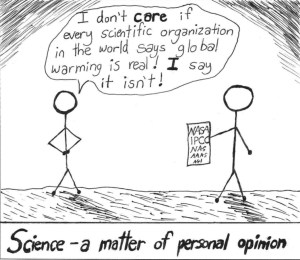

I read an interesting article not long ago that claimed that scientists were not debating climate change enough. It said that they were refusing to debate skeptics on television and in the media, as they “knew they would lose”. Examples of “believers” who apparently refused such debates were Al Gore, David Suzuki, and well-known climatologists such as Hansen and Weaver.
Could it be that these advocates are refusing debates not because they “know they will lose”, but because they know that such a media-ravaged spectacle will have no scientific value?
If you look at these people, two – Gore and Suzuki – do not specialize in climatology. They are purely lobbyists and media figures (Suzuki is also a geneticist). For the purpose of determining how much debate goes into creating working conclusions on climate change, we should look at the top of the credibility spectrum. Let’s exclude An Inconvenient Truth, editorials, films, and narrative non-fiction (such as Keeping Our Cool by Dr Weaver). These have not been peer-reviewed. They are (hopefully) based upon scientific conclusions, but would not be acceptable to cite in a research paper about climate change. They were created purely to reach the general public and to relay a certain political or ethical message.
What we will include are the documents which drive government policy, which have been peer-reviewed (or are peer-reviewed compilations of peer-reviewed science, such as the IPCC reports) and which have been created by sources at the top of our credibility spectrum. NASA is a good source. So is the IPCC. So are the 32 national academies of science that have approved the IPCC. Peer-reviewed scientific journals such as Nature, Science, or EOS are also credible.
This is where it all starts. This is where climate change theory began. It wasn’t cooked up by the government, the media, or someone like Al Gore. These are the people that objectively study details of global warming that you or I can’t even understand.
Back to the debate thing
There would be no point in Al Gore facing down a skeptical journalist in a “scientific debate” on prime-time TV. One of two scenarios would occur:
1) The debate would be of a true scientific nature (which would be surprising as neither of the sources are even climatologists). They would be talking about things like Dansgaard-Oeschger events, Milankovitch cycles, and the solubility of carbonic acid in water as a function of temperature. To the average viewer, it would be really boring. They wouldn’t understand a word of it. Nobody would watch. The television station would declare it a failure.
2) The debate would resort to name-calling and ridiculous claims. The journalist would go on about it all being a liberal conspiracy. Al Gore would go on about ethical responsibilities. The journalist would take advantage of the audience’s lack of scientific knowledge and claim that, as CO2 levels often lag behind temperature, climate change wasn’t real at all. Al Gore would take advantage of the audience’s lack of scientific knowledge and claim that Hurricane Katrina could be directly attributed to a warming planet. Scientists all over the world would shake their heads. The public would get even more confused.
You can have a scientific discussion. You can have a debate that becomes a media spectacle. It’s much harder to do both at once.
Scientists aren’t lawyers. They don’t each try to prove opposing arguments. Scientists aren’t politicians. They don’t try to make their ideas interesting for the general public. Scientists are seekers of truth, or the closest to truth humans can get, regarding the physical world.
Getting closer to that truth requires a lot of second-guessing, a lot of checking and revising and admitting that you’re wrong. It requires looking at every possible outcome and deciding which is the most probable. It requires inspecting new evidence whenever it comes up. It is “debating” in a gentler, more objective, more dry sense of the word.
So yes, scientists do debate in their own way. It’s called peer-review. It involves all that second-guessing, checking, and revising we just mentioned. It involves considering every objection. It involves addressing every objection that is deemed relevant. The sources we listed above – NAS, IPCC, Nature – peer-review all of their publications.
If this skeptical journalist had a new idea about climate change, he or she should get a degree, study their idea meticulously, write it up in the form of an article and submit it to a peer-review institution. That’s the normal scientific practice. Spreading their scientific hypotheses around the media without first passing their work through a peer-review process shows that they’re trying to influence the public, not educate them.
Go do some reading about how claims like “climate change is caused by the sun” or “it’s a natural cycle” have stood up to peer-review. Go see what the qualified, credible, objective scientific theories have found. Go see just how much research the scientific community has done about solar activity or natural cycles.
Yes, scientists do debate about climate change.
They just don’t do it on TV.
I’m not actually interested in changing the minds of climate skeptics.
If they’re stubborn enough that the work of NASA, 32 national academies of science, the IPCC, the World Meterological Society, and every other professional scientific organization on the planet can’t change their minds, the chance of a mere student like me having any influence on them isn’t really worth the time.
What I’m worried about is the average person.
The average person, reading the newspaper, who sees dozens of editorials every year that claim climate change is nonexistent/natural/a hoax. Editorials written by scientists who, in the extreme minority, have a hard time publishing anything peer-reviewed, so they spend their time with the media instead. Scientists who seem credible until you read up a little on their background.
I worry that the average person will get the impression that the existence of anthropogenic climate change is still under scientific debate. I worry that they’ll think the two sides are equal. I worry that, having little to no background in climate science, they’ll buy claims like “temperature drives carbon dioxide, not the other way around” or “the data is skewed by the urban heat island effect” or “global warming is caused by the sun”.
I worry that this discrepancy in the media will begin to change the public opinion. I worry that, eventually, the majority of people will begin to disregard climate change. I worry that this majority will use their voting power to suppress any climate change legislation. I worry that we’ll never be able to act against this problem because most people don’t think it’s a problem at all.
And the consequences of not acting against this problem are so dire that I can’t even let myself worry about them.
I’m not jumping on any kind of green bandwagon. I’m not trying to control people with government taxes and regulation. As far as I know, I’m not part of a global scientific conspiracy.
I’m just worried about my future, and the future of the people I love.
All issues have two (or more) sides. We can probably all agree on that. But are they always two equal sides?
Journalists are trained to always present both sides of an issue with equal weight. This works well for matters of politics. Got the Conservative? Get the Liberal. (That’s Republican and Democrat, respectively, for our American friends.) It works for policy – reporting the pros and cons of building a new bridge vs not building a new bridge. Journalistic balance is appropriate for matters which concern personal opinion, where everyone’s view is as credible as anyone else’s, and you don’t need a PhD to understand the stuff.
But what about matters of science?
Remember high school science class? Did they present both sides of absolutely every topic with equal weight? Did they say to you, “This is the evidence for and against the existence of photosynthesis. You can form your own personal opinion”? Did they do the same with Newton’s Laws, chemical reactions, or the idea of a heliocentric universe? Of course not. It would just confuse you further, and it was unnecessary as the ideas being taught were widely accepted in the scientific community.
So why should climate change be any different?
“Climate change is still being debated,” you might say. “Scientists are split over whether or not it’s happening, and whether or not we’re causing it.”
And that, my friends, is where the media comes back into the story.
Let’s hear what Ross Gelbspan has to say in his book The Heat is On.
“The professional canon of journalistic fairness requires reporters who write about a controversy to present points of view. When the issue is of a political of social nature, fairness – presenting the most compelling arguments of both sides with equal weight – is a fundamental check on biased reporting. But this canon causes problems when it is applied to the issue of science. It seems to demand that journalists present competing points of view on a scientific question as though they had equal weight, when actually they do not.”
We’ve previously discussed how there is wide agreement over the existence of anthropogenic climate change among individual scientists. Among professional scientific organizations, the numbers are even higher. As soon as you tune into the discussions of scientists, instead of only what you hear in the media, it’s clear that climate change was accepted long ago. Right now, they’re debating technicalities such as when the Arctic will be free of summer ice, how quickly feedback mechanisms will work, and how much emission reduction is necessary.
But the media hasn’t caught onto this. The media likes a controversy, and they don’t want to be accused of only presenting one side. So they present the opinions of climate scientists as 50-50, instead of the 97-3 that Doran and Zimmerman determined.
What kind of balance is this, when the fringe opinions are hugely over-represented, and the vast majority are hugely under-represented? Does that not cause more bias than we were trying to avoid?
*Further reading: Misguided “Balance” in Science Journalism by Chris Mooney*
 ClimateSight