Scientific error is unavoidable. There is a very good chance that whatever measurements we take will be slightly off. There is even a small chance that our conclusions are completely wrong. We accept that we don’t know everything. We live with it. We do the best we can.
Stating error and uncertainty is required in peer-reviewed science. Quite simply, it increases the author’s credibility. When you admit that you might be wrong, people feel more inclined to trust you. You seem like the kind of person that would admit to mistakes, and continually revise your findings to improve them as much as possible.
Something you hear a lot from climate change skeptics is something along the lines of, “We’re not completely sure if humans are changing the climate. Therefore, we shouldn’t waste money on reducing our emissions.” To me, it often seems like the people making these statements are exploiting the natural uncertainty of science, doing everything they can to make the uncertainty of climatology seem unusual. My favourite example of this can be read here.
If you go and read a peer-reviewed scientific report on any topic at all, you’ll see that the uncertainty over anthropogenic climate change isn’t really that unusual. We’re not completely sure about how gravity works. We’re not sure if light is a particle or a wave (or a particle that’s a wave, or a wave that’s a particle, etc). In fact, there are no conclusions in scientific articles that claim to be infallible.
This doesn’t mean there are two equal sides fighting over every topic you can imagine. In a lot of the cases, scientists have pretty much made up their mind. But they must, and always do, remain open to the possibility that they could be completely wrong.
Let’s look at the quantitative explanation of some terms of likelihood used by the IPCC. Extremely unlikely refers to a <5% chance. Virtually certain refers to a >99% chance. The numbers 0% and 100% are non-existent. They never say that something will definitely happen, or definitely not happen.
Check out the claims from the scientific organizations at the top of our credibility spectrum. Read the statements on climate change from the national academies of science of every major industrialized nation. Read what the folks at NASA have to say. Watch for the error measurements, and uncertain words like “evidence for” or “reason to believe”.
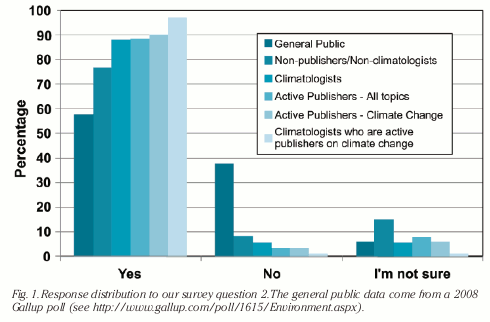
The important part
And then, more often than not, a lot of the people who said “Climate change is too uncertain” then turn around and make claims with no acknowledgement that they could be wrong. Let’s find some of the most extreme examples of this phenomenon….anonymous YouTube comments.
“The Earth has been heating up for thousands of years at a steady rate and it has nothing to do with people.”
“If these findings were anywhere near accurate, then I would see changes on at least a weekly basis. But nothing.”
“Nothing is significantly wrong that Mother Nature cannot put right.”
“I don’t think CO2 causes global warming, not at all.”
When I see comments like these – which are, sadly, extremely common – I wish I could say to every one of them, “What if you were wrong?”
I realize I could be wrong. It’s something I came to terms with long ago. I could be totally wrong about all this climate change stuff (in fact, I’d love to be). That’s why I support multi-benefit policies, that will help areas like the economy or health. If climate change turns out to be nonexistent/natural/a global conspiracy, at least our action will have brought us some good.
But what if all these anonymous YouTubers were wrong?
All those people who are so certain that we’re causing no change in the climate.
What if they were wrong? Can you imagine what the consequences could be?
Is this really something worth questioning, when there is so much agreement, and the stakes are so high?
Is this really a gamble worth taking?
 ClimateSight