So What Happened with ClimateGate?

Remember back in December, when the news was buzzing each day about the stolen emails from top climate researchers? They were described as “the final nail in the coffin of anthropogenic global warming”, or worse. Apparently, the scientists had written things that severely compromised the underpinnings for the idea that human activity was causing the Earth to warm. We could now all stop worrying and forget about cap-and-trade.

But that wasn’t the end of the story. There were no less than four independent investigations into the contents of these emails – conducted by scientists, universities, and governments, not general reporters rushing off a story about an area of science with which they were unfamiliar, and trying to make it sound interesting and controversial in the process.

So what did these investigations find? Is the Earth still warming? Are humans still responsible? Can we trust the scientific process any more, or should we throw peer-review out the window and practice Blog Science instead?

Actually, all four of the investigations concluded that absolutely no science was compromised by the contents of the emails. The CRU scientists weren’t as good as they should have been about making data easily accessible to others, but that was the only real criticism. These scientists are not frauds, although they are accused of it on a daily basis.

Pennsylvania State University, over a series of two reports, investigated the actions of their employee, Dr. Michael Mann, who is arguably at the top of the field of paleoclimatology. They found that, contrary to most accounts in the mainstream media, he did not hide or manipulate any data to exaggerate global warming, delete any emails that might seem suspicious and be subject to Freedom of Information requests, or unjustly suppress skeptical papers from publication. After a second investigation, following up on the catch-all accusation of “seriously deviating from accepted practices within the academic community”, Penn State exonerated Mann. They criticized him for occasionally sharing unpublished manuscripts with his colleagues without first obtaining the express permission of the authors, but besides that minor (and somewhat unrelated) reprimand, they found absolutely nothing wrong.

The British House of Commons investigated the actions of CRU director Phil Jones, and came to a similar conclusion. They found that his “actions were in line with common practice in the climate science community”, that he was “not part of a systematic attempt to mislead” or “subvert the peer review process”, and that “the focus on CRU….has been largely misplaced”. They criticized CRU’s lack of openness with their data, but said that the responsibility should lie with the University of East Anglia, which CRU is a part of. So these scientists should really catch up to the climate research team at NASA, for example, which publishes all of their raw data, methodologies, and computer codes online, with impeccable archives.

The University of East Anglia conducted their own investigation into the actions of CRU as a whole. They found no hint of tailoring results to a particular agenda”, and asserted thatallegations of deliberate misrepresentation and unjustified selection of data are not valid”. They also explored the lack of transparency in CRU, but were more sympathetic. “CRU accepts with hindsight”, they write, “that they should have devoted more attention in the past to archiving data and algorithms and recording exactly what they did. At the time the work was done, they had no idea that these data would assume the importance they have today and that the Unit would have to answer detailed inquiries on earlier work.” They also note that CRU should not have had to respond to Freedom of Information requests for data which they did not own (such as weather station records).

Just last week, the final investigation, headed by Sir Muir Russell on behalf of UEA, found that “their rigour and honesty as scientists are not in doubt.” Is this starting to seem a bit repetitive? To illustrate their point, over the course of two days, they independently reconstructed the global temperature record using publicly available data, and came to the same conclusion as CRU. Again, there was the criticism that CRU was not as open as it should have been. They also noted that an obscure cover figure for a 1999 World Meteorological Organization report, constructed by Phil Jones, did not include enough caveats about what was proxy data and what was instrumental data. However, the more formally published, and much more iconic, graphs in Mann 98 and the IPCC TAR, were fine.

There have been some great comments on the results of these investigations since they were released, especially by scientists. Here are some samples:

[The CRU researchers] are honest, hardworking scientists whose reputations have been unjustifiably smeared by allegations of unscrupulous behaviour…I hope that the media will devote as much attention to this comprehensive dismissal of the allegations as it did to promoting the hysteria surrounding the email theft in the first place. Will the Daily Telegraph now retract its claim that the emails revealed “the greatest scientific scandal of our age” and apologize unreservedly to Phil Jones? Will there now be a public inquiry about the erroneous, shallow and repetitive nonsense promulgated in the media over this affair? If there is a scandal to be reported at all, it is this: the media stoked a controversy without properly investigating the issues, choosing to inflate trivialities to the level of an international scandal, without regard for the facts or individuals affected. This was a shameful chapter in the history of news reporting. -Raymond Bradley, director of the Climate System Research Center at the University of Massachusetts

The call for greater transparency and openness among scientists and their institutions is necessary and welcomed, but certainly they aren’t the only ones who deserve that reminder. What institution on the planet would pass muster under such intense scrutiny? Certainly not the U.S. government agencies, which often deny or impede FOIA requests, or global corporations like BP, Massey Energy and Koch Industries, which seem to revel in hiding information from the public all the time. More transparency is needed everywhere, not just among scientists in lab coats. -Brendan DeMelle, freelance journalist, DeSmogBlog

[The Muir-Russell report] makes a number of recommendations for improvements in processes and practices at the CRU, and so can be taken as mildly critical, especially of CRU governance. But in so doing, it never really acknowledges the problems a small research unit (varying between 3.5 to 5 FTE staff over the last decade) would have in finding the resources and funding to be an early adopter in open data and public communication, while somehow managing to do cutting edge research in its area of expertise too. -Steve Easterbrook, computer science professor at the University of Toronto

I agree with these statements. I think that we are holding scientists in general, but especially climate scientists, to a far higher standard than any other group of people in the world. We need to relax a bit and realize that scientists make mistakes, and that innocent mistakes are not evidence of fraud that will bring a long-standing theory tumbling down. We need to realize that scientists are employees like any others, who don’t always follow ideal actions in every professional situation, especially when they are under intense pressure that includes death threats and accusations of criminal activity.

However, at the same time, we need to start holding other groups of people, especially journalists, to a higher standard. Why has the media been able to get away with perpetuating serious allegations without first investigating the what really happened, and without publishing explicit retractions and apologies when the people whose reputations they smeared are found innocent? Why haven’t there been four official investigations into who stole these emails, and why?
How We Should Communicate

I really enjoyed this post by Andrew Freedman on the Washington Post blog Capital Weather Gang. I think it is written at the perfect level – basic enough for new readers to catch up on current events, while including enough creative insights to keep the interest of climate science enthusiasts.

The article covers the attempts of Dr Andrew Weaver, a top Canadian climate modeler, to fight back at the misinformation that has been willingly spread by top media outlets throughout the past few months. Here is an excerpt:

In late April Weaver filed suit against the National Post, a Canadian newspaper that has run numerous articles extremely critical of Weaver’s work and those of his colleagues. For example, according to Wihbey, the Post has called Weaver “Canada’s warmist spinner in chief,” and “generally impute[ed] to Weaver various views that he claims he doesn’t have.” (Weaver’s requests that the newspaper correct the record by issuing retractions/corrections were unsuccessful).

In the lawsuit, Weaver, who was a lead author of one of the IPCC’s working groups for its 2007 report, claims the articles include “grossly irresponsible falsehoods that have gone viral on the Internet.” Among those claims is that Weaver has turned against the IPCC and its conclusions, as trumpeted in this story in late January.

“If I sit back and do nothing to clear my name, these libels will stay on the Internet forever,” Weaver stated. “They’ll poison the factual record, misleading people who are looking for reliable scientific information about global warming.”

I am impressed at Dr Weaver’s courage and persistence to improve the accuracy of science journalism. For an issue that has potential consequences of an unprecedented scale in human history, we should be able to trust what the media tells us.

Something else I enjoyed was a sketch by Mitchell and Webb, a British comedy duo, making fun of how politicians pretend to promise action on climate change. Enjoy.

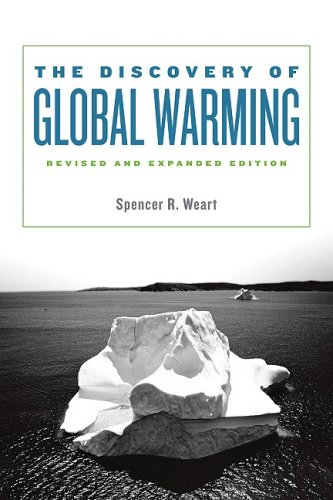
The Discovery of Global Warming

A common remark I make about climate change books I like is that “it wasn’t like a textbook”. I like non-fiction books that I can carry around and read cover-to-cover just like I would a novel. I like them to draw me in and catch my interest as if they were a suspenseful PD James or just a comfortable Maeve Binchy.

The Discovery of Global Warming, by Spencer Weart, had all of these qualities and more: It contained as much information as a textbook, even if it didn’t read like one. That, I think, is the benefit of science history. It can be written in a way that is compelling as fiction, but it’s all true.

I think I will place this book near the top of my list of resources for concerned citizens who are looking for more information on climate change. It is so helpful because, instead of saying “scientists are confident that humans are causing the Earth to warm”, it traces back through history and follows this discovery all the way through, from Fourier to the AR4. We see the top of the credibility spectrum in action, and examine exactly where the conclusions of the scientific community came from.

There are lots of great details in this book to sink your teeth into. How did the Cold War pave the way for much of our knowledge about the atmosphere? Why does chaos theory apply to weather models much more than climate models? And, of course, my very favourite – the 1970s aerosol debate. How did scientists realize that the warming force of greenhouse gases would overpower the cooling force of aerosols, long before the warming was actually observed?

All of this is written in an incredibly elegant and engaging tone. Weart’s style of writing somehow reminds me of Sir Arthur Conan Doyle in The Lost World – succinct characterization, unintended (or just well-hidden) satire, a calm detachment from the story that somehow makes it all the more fascinating.

I read the “Revised and Expanded Edition”, so I’m not sure if all editions of The Discovery of Global Warming contain all the extras in the back: a timeline, an index, and a chapter entitled “Reflections” that is full of Weart’s musings about risk management and science communication. “Unlike, say, the orbits of planets,” he writes, “the climate in the future actually does depend in part on what we think about it. For what we think will determine what we do.”

A tangible alternative to the more comprehensive online version (really, who wants to read a book by navigating a web of links and scrolling through chapters on a computer screen?), The Discovery of Global Warming is worth every cent, and every minute of your time it takes to read it. I look forward to future volumes as this story continues to unfold.

The Celebrity Phenomenon

It is a very small subset of people that actually reads the scientific literature on climate change.

Even publishing scientists don’t usually follow research outside of their field. Few of us climate science enthusiasts read about the role of low hepatic copper concentrations in nonalcoholic fatty liver disease, so why should we be surprised when medical researchers, flipping through Nature, don’t stop to read about the sea level during the last interglacial and its relevance to today?

For the 99% of us who are not publishing scientists in any area, and do not have a subscription to Nature, and don’t really find it too riveting anyway, we get all of our climate science news from the media. The mainstream media is generally mediocre when it comes to reporting science, but when it comes to climate science they do an abysmal job.

Many people know this – you shouldn’t trust the media, especially when it comes to stories of impending disaster.  You should take every such story with a grain of salt. However, it’s no good to stop there, and never do any research into its validity. Because what if it’s actually true? Then you’ll just be shrugging it off and going “maybe, maybe not” for no reason.

This happens a lot with celebrity climate science communicators, like Al Gore, or, in Canada, David Suzuki.

I’ve written about Al Gore before, and the important thing to stress is that he doesn’t matter. In general, his communication of climate science is very accurate – he has a few minor errors in his book and movie, but the overarching message that humans are causing dangerous warming of the planet is fully supported by science.

But it couldn’t matter less if Al Gore was or wasn’t telling the truth, because absolutely no scientific research rests on him. He hasn’t published any peer-reviewed papers about anything even remotely related to climate. He is purely a communicator.

A lot of people don’t like Al Gore, and therefore think that global warming is bunk. This kind of reasoning is very unfortunate. They recognize that they are hearing scientific information from a partisan source, so they assume that it’s wrong without researching what credible, nonpartisan sources say about it. All you need is a credibility spectrum, and you’re good to go.

There’s somewhat less of a problem when it comes to David Suzuki – after all, he’s not a former politician, he has more scientific training (a biology doctorate) than Gore, and according to a Reader’s Digest poll, Canadians trust him more than any other celebrity. It’s still easy, though, to find people who don’t like him for one reason or another. If it comes from David Suzuki, it has to be an extremist environmental craze, so they brush off what he says without looking at more credible sources.

Celebrities like Gore and Suzuki don’t matter. What matters, though, is people with severely limited knowledge of the scientific process, access to credible sources, or motivation to do a little research. What matters is the factors shaping society that have allowed so many of us to be this way. Why do schools frame science as answers, not questions? Why is literature vital to public communication hidden behind paywalls? And why do so many people assume that entire fields of science are dependent on one or two celebrity communicators?

Uncertain Science….Uncertain World

Several months ago, I wrote a generally favourable review of geophysicist Dr. Henry Pollack’s newest book, A World Without Ice. So when I came across his earlier book, which was about the nature of the scientific process  – something that fascinates me – I couldn’t wait to read it.

Uncertain Science, Uncertain World is about uncertainty in science, as you may have guessed from the title, and it is absolutely fantastic. If you’re pressed for time, just read the first three chapters – they’re the best. They discuss how the public’s tendency to “equate science with certainty, rather than uncertainty” has been fed by the American school system and the mass media, and what the consequences are.

He talks about how everyone is born a scientist, how children observe the world around them with a fierce curiosity, instinctively exploring and experimenting. Then they go to school, and decide that science is boring. In elementary school, and to some extent in high school, science is presented as a memorization of facts and theories, rather than an exploration of the boundaries of and barriers to our knowledge, which is what scientists actually study. “Science is presented as answers rather than questions,” Pollack writes.

I couldn’t agree more. I wasn’t always the self-professed science addict that I am now. Until I reached high school, I thought that science was dry and boring, and until I started researching climate change, I didn’t see the creativity and problem-solving in it. In science class you memorize facts and do calculations, so it’s very hard for students to realize how cool it is to discover facts and derive calculations, rather than just repeating what someone else did before you. Intelligence is defined as how many facts you can stuff into your head, not how good you are at figuring things out for yourself.

The media doesn’t help, either. Pollack explores the well-known ails of science journalism, and the stigma against public communication in the scientific community. He shares a great example of how the media turned an amateur earthquake prediction, with no support from geologists, into a national frenzy that led to evacuations and the closure of schools. Mainstream journalists, in general, are not good at assessing credibility for scientific issues, but their influence on the public is so great that frequent mistakes by journalists lead to worldwide misconceptions.

This public illusion of certainty, in a field that actually thrives on uncertainty, can be easily exploited by vested interests. “When scientists acknowledge that they do not know everything about a complex natural phenomenon,” writes Pollack, “the public sometimes translates that to mean that scientists do not know anything about the subject,” and, for issues such as climate change, there are many people actively encouraging this jump in logic.

After the stellar beginning, the rest of the book is somewhat more mediocre, albeit still enjoyable. Pollack uses a series of examples and metaphors to explain irreducible measurement error, confidence expressed as statistical probability, conceptual and numerical models, experimentation, and forecasting vs hindcasting. As Pollack is currently studying how rocks retain heat and provide a record of past temperatures that can be used as proxy paleo data, facets of climate science are used as examples in nearly every chapter, and the last chapter of the book is devoted to climate change. However, he also uses examples from economics, plate tectonics, election polling, and the legal system. It is truly a multidisciplinary approach that will appeal to scientists and science enthusiasts from every field. Highly recommended to all.

Salvaging Science Journalism

Yesterday, I felt depressed about the state of the world – as if we were walking blindly into heavy traffic without bothering to stop or even open our eyes. I think it was this Globe and Mail editorial that put me over the edge. It claimed that the original 2035 Himalayan glacier claim was “reported around the world“, that Rajendra Pachauri “shrugged it off“, and that the 40% Amazon reduction claim was “a mess” (just like Leake, this article doesn’t mention that the statistic itself was correct, it was just cited incorrectly).

And that’s just in the first few paragraphs. I could go on and on about the inaccuracies and unsubstantiated claims, especially once it gets going on ClimateGate. If the author had bothered to read the primary sources for the Amazon claim, to read the supposedly-nefarious emails in full context (as well as the results of the first inquiry), or to read the IPCC’s actual response to the Himalayan glacier screw-up, her proclamation of “scientific scandals” would have fallen apart.

We see this all the time, everywhere, and it’s doubtlessly gotten worse in the past few months. The line of attack has switched from the science to the scientists. It’s just as unsubstantiated as the claim that global warming stopped in 1998, but that doesn’t matter. Science journalism, as it pertains to climate change, doesn’t seem to care about the facts any more. Fox News is one thing, but really – the Globe and Mail?

So what do we do to fix it? I can’t just sit around anymore and wait for it to pass. Many of us reading this blog have largely given up on the mass media as a source for climate change information, passing it off as a lost cause. But most of the public doesn’t know that it’s a lost cause. I think fixing it is better than ignoring it.

I have a few preliminary ideas that I’d like to open up for discussion:

1) Good old letter writing campaigns. Once a week, say, we could choose an article that’s particularly devoid of accuracy and citations, but written by a generally responsible journalist (eg not Glenn Beck). We could each write a unique letter to the author/the paper/the editor of the paper expressing the problems with the article. We can rant a bit about the media’s responsibility to provide people with accurate journalism.

2) Lobby for a citation policy. I got some great responses from my last post about the importance of a comment policy to promote better discussion that doesn’t turn into a food fight. What if we pushed to enact a similar policy in mainstream media outlets? The policy would be different for each outlet, obviously, but the basic rule would be that all articles/letters to the editor that dealt with science had to include peer-reviewed citations when appropriate. Let’s stop treating science like opinion, and start getting people to back up their arguments before we give them space.

3) Volunteer ourselves as research tools. By the time most of us read articles about climate change in the mainstream media, we’ll have heard about the particular issue in question for several days, and we’ll be able to point to two or three credible sources pertaining to it. We could help journalists and newspapers do their research more quickly and accurately.

4) Become a part of the mass media. I know a lot of great science journalists, but none of them are regulars in the mainstream media. I know Michael Tobis, and Tim Lambert, and Coby Beck, and James Hrynyshyn. (Tamino and the RC folks are great too, but geared toward a more technical audience.) These guys back up every statement they make, provide citations, correct their mistakes, and follow the “means justify the ends” approach. As part of our outreach for accurate journalism, why don’t some of us try to get columns in the mainstream media outlets?

Let me know what you think.