
The Average Person

craven I first watched the Manpollo videos about a year and a half ago, when I had the flu, and ended up watching the entire six hours over two days. I don’t remember when it was that I discovered Greg Craven was writing a book based on the videos, but I’ve been excited to read it ever since.

The Manpollo videos have inspired my view on climate change and transformed my way of talking about it more than anything else I’ve read or watched. In a nutshell, Greg Craven’s process of risk management takes the pressure off us to be amateur scientists. It doesn’t require that we assess the statistical methods of people with PhDs when we only have a high school knowledge of science. Instead, it shows us how to use logic, assess credibility, and weigh the benefits and consequences of taking action vs not taking action on an uncertain threat.

I suppose I sort of expected that Greg Craven’s book would be a step up from the videos, would contain even more ideas, anecdotes and talking points that I could really sink my teeth into, would tell me more that I hadn’t already heard in the six hours of Manpollo.

But his book wasn’t like that. Greg Craven disappointed me.

And I’m grateful for that.

See, the book was not aimed at people like me who have an interest in climate change that borders on obsession. It was not aimed at the people who already know which sources are skeptical of anthropogenic climate change and which are worried about it. It was not aimed at those of us who can rattle off the current concentration of atmospheric CO2 without a second thought.

The book was aimed at the average person, who basically knows what climate change is but hears so much shouting in the media that they have no idea of its level of agreement. Who knows there are two sides and doesn’t want to offend anyone. Who has never heard of Milankovitch cycles, methane hydrates or the Goddard Institute of Space Studies.

If the average person stumbled upon most climate change blogs, most of the terms would be foreign to them. I hope they’d be able to understand most of what I write here on ClimateSight (as I try to stay away from analysing hard data) but they’d probably still need a bit of background information.

The average person, with little to no background information on climate science and policy, needs somewhere to start. They need the tools to assess the credibility of a source. They need to know where to go for more information about a topic. They need a basic knowledge of risk management, logic, and bias.

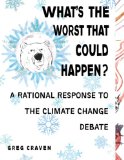
What’s the Worst that Could Happen? provides exactly that. It seems like a more concise version of the Manpollo videos, all the topics outlined in a simple process without the need for much background reading. If I were to recommend a book to start with for this anonymous average person we’re discussing, it would be hard to find one better than this one.

Instead of telling you stuff, Greg Craven tells you how to find stuff out for yourself. He doesn’t tell you how much agreement there is on climate change, he introduces you to a credibility spectrum instead. And even then, he doesn’t just give you his credibility spectrum, he shows you how to make your own.

He doesn’t tell you that oil executives are denialist trolls, he explains possible biases that could lead a person to a hasty conclusion. He gives one of the best basic explanations of the mechanics of anthropogenic climate change that I’ve ever read. Craven is possibly the least offensive, but most helpful, writer I’ve ever encountered.

My only complaint about the book was how he handled the “individual professional” and “individual layperson” sections in the chapters about statements. On the Skeptic’s side, he listed every individual prominent skeptic he could think of, I believe it was about a dozen. On the Warmer’s side, he had Hansen, Oreskes, and Gore. That was it. He explained that this was because he filled his credibility spectrum from the top down, and the statements at the top were almost exclusively weighted to the Warmer’s side. But there is something personal about an individual’s work that makes a person trust them and put faith in their arguments, rather than a report like the IPCC which is dry and anonymous. I wish that Craven had put some kind of indication, perhaps the Doran and Zimmerman report, that the opinion of individual scientists was also weighted towards the Warmer’s side. Otherwise it seems like the masses are not in agreement with the authority, which is supposed to be the source you listen to.

And because I agree with this concept so wholeheartedly, I feel compelled to share with my readers my answer to the question Craven asks at the very beginning – what would make you change your mind?

I would change my mind about dangerous anthropogenic climate change if a new discovery was made, if some new explanation came forward that gained as much agreement as the current theory holds now. If the national scientific bodies of the world, the peer-reviewed journals, and university textbooks had a complete overhaul because scientists discovered that humans were not changing the climate. If some new explanation surfaced that proved Arrhenius and Callendar wrong. It would be a discovery akin to the theory of relativity. As George Monboit said, “If you can prove these statements wrong, you should apply for a Nobel Prize. You will have turned science on its head.”

I listen to the scientists. I’m not surrending my rights and freedoms as an individual to them. I just trust their analysis more than I trust my own.

To conclude

If you already know a fair bit about climate change, and want some really fascinating dicussion points that will keep you going for literally years, watch the Manpollo videos. If you’re a really hardcore skeptic who thinks climate change is a global conspiracy, Manpollo was made especially for you.

But if you’re new to this topic, start with What’s the Worst that Could Happen? I assure you that there is no better place to begin.

A Story Worth Hearing

I found a great article on one of the blogs I read a few days ago. It was the first time I’d heard of the story, and it made me so mad that I knew I had to share it on ClimateSight. But this article was so well-written that I doubted I could come up with anything better.

In a nutshell…..an old paper that didn’t pass through the peer-review process of the EPA contained all sorts of climate-denial “evidence” which has been proven wrong countless times. The peer-review panel wasn’t trying to suppress contradictory evidence – in fact, publishing contradictory evidence would be great for the journal and the advancement of science – the paper was just utter nonsense!

But the Republicans threw a fit when they discovered that a paper questioning anthropogenic climate change was deliberately suppressed so the EPA could begin a communist takeover….or something like that. They want a criminal investigation. As David from Through a Green Lens writes,

“The irony is that these people watched calmly as the Bush-Cheney Administration suppressed global warming science.  Now, the party that supposedly promotes “fiscal responsibility” would like to spend millions of dollars on an investigation into why faulty science was not included in an EPA decision.”

Read the rest of his post here.

PS: A number of you have brought it to my attention that the ever-narrowing nested comments get very hard to read. I went to go check it out (I usually view comments from my WordPress dashboard) and my goodness, one word per line…..no wonder you were complaining!

I played around with the discussion settings, and I think I’ve fixed it as much as I can. Replies to comments will no longer appear indented below the original comment, but I’ve placed the oldest first, instead of the newest first, so that it makes more chronological sense. Unless there’s multiple discussions going on at once, I think it’s okay.

Let me know what you think, and if you have any more suggestions.

Paul Krugman Says it Best

“[Climate change deniers] don’t like the political and policy implications of climate change, so they’ve decided not to believe in it — and they’ll grab any argument, no matter how disreputable, that feeds their denial.

Indeed, if there was a defining moment in Friday’s debate, it was the declaration by Representative Paul Broun of Georgia that climate change is nothing but a “hoax” that has been “perpetrated out of the scientific community.” I’d call this a crazy conspiracy theory, but doing so would actually be unfair to crazy conspiracy theorists. After all, to believe that global warming is a hoax you have to believe in a vast cabal consisting of thousands of scientists — a cabal so powerful that it has managed to create false records on everything from global temperatures to Arctic sea ice.

Yet Mr. Broun’s declaration was met with applause.”

Paul Krugman, New York Times

Context

Most long-time readers are familiar with the story of Stephen Schneider’s misquoting, which I discussed in one of my earliest posts. Read that post if you haven’t already, otherwise the rest of this post won’t make a lot of sense.

So imagine my surprise and disgust when I received a “pingback” (a message that someone else on WordPress has linked to your site) from a post entitled “Environmental Hoax Proof”. The post on WordPress looked like it was republished from somewhere else, and I believe this is the original.

The part of the post which links to me is as follows:

“We need to get some broad based support, to capture the public’s imagination. So we have to offer up scary scenarios, make simplified, dramatic statements and make little mention of any doubts. Each of us has to decide what the right balance is between being effective and being honest.” – Stephen Schneider, Stanford Professor of Climatology, lead author of many IPCC reports

https://climatesight.wordpress.com/2009/04/12/the-schneider-quote/

The author must have read my post before linking to me. Yet they printed the widely-circulated, out-of-context quote anyway.

A lot of people use that particular quote without knowing the backstory. But the author of this post must have known the backstory (unless they didn’t even bother to read what they were providing as a source), and chose to print the seemingly scandolous quote anwyay.

Dishonesty. Fundamental dishonesty. And a real strong faith in the readers that they won’t actually click on the links.

The rest of the post included a lot of similar quotes from climatologists and environmentalists. I could tell without even looking further into any of them that they were similarly out of context.

What does this say about the credibility of some of our opponents?

A Retraction?

A recent comment by a long-time reader brought a new piece of information to my attention. “What about the JSER?” they asked. “[Someone claimed] that it was a Japanese scientific society that endorsed the falsity of global warming…..What do you think?”

Did this bring the absense of disagreement among professional scientific organizations, at the top of our credibility spectrum, to a close?

I mulled it over and decided to do what seemed to be the most honest course of action. I would research this claim as thoroughly as my resources allowed, and if it turned out to be true, I would publish a retraction of my former statement regarding organizations.

First, however, I needed to get more information. I researched with the following questions in mind:

1) Is the JSER a professional scientific organization? This part of the claim appeared to be true – according to the English section of their website, they published a scientific journal, held conferences and seminars, and boasted over 1500 members.

However, the JSER – the Japan Society of Energy and Resources – likely has a high chance of bias. Its goal is “to promote the science and technology concerning energy and resources and thus to facilitate cooperation among industry academia and governmental sectors for coping with the problems in this field.” With today’s fossil-fuel dependent economy, the JSER likely has a lot of members representing the oil and gas industry. Oil and gas officials can easily fall prey to confirmation bias – their jobs depend on a resource which is causing dire problems for our planet. In their situation, it’s often easiest to deny such problems. In fact, the final scientific organization to change its statement from “humans aren’t affecting the climate” to “oops, yes they are” was the American Association of Petroleum Geologists.

2) Did the JSER officially state that humans aren’t affecting the climate? I found no evidence for an official statement.

3) So where did the claim come from? It started with a written discussion between five JSER representatives. One, the only climatologist of the five, defended the mainstream opinion that humans are causing climate change. One was undecided. The remaining three rejected the theory.

However, this discussion was mistakenly perceived as a “report” by The Register, a British media news source. I found no evidence that this so-called “report” was peer-reviewed (and how could it possibly have passed peer-review – it claimed that global warming stopped in 1998!). For example, the Register article noted, “Remarkably, the subtle and nuanced language typical in such reports has been set aside.” One of the authors is alleged to have compared climatology to ancient astrology.

I think we can safely leave this source as an email debate between colleagues. I cannot imagine how it could be a peer-reviewed document worthy of consideration.

However, as always, I could be wrong. There is little on the Internet regarding the JSER and its report. If any readers have additional information, please comment.

Update: Thanks to John for pointing me to the website of James Annan, a climatologist living in Japan. He knows the authors of the document personally and says, “The “report” is simply the collation of one of these popular-but-pointless sceptic-vs-scientist debates, and has no official status.”

Skepticism and Denial

Skepticism and denial are two words that many climate change activists throw around. What is the difference between them? What is the appropriate usage for each? And which camp do most of so-called “global warming skeptics” fall into?

A skeptic is someone in doubt. The key word here is “doubt”. They are willing to listen to evidence from all sides because they haven’t formed an opinion yet. However, it will take very strong evidence for them to accept a theory or belief.

All scientists are taught to be skeptical – to never make assumptions, jump to conclusions, or accept a theory without asking further questions. Skepticism is scientific nature. It is a way of saying, “I don’t know enough about the topic to make a decision.” Skepticism shows inherent objectivity.

A denialist will adamantly reject something, no matter how much evidence supports it. They will only listen to evidence from the side of the debate they support. Unlike a skeptic, who will accept a theory when strong evidence arises, a denialist will never accept a theory. Denial shows inherent bias.

Applying these definitions

In the context of climate change, I feel that denial, in a way, is opposite to skepticism. All over the Internet there are people claiming that climate change is nonexistent/natural/a global conspiracy. They say that they are “skeptical” of the evidence that humans are causing the Earth to warm. Let’s look at a rather tragic story and see if it sheds some light on whether they are actually skeptical, or if they are, in fact, in denial.

In The Great Global Warming Swindle – as well as countless other sources – a graph is presented which shows the Medeival Warm Period to be slightly warmer than the present day.

ipcc1This graph is from the first IPCC report, dated 1990. The film is adamant that this graph is correct. However, in the years following 1990, the IPCC did more research on the Medeival Warm Period, as almost all of their historical temperature data was from Europe. They looked at data from other parts of the world and discovered that the warming was confined to Europe. The Earth, as a whole, hardly warmed at all. By the third IPCC report, the graph had advanced dramatically, to what is known as “the hockey stick”.

ipcc2

This graph prompted a lot of yelling and screaming, and a lot of claims that the IPCC was forging data. But, in actuality, their data set had just improved. And it was continuing to improve. By its fourth report, the IPCC had not just a hockey stick, but a whole hockey team.

ipcc4

This graph, the most recent, was created by the same source as the first graph, which showed the Medeival Warming Period to be warmer than today. It was 17 years more recent. It had advanced dramatically. However, the Great Global Warming Swindle et al continued to use the graph from 1990 and claim that it was credible. Do they hold valid scientific concerns regarding the stastical methods used to create the more recent graphs? Or are they simply cherry-picking data?

There are other, similar, stories. Many skeptics put incredible faith on the idea that other planets might be warming – a dubious area of research we’re just starting to explore – and then turn around and say that the Earth’s temperature record, which has been going strong for a century, is flawed. They say that the 1970s theory of an impending ice age – which was mentioned by a single, discredited paper – held complete consensus in the scientific community, whereas there is apparently “no agreement” over the idea of human-caused warming.

They call themselves “skeptics”. But how can they really be of skeptical nature when they are clinging to certain pieces of evidence in a way that’s not skeptical at all? How can they claim that they hold logic, rationality, and common sense when they are advocating – without analysis, investigation, or statements of uncertainty – for all evidence which supports their pre-conceived conclusion?

Does this show inherent objectivity – skepticism?

Or does it show inherent bias – denial?

Ignore the Petition Project

Many of you have probably heard of Ron Paul’s recent statement in Congress regarding a petition signed by thousands of scientists claiming that there was no scientific evidence for anthropogenic climate change, no evidence that burning hydrocarbons was harmful, and, in fact, evidence that burning hydrocarbons would be beneficial for the Earth. The purpose of this statement was to persuade the American people to reject the cap-and-trade bill being negotiated in Congress.

I was skeptical of this petition. I did a little research to find out its legitimacy. Before long I discovered that it was an updated edition of the Oregon Petition, which was created to persaude America to reject Kyoto.

The Oregon Petition has some major problems. Firstly, attached to the petition was an article supporting its claims. The article was designed to look just like an article from the Proceedings of the National Academy of Sciences, a reputable peer-reviewed journal. However, the article was created by three skeptics and was not peer-reviewed at all. The NAS was subject to a lot of inquiries and controversy following the publication of this petition. It eventually had to publish a statement saying that the NAS had nothing to do with the article.

Secondly, the petition could be signed by scientists from any discipline, even if they had no experience studying climatology. As British physics student Michael Ashcroft writes,

“The problem is that, as science is such a vast field, you can spend your entire life studying one branch of science and still know absolutely nothing about another. For example, I am a physics student, and I can honestly say that I know nothing about medicine. I also wouldn’t expect an ecologist to understand the processes behind the formation of stars, for example.This is precisely what the Petition Project does assume, though. If we look at the qualifications of the signers, we see that even medical doctors are eligible to sign. Take a look. Some of the more amusing backgrounds, that supposedly give these people enough special knowledge about global warming to deny its existence, include:

Mathematics – without a special interest in the climate, this is worthless in the field.

Physics – I have almost finished a Bachelor’s degree in Physics and there has been only one, optional course about “Environmental Physics”, so I can argue from experience that a degree in Physics does not necessarily equip someone with the information they may need to decry global warming.

Biology – unless there’s a large degree of specialisation of the effects of climate change on some biological variable (growth, change of ecosystems etc), this has no bearing on the subject.

Medicine – What?!

Aerospace Engineering – I happen to live with an Aeronautical Engineering student, who has had no training in any environmental subjects whatsoever.

Computer Science – see Aerospace Engineering

It is like asking celebrities what they think of the economy of Chad. They may be famous, and therefore carry some weight, but their opinions are nothing more than opinion. Asking “Dr X” what he thinks of the manufacture of steel may be all well and good, except that “Dr X” has a PhD in ancient history. He may be qualified in something, but it is misleading to assume that because he is a doctor of something, he must know everything about everything.”

Thirdly, the scientists who did sign may have been misrepresented. An article in Scientific American conducted a study regarding the participants.

Scientific American took a random sample of 30 of the 1,400 signatories claiming to hold a Ph.D. in a climate-related science. Of the 26 we were able to identify in various databases, 11 said they still agreed with the petition—one was an active climate researcher, two others had relevant expertise, and eight signed based on an informal evaluation. Six said they would not sign the petition today, three did not remember any such petition, one had died, and five did not answer repeated messages. Crudely extrapolating, the petition supporters include a core of about 200 climate researchers; a respectable number, though rather a small fraction of the climatological community.”

The Seattle Times also investigated the Orgeon Petition, and found that some questionable people had signed.

“Several environmental groups questioned dozens of the names: “Perry S. Mason” (the fictitious lawyer?), “Michael J. Fox” (the actor?), “Robert C. Byrd” (the senator?), “John C. Grisham” (the lawyer-author?). And then there’s the Spice Girl, a k a. Geraldine Halliwell: The petition listed “Dr. Geri Halliwell” and “Dr. Halliwell.”

Asked about the pop singer, Robinson said he was duped. The returned petition, one of thousands of mailings he sent out, identified her as having a degree in microbiology and living in Boston. “It’s fake,” he said.

“When we’re getting thousands of signatures there’s no way of filtering out a fake,” Robinson, 56, said in a telephone interview from Oregon.”

 Finally, for a more thorough and visually appealing analysis of the Oregon Petition, including the motives and credibility of its creators, I’d encourage you all to watch this video by Peter Sinclair.

We should all assess the credibility of the Petition Project. Its first revision has some major problems. Should we trust it a second time? Can it compare with the G8 Statement, the Joint Academies’ Statments versions I and II, the survey of individual climatologists by Doran and Zimmerman, and the dozens of other organizations that have made indepent statements?

Which statements truly reflect the opinion of the scientific community?

Why Credibility Matters: An Example

Has anyone ever referred you to the documentary The Great Global Warming Swindle for “the other side of the story”?

As we can see from our credibility spectrum, documentaries shouldn’t be taken too seriously – their directors are, at best, professional individuals. A documentary should never be treated like a scientific report. Just because you saw it on TV, doesn’t mean it’s true, or even the prevailing scientific view.

The Great Global Warming Swindle is an example of why documentaries should not be blindly trusted. Take a look at this video, by the ever-more-popular Peter Sinclair, to see why.

The Time We Have Left

11th hourLast Christmas, I was given the documentary The 11th Hour as a gift. I admit that I was somewhat skeptical of its legitamacy – as much as we all loved Leonardo DiCaprio in Titanic, I wasn’t sure how credible a documentary created by a movie star would be. It was also wrapped in something called BioFilm that sounded kind of sketchy (admittedly, I don’t know what the plastic was made of, but chances are that it’s corn ethanol – not the greatest of fossil fuel replacements).

However, when I watched the film, I was utterly engrossed. My favourite thing about the 11th hour is that most of the dialogue and narration comes from interviews with incredibly articulate experts. This film featured scientists, authors, First Nations leaders, CEOs of green businesses, and national security officials. David Suzuki, Stephen Schneider, Paul Hawken, and Stephen Hawking were just a few of those interviewed.

The 11th Hour dicusses many different aspects of environmental depletion, sociology, and solutions. It opened with a sort of celebration of life and the beauty of nature. I believe it was Paul Hawken that said something along the lines of, “In your body, right this very second, there are three (something with a lot of billions and trillions) things happening at once. That’s a three with twenty-four zeros after it. Right this second. And in the next second, as you sit there on the couch, one hundred times more things are happening than there are stars and planets in the universe. And that is what we call life.”

The section on climate change was brief, but quite well done. Most of the time was devoted to talking about possible impacts – how warming would affect our water security, food security…..However, Stephen Schneider delivered a fantastic quote that’s quite relevant to this blog:

“Some scientists are amazed that in the media debate and in Congress there are people who stand up and say, “I believe” or “I don’t believe in global warming,” as if it were some sort of object of religion, instead of based in evidence.”

(Check out the post Making Up Your Own Science for more on that topic.)

Following the climate change discussion were small sections devoted to forestry, aquatics, biodiversity, and hyperconsumerism. However, the discussion on extinction was so compelling to me that it dwarfed all the previous discussions. The film explored how extinction is inevitable to a species, that the demise of an entire species is as natural as the death of a single organism. It’s no secret that humans will eventually become extinct. The question is how our actions today are affecting when that extinction will happen, and how many other species we are taking down with us.

The last third of the movie was devoted to possible solutions. I applaud the filmmakers in this decision. The first part of the film was pretty darn scary, and ending on an optimistic note made me feel more motivated for action. And what an optimistic note it was! The film discussed how our current system of economics discourages environmental action, and how we could reinvent our economy so that it is more in tune with sustainability and quality of life. It discussed biomimicry, a principle of design which mimics nature, such as the incredibly strong spider’s silk, the structural (rather than pigmented) colour of the blue morpho butterfly, and self-cleaning leaves. “The generations alive today,” Paul Hawken said, “will have to reinvent everything…..what a great time to be born, what an opportunity.”

Happy things

The 11th Hour ended on such a hopeful note that I felt myself becoming more optimistic. There is time to solve the problem of climate change. If our global carbon emissions drop to zero by the middle of this century, we will never pass the 2 C warming which is estimated to be a tipping point. Some warming is inevitable, but we still have time to stop it getting out of control.

In the Discover article on climate change this June, the panel of scientists was asked how hopeful they were that humanity could solve the problem of climate change. Most of them answered that they felt very sure that we had the resources and technology to drastically reduce, or even eliminate, carbon emissions. But they weren’t so sure that we had the will. The world has known about this problem for over 40 years, but little has been done.

But to think that we still have a chance…..no matter how small….it makes me want to grab on to that chance and run with it and do all that I can to make it come true.

If it clashes with the economy, we’ll reinvent the economy. If the oil executives get mad, we’ll pay them a lot of money to develop wind power and geothermal. If the skeptics continue to argue, we’ll say to them, as we should be saying now, “The stakes are too high to base our actions on the best possible scenario.”

The fact that there still is a tangible chance, however small, that we could fix the problem of climate change altogether, is so exciting that I feel obliged to pursue it.

In All Honesty

An interesting theory as to why so many people reject climate change is that they don’t want to take action. Whether they work in the fossil fuel industry or are vehemently opposed to government regulation, they feel that the consequences of taking action will be worse than not taking action.

This is a legitimate opinion, even though I disagree with it. It involves policy (what we should do about the problem) instead of science (deciding if there even is a problem). Stating that we shouldn’t take action at all is, in a way, deciding what action we should take. It’s a personal opinion. You don’t need a PhD for it to be respected.

However, it’s fairly obvious that accepting the problem of climate change but refusing to take any action would make the public very angry. Here in Canada, many environmental advocates aren’t too happy with Stephen Harper (our prime minister) as he’s scrapped yet another emissions legislation plan – the third one, I believe. He’s now decided to not take any action against climate change until the American legislation is completely implemented. If Harper gets his way, it’ll be about 2016 before Canada starts regulating emissions. I’ve never seen David Suzuki so mad.

The aforementioned theory goes on to say that, instead of accepting the problem but refusing action, the regulation-wary people deliberately create confusion around the science supporting the idea of climate change. Their purpose is not to win the debate, but to prolong the debate. The longer they can keep the public wondering if climate change is a problem or not, the longer it will take for action to begin. This goal is mainly achieved by opinion editorials, credible-looking websites, and interviews with the media, all of which contradict as much of the prevailing scientific opinion as possible.

This strategy is not new, or exclusive to climate change. Suspicion has arised that it has been used before when products such as tobacco or CFCs began to be regulated. Some great sources dealing with this theory are this lecture by scientific historian Naomi Oreskes and this documentary by a Canadian televison network (sorry if it’s not available to American viewers). I say “suspicion” because there is no solid way to prove this theory, it is only speculation.

If there is anyone reading this who is using the strategy of confusing the public on the science in effort to delay action, please reconsider your actions. If you’re worried about the potential costs of action against climate change, tell us your worries. We may be able to find a way around them. We’ll work as hard as necessary to avoid excessive regulation and counteract economic harm. The economy is a human-created system; we can manipulate it to fit our needs. The sooner we start working to fix this problem, the easier it will be.

Please don’t try to delay action by debating the science. If you’re open and honest about your worries, we may be able to solve them – no deception, confusion, or aggression necessary.