Now We’re Talking!

Another batch of private emails from climate scientists has been leaked/hacked/stolen/whatever. These ones, though, are very different than the last.

It’s a thread of emails from the NAS, and these guys are mad. They are mad about vested interests skewing the discussion. They are mad that journalists have sat and lapped it right up without checking their facts. They are mad that the public is suddenly more confused than ever about a field of science that is more united than ever.

They want to get hundreds of scientists to sign a declaration that yes, the anthropogenic combustion of fossil fuels is still causing the Earth to warm, and print it in newspapers like the New York Times, using only NAS money. They want to start a prime time science program on PBS. They want to have dozens of public lectures communicating climate science. They want a concise assessment report by the NAS written in layman’s terms. They want a nonprofit group to bridge communication between scientists and the public. They want “nothing short of a massive publicity campaign to educate the citizenry about what our best science is saying and why.”

“We will need funds to make something happen,” says Paul Falkowski, and by February 27th, about 15 NAS scientists had pledged $1000 each, out of their own pockets.

“How can we sit back while many of our colleagues and science as a whole is under attack?” writes Paul Ehrlich.

William Jury describes public presentations he’s given since the CRU hack, and how a common question is, “If the recent charges by anti-warming people aren’t true, why is nobody coming forth to prove it to us?”

And why not? All of us here have done our part, but it’s still not enough. I’m sure I’m not the only one who’s felt pretty powerless over the past few months. It’s incredibly obvious, to those who have all the context, that the theory of AGW is as rock-solid as ever. But truth is not enough, not when we’re up against the most effective spin machine in history. I feel like no matter how much work I put into the communication of real science, this machine will always be ten steps ahead.

Reading this string of emails gave me the most hope I’ve felt in months that we might actually be able to steer public opinion in a more accurate direction, so that we can get to work on fixing this problem. It was exhilarating to read that so many scientists are ready and willing to mobilize public communication when we need it the most. I wanted to jump up from the computer and wave my arms around and shout in joy. If I hadn’t been in the school library, I probably would have.

There has long been a stigma against communication in science – for example, Stephen Schneider faced demeaning remarks from his colleagues in the 70s for even speaking to the newspapers about his work. Couple this with the big difference between these two sides fighting for public opinion: one academic, the other political/industrial. When our academic institutions get money, they’ll spend it on research, not on public communication……while the lobby groups and oil companies are hard at work on advertising like this. (Worth a watch, it’s hilarious.)

The amount of public communication and education proposed by the NAS scientists is enormous, but it’s never been more justified than now.

Recommendations?

I’m interested in finding out how and why climate change action became a partisan issue. As Stephen Schneider says in his new book, there’s a reason that “conservation” sounds so much like “conservatism”.

The fiscal conservative school of thought is to save money for a rainy day, and to minimize spending so the economy is more sustainable in the long run – so why does this only apply to money? Money, after all, is only a representation of wealth, which – more often than not – ends up representing resources and ecosystem services, which depend on a stable climate. Conservatism, at least in our society, also tends to be more aggressive to national security threats such as terrorism. Why is climate change exempt yet again? Is it somehow any less threatening?

It seems dubious that climate change action really conflicts with conservative ideologies. How and why did it begin to be framed this way? At some point along the line, conservative media and politicians began to repeat it, to the point where it became accepted as the “party line” of the ideology, and citizens who were conservative on most other issues accepted this addition to the party line automatically.

This is why I would ideally prefer a direct democracy, as it allows citizens to vote directly on each issue, rather than just choose the party that hits the most of their requirements. We can’t just categorize people by ideology and assume that all of their opinions will fit neatly into one box. (Or three boxes at once – several flagged comments accused me of being “a Communist and a socialist and a Marxist” – is it even possible to be all three of those things at once? Don’t they have some inherent contradictions?)

I’ve stated before that my opinions on policy tend to be more social, but I’m beginning to wonder more and more how much this reflects my character and how much reflects my age. In world issues class, everyone took the Political Compass quiz, and plotted their results anonymously on a single graph so we could look at the class as a whole. Virtually everyone was in the bottom left quadrant – social libertarian. I was somewhere in the middle of those dots. Unless my class was a hotbed of radicals, it seems that ideology tends to correspond to age. Maybe it’s not because I’m a social libertarian. Maybe it’s just part of being seventeen, and as I grow older, I’ll remain somewhere near the centre of my society’s political spectrum, wherever it may fall.

Right now, at least, my opinions regarding many matters of policy fall to the left on Canada’s political spectrum. However, I view my work on climate change communication to be very separate to ideology. It began as a bid for a secure future for my generation, which is looking less and less likely. However, as the anti-action campaigns began to attack scientists and the scientific process, rather than (or in addition to) the theories and statistics themselves, I have begun to defend the nature of science, specificially climate science, instead.

I think I have the mind of a scientist, and I really want to be a scientist. Not to be a doctor/dentist/pharmacist, which is often the automatic course for high school students who are good at science and math, but to be a researcher and conduct studies and publish in journals and discover things. I feel more and more sure about this as I get older. I think this deep connection to the scientific process has given me some elements of conservatism. I am quite conservative about the process of peer-review, resist change to its structure, and hold tightly to fundamental discoveries in the field of climate science, rather than blowing off Arrhenius just because of something written in Energy & Environment.

I am not writing this blog, or pushing for climate change action and communication, for any ideology or party or political belief. I am defending both science and the future, two parties that get very little say in the political system. I am defending the mountain of evidence that many seem willing to discount entirely.  I am defending the millions of unborn citizens who have the right to a world just as good, if not better, than the one we have today.

This post has become a ramble I didn’t expect to go on – it’s late, after all, and I’m a teenager who needs her sleep. So I’ll bring it back to the beginning. Are there any recommendations as to which sources I should look at for research into how and why this became a partisan issue? Books, US politics backgrounders, Spencer Weart posts? I’d appreciate your input.

The Antithesis to Nitpicking

Sometimes we have to step back and look at the big picture. We have to remember that not everyone has heard or believed the one about global warming stopping in 1998. Denialists centre around nitpicking and ideas that global warming is a “house of cards”, so we respond the same way: countering all the “mistakes” they claim to have found.

In reality, climate change is an incredibly robust phenomenon that we’ve known about for decades – and the basic physics behind it, for over a century. It’s not some new, shaky discovery. It’s not going to be overturned because scientists at CRU do not always say nice things about their critics.

So I was very pleased when I opened up YouTube today to see that Peter Sinclair’s latest video was all about this big picture. If I had to choose just one of his videos to share with everyone I knew, this would certainly be it. This is the kind of message we need to get out there; this is the kind of angle we need to take.

IPCC Reform

The IPCC is far from ideal, and we knew this even before word got out that WG2 had made several minor mistakes. I’ve written about this before – here I discuss how the IPCC is naturally biased towards understating climate change: being too optimistic in its results. And here I discuss the difference in public attention when the IPCC understated central claims (such as sea level rise, Arctic sea ice melt, and emission scenarios) to when they overstated a detail that didn’t even make it into the technical summary – exactly how fast the Himalayan glaciers would melt.

Several British journalists have managed to construct several other “scandals” in the IPCC claims, which have little to no merit. Tim Lambert has spent the past few weeks investigating the legitimacy of these allegations, and one thing stands out above all others: facts do not matter in the way the media reports alleged IPCC mistakes or misconduct. One journalist in a minor British paper can make an erroneous claim that shouts “IPCC scandal”, and even after scientists have patiently explained, multiple times, why it is untrue, the claim is repeated in every major newspaper in the world. Consequently, even though virtually all of these “scandals” have to do with the WG2, the opinion pages use it as an excuse to vehemently question the idea that humans are causing the Earth to warm. This is obviously WG1 material, which is based on the laws of physics and decades of peer-reviewed science – but that doesn’t matter to the media, does it?

For people like us, who are so intent on scientific accuracy, it is incredibly frightening when accuracy becomes irrelevant in the sources that virtually everyone else relies on for climate change information. Even after factual errors that fundamentally change the message of the story are pointed out, no retraction is printed, and the authors are dealt no consequences. As scientists and concerned citizens, our greatest weapon is truth. But that can no longer be enough – not when our fourth estate drops its responsibility to truth, at least for this issue.

The IPCC was formed in the late 80s, and the relationship between climate science and the rest of the world has changed fundamentally since then. We have gained much more understanding of what climate change could mean for the world, so creating a document that encompasses absolutely everything we know is longer and more tedious. Governments fearful of climate change action have abused their powers of IPCC editing and review, as Stephen Schneider describes in his excellent book Science as a Contact Sport. Special interests muddled the lines of communication between scientists and the public, and when, due to the Internet, this communication became impossible to stop, the special interests decided to smear the reputations of scientists, scientific organizations, and science itself. The media and the public fell willingly to this muddling and smearing, so these special interests have gained far more influence than truth should allow them.

Is it necessary, or even desirable, to reform the structure of the IPCC to better suit its communication with the public? In terms of producing the most accurate science, I feel that it’s doing just fine the way it is, with the exception of needing some new WG2 review editors, and a delayed deadline for the WG2 and WG3 publications (instead of having all three reports released simultaneously).

Nature recently published recommendations from five diverse climatologists as to how to reform the IPCC. Subscription or payment is needed to read the full article, so I’ll give a quick summary here:

Mike Hulme wants to split the IPCC into three – a Global Science Panel that frequently publishes smaller reports about WG1 topics, five or ten Regional Evaluation Panels that report on region-specific WG2 topics, and a Policy Analysis Panel that frequently publishes examinations of different policy options.

Eduardo Zorita wants the IPCC to employ full-time scientists, instead of doing all the work on a volunteer basis.

Thomas Stocker wants the IPCC to stay the way it is, but to pay extra attention to following their self-imposed rules.

Jeff Price wants to select more lead authors to produce “short, rapidly prepared, peer-reviewed reports” instead of a set of massive ones every six years.

John Christy wants the IPCC to be removed from UN oversight and adopt an open, continually updating “Wikipedia” structure. I think a more accurate allusion to Christy’s proposition is the Encyclopedia of Earth, which has lead authors and a basic review system.

Personally, I agree with Jeff Price’s proposal. Mike Hulme’s seems to be very similar, and I like the way he separates and organizes the different panels. John Christy’s idea of a continually updating report intrigues me, but the more open approach to peer-review and a policy to “hear all sides” could easily be abused through artificial balance – equality over accuracy.

Any thoughts, further suggestions, background information to share? What changes, if any, should be made to the IPCC? And how can we possibly immunize the public to this incredible excuse to be misled?

Bookmark and Share

How to Prove Global Warming Wrong

Over the past twenty years, vested interests and political lobby groups have done a fantastic job confusing the public about anthropogenic climate change. To many, they seem to have proven the whole theory wrong.

But how could you actually prove global warming wrong – not just in the minds of the public, but through the established scientific process? What scientific discoveries – if they held up through peer-review, further criticism, and replication – would render climate change a non-problem?

One of the surest ways to stop all this cap-and-trade discussion would be to disprove the greenhouse effect itself – the mechanism by which the Earth absorbs and emits the same energy multiple times, due to the presence of greenhouse gas molecules that “bounce it back”. This keeps the Earth substantially warmer than it would be otherwise. Additionally, if the concentrations of greenhouse gases increase, so will the temperature of the Earth. This process was first hypothesized by Joseph Fourier in 1824, and was experimentally confirmed by John Tyndall in 1856. The first prediction of eventual man-made global warming came from Svante Arrhenius, in 1896. It wasn’t a theory as much as a logical result of a theory, one that was deeply rooted in physics and chemistry.

Unless our understanding of entire fields of physical science is totally off base, we can be sure that our greenhouse gas emissions will cause climate change eventually. But hey, if you could overturn all of thermodynamics, you wouldn’t have to worry about carbon taxes.

  • Cheap-out option: Svante Arrhenius was Swedish, but his name sounds sort of Russian, and 1896 wasn’t very long before the Russian Revolution. Therefore, Arrhenius was a Communist, and none of his scientific work can be trusted.

Knowing that something is sure to happen eventually, though, is different from knowing that it is happening right now with substantial speed. We know that the Earth is warming – even if you found some statistical way to disprove three separate temperature records, the physical and biological systems of our planet still stand: 90% of observed changes in the natural world, like the blooming of flowers, the peak flows of rivers, and the spawning of fish, are in the direction expected with warming (Rosenzweig et al, 2008).

But how do we know that the warming is caused by us? Climate change has been caused many times in the past by factors unrelated to greenhouse gases – like solar influences, whether they’re direct (a change in solar output) or indirect (a change in the Earth’s orbit). How do we know that’s not happening now?

If the warming was caused by the sun, the atmosphere would warm uniformly at all levels. However, if the Earth was warming from greenhouse gases, the troposphere (the layer of the atmosphere closest to the planet) would warm while the stratosphere (the next level up) would cool. This is because more heat is getting bounced back to the surface by greenhouse gases, and is subsequently prevented from reaching the stratosphere.

A cooling stratosphere has been described as the “fingerprint” evidence of greenhouse-induced warming. And, in fact, the stratosphere has been cooling over the past 30 years (Randel et al, 2009). Therefore, if you could somehow show that something else was causing this pattern of a warming troposphere and a cooling stratosphere, and that the significant, anthropogenic rise in greenhouse gases was somehow not affecting it, you would have a case for global warming being natural.

Update (18/2/10): About half of this cooling can be attributed to ozone depletion, and the other half can be attributed to greenhouse gases (NOAA, 2006). The flat trend in stratospheric temperatures from 1995-2005 (see the Randel citation above) can be explained by the recovery of ozone, which is temporarily offsetting the greenhouse gases. Interesting how the temperature of the stratosphere has just as many factors as the temperature of the troposphere…..but in both cases, you can’t explain the temperature trends without including human activity. Scott Mandia has a great explanation here.

  • Cheap-out option: Omit the explanation of why greenhouse warming causes stratospheric cooling. Just point to the graph that goes down and say, “The atmosphere is cooling! Therefore, the IPCC is a hoax!”

Finally, even if you couldn’t disprove that global warming is expected, observed, and anthropogenic, you could still show that it isn’t very significant. The way to do this would be to show that climate sensitivity is less than 2 C. Climate sensitivity refers to the amount of warming that would result from a doubling of carbon dioxide equivalent, and 2 C is generally accepted as the maximum amount of warming that our society could endure without too much trouble. The current estimates for climate sensitivity, in contrast, average around 3 C (a range of 2-4.5), and it is very unlikely to be less than 1.5 C (IPCC AR4).

However, a climate sensitivity of less than 2 C only means that climate change isn’t a problem if our greenhouse gases stop at a doubling of carbon dioxide equivalent from pre-industrial levels. Even without taking methane and other greenhouse gases into account, this brings us to a CO2 concentration of 560 ppm, which we are well on track to surpass, even with cap-and-trade. So you’d have to argue for a climate sensitivity of even less. Seeing as we’ve already warmed 0.8 C, it doesn’t leave you with a lot of wiggle room.

  • Cheap-out option: Build a climate model that does what you want it to, without any regard for the laws of physics. ExxonMobil will probably sponsor the supercomputers. Widely publicize the results and avoid peer-review at all costs.

Daunting tasks, certainly. But if you really believe that global warming is natural/nonexistent/a global conspiracy, this is the way to prove it. If you managed to prove it, and change the collective mind of the scientific community (not just the public), you’d probably win a Nobel Prize. So it’s certainly worth your time and effort.

Why Canada Is the Way it Is

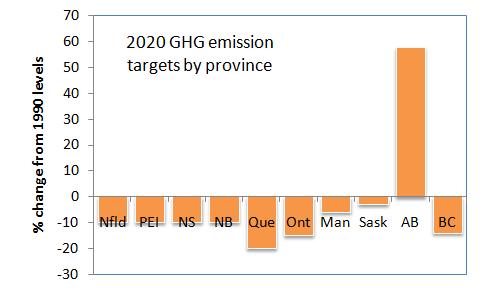
The Canadian government has decided that their meager 20% emission cut from 2006 levels by 2020 (equivalent to 3% cut from the standard base year of 1990) is tenuous – it all depends on what the US decides to do. (Why even bother having a separate Canadian government if they’re just going to follow all US decisions?)

Wondering why they’re still wasting time? This is why (courtesy of the  Globe and Mail):

Luckily, Canada now has its hands tied, as Obama just announced a target that’s slightly stronger – a 28% cut from 2005 levels by 2020, up from the previous target of 17%.

Funny how these things work out, isn’t it?

Manufacturing Doubt

I recently wrote this term paper for my world issues course. Enjoy.

There are many questions which remain controversial among scientists, but the existence of human-caused climate change is not one of them. Over 97% of publishing climatologists (Doran and Zimmerman, 2009), virtually 100% of peer-reviewed studies (Oreskes, 2004), and every scientific organization in the world (Logical Science, 2006) agree that humans are causing the Earth to warm. As Donald Kennedy, former editor-in-chief of the prestigious journal Science, says, “Consensus as strong as the one that has developed around this topic is rare in science.”

However, this consensus does not extend to the general public. On a particularly cold day, the cashier at the grocery store will say to you, “So much for global warming.” Over Thanksgiving dinner, your uncle will openly wonder if the warming in the Arctic is just part of a natural cycle. Your local newspaper will print letters to the editor almost daily claiming that, as CO2 is natural and essential to life, we shouldn’t worry about climate change.

What is the reason for this disconnection between scientific opinion and public opinion? There are obviously many factors involved, but it is probable that this discrepancy exists partly because of the widespread media coverage of scientists who do not accept anthropogenic climate change. Anyone with an Internet connection or a newspaper subscription will be able to tell you that many scientists think global warming is natural or nonexistent. As we know, these scientists are in the vast minority, and they have been unable to support their views in the peer-reviewed literature. The key question, therefore, is this: Why are so many of them still publicizing their beliefs so prominently?

Two plausible outcomes exist. Firstly, a scientist who could not prove a hypothesis could still feel that it was an idea worth consideration, and would want to capture the imagination of other scientists so it would be studied more closely. Alternatively, a scientist might be willing to keep the public confused about climate change. For example, scientists employed by the fossil fuel industry, or by organizations with strong laissez-faire agendas, could be motivated to spread rumours about weaknesses in the anthropogenic climate change theory. So, do these skeptics honestly doubt the integrity of climate science? Or are they being paid to manufacture doubt?

To distinguish between these two motives, it is important to understand a distinct difference in the formation of scientific opinions and political opinions. In science, one should examine all the evidence and then develop a logical conclusion. However, it is all too common in politics, lobbying, and the media for one to choose a convenient conclusion, then build evidence around it. This process is akin to an “ends justify the means” approach. The means (evidence and methods) are justified as long as they support the ends (a preconceived conclusion). In contrast, science, which is continually striving for a hypothetical physical truth, works the other way around – the means justify the ends. The conclusion is less important than the evidence and analysis used to reach it. Therefore, to tell the difference between an honest scientific argument and one that was constructed for political means, one simply has to distinguish between the ends and the means, and decide which is more central to the structure of the argument.

Let us now apply this strategy to the arguments of three of the skeptics who are most visible in the media. In articles from the popular press and news segments from major television stations, the names of these skeptics appear more than any others. Firstly, S. Fred Singer is an atmospheric physicist and retired environmental science professor. He has rarely published in scientific journals since the 1960s, but he is very visible in the media. In the past five years, he has claimed that the Earth has been cooling since 1998 (Avery, 2006), that the Earth is warming, but it is natural and unstoppable (Avery and Singer, 2007), and that the warming is artificial and due to the urban heat island effect (Singer, 2005).

Richard Lindzen, also an atmospheric physicist, is far more active in the scientific community than Singer. However, most of his publications, including the prestigious IPCC report to which he contributed, conclude that climate change is real and caused by humans. His only published theory that disputed climate change was met with vigorous criticism, and he has publicly retracted it, referring to it as “an old view” (Seed Magazine, 2006). Therefore, in his academic life, Lindzen appears to be a mainstream climate scientist – contributing to assessment reports, abandoning theories that are disproved, and publishing work that affirms the theory of anthropogenic climate change. However, when Lindzen talks to the media, his statements change. He has implied that the world is not warming by calling attention to the lack of warming in the Antarctic (Bailey, 2004) and the thickening of some parts of the Greenland ice sheet (Beam, 2006), without explaining that both of these apparent contradictions are well understood by scientists and in no way disprove warming. He has also claimed that the observed warming is minimal and natural (Fox News, 2006).

Finally, Patrick Michaels is an ecological climatologist who occasionally publishes peer-reviewed studies, but none that support his more outlandish claims. In statements to the media, Michaels has said that the observed warming is below what computer models predicted (Chatterjee, 2009), that natural variations in oceanic cycles such as El Niño explain most of the warming (Knappenberger and Michaels, 2009), and that human activity explains most of the warming but it’s nothing to worry about because technology will save us (Miller, 2009).

While examining these arguments from skeptical scientists, something quickly becomes apparent: many of the arguments are contradictory. For example, how can the world be cooling if it is also warming naturally? Not only do the skeptics as a group seem unable to agree on a consistent explanation, some of the individuals either change their mind every year or believe two contradictory theories at the same time. Additionally, none of these arguments are supported by the peer-reviewed literature. They are all elementary misconceptions which were proven erroneous long ago.

With a little bit of research, the claims of these skeptics quickly fall apart. It does not seem possible that they are attempting to capture the attention of other researchers, as their arguments are so weak and inconsistent. However, their pattern of arguments does work as a media strategy, as most people will trust what a scientist says in the newspaper, and not research his reputation or remember his name. Over time, the public will start to remember dozens of so-called problems with the anthropogenic climate change theory. From this perspective, it certainly seems that prominent skeptics are focusing on the ends, rather than the means. They are simply collecting as many arguments as they can to denounce global warming, and publicizing them vigorously. But why?

Earlier, we identified that organizations with a laissez-faire agenda would have reason to spread doubt on climate change, as the most effective form of mitigation would involve government regulation of fossil fuels. Many of these organizations, known as conservative think tanks, exist. Think tanks are supposed to be centres of independent, policy-related research, but conservative think tanks have migrated into an entirely new category. Over the past forty years, they have evolved into lobby groups that denounce any threat to the free market or laissez-faire economics. This objective often leads to the denial of established science, such as the relationship between smoking and cancer (which, if accepted, would lead to government regulation of tobacco and controls on where people could smoke), the destructive effects of CFCs on ozone (which could ban the products of an entire chemical industry), and, most recently, the climatic forcing of fossil fuel combustion, and the attribution of late-20th-century warming to this forcing.

The tactics that conservative think tanks (CTTs) use to manufacture doubt on climate change are often questionable and dishonest. On the rare occasion that their citations are peer-reviewed, they are discredited, cherry-picked, or misrepresented. For example, CTTs repeatedly cite data that shows slight cooling of the Earth – but only from before mechanical flaws in the satellites were corrected and the data began to show warming. They also cite a 2003 study by Sallie Baliunas and Willie Soon, claiming that the recent warming is attributable to sunspots. What CTTs don’t say is that, following the publication of this paper, 13 of the authors of data sets it incorporated refuted Baliunas’ interpretation of their work, and half of the editorial board resigned in protest against failure of the peer-review process. Additionally, CTTs argue that the wavelength band of CO2 absorption is already saturated, so adding more CO2 to the atmosphere wouldn’t cause any more warming – a theory that scientists proved wrong when spectroscopes improved in the 1950s.

Again, note the inconsistency of these statements, all of which were present at the same time on the Heartland Institute’s website. This CTT simultaneously claims that the world is cooling, that the world is warming naturally, and that the world is warming anthropogenically, but has maximized its potential. Evidently, these arguments were chosen because they fit with a preconceived conclusion, not with our understanding of science.

When their arguments are so similar, it should come as no surprise that most skeptics have ties to CTTs. Many of the most prominent skeptics write books – S. Fred Singer has written at least eight books skeptical of climate change, and Patrick Michaels has written at least five (Amazon). In 2008, a survey was conducted of books skeptical of climate change or other environmental issues, and found that an incredible 92% of the authors were affiliated with a CTT (Jacques, Dunlap, and Freeman, 2008). Additionally, some of the authors had connections to more than one CTT. For example, S. Fred Singer has been a part of ten different CTTs throughout his career. Patrick Michaels has been part of two, and Richard Lindzen has been part of three (Greenpeace USA).

It is obvious that CTTs want “experts” on their staff, because they want to sound scientific and credible. Additionally, the CTTs are willing to pay generous sums of money for expertise with a convenient conclusion. In 2006, the American Enterprise Institute offered ten thousand dollars plus expenses to any scientist who wrote a critique of the IPCC (Hoggan and Littlemore, 2009). Sure enough, a handful of scientists responded, and with good reason – they wouldn’t get a ten-thousand-dollar bonus for publishing a regular old peer-reviewed study.

What do these ties with CTTs tell us about skeptics? Have they decided to switch careers from researchers to PR representatives, trading in their scientific integrity for the promise of monetary gain? After all, if they work for a CTT, their arguments don’t have to be accurate – they just have to be effective in manufacturing doubt.

Another interesting fact about publicized skepticism is that it did not appear until governments started promising action on climate change – George  HW Bush in 1988 (Hoggan and Littlemore, 2009), Margaret Thatcher in 1990 (Thatcher, 1990), and Brian Mulroney in 1992 (United Nations). In fact, 87% of the books from the Jacques, Dunlap, and Freeman survey were published in or before 1988. Those published before likely did not even mention climate change – many of their titles suggested skepticism about toxic chemicals, the environmental concern of the 1970s. Therefore, it is very easy to pinpoint a short period of years and political events that sparked mass PR coverage of skeptical viewpoints. This trigger provides yet more evidence that skeptics are publicizing their views not to further scientific knowledge, but to manufacture public doubt and delay action.

So, when skepticism started in response to political promises, where were its roots? Unsurprisingly, the manufacture of doubt started with fossil fuel companies. In 1991, the Western Fuel Association, the National Coal Association, and the Edison Electric Institute formed a PR coalition named, ironically, the Information Council on the Environment (ICE). ICE launched a major advertising campaign denouncing the idea of anthropogenic global warming. The campaign’s objective, in ICE’s own words, was “to reposition global warming as a theory (not fact)” and “to supply alternative facts that suggest global warming will be good” (Hoggan and Littlemore, 2009). These objectives are a blatant example of manufacturing doubt, because they are based on the ends, not the means. ICE chose a conclusion that was convenient for their industry, and cherry-picked “alternative facts” to support it.

Several years later, a leaked document from another fossil fuel company, the American Petroleum Institute, gave away the organization’s entire game plan. The document laid out an ideal scenario in which the media reflected climate change as an equal-sided, unsettled debate, citizens began to accept this framing, and public support for the Kyoto Protocol fell apart. To achieve this utopia, API planned to “produce, distribute via syndicate and directly to newspapers nationwide a steady stream of op-ed columns and letters to the editor authored by scientists” (Walker, 1998). By manipulating how the media framed climate change, API could push public opinion in a predetermined direction. This document shows that fossil fuel companies such as the API have stopped caring about science anymore, otherwise the objectives would be “to publish our latest discovery that invalidates global warming in a prestigious journal”. Rather, their efforts are focused on the media, the public, and policymakers. They are consistently promoting ends that don’t have means to support them.

Over the last decade, however, fossil fuels have gradually shifted away from creating their own propaganda, choosing to fund CTTs instead. ExxonMobil, for example, has spent $20 million since 1998 funding CTTs that express climate change skepticism (Hoggan and Littlemore, 2009), and it releases annual breakdowns of its funding. Let’s look at some of the CTTs that our three major skeptics are a part of. Firstly, the Science and Environmental Policy Project, of which S. Fred Singer is president, has received $20 000 from Exxon since 1998. The Cato Institute, which has Patrick Michaels as a senior fellow, Richard Lindzen as a contributing expert, and S. Fred Singer as an advisory board member, has received $125 000. The Heartland Institute, which lists all three as “HeartlandGlobalWarming.org experts”, has received $676 500. (Greenpeace USA). At times, Exxon specifically notes that this funding is for “climate change efforts”, so it’s pretty obvious what kind of message they’re pushing.

Fossil fuel companies are some of the largest businesses in the world, and they are using their money and power to promote messages that are convenient for their further domination. Conservative think tanks – and, therefore, the experts they employ – are being paid, by vested interests, to say that global warming isn’t real. It provides yet another motive for skeptics to give more weight to the ends, rather than the means.

It seems quite obvious that these skeptics should not be trusted, as their arguments are inconsistent and unsupported, and they have potential fortunes resting on what they say, not how they prove it. However, the vested interests of CTTs and fossil fuel companies have been wildly successful in using these skeptics as their spokespeople. For example, the majority of articles from well-respected newspapers present the issue as an equal-sided debate, giving equal time to arguments for and against the idea of human-caused climate change (Boykoff and Boykoff, 2004). This framing has permeated to the public, as 39% of American adults think humans are not changing the climate (Gallup, 2007), and 42% think scientists disagree a lot about the issue (Newsweek, 2007). The constant presence of manufactured doubt in the media has taken its toll.

Additionally, since the skeptical view exploded following the near-action in the late 1980s, our society has spent 20 years without any significant plans for mitigation. The Kyoto Protocol failed in both Canada and the US. The Copenhagen summit did not lead to any politically binding targets. US President Barack Obama is finding it difficult to pass even the most meagre cap-and-trade legislation through the Senate, and the position of the Canadian government is to wait and see what the Americans do.

A democracy cannot function without an electorate that is accurately informed. We see an example of this scenario with regards to climate change legislation. Even though the scientific community is, essentially, as sure as it can get about the existence of human-caused climate change, the manufacture of doubt has prevented the public opinion from following suit, and prevented voters from demanding necessary political action. A well-funded campaign has led us astray from the ideals of democracy.

It’s not over yet, though. Climate change action is not a question of all or nothing. Even if we fail to keep the warming at a tolerable level, there is still a wide range of outcomes. Three degrees of warming is better than five, and five degrees is better than eight. We should never throw up our hands and say that all is lost, because we can always prevent the situation from getting worse.

To pull our society together in order to minimize global warming, we need the public to be better informed about climate change. This does not require everyone to know climate science – rather, all that is needed is for the public to be able to recognize whether or not they can trust an argument. Everyone needs to understand the importance of peer-review and the difference between the ends and the means. People do not need to know science – they just need to know how the system of scientific opinion works. Once this literacy becomes widespread, people will understand the urgency of action, and they will stop listening to those skeptical scientists on the news.

Works Cited

Amazon. “Patrick Michaels.” Amazon.com. Web. 7 Jan. 2010.

Amazon. “S. Fred Singer.” Amazon.com. Web. 7 Jan. 2010.

Bailey, Ronald. “Two Sides to Global Warming.” Weblog post. Reason.com. 10 Nov. 2004. Web. 9 Dec. 2009. <http://reason.com/archives/2004/11/10/two-sides-to-global-warming&gt;.

Beam, Alex. “MIT’s Inconvenient Scientist.” Boston Globe. 30 Aug. 2006. Web. 9 Dec. 2009. <http://www.boston.com/news/globe/living/articles/2006/08/30/mits_inconvenient_scientist&gt;.

Boykoff, Maxwell, and Jules Boykoff. “Balance as bias: global warming and the US prestige press.” Global Environmental Change 14 (2004): 125-36. Print.

Chatterjee, Neera. “Prof. says climate change exaggerated.” The Dartmouth. 24 Feb. 2009. Web. 10 Dec. 2009. <http://thedartmouth.com/2009/02/24/news/climate&gt;.

Dennis, Avery. “Global Cooling?” Web log post. Free Republic. 30 June 2006. Web. 9 Dec. 2009. <http://www.freerepublic.com/focus/f-news/1658580/posts&gt;.

Doran, Peter, and Maggie Zimmerman. “Examining the Scientific Consensus on Climate Change.” EOS 90.3 (2009): 22-23. Print.

Exxon Secrets. Greenpeace USA. Web. 10 Nov. 2009. <http://www.exxonsecrets.org/maps.php&gt;.

Fox News. “Global Warming: Climate of Fear?” Fox News. 25 May 2006. Web. 9 Dec. 2009. <http://www.foxnews.com/story/0,2933,195551,00.html&gt;.

Gallup. Environment Poll. 2007. Raw data.

Heartland Institute. Heartland Institute. Web. 13 Dec. 2009. <http://heartland.org&gt;.

Hoggan, James, and Richard Littlemore. Climate Cover-Up. Vancouver: Greystone, 2009. Print.

Jacques, Peter, Riley Dunlap, and Mark Freeman. “The organisation of denial: Conservative think tanks and environmental scepticism.” Environmental Politics 17.3 (2008): 349-85. Print.

Kennedy, Donald. “An Unfortunate U-Turn on Carbon.” Science 291.5513 (2001): 2515. Print.

Logical Science. “The Consensus on Global Warming/Climate Change: From Science to Industry & Religion.” Logical Science. 2006. Web. 9 Nov. 2009.

Luntz, Frank. “Straight Talk: The Environment: A Cleaner, Safer, Healthier America.” Letter to Republican Party. 2002. Political Strategy. Web. 10 Nov. 2009. <http://www.politicalstrategy.org/archives/001330.php&gt;.

Miller, Dan. “Look Who’s Talking.” Heartland Institute. 28 May 2009. Web. 10 Dec. 2009.

Miller, Dan. “Look Who’s Talking.” Heartland Institute. 28 May 2009. Web. 10 Dec. 2009.

Newsweek. Environment Poll. 2007. Raw data.

Oreskes, Naomi. “Beyond the Ivory Tower: The Scientific Consensus on Climate Change.” Science 306.5702 (2004): 1686. Print.

Oreskes, Naomi. “You CAN Argue with the Facts.” Stanford University. Apr. 2008. Lecture.

Paul, Knappenberger C., and Michaels J. Patrick. “Scientific Shortcomings in the EPA’s Endangerment Finding from Greenhouse Gases.” Cato Journal. Cato Institute, 2009. Web. 9 Dec. 2009. <http://www.cato.org/pubs/journal/cj29n3/cj29n3-8.pdf&gt;.

Revkin, Andrew. “Industry Ignored Its Scientists on Climate.” New York Times. 23 Apr. 2009. Web. 10 Nov. 2009. <http://www.nytimes.com/2009/04/24/science/earth/24deny.html&gt;.

Seed Magazine. “The Contrarian.” SeedMagazine.com. 24 Aug. 2006. Web. 3 Jan. 2010. <http://seedmagazine.com/content/article/the_contrarian/?page=all&gt;.

Singer, S. Fred, and Dennis Avery. Unstoppable Global Warming: Every 1500 Years. Lanham: Rowman & Littlefield,, 2007. Print.

Singer, S. Fred. “British Documentary Counters Gore Movie.” Heartland Institute. 1 June 2005. Web. 9 Dec. 2009.

SourceWatch. “Global Climate Coalition.” SourceWatch. Web. 7 Nov. 2009. <http://www.sourcewatch.org/index.php?title=Global_Climate_Coalition&gt;.

Thatcher, Margaret. “Speech at 2nd World Climate Conference.” Speech. 2nd World Climate Conference. Geneva. 1990. Margaret Thatcher Foundation. Web. 9 Nov. 2009. <http://www.margaretthatcher.org/speeches/displaydocument.asp?docid=108237&gt;.

United Nations. “Country Profile – Canada.” United Nations. Web. 9 Nov. 2009. <http://www.un.org/esa/earthsummit/cnda-cp.htm&gt;.

Walker, Joe. “Draft Global Climate Science Communications plan.” Letter to Global Climate Science Team. Apr. 1998. Web. 9 Nov. 2009. <http://euronet.nl/users/e_wesker/ew@shell/API-prop.html&gt;.

Weart, Spencer. The Discovery of Global Warming. Harvard UP, 2004. Print.

Partisan

How did objectivity itself become partisan?

I’m not quite sure how this thought came into my mind. I was angry about what Mark Steyn is regularly allowed to write in Maclean’s (Peter Sinclair, if you’re reading, you should really use his columns as case studies for your videos – this is the most popular news magazine in Canada). Then I read his Wikipedia page and discovered that he regularly appears on Rush Limbaugh, writes for the National Post, and gets awards from Fox News. Somehow that made my anger diminish, as I started to look at his articles as case studies rather than as a reporter from a magazine I’ve grown up with. His climatology arguments are easily invalidated by the cooling stratosphere as well as tracking the warming over decades rather than years – just like S. Fred Singer. Singer’s writing doesn’t make me mad anymore, because it’s a case study, not a source.

Then I got distracted wondering what would happen to the temperature of the stratosphere if the planet was experiencing an aerosol-induced cooling. That sort of energy balance mechanism fascinates me, but I couldn’t figure it out.

Eventually I got back to politics and the media, and I started wondering how climate science became a partisan issue. It’s math and physics when you boil it all down, just like any other physical science – the very subjects which are, ideally, the pinnacles of objectivity. At what point did the public perception of the objectivity of climatology fall apart?

I trust scientists, and I trust science more than any other field to guide my decisions, so maybe I’m expecting that everyone else would feel the same way. But if I was confused about the link between the ozone hole and Antarctic temperatures, my first reaction would not be to declare that both ozone depletion and climate change were “religion, not science”. My first reaction would be to assume that I did not fully understand, and that the scientists had covered all of my misconceptions long ago. Then I would go to Google Scholar, rather than writing an erroneous editorial in a major national magazine.

However, when one frames their own scientific misconceptions as a conservative viewpoint of climate science, the more informed message of those who work in the field and keep up to date with the literature is cast as “liberal”. Then the artificial balance complex of the mainstream media kicks in. Equal time is given to contrasting conclusions, rather than to the most accurate and conscientious arguments. Space is allocated based on the ends (conclusions) rather than the means (methods and analysis).

Science is so fundamentally different from everything else the media reports. In politics and religion and musical tastes, there is no right and wrong. But in science, there is a right and wrong – at least hypothetically. We know there’s a physical truth out there, and we’re always striving to come closer to it.

The fallacies of the mainstream media make it incredibly easy to create a controversy where there is none. You can get away with misconceptions or outright lies (any guesses on how Steyn finished the phrase “hide the decline in….”?), as long as you frame it as a partisan opinion.

ClimateSight/CCC Movies!

Here is a re-upload of some public education videos (aimed at students) I created in the summer, in association with Climate Change Connection.

Read the citations, and take the survey if you’re feeling brave.

Enjoy!

On Media

I have given up on my local newspaper.

It’s been a long time coming. I’m tired of letters to the editor that talk about how carbon dioxide is good for the environment because it makes plants grow. I’m tired of editorials that conclude with, “So-and-so is a senior fellow at (insert name of suspiciously-funded conservative lobby group here).” I’m tired of the skeptical editor who gets an entire page on Saturdays and one or two columns during the week, often to talk about “Al Gore’s eco-horror film” and “scientists who have exaggerated data and silenced critics”. And I’m tired of the paper’s notion that any story even remotely related to global warming has to include a picture of a polar bear. If there’s one thing that the public needs to know about climate change, it’s that it’s not just a problem for the polar bears.

I’ve been reading my local newspaper every day for years, but now I have decided two things. Firstly, this isn’t a paper that I want to support. But more importantly, when the paper is making such a muddle out of their climate change reporting, it’s not a source that I trust to inform me accurately on other issues.

In terms of alternatives, I’ve subscribed to RSS feeds from the CBC for national and world politics, and the BBC for science and technology. I’ll read the Globe and Mail when I can get my hands on it, as it’s a very good paper that does a good job (at least comparatively) of climate change reporting.

I can always use my local paper, or any paper in the world for that matter (yay Internet) as a case study for how the media reports climate change. However, I’d like to rely on something else for my personal knowledge about the world. And it’s very nice not to feel that sense of doom as I turn to the editorial page.