Here is a re-upload of some public education videos (aimed at students) I created in the summer, in association with Climate Change Connection.
Read the citations, and take the survey if you’re feeling brave.
Enjoy!
Here is a re-upload of some public education videos (aimed at students) I created in the summer, in association with Climate Change Connection.
Read the citations, and take the survey if you’re feeling brave.
Enjoy!
I’m not really sure how I feel about Copenhagen.
In a way, I was pleasantly surprised that anything happened at all. I had been following the feeds from DeSmogBlog and U of T throughout the conference, and it was after midnight on the last evening before any agreements were actually made.
Obviously, Copenhagen didn’t progress to the stage it was supposed to. However, I feel that the stage that was reached was successful. For unsubstantiated, unexplained goals to simply “take note of”, they’re certainly very good goals.
I’m also pleased that it was China and the US who finally sat down to get something done. As the the largest emitters and largest economies in the world, all the other countries are going to follow whatever they do. And I’m glad that the senior leadership (if not the legislative assemblies) from both countries seems to be pushing in the right direction.
It ended up better than I expected. But it still isn’t enough. We really should have reached this stage 20 years ago. We’re far behind schedule, and we don’t seem willing to catch up.
 I’m fairly new to the issue of climate change, and even newer to the politics surrounding it. I’ve spent the past two years reading about climate change causes, impacts, projections, myths, media blunders, and public misconceptions.
I knew that vested interests, such as the fossil fuel industry and political lobby groups, had played a part in the widespread public confusion. However, I naively assumed that they had simply taken advantage of said confusion – that the public was already unsure, so the vested interests decided to jump in and prolong it.
How wrong I was. How very, very wrong I was, as Jim Hoggan and Richard Littlemore proved to me in their new book, Climate Cover-Up.
Example after example, and story after story, showed that vested interests didn’t just take advantage of public confusion surrounding climate change. They created it. They deliberately constructed the so-called “debate” in an effort to – what? Earn more money? Fight socialism?
Take the Information Council on the Environment, one of the first climate change lobby groups. They were established in 1991, right after governments first started to respond to climate change – Thatcher, Bush Sr, and Mulroney all made promises to reduce emissions. The ICE flat-out stated that their objective was “to reposition global warming as a theory (not fact)” and “to supply alternative facts to support the suggestion that global warming will be good”.
The American Petroleum Institute was even more blatant. A leaked email contains a list of objectives for their PR campaigns:
Victory Will Be Achieved When
-Average citizens “understand” (recognize) uncertainties in climate science; recognition of uncertainties becomes part of the “conventional wisdom”
-Media “understands” (recognizes) uncertainties in climate science
-Media coverage reflects balance on climate science and recognition of the validity of viewpoints that challenge the current “conventional wisdom”
-Industry senior leadership understands uncertainties in climate science, making them stronger ambassadors to those who shape climate policy
-Those promoting the Kyoto treaty on the basis of extant science appear to be out of touch with reality.
Everything that we’ve been bemoaning for years now. Misplaced public doubt, artificial balance in the media, Bush and Harper’s ties to the oil industry. It didn’t just happen by accident.
The email goes on to discuss strategies to achieve these objectives, including plans to produce and distribute “a steady stream of op-ed columns and letters to the editor” doubting climate change. So all those skeptical editorials in the popular press might not be written by journalists that have been taken for a ride. They might actually be by people with ties to lobby groups like the American Petroleum Institute.
You could look at Frank Luntz’s plans to capitalize on uncertainty. Or the American Enterprise Institute’s offer of $10 000 to any scientist who wrote a critique of the IPCC. Or how The Great Global Warming Swindle, a documentary oft-cited by YouTubers, creatively took statements from its interviewees out of context.
Climate Cover-Up made me so angry. I remember not being able to fall asleep the night I finished it. Then telling everyone I could about it. I had been immersed in the issue of climate change for two years, and yet I had failed to grasp the scope of vested interests’ influence on the public.
Many of our readers, who have been following this issue for years, are probably familiar with the stories and examples in the book. There isn’t anything in it that will be new to everyone.
But that wasn’t the book’s purpose, and climate scientists aren’t the book’s audience. Rather, Climate Cover-Up is aimed at those just becoming interested in climate change politics. It’s aimed at people who are unaware of the near-constant misinformation thrown at them, who are new to the immense power of money and industry over science and truth, who wouldn’t think to check the citations of editorials. It’s aimed at people like I was, two years ago.
I must also note that Climate Cover-Up is substantially easier to read than most books about climate change. The prose is witty and easy to follow. It doesn’t talk about science. It feels nothing like a textbook.
I’d like everyone in the world to read this book. But truthfully, I’d rather that it hadn’t needed to be written at all.
Stephen Harper is coming to Copenhagen. It really surprised me when the Canadian media started patting him on the back for announcing this, as if he was finally cleaning up his act and showing some leadership. Coming to a conference – and most likely only for a day or two, for a photo op – doesn’t show leadership. As I’ll explain in this post, it’s the latest in a chain of attempts by the Canadian government to look like they’re doing something about climate change, without actually doing anything at all.
Obama is only coming to Copenhagen for one day. Almost certainly a photo op. But I find this somewhat more excusable because the US is already working on their own climate change legislation, independent of Copenhagen. The US has something against international agreements, but they’re being proactive and finding ways to achieve the same ends regardless. Canada hasn’t done any such thing.
And it’s not just the Conservatives that are being difficult. Michael Ignatieff, the leader of the opposition, says that Canada has wasted four years on climate change action. Actually, we’ve wasted twenty. But Ignatieff will only say four years, because beyond that, it was his party that was the problem. The Liberals were the ones to sign Kyoto and agree to an emissions cut of 6% below 1990 levels. Instead, as of 2006, they were 22% above.
The recommended emissions target for developed nations is a 25-40% cut from 1990 levels by 2020. Most developed nations have stepped up to the plate. Norway has pledged a 40% reduction. Japan has pledged 25%. Australia has agreed to 5-24%, depending on whether there is an agreement at Copenhagen. The EU will cut 20% no matter what, and will increase this to 30% with an international agreement. Britain has increased this even further, with a 34% pledge.
The US is a little trickier. Waxman-Markey will cut 14-20%, but from 2005 levels, not 1990. Does anyone know how to convert this so we can properly compare it to other countries?
Then there’s Canada. Canada has pledged 3% from 1990 levels. Absolutely pitiful. Depending on what the US conversion turns out to be, there’s a good chance that our humble country is the worst in the world for climate change action and leadership.
The government knows this, and they’re spending a great deal of time and energy trying to cover it up. For example, they won’t say “3% by 1990”, because it’s so obviously pitiful. Instead, they say that they’ve pledged “a 20% cut by 2020″…..from 2006 levels. What is the point of deviating from the standard baseline among countries who signed Kyoto, unless you’re deliberately trying to keep your citizens happy with you?
And that’s not all. In the summer, I wrote about how Canada was still advertising its Turning the Corner plan, even though it appeared to have abandoned it. When I went to PowerShift in October, I had the chance to talk to a lot of people who knew a lot about Canada’s climate change policies. And yes, our government has definitely abandoned Turning the Corner. But it’s still one of the first links in their sidebar. And when you click on that link, you discover that it hasn’t been updated since August 2o08, and the legislation is supposed to come into effect in January 2010. Yet another example of keeping the citizens happy without having to do anything.
Stephen Harper’s climate change website is full of talk about emissions intensity and CSS. There are pictures of him shaking hands with Obama and planting trees. But trying to get any real information out of it is next to impossible.
The government is spending so much time trying to convince Canadians that they’re taking bold action on climate change. They’re devoting so much energy to putting on sustainable masks that contradict all their talk of a transparent government. All without having to take any action at all.
What I ask is, why not spend all that time and energy actually doing something? Why not cooperate with other nations and realize that this is the way the world economy is going? Why not be proactive and prepared instead of hoping that the whole issue will just go away?
It actually makes me ashamed to be Canadian. Ashamed to be part of this country that tosses around the future of our civilization, the future of my generation, so lightly. And for what?
Anyone who lives in the north-central United States, or most areas of Canada, can agree with me here: Spring and summer have been incredibly cold this year.
Yesterday, I asked a climatology prof that I know, “Is there a reason for this? Or is it just a fluke?”
There was a reason, as he explained. And it’s incredibly cool (to me at least) and in no way proves that global warming is all wrong.
Let’s help the story along with a map, courtesy of World Atlas (doodles and arrows are my own).

The jet stream (the black curvy line on the map) is the boundary between the cold polar winds and the warmer temperate winds. In the Northern Hemisphere, when the jet stream is south of you, your area will be cold. When it is north of you, it’ll be nice and warm.
The northwestern Pacific has been warm this spring and summer. This warmth is pushing the jet stream further north. BC is experiencing the effects of this change – it’s had unseasonably hot, dry conditions, which are aggravating their already-worrisome forest fire problem.
When the jet stream peaks northward, the prof explained, it has to follow that with a trough. The peak on the West coast was very strong, so the trough further eastward, in the continental US and Canada, has also been very strong. Areas as far south as Chicago have had many days where the jet stream is south of them, so they’re submerged in polar air.
So all spring and summer, the jet stream has been “stuck” in the (very approximate) shape you see above. As an El Niño just began, our area would usually expect a warm winter. However, should the jet stream stay stuck in this shape…..we might have a colder winter than normal. The Prairie winters are bad enough already. I can only imagine the “so much for global warming” comments which would happen if such a winter came to pass.
So, in a strange way, our area has been so cold because somewhere else has been really warm. This can’t prove that the Earth is warming, as no single event can.
But it certainly doesn’t disprove it.
A nation’s policies usually only affect its citizens. Take health care, crime, or taxes. These policies could affect the rest of the world indirectly – through the economy, for example – but the benefits and consequences of the policies’ effectiveness, or lack thereof, will be present first and foremost in the nation in which they were created.
Climate change legislation doesn’t work the same way.
Firstly, the mechanism of climate change is just not fair. If it was, the countries which had caused the problem would suffer the greatest consequences, and those which had had no hand in causing the problem would go on as normal. Unfortunately, the areas which will suffer the most from a warming climate are affected due to their physical geography – such as latitude, ocean and wind currents, and topography – not due to the amount they contributed to the problem. This means that a lot of developing nations, whose per capita carbon emissions are virtually nil, will suffer greatly from climate change.
Additionally, developed nations are undoubtedly the best equipped to deal with the consequences they do suffer. Here in Canada, for example, we have floodways, free health care, food reserves, and insurance. But look at somewhere like sub-Saharan Africa. What backup plans do they have for natural disasters?
I am not suggesting that I want the developed nations to experience the drastic consequences of their actions. Conversely, I am suggesting that the developed nations have a global responsibility to repair their actions, as the consequences will affect many who are innocent and unequipped.
We should stop looking at climate change legislation, or lack thereof, as “How will this help or hurt me?” and start looking at it as “How will this affect the rest of the world?”
An interlude of Canadian politics
Prime Minister Stephen Harper, head of our minority government (for our American friends – read up on Canada’s governmental system here if you’re lost) hasn’t done a lot about climate change. When he came into power several years ago, he got rid of the previous government’s emission plan and got rid of our Kyoto agreement. Then he created a “20% emission reduction by 2020” plan which looked pretty decent. But then the economy went downhill and he got rid of that plan as well. Now he’s pledged to not take any action against climate change until the US plan is fully underway – 2016 or so.
Luckily, here in Canada, we can call elections whenever we want (not just every four years), so he may be out as early as September, depending on how angry the opposition gets with him.
Regardless, it’s pretty obvious that Canada isn’t going to take any action until the United States does.
Why I care about US policy
I am not a citizen of the United States. I’ve only ever travelled there, I believe, three times. I assume that the US culture is quite similar to Canada’s, but I don’t know for sure. I’m perplexed at the lack of recycling in the States.
But I care a lot about what the US does in terms of climate change policy. I care what American citizens think about climate change. I believe that when the US takes significant action, the rest of the world will follow. As an economic superpower, the US has the biggest potential to be a leader in climate change action. As the largest per-capita emitter in the world, it also has the biggest potential to make climate change worse if it doesn’t take action.
“Why do you care about US policy?” you may ask me. “It’s not even your country.”
No, it’s not my country.
But it is my world. It’s everyone’s world. And what the United States does about climate change will affect everyone.
The first of many reviews planned for ClimateSight!
Climate change skeptics like to imply that Al Gore’s word is all we have going for us. That our faith in the theory is upheld simply because he supports it. That he’s brainwashed us all and we should think for ourselves. If it sounds like I’m exaggerating, go check out some YouTube comments – and even entire videos – dedicated to these concepts.
But the truth is, Al Gore could have never existed and the scientific theory of anthropogenic climate change would be the same as it is today.
Let’s take some time for historical context. The greenhouse effect began to be studied in the late 1800s by Svante Arrhenius. The current theory that anthropogenic CO2 emissions are causing the Earth’s temperature to rise was hypothesized by Guy Callendar in the 1930s. A great historical account of climate science is available to read online here.
The beginnings of the modern-day scientific view were present before Al Gore was even born. The idea that he thought up the whole conspiracy theory quickly falls apart. (But if you’d like a good laugh, check out this April Fool’s article. It made my day.)
Al Gore was educated at Harvard. He was fascinated by courses from Roger Revelle, another climatology pioneer. Before long, though, Gore became interested in politics. He graduated with a BA in government.
Try swaying the minds of every major scientific establishment in the world when the only formal education you have in climatology is a couple of undergraduate courses.
I’m sure Al Gore understands climate change better than most members of the general public. I’m also sure that the folks at national academies of science and organizations such as NASA, all at the top of our credibility spectrum, understand climate change a heck of a lot better than Al Gore. Check out what they’re saying here (thanks to Logical Science, who cited all of the statements so well).
It’s clear that, under our credibility spectrum, Al Gore would fall under the professional. He keeps well up to date with the scientific literature, but is not a scientist himself. He is only slightly more credible than the average person.
And with this context, let’s take a look at An Inconvenient Truth.
An Inconvenient Truth (2006) – Review
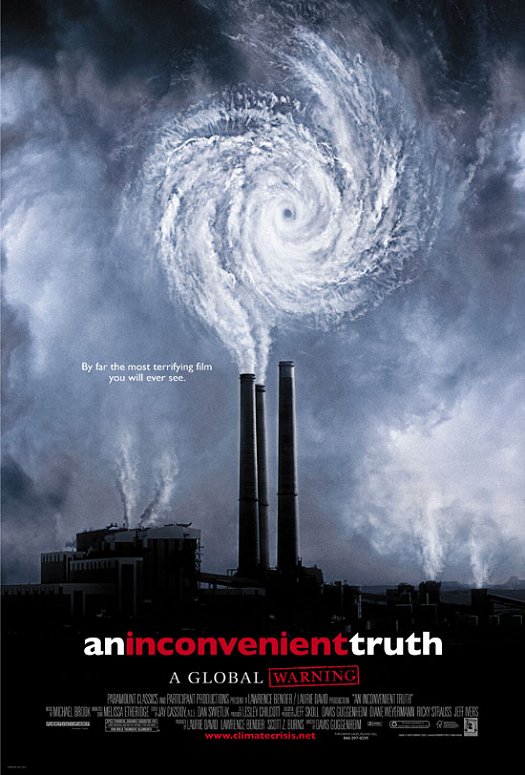
This is definitely not an example of scientific literature. It was not intended to be, and should not be taken as such. This is not to say that Gore’s statements about climate change are wrong. His overall message is greatly supported by the scientific community. However, it’s not the kind of text you’d want to cite in a research paper.
It’s clear that the purpose of this documentary was to increase public awareness, not to imitate a science textbook. Taken in that context, An Inconvenient Truth fulfills its purpose tremendously – almost too well, I’d say, as the first thing that comes to most people’s minds when they hear about the theory of climate change is not the IPCC, national academies of science, or university professors, but Al Gore. A lot of people think it’s Al Gore’s problem, and not much else.
And, sadly, if you wanted to take down the scientific side of Gore’s argument, it wouldn’t be too hard.
Early in the film, Al Gore says that we are adding to the greenhouse effect by “thickening” the atmosphere. This is more than just oversimplification. Burning fossil fuels not only increases CO2 concentrations in the atmosphere, it decreases O2 concentrations, by attaching one carbon atom to each molecule of oxygen in the combustion process. Read more about this concept here.
We are not “thickening” the atmosphere at all. But someone who watched An Inconvenient Truth could come away with that impression. That person would be very vulnerable to claims such as “Carbon dioxide only makes up 0.04% of the atmosphere.” The relative abundance of a gas in the atmosphere would seem important for its radiative properties, while basic laws of chemistry indicate that it is not.
Luckily, the major misconceptions ended there. However, Al Gore used anecdotal evidence, rather than citing cumulative studies, almost exclusively. For example, he showed pictures of a dozen or so glaciers across the world that were retreating. It couldn’t be too hard to find the same amount of glaciers that were advancing and present them as proof that Gore was wrong. What would be considered appropriate evidence would be a study that examined every major glacier in the world and determined the percentage that were retreating vs advancing.
Al Gore used similar tactics with evidence such as heat waves, hurricanes, and tornadoes. He referred to specific events and/or regional records rather than looking at the processes on a global scale. However, anecdotal evidence is much more compelling to an audience than a bunch of graphs. For the purpose of his documentary, we can probably forgive Gore for that misstep.
There were points in the documentary where it was unclear whether Gore was using a historical event as evidence or as an example of how bad the future could be. For example, when the film examined Hurricane Katrina, it was hard to tell if Gore’s message was, “This was caused by climate change” – which is almost impossible to determine for a specific event; you can’t really prove that it wouldn’t have happened anyway – or “Look at how devastating hurricanes can be – and they could become more frequent.”
The last scientific complaint I have to make against An Inconvenient Truth is the lack of time scale provided. When Al Gore showed how a sea level rise of 20 feet (~7 m) would affect coastlines across the world, he failed to mention that such an event is not expected for another few centuries. In the IPCC 4th report, a rise of 18 to 59 cm is expected by 2100. If we keep going at our current pace, we’ll eventually hit 7 m, but it won’t be in the next few decades, as he seems to imply. I don’t see what the harm would be in telling the audience when the 7 m rise would happen – if anything, it would increas his credibility. The idea of such a catastrophe being 200 years away doesn’t make it any less scary to me.
That’s the science stuff out of the way. Now let’s look at the real purpose of the film – the implications for policy. Al Gore is probably one of the most experienced people in the world on climate change legislation. He is, after all, a politician, and spent a great deal of his career trying to pass emission targets. Gore provided an especially good argument as to why we don’t have to choose between the environment and the economy; how environmental action could actually foster economic growth. Of course, he took as many stabs at the Republican party as he could in this part of the film.
I also enjoyed the “frog in boiling water” metaphor, regarding how a slow change can go unnoticed by the human brain until it’s too late. The psychology of fear and how it relates to climate change is fascinating to me. I’d recommend that you all read this editorial, written by psychologist Dr Daniel Gilbert. (Don’t be put off by the title – it makes more sense after you read the article!)
And, of course, as major climate change legislation has yet to be passed in the States, Gore ended on the note of individual action. The things we’ve all heard before – ride your bike, insulate your attic, get a low-flow showerhead. As important actions as these are to take, realistically, they will not be enough. We need major policy changes if we hope to make any difference in our total emissions. As Thomas Homer-Dixon said, “We’re not going to get there by changing our lightbulbs.”
Overall, I think An Inconvenient Truth fulfilled its purpose, which was to increase public awareness and encourage action. We just need to remember that it was never intended to be a solid source of scientific data.
After all, we have much more than Al Gore on our side.
In Canada, where I live, there are recycling bins everywhere you go. Every public place, office building, or school has blue boxes that are almost as easy to find as garbage cans. In Canada, it is almost a public embarrassment not to recycle. I seem to remember reading that upwards of 97% of homes put out recycling with their garbage pickup every week.
In Canada, it would be hard to find a suburban street where nobody had a compost pile in their backyard. Most universities have some sort of campus composting program. More and more municipalities are even getting curbside compost pickups along with their garbage and recycling.
In Canada, most sit-down restaurants serve their meals in reusable dishes. Receiving a meal where anything other than the napkin was designed to be thrown out would reflect badly on the restaurant. Eating a hotel breakfast out of Styrofoam would make the hotel seem much less classy.
In Canada, we know we have a long way to go. We continually feel bad about our national ecological footprint. We compare ourselves to Europe and groan. We’re one of the worst per-capita polluters in the world.
I have never had reason to feel proud of the environmental practices of my country. Until now.
A trip south
This weekend, I travelled down to the United States for the first time since becoming interested in the environment. I already knew that the US was slightly worse than Canada in terms of environmental policy. But I wasn’t prepared for what I found.
Recycling appeared to be nonexistent. It was the exception rather than the rule. At the hotel I stayed at, there was not a single recycling bin in the entire building. Not even for paper! In my entire stay, I believe I saw recycling bins in two public places. I ended up hoarding all my recyclables and bringing them home with me. I couldn’t bear to throw out a milk carton, drink can or piece of cardboard.
Even worse were the widespread use of disposable products. The continental breakfast that the hotel served did not offer a single reusable plate, glass, or piece of cutlery. There were only two places that I ate where not everything was designed to be thrown out. One of those places randomly served water and soft drinks in flimsy plastic cups. Food just doesn’t taste as good in dishes designed for the landfill, at least for me. I ate out of a Tupperware container and a travel mug for most of my meals.
I am so used to, after every meal, separating my waste into three piles: recycling, composting, and garbage. It’s almost unconscious. And now, suddenly, I was expected to merge my three piles into the one that I avoided most of all.
How could the most economically powerful nation in the world lack basic sustainability practices? How could cities that have light rail transit not have a recycling program?
It never occurred to me that somewhere so developed could be so undeveloped in their environmental practices.
Please, America. Catch up to the rest of the world. This isn’t like health insurance where only the nation involved is affected. When you take no measures to decrease your environmental impact, every being on this planet is being harmed.
 ClimateSight