Open Letter from U.S. Scientists on the IPCC

Joining the push for better climate science communication are over 300 US scientists. On March 13, they sent an open letter to US federal agencies about why a few errors in the IPCC AR4 do not impact our understanding of the climate system and the changes occurring, and should not impact our efforts to mitigate and adapt to such changes.

The introduction to the letter reads:

Many in the popular press and other media, as well as some in the halls of Congress, are seizing on a few errors that have been found in the Fourth Assessment Report (AR4) of the Intergovernmental Panel on Climate Change (IPCC) in an attempt to discredit the entire report.  None of the handful of mis-statements (out of hundreds and hundreds of unchallenged statements) remotely undermines the conclusion that “warming of the climate system is unequivocal” and that most of the observed increase in global average temperatures since the mid-twentieth century is very likely due to observed increase in anthropogenic greenhouse gas concentrations. Despite its excellent performance for accurately reporting the state-of-the-science, we certainly acknowledge that the IPCC should become more forthcoming in openly acknowledging errors in a timely fashion, and continuing to improve its assessment procedures to further lower the already very low rate of error.

Read the full text here.

Over 300 US scientists have signed the letter, and signatures are still being collected. You can view the list of signatures here. I see a few familiar names already (eg Scott Mandia)!

However, I must say that I am profoundly disappointed that the letter can only be signed by American scientists. Although it is intended for American federal agencies, what the US does about climate change will impact the whole world. Firstly, many countries (*cough*cough* Canada) plan to delay action on climate change until the US has a clear plan, so they can follow suit. And, perhaps most importantly, having the largest per-capita emissions and cumulative emissions, as well as the second-largest annual emissions, the US is driving the changes in the climate system with disproportionate responsibility. As its actions will have international repercussions, both politically and environmentally, I believe that the list of signatures should be open to scientists worldwide.

What The Press Should Cover, and Won’t

The first of three investigations into the CRU emails has been released. You can read the British House of Commons’ entire report here, but I found the summary on page 7 to be just as useful. In part, it reads:

We believe that the focus on CRU and Professor Phil Jones, Director of CRU, in particular, has largely been misplaced. Whilst we are concerned that the disclosed emails suggest a blunt refusal to share scientific data and methodologies with others, we can sympathise with Professor Jones, who must have found it frustrating to handle requests for data that he knew – or perceived – were motivated by a desire simply to undermine his work.

In the context of  the sharing of data and methodologies, we consider that Professor Jones’s actions were in line with common practice in the climate science community. It is not standard practice in climate science to publish the raw data and the computer code in academic papers. However, climate science is a matter of great importance and the quality of the science should be irreproachable. We therefore consider that climate scientists should take steps to make available all the data that support their work (including raw data) and full methodological workings (including the computer codes). Had both been available, many of the problems at UEA could have been avoided.

We are content that the phrases such as “trick” or “hiding the decline” were colloquial terms used in private e-mails and the balance of evidence is that they were not part of a systematic attempt to mislead. Likewise the evidence that we have seen does not suggest that Professor Jones was trying to subvert the peer review process. Academics should not be criticised for making informal comments on academic papers.

In the context of Freedom of Information (FOIA), much of the responsibility should lie with UEA. The disclosed e-mails appear to show a culture of non-disclosure at CRU and instances where information may have been deleted, to avoid disclosure. We found prima facie evidence to suggest that the UEA found ways to support the culture at CRU of resisting disclosure of information to climate change sceptics. The failure of UEA to grasp fully the potential damage to CRU and UEA by the non-disclosure of FOIA requests was regrettable. UEA needs to review its policy towards FOIA and re-assess how it can support academics whose expertise in this area is limited.

DeSmogBlog also has a great summary which you can read here.

We know that the system of climate science is not perfect, and that the folks at CRU did not handle things in the best of ways all the time, but who ever does, especially when you are the target of organized campaigns to discredit your field? The real problem, though, is that everyone who keeps up with North American or British news heard that climate scientists were accused of fudging and manipulating data. There is no evidence to support these allegations, and the House of Commons’ report confirms this. However, I’m not naive enough to believe that the media will cover the result of this “scandal” as intensely as they covered the allegations themselves.

Imagine that you read in the newspaper that a man has been charged with murder. It will be months before you find out the verdict of his trial, and unless it’s OJ Simpson, you probably won’t hear the verdict at all. Many, perhaps most, people would assume that the man is guilty.

We assume that allegations have merit, when – at least when it comes to climate science – they just as often do not.

A First Step

Scientists are beginning to fight back against inaccurate climate change journalism, and Simon Lewis is taking one of the first steps. He officially complained to the UK Press Complaints Commission about an “inaccurate, misleading and distorted” article by Jonathan Leake in the Sunday Times.

It’s one of Leake’s many “IPCC errors uncovered” – the AR4’s claim that “up to 40% of the Amazonian forests could react drastically to even a slight reduction in precipitation”. There was a referencing error for this claim, as Daniel Nepstad explains here (citations within), but the statement is correct.

Tim Lambert contacted the scientists that Leake interviewed and discovered that three different people had told him that the claim was correct before the Times article was published – but he went ahead and called it “bogus” anyway.

Hopefully the PCC will do its job and correct the errors that were made in Leake’s article. However, the misinformation has spread beyond that. Newspapers all over the world – even the highly respected Globe and Mail – have repeated Leake’s allegations. There are a lot of ripples here that can’t be undone.

“There is currently a war of disinformation about climate change-related science, and my complaint can hopefully let journalists in the front line of this war know that there are potential repercussions if they publish misleading stories,” says Simon Lewis.

If only it were as simple as that. Still, it’s a first step.

Now We’re Talking!

Another batch of private emails from climate scientists has been leaked/hacked/stolen/whatever. These ones, though, are very different than the last.

It’s a thread of emails from the NAS, and these guys are mad. They are mad about vested interests skewing the discussion. They are mad that journalists have sat and lapped it right up without checking their facts. They are mad that the public is suddenly more confused than ever about a field of science that is more united than ever.

They want to get hundreds of scientists to sign a declaration that yes, the anthropogenic combustion of fossil fuels is still causing the Earth to warm, and print it in newspapers like the New York Times, using only NAS money. They want to start a prime time science program on PBS. They want to have dozens of public lectures communicating climate science. They want a concise assessment report by the NAS written in layman’s terms. They want a nonprofit group to bridge communication between scientists and the public. They want “nothing short of a massive publicity campaign to educate the citizenry about what our best science is saying and why.”

“We will need funds to make something happen,” says Paul Falkowski, and by February 27th, about 15 NAS scientists had pledged $1000 each, out of their own pockets.

“How can we sit back while many of our colleagues and science as a whole is under attack?” writes Paul Ehrlich.

William Jury describes public presentations he’s given since the CRU hack, and how a common question is, “If the recent charges by anti-warming people aren’t true, why is nobody coming forth to prove it to us?”

And why not? All of us here have done our part, but it’s still not enough. I’m sure I’m not the only one who’s felt pretty powerless over the past few months. It’s incredibly obvious, to those who have all the context, that the theory of AGW is as rock-solid as ever. But truth is not enough, not when we’re up against the most effective spin machine in history. I feel like no matter how much work I put into the communication of real science, this machine will always be ten steps ahead.

Reading this string of emails gave me the most hope I’ve felt in months that we might actually be able to steer public opinion in a more accurate direction, so that we can get to work on fixing this problem. It was exhilarating to read that so many scientists are ready and willing to mobilize public communication when we need it the most. I wanted to jump up from the computer and wave my arms around and shout in joy. If I hadn’t been in the school library, I probably would have.

There has long been a stigma against communication in science – for example, Stephen Schneider faced demeaning remarks from his colleagues in the 70s for even speaking to the newspapers about his work. Couple this with the big difference between these two sides fighting for public opinion: one academic, the other political/industrial. When our academic institutions get money, they’ll spend it on research, not on public communication……while the lobby groups and oil companies are hard at work on advertising like this. (Worth a watch, it’s hilarious.)

The amount of public communication and education proposed by the NAS scientists is enormous, but it’s never been more justified than now.

Freedom of Information

The only real issue that the hacked CRU emails brought up, the only allegation that didn’t fall apart if you were familiar with the literature (*cough cough hide the decline*), was the failure of Phil Jones to respond to some of the FOI (Freedom of Information) requests.

This looks bad on the surface, and it certainly has been spun that way – climate scientists hiding their data because they know it’s wrong and they don’t want anybody to find out. And ignoring FOI requests is a really stupid thing to do, no matter what the situation is. However, as with all the other allegations, some more context as to the nature and volume of these requests makes ignoring them understandable, if not excusable.

The Freedom of Information Act is important to a democratic society, but its major flaw is that it fails to distinguish its abuse. An article from the Sunday Times describes, in an interview with Phil Jones, what the FOI situation at CRU was.

In July 2009 alone, they received 60 FOI requests – most asking for data that was already freely available online. However, turning down a request takes 18 hours of work, and they only had 13 staff at CRU – all of which had better things to do than respond to needless FOI requests.

In another instance, over a matter of days, they received 40 FOI requests, which obviously all came from the same form letter – but each asked for data from a different 5 countries. So in total, temperature data for 200 different countries (again, most of which was already freely available) was requested, and all the forms came to CRU rather than the offices in the countries the data came from, or even the countries the authors of the FOI forms lived in. Phil Jones is sure that this coordinated attack originated at Climate Audit, which “just wanted to waste our time….they wanted to slow us down.”

Out of irritation, Phil Jones made some comments over email to his colleagues about how he wished that they could just get rid of the data rather than do all this work distributing it needlessly. This was purely a hypothetical proposition, though, as CRU doesn’t own any of the data. “We have no data to delete,” he says. “It comes to us from institutions around the world….it’s all available from other sources.”

When you are abused with FOI requests, ignoring them is not the right thing to do, and Phil Jones knows it – “I regret that I did not deal with them in the right way,” he says. His actions and words cannot be excused, but with more context, it’s obvious that his motives were not to cover up flaws in the data or hide it from critics. He just wanted to do his work.

It’s a great example of how the CRU hack compromises the professional reputations of some of the scientists involved, but it does not compromise one iota of the science. “I am obviously going to be much more careful about my emails in future, ” remarks Phil Jones. “I will write every email as if it is for publication. But I stand 100% behind the science. I did not manipulate or fabricate any data.”

CRU was not the only institution to be abused with FOI requests. The field of climate research has been grappling with this issue for the past few years. Take Benjamin Santer, for example. In a story he relays here, he describes how, following the publication of his 2008 paper, an FOI request by Stephen McIntyre asked for all the raw data used in his study so it could be replicated. Santer pointed him to the data, which was already freely available online. But then he was given two subsequent FOI requests, which asked for all of his intermediate calculations and two years of email correspondence related to the data. Obtaining this information is completely unnecessary to replicate a study, and it is certainly not normal scientific practice – the only reason you would want them would be to find material that could be framed as embarrassing and used to discredit the study and the researcher – as if Ben Santer hasn’t been through enough already. So he turned the FOI requests down, and was immediately flooded with hate mail from Climate Audit readers until he released the intermediate calculations, purely because he “wanted to continue with my scientific research…….I did not want to spend all of my available time and energy responding to harassment incited by Mr. McIntyre’s blog.”

Gavin Schmidt, a climate modeler at NASA, adds to the list of instances of FOI abuse in climate science. He remarked that “In my previous six years I dealt with one FoIA request. In the last three months, we have had to deal with I think eight…..These FoIAs are fishing expeditions for potentially embarrassing content but they are not FoIA requests for scientific information.”

James Hansen, the director of GISS at NASA, has similar opinions. Following the CRU hack, he writes, “I am now inundated with broad FOIA requests for my correspondence, with substantial impact on my time and on others in my office. I believe these to be fishing expeditions, aimed at finding some statement(s), likely to be taken out of context, which they would attempt to use to discredit climate science.”

The broad abuse of the Freedom of Information Act in the field of climate science is worrying, and it calls for some kind of caveat that will distinguish it from legitimate use of FOI. Research into climate change is vital at this point in human history, but if top researchers are forced to spend their time filling out needless paperwork instead, the field will suffer. The past few months have shown us that institutions of climate science are in need of representatives specialized in media relations. Perhaps they also need to employ dozens of students to fill out FOI forms, or lawyers to defend them from the constant attack they are under.
All the Gates Explained

RealClimate just posted a very comprehensive and well-cited analysis of Glaciergate/Seagate/Africagate/Amazongate/whatever else Jonathan Leake has come up with.

They conclude that the only real error discovered in the IPCC AR4 was the Himalayan glacier screw-up. The claim that 55% of the Netherlands is below sea level (when only 26% is below sea level, but a further 29% is susceptible to river flooding) is incorrect, but as it “has no bearing on any IPCC conclusions and has nothing to do with climate science…it is questionable whether it should even be counted as an IPCC error.”

Beyond that, it’s all the work of one or two British journalists really hoping that they can ruin the IPCC’s credibility if they try hard enough. A valiant effort, but not legitimate.

Read the full post here.

Why Canada Is the Way it Is

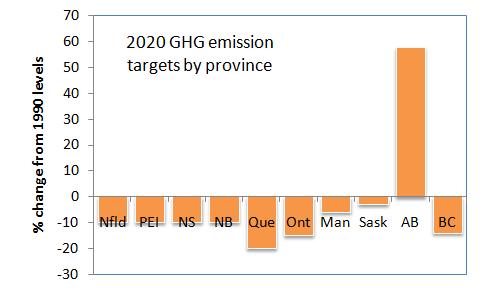
The Canadian government has decided that their meager 20% emission cut from 2006 levels by 2020 (equivalent to 3% cut from the standard base year of 1990) is tenuous – it all depends on what the US decides to do. (Why even bother having a separate Canadian government if they’re just going to follow all US decisions?)

Wondering why they’re still wasting time? This is why (courtesy of the  Globe and Mail):

Luckily, Canada now has its hands tied, as Obama just announced a target that’s slightly stronger – a 28% cut from 2005 levels by 2020, up from the previous target of 17%.

Funny how these things work out, isn’t it?

Mistakes

I have watched with interest the coverage of the IPCC’s screw-up over the Himalayan glaciers.

“Screw-up” is really the best way to describe it. It really shouldn’t have happened. WG2 cited a secondary source that cited something else that cited something else that turned out to be an erroneous New Scientist article. The reviewers of WG2 did realize that something was wrong with the citation, but the editor didn’t bother to take the statement out while they investigated it, and then their deadline passed. Long story short, the Himalayan glaciers are definitely not going to disappear by 2035.

However, what the mainstream media considers “the IPCC report” is generally only WG1, and more specifically the WG1 Summary for Policymakers. This Himalayan glacier claim was in the lower-profile WG2, and it didn’t even make it into any of the WG2 summaries. If it had, the chances of it slipping through would have decreased dramatically. As it was, the mistake was present in one paragraph of the 938-page WG2 which is one of three sections of the fourth edition of the IPCC report. Not very high-profile, as these things go.

It’s strange, though, to watch the media coverage of this screw-up. It ended up in my BBC News feed, and according to one of my teachers, in the Globe and Mail as well as the local newspaper I just gave up on. That’s fine, as I didn’t see the kind of blatant misquotes and jumps in logic as during the CRU reporting. However, it makes me wonder – why weren’t all the other IPCC mistakes reported?

The IPCC tries to be centrist, and to report the median opinion of the climate science community. The more extreme claims on either end of the spectrum are given minimal attention. Therefore, the IPCC is bound to make some mistakes. However, with the exception of this screw-up, virtually all the mistakes have been on the side of “oops, it’s going to be worse than we thought”.

Take the Copenhagen Diagnosis, a 2009 report written by a dozen or so top climate scientists around the world. Its purpose was to update policymakers, in time for Copenhagen, on what had been learned since the AR4. Here are the major discrepancies they found:

  • From 2007-2009, there was about 40% less Arctic summer sea ice than the IPCC predicted, far exceeding its worst-case scenarios.
  • Recent global average sea-level rise is about 80% more than the IPCC predicted.
  • By 2100, global sea level is expected to rise at least twice as much as the IPCC predicted.
  • Global CO2 emissions are around the highest scenarios considered by the IPCC.

Hmmm, these areas of discrepancy – emissions, Arctic ice, sea level rise – are a lot higher-profile than one paragraph about the Himalayan glaciers in WG2. But I don’t remember reading about the Copenhagen Diagnosis anywhere other than the climate science blogs I follow. None of the mainstream media outlets I follow covered it. Did anyone else see it somewhere?

I encourage the reporting of scientific mistakes, as long as the journalism is accurate. Doesn’t it seem strange, though, that the findings of the Copenhagen Diagnosis went virtually unnoticed – while the Himalayan glacier screw-up was covered in every major newspaper in the world? Who is choosing to frame the IPCC as alarmist – rather than its true centrist position – and why?

NASA Speaks on 2009

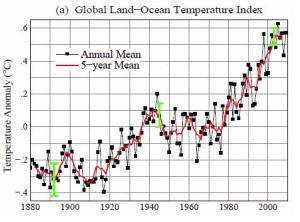
I’d been watching the GISS page closely, to no avail, but it turns out that the annual summation for 2009 global temperatures was posted on James Hansen’s Columbia page.

(Click on the graph for a better resolution in the Columbia document.)

2009 is the second warmest on record, “but it is so close to 1998, 2002, 2003, 2006, and 2007 that we must declare these years as being in a virtual tie as the second warmest year,” says Dr  Hansen. 2009 is probably the warmest among those years, and 2006 is probably the coolest.

2009, especially the spring and summer, was quite chilly in my area, so this is a perfect example of the difference between regional and global temperature. Global temperature reflects the amount of infrared radiation in the atmosphere; regional temperature reflects how that energy is distributed.

NCDC’s preliminary calculations, however, show 2009 as the fifth warmest on record. What are the reasons for this discrepancy? Do they monitor Arctic temperatures differently than NASA, like the British Met Office does?

Hopefully, this will be the end of “global warming stopped in 1998” comments. But maybe the usual suspects will keep saying it and hope nobody notices, or say “global warming stopped in 2005” instead.