Too Much at Every Level

I think that action to mitigate climate change has been so slow (in many cases, nonexistent) partly because the problem is just so massive. At every single level – individual, politician, government, country – people think that they can’t possibly solve it on their own, so there’s no point in trying at all.

It’s not the same kind of problem as something like world poverty, or disease in developing countries. In a way, I wish it was. It’s not really possible for a single person to solve these problems either, but at least they can solve it for someone. They can pay for a child’s education in Africa. They can build a well with clean water for an entire community. These types of problems are measured in increments, rather than gradients – just like the corpuscular theory of light. The problem comes in small packages of one person each, and even if you can’t eliminate the problem for everyone, you can chip away.

Conversely, climate change is a gradient, and one that is very resistant to reversal. Even if a family manages to completely eliminate all sources of carbon emissions in their life, they’re only preventing a fraction of a fraction of a fraction of a degree of warming. 2.999997 C warming isn’t very different to 3 C. And that difference of 0.000003 C isn’t changing the life of a child. (These are just arbitrary numbers, don’t quote me on them!) Really, it isn’t having any impact at all. So most people don’t even bother. They feel so powerless – after all, this problem is far too big for them to solve.

I believe that individual action on climate change is definitely worth it, but in a more symbolic manner. No, composting your kitchen waste isn’t going to eliminate enough methane to make a difference in the global radiative forcing of greenhouse gases. But it gets you in the right mindset. It makes you stop and think about the planet and the future. And the chance that you might inspire all your friends and neighbours to compost as well, who would then inspire all of their friends, and eventually start a chain reaction that could, conceivably, start to make a difference, is just too good to pass up. (Besides, composting is fun to watch. We get some very cool slugs hanging out around ours this time of year.)

Regardless, the feeling of powerlessness becomes the norm, to the point where even politicians don’t think they can make any difference. I have a friend who asked his MP, a Liberal, what she was going to do about climate change. Her response was, “What can I do? I’m only one person.” I find it absolutely astounding that a politician who represents tens of thousands of people, and who helps to govern the entire country, could have this attitude. It’s kind of sad when even our Members of Parliament feel powerless.

Of course, Canada’s national position on climate change action is “whatever the States decides, and we won’t do anything at all unless and until they do”. The federal government feels powerless too, because (as they constantly remind us) Canada produces only 2% of the world’s greenhouse gas emissions. What’s the point of reducing them if the U.S. isn’t going to do the same?

We all know that the U.S. isn’t going to pass cap-and-trade any time soon. It looks like the Republicans are keeping their promise of preventing Obama from passing any more sweeping legislation, after the health care bill. And a big reason (or at least a common excuse) for this lack of initiative is that India and China will soon produce most of the world’s carbon emissions. What’s the point of the U.S. making any mitigating effort if the soon-to-be-major-players won’t?

What federal governments fail to realize is that they have far more power than they give themselves credit for. If the U.S. decides that they want a global economy of clean energy, they have enough influence over the market to make that happen. If Canada decides that tar sands actually aren’t such a good idea after all, all the countries that import from us will have to find alternatives. But this hasn’t happened, because governments are far more concerned about the next election.

At times like these, I just want to look politicians in the eyes and tell them to wake up. Stop playing games, pointing fingers, and sabotaging your enemies. Remember that your job is to look out for us, and start getting serious on a crisis that is unprecedented in all of human history – one that we could all avoid, even now, if you just got your acts together.

I am now a voting member of the public, a legal adult. And I don’t have a clue who to vote for, because nearly every politician has lost my support. If they cared at all about the kind of world I will live in after they are gone, and the kind of world the children I hope to have will live in after I am gone, they would start doing their jobs. I think I will find myself voting against politicians, rather than for politicians. I will vote for those who are the least bad, so that the worst don’t get into office.

I am not optimistic about climate change, but I know that we have a chance to prevent the worst of it. I am not optimistic, but I do not feel powerless. I believe in the power of knowledge and inspiration and culture. I believe in the potential of accomplishing a great deal in a short period of time. At some point in this chain of people who are overwhelmed or apathetic, something needs to give.

Forcings

Last time, we talked about the energy budget – the process of radiation coming in from the sun, being absorbed by the Earth, and then emitted as infrared radiation, which we perceive as heat when it hits us. Remember that this outgoing emission of energy is what determines the temperature of the Earth.

So how can the temperature of the Earth be changed? Naturally, there is a lot of year-to-year variation. For example, when the oceans absorb radiation from the sun, they don’t always emit it right away. They will store energy for a long time, and sometimes release lots at once, during El Nino. This kind of internal variability makes the average global temperature very zig-zaggy.

We need to revise the question, then. The question is not about the average global surface temperature – it’s about the amount of energy on the planet. That’s generally how the climate is changed, by increasing or decreasing the amount of energy the Earth emits as infrared radiation, and consequently, the temperature.

There are two ways to do this. The simplest method is to change the amount of incoming energy. By increasing or decreasing the amount of solar radiation that hits the Earth – either directly, by changing the sun’s output, or indirectly, by increasing the albedo or reflectivity of the Earth – the amount of infrared radiation emitted by the surface will also increase or decrease, because incoming has to be equal to outgoing. The change in outgoing radiation will often take a bit of time to catch up to the change in incoming radiation. Until the two reach a new equilibrium, the Earth will warm or cool.

Another way to change the Earth’s temperature is by artificially changing the amount of incoming energy. The same amount of solar radiation reaches the Earth, but when it is absorbed and emitted, some of the emitted infrared energy gets bounced back so the Earth has to absorb and emit it again. By processing the same energy multiple times, the temperature is a lot warmer that it would be without any bouncing. We refer to this bouncing as the “greenhouse effect”, even though greenhouses work in a completely different way, and we will be discussing it a lot more later. By increasing or decreasing the greenhouse effect, the temperature of the Earth will change too.

A change in incoming energy is referred to as a radiative forcing, because it “forces” the Earth’s temperature in a certain way, by a certain amount. It is measured in watts per square meter (W/m2), and it doesn’t take very many watts per square meter to make a big difference in the Earth’s temperature. The resulting change in temperature is called a response.

My favourite analogy to explain forcing and response uses one of the most basic physics equations – F=ma. Mass (m) is constant, so force (F) is proportional to acceleration (a). Applying a forcing to the Earth is just like pushing on a box. If the force is big enough to overcome friction, you get an acceleration – a response.

It’s also very important to use net force, not just any force. If there are two people pushing on the box in different directions with different amounts of force, the acceleration you observe will be equal to the result of those forces combined. Similarly, there are often multiple forcings acting on the climate at once. The sun might be getting slightly dimmer, the albedo might be decreasing, the greenhouse effect might be on the rise. The response of the climate will not match up to any one of those, but the sum of them all together.

Here is a video I made last year, in collaboration with Climate Change Connection, about this very analogy:

In future posts, I will be discussing different forcings in more detail. Stay tuned!

Snowball Earth

Of all the books I have read about climate change, Snowball Earth, by Gabrielle Walker, is definitely one of the best – and it’s not even about the current climate change.

Part of what makes it so good is the style of writing. As the Los Angeles Times said about her later book, An Ocean of Air, “Walker has a Ph.D. in chemistry, but she writes like a poet.” And, indeed, after an education at Cambridge, Walker has spent most of her career as a science journalist. It’s sort of sad that this doesn’t happen more often. Usually, those who understand a subject best are not the ones who communicate it. Walker is the exception to this rule.

Take, for example, this passage about the history of life on Earth:

Stretch your arms out wide to encompass all the time on Earth. Let’s say that time runs from left to right, so Earth was born at the tip of the middle finger on your left hand. Slime arose just before your left elbow and ruled for the remaining length of your left arm, across to the right, past your right shoulder, your right elbow, on down your forearm, and eventually ceded somewhere around your right wrist. For sheer Earth-gripping longevity, nothing else comes close. The dinosaurs reigned for barely a finger’s length. And a judicious swipe of a nail file on the middle finger of your right hand would wipe out the whole of human history.

Another impressive aspect of Walker’s writing is her characterization. Wacky, stubborn, and exuberant scientists are brought to life. Instead of just hearing about their work and accomplishments, you feel like you’re getting to know them as people. She writes about arguing scientists particularly well. Arguing scientists are so much fun to read about – that’s one reason I loved The Lost World by Arthur Conan Doyle.

However, the best part of this book, by far, is the subject matter. The theory of Snowball Earth is possibly the most awesome thing I have ever heard about. Here’s how the story goes:

From what paleontologists can see preserved in fossils, complex life arose at a very specific point in prehistory: the end of the Precambrian. For several billion years before that, the only thing that lived on Earth was unicellular goop. But then, suddenly, all at once, complex organisms burst onto the evolutionary stage.

Something must have caused this dramatic appearance, and a series of scientists from the 1940s on – most prominently, Paul Hoffman – likely have discovered what. At the end of the Precambrian, there are signs of ice in rocks all over the world – scratches, rock deposits, everything that led Agassiz to discover the ice ages.

Because plate tectonics moves everything around so much, though, rocks were not necessarily formed at the location they sit today. Their magnetic field is what discloses their birthplace. Tiny bits of magnetic material, such as iron, line their field up with the Earth’s. The Earth’s magnetic field is perpendicular to the surface at the poles and parallel to the surface at the Equator, like this:

So, if a rock’s magnetic field is vertical, it was formed at the poles. If it is horizontal, it was formed at the equator. Incredibly, scientists found Precambrian rocks, with signs of ice, with horizontal magnetic fields. During that period of prehistory, the equator was covered in ice – and, therefore, the whole planet, because it’s not really possible to freeze the equator without freezing all the other latitudes too.

The scientists determined that, for several instances on the Precambrian, the continents were arranged in a way that was very conducive to ice-albedo feedback. With the smallest trigger, ice from the poles would creep across the temperature zones and meet at the equator. Frozen oceans, frozen land, the whole bit.

And now CO2 comes into the story. Volcanic eruptions naturally release carbon dioxide, but the amount is so small that the oceans have no trouble soaking them up – unless they’re frozen on the surface and cut off from the air. CO2 would gradually build up, in that case, and millions of years later, the greenhouse effect would be so strong that all the ice would melt and the planet would plunge into a state referred to as Hothouse Earth. Then the oceans would start absorbing all the extra CO2, and ice would reappear at the poles, and the cycle would begin again.

Many scientists believe that these Precambrian cycles of extreme heat and extreme cold provided such a strong pressure on organisms that natural selection was pushed to new boundaries. Complex life had an advantage in these extreme conditions, and it flourished. The most catastrophic climatic event our planet has ever experienced, in our knowledge, was what led to the evolution of multicellular organisms, and eventually, us.

It makes me feel very small, the same way that attempting to comprehend the vastness of the universe makes me feel very small. The life we see all around us only exists because of a series of coincidences. Human beings, one of the youngest of the millions of animal species that have ever existed, are alive because of continental drift lining things up in the right way. And who knows what would have happened if things had been slightly different?

All Is Not Lost

I really enjoyed reading two recent polls conducted by George Mason University’s Center for Climate Communication. In particular, the results made me wonder why the US government still hasn’t passed a climate bill.

For example, US presidents have been saying for over a decade that it is unfair to force their industries to reduce emissions if developing countries do not have similar targets. However, only 8% of American adults share this view, and 65% believe that “the United States should reduce its greenhouse gas emissions regardless of what other countries do.” 77% agree that CO2 should be regulated, and 65% would like to see an international treaty signed.

The only solution which had less than 50% support was a tax on gasoline, even if it was revenue-neutral: offset by a decrease in income tax rates. This opposition can’t really be a case of people worrying about money. In this hypothetical situation, taxes aren’t being increased – they’re just being moved around, in a way that actually gives people more control over how much they are charged. Perhaps the public would prefer a more laissez-faire approach, or perhaps they had a knee-jerk reaction to the word “tax”. It’s not like the revenue-neutral aspect of this solution is well-known to most.

When the poll was broken down by political party, there were some surprising results that ran contrary to what one hears in the halls of Congress. 64% of Republicans support regulating CO2. Only 30% think that protecting the environment reduces economic growth and costs jobs.

Overall, the poll showed very strong support among Americans for action that still hasn’t happened, largely because a very vocal minority has had a disproportionate influence on the policy debate. If there was a referendum today, Kyoto targets and the cap-and-trade bill would pass with flying colours.

This support was even more interesting when compared to the questions regarding science. Only 61% of Americans think that the Earth is warming, and only 50% think that it is due to human activities. 45% think “there is a lot of disagreement among scientists about whether or not global warming is happening”, and only 34% were aware of the existing consensus.

The discrepancy between scientific understanding of the issue and support for mitigation shows that Americans, in general, practice risk management when it comes to climate change. Even if they’re not sure whether or not there is a problem, they understand what is at risk, and are willing to take action to prevent major consequences. Greg Craven, you got your wish.

I think that the misconception of a voracious scientific debate, apart from being perpetrated by the media, stems partly from the fact that most of the public lacks the experience to distinguish between scientific and quasi-scientific debates. Competing hypotheses, published in leading journals, seen as the frontier of the field….that’s a scientific debate. Editorials, written by anyone other than a scientist publishing in the field, claiming to refute an overwhelming consensus? Can’t even come close. However, I suspect that many would categorize the second as “scientific debate”, simply because it’s their only encounter with science.

All is not lost, though. 81% of Americans trust scientists as a source of information about global warming. That’s more than they trust any other source that was mentioned in the question. And 20%, 27%, and 29% say that they need a lot more, some more, or a little more information, respectively. Maybe all that needs to happen is for us to speak louder – because people are ready and willing to listen.

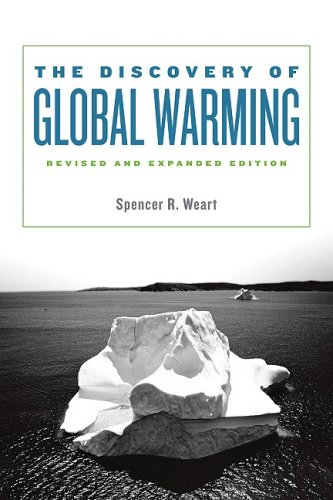
The Discovery of Global Warming

A common remark I make about climate change books I like is that “it wasn’t like a textbook”. I like non-fiction books that I can carry around and read cover-to-cover just like I would a novel. I like them to draw me in and catch my interest as if they were a suspenseful PD James or just a comfortable Maeve Binchy.

The Discovery of Global Warming, by Spencer Weart, had all of these qualities and more: It contained as much information as a textbook, even if it didn’t read like one. That, I think, is the benefit of science history. It can be written in a way that is compelling as fiction, but it’s all true.

I think I will place this book near the top of my list of resources for concerned citizens who are looking for more information on climate change. It is so helpful because, instead of saying “scientists are confident that humans are causing the Earth to warm”, it traces back through history and follows this discovery all the way through, from Fourier to the AR4. We see the top of the credibility spectrum in action, and examine exactly where the conclusions of the scientific community came from.

There are lots of great details in this book to sink your teeth into. How did the Cold War pave the way for much of our knowledge about the atmosphere? Why does chaos theory apply to weather models much more than climate models? And, of course, my very favourite – the 1970s aerosol debate. How did scientists realize that the warming force of greenhouse gases would overpower the cooling force of aerosols, long before the warming was actually observed?

All of this is written in an incredibly elegant and engaging tone. Weart’s style of writing somehow reminds me of Sir Arthur Conan Doyle in The Lost World – succinct characterization, unintended (or just well-hidden) satire, a calm detachment from the story that somehow makes it all the more fascinating.

I read the “Revised and Expanded Edition”, so I’m not sure if all editions of The Discovery of Global Warming contain all the extras in the back: a timeline, an index, and a chapter entitled “Reflections” that is full of Weart’s musings about risk management and science communication. “Unlike, say, the orbits of planets,” he writes, “the climate in the future actually does depend in part on what we think about it. For what we think will determine what we do.”

A tangible alternative to the more comprehensive online version (really, who wants to read a book by navigating a web of links and scrolling through chapters on a computer screen?), The Discovery of Global Warming is worth every cent, and every minute of your time it takes to read it. I look forward to future volumes as this story continues to unfold.

We Have Slides!

After a marathon PowerPoint-session yesterday I finally got my 63 slides out of the way. Here is the presentation for anyone who is interested. The script is written in the notes beneath the slides.

I like to have things fading in and out of my slides, so sometimes the text boxes and images are stacked on top of each other and it won’t make sense until you view the animation.

Researching the median lethal dose of arsenic during my spare at school was really awkward. I had to do a lot of hasty explaining to my friends about how it was a metaphor for small concentrations having large effects, and no, I wasn’t planning to poison anyone.

Anyway, enjoy.

Mind the Gap (12 MB)

Another Good TED Talk

Something I’ve been pretty interested in for the past few weeks….geological eras, mass extinctions, and the role of climate change in anoxic events. Enjoy…not that this is very enjoyable stuff, it’s kind of icky in fact, but it is fascinating.

Mind the Gap

This is the script of a presentation I will make to several groups of high school students on Earth Day. I was originally going to use the same script from my PowerShift presentation, but in light of recent developments and my ever-expanding thoughts on climate change, I decided to create an entirely new presentation.

I would greatly appreciate any thoughts, input, suggestions, etc. Keep in mind that I don’t have my PowerPoint created yet, so some of the text may seem a little confusing without the visuals I’ll be pointing to.

Enjoy!

Update: Thanks for all the helpful comments and critiques. I’ve made some changes here, but feel free to keep them coming.

Welcome everyone, nice to see you all here. My name is Kate, I’m in my last year of high school, and I am here to talk to you about climate change, or global warming. After I graduate I want to be a climate scientist, so until then, I’m channelling my obsession into a website. For the past year, I’ve been writing the blog ClimateSight.org, which has allowed me to meet a lot of cool people and correspond with a lot of scientists.

I’ve spent several years doing a lot of research on climate change, and something that’s been really interesting to me is the link between climate scientists and the public – the communication between these two groups. And the very first thing I want to talk about is assessing credibility, which is probably the most important tool I can give you. How much weight should you give different statements from different sources about scientific issues?

The scientific community that is actually studying the issue is going to be more credible than the media and the public. And that scientific research starts with scientists. They write peer-reviewed articles, published in journals like Nature or Science. Anything that is a serious scientific idea will be in one of these journals at some time or other. But there are thousands of journal articles published every month, and because they’re generally studying the frontier of their field, it’s inevitable that some of them are going to be proven wrong later. That’s why there are scientific organizations and assessment reports that look back at all these papers and compile what we know about the major issues. So statements from organizations like NASA, or from assessment reports like the IPCC, means that something has stood the test of time.

Among all the people who are not scientists, some know more than others. People who communicate science, like journalists and high school teachers and some politicians, are held a little more accountable for what they say than just any random person on the street.

So let’s see what the different levels of the credibility spectrum say about global warming. Who would disagree – who would say that humans are not causing the Earth to warm? 0% of scientific organizations say no. Pretty much 0% of peer-reviewed articles say no – there is the odd one out there, but they’re so small in number that they round right down to zero. And less than 3% of publishing climatologists say no. But 57% of articles in leading newspapers say no (or probably not, or maybe, maybe not), and 53% of the public says no.

As you can see, there is a big gap right here. The top half of the credibility spectrum is very confident about human-caused global warming, and the bottom half is very confused. Why is this? How can an issue that is so important to public policy have such drastically different levels of support between those who study it and everyone else?

There are all kinds of common objections that you and I hear about global warming. What if it’s a natural cycle and we’re just coming out of an ice age? What if the Sun is heating up? And how could there possibly be global warming when it is so cold outside? There are all kinds of arguments against the idea of climate change that everybody knows. But the scientific community is still saying this. They are still sure that yes, it’s going on and yes, it’s us.

So there are three possible explanations. Scientists could be ignorant and overconfident. Maybe they never considered the idea it could be a natural cycle. Scientists could be frauds, part of some Communist conspiracy to take over the world somehow. Or, maybe scientists know what they’re doing, and have evidence to say what they’re saying. So let’s look at the evidence that they do have.

We’ve been studying this problem for a long time, and it all started in the 1800s, when the greenhouse effect was discovered – the gases in the atmosphere that trap heat and keep the planet warm enough for life. The idea that emissions of carbon dioxide from our burning of fossil fuels – like coal, oil, and natural gas – would eventually cause warming was first proposed in 1896. So this is not a new theory by any means.

We began measuring the carbon dioxide content of the atmosphere in the 1950s, and we can see that it’s steadily going up. Over the last 2.1 million years, CO2 never exceeded 300 ppm, but right now it’s at 390. This might not seem like a lot, but 390 ppm of arsenic in your coffee would kill you.

We can confirm that this increase in CO2 is due to human activity because of its isotopes. The carbon in CO2 from fossil fuels has fewer neutrons, on average, than CO2 from natural sources like volcanoes or the ocean. That makes it lighter, so we can tell the difference in samples from the air.

So we know that an increase in greenhouse gases causes warming, and we know that we are increasing greenhouse gases. So it’s not really a surprise that we’re starting to see the warming show up. There are five independent research teams worldwide that measure the average global temperature, some from weather stations and some from satellites, and all five of them are finding a very similar pattern of warming since about 1975.

But what if it’s a coincidence? What if something else was causing the warming, and it just happened to be at the same time that we were dumping fossil fuels into the air? Something that a lot of people don’t know is that there are ways that we can confirm that the warming is caused by us. First of all, there’s nothing else going on that could be causing it. Actually, if you took human activity out of the picture, we would be slowly cooling: the cycles of the Earth’s orbit show that we should be very very slowly going into a new ice age.

There is also a specific pattern of warming we can look at. If warming were caused by the sun, the entire atmosphere would warm in a uniform fashion. But if greenhouse gases were causing global warming, the first layer of the atmosphere (the troposphere) would be warming, but the next layer up, the stratosphere, would be cooling. This is referred to as the “fingerprint” of greenhouse warming, because it’s like DNA evidence or the smoking gun. And that’s exactly what we’re seeing – stratospheric cooling. (Randel et al, 2009).

So we can be very sure that yes, our activities are causing the Earth to warm, at a rate that we haven’t seen for at least the past 55 million years, which was before humans even existed. That’s really the problem – the rate of change. It’s not the actual temperature that poses a threat, it’s all about how much it changes and how fast. The world has been plenty warmer than this at times, like when dinosaurs were around. And dinosaurs were okay with that because it had been like that for a really long time and they had adapted to it. But a change in temperature at the rate we’re seeing now? It might seem slow to you and me, but on a geological timescale, it’s incredibly quick, too quick for species – including humans – to adapt. Yes, the climate has changed many times before, but it never really ended well.

For example, the largest extinction in our Earth’s history, the Permian extinction 250 million years ago, was most likely caused by warming from greenhouse gases that came out of supervolcanoes much larger than anything we have today. It got so warm that the ocean couldn’t hold any oxygen and produced hydrogen sulphide instead. That’s what makes rotten eggs smell bad, and it’s actually poisonous in large enough quantities. It killed 97% of species in the ocean and 70% of species on land. It has been nicknamed “The Great Dying”. So this is the absolute worst-case scenario of what can happen when too many greenhouse gases go into the atmosphere at once. It means a whole lot more than just nicer Winnipeg winters.

So, to the people who really look at this issue, the evidence is undeniable. In academic circles, there really is no argument. All the objections that we have – they thought of them long ago, and covered them all, and ruled all of them out, before you and I even knew what global warming was. The evidence for climate change is not a house of cards, where you take one piece out and the whole theory falls apart. It’s more like a mountain. Scrape a handful of pebbles off the top, but the mountain is still there.

As for the second option, that scientists are part of a conspiracy – if you stop and think about it, like, really? Scientific fraud happens, but on the scale of one paper, or at the most one scientist, not an entire field stretching back for over a century. Scientists are not that organized. And that only leaves one explanation – that the field of climatology does know what it’s doing, and does have evidence to say what it’s saying: that humans are causing the Earth to warm, and it’s not going to be good.

We’ve established that the top half of the credibility spectrum is the one that we can trust on this issue. So what’s going on in the communication between the top and the bottom so that the public has got totally the wrong idea? This is what I spend most of my time working on, and there are a lot of factors involved, but it really comes down to three points.

Firstly, climatology is a complex science, and it’s not a required course in high school, so the public doesn’t understand it the way they understand Newton’s Laws of Motion. Most people do not know all this stuff I just told you, and that’s only scratching the surface; there is so much more science and so many more lines of evidence. And when you only have bits and pieces of this story, it’s easy to fall prey to these kinds of misconceptions.

Second, there are, sadly, a lot of people out there trying to exploit number one. There are a lot of very prominent people in the media, politics, and industry who will use whatever they can get – whether or not it’s legitimate, whether or not it’s honest – as proof that global warming is not real. You’ll hear them say that all scientists said an ice age was coming in the 70s, so we shouldn’t trust them now. In reality, most scientists were predicting warming by the 70s, and the single paper to talk about an ice age was proven wrong almost immediately after its publication. You’ll hear them say that volcanoes emit more CO2 than humans, but volcanoes only emit about 1% of what we do. They’ll say that the Greenland ice sheet is getting thicker, so therefore, it cannot be warming. But the reason that Greenland is getting thicker is that it’s getting more snow, caused by warmer temperatures that are still below zero.

Some of these questionable sources are organizations, like a dozen or so lobby groups that have been paid a lot of money by oil companies to say that global warming is fake (Hoggan and Littlemore, 2009). Some of them are individuals, like US Senator James Inhofe, who was the environment chair under George W. Bush, and says that “global warming is the greatest hoax ever imposed upon the American people.” Some of them have financial motivations, and some of them have ideological motivations, but their motivations don’t really matter – all that matters is that they are saying things that are inaccurate, and misleading, and just plain wrong.

The third reason that the public is so confused about climate change is that the media has been very compliant in spreading the message of these guys. You would expect that newspapers and journalists would do their research about scientific issues, and make sure that they were writing science stories that were accurate, but sadly, that’s not what’s happening.

One of the major problems is that there are fewer journalists than there used to be, and there are almost no science journalists in the mainstream media – general reporters cover science issues instead. Also, a few decades ago, journalists used to get a week or two to write a story. Now they often have less than one day, because speed and availability of news has become more important than quality.

And, finally, when it comes to climate change, journalists follow the rule of balance, or presenting “two equal sides”, staying neutral, letting the reader form their own opinion. This works really well when the so-called controversy is one of political or social nature, like tax levels, a federal election, how we should develop infrastructure. In those cases, there is no real right answer, and people usually are split into two camps. But when the question at hand is one of science, there is a right answer, and some explanations are better than others. Sometimes the scientists are split into two equal groups, but sometimes they’re split into three or four or even a dozen. And sometimes, like we see with climate change, pretty much all the scientists are in agreement, and the two or three percent which aren’t don’t really publish, because they can’t prove what they’re saying and nobody really takes them seriously. So framing these two groups as having equal weight in the scientific community is completely wrong. It exaggerates this extreme minority, and suppresses everyone else.

All these problems are perfectly explained by a man named James Hrynyshyn, a journalist himself. He says, “Science journalism….is too often practiced by journalists who know so little about the subject they’re covering that they can’t properly evaluate the reliability or trustworthiness of potential sources. The result is that sources with no credibility in the field routinely appear alongside genuine experts as part of an effort to provide balance.”

One of the best examples of how this kind of journalism can really go wrong happened quite recently. Someone hacked into the email server of the Climatic Research Unit in the UK, stole thirteen years of emails between scientists, sifted through them all to find the juiciest ones, and put them on the Internet. The police are trying to figure out who did this, because it’s quite illegal, but it wasn’t some teenage kid in their basement.

Some of the emails certainly were embarrassing, the scientists said some things that weren’t very nice and insulted some people. But can you imagine if all of your email was released to the world? Scientists are people too, and they say stupid stuff that they don’t mean over email just the same as you and I do – especially when there are so many people actively spreading lies about their work.

The most important thing, though, is that there was nothing in there that compromised any science, any data sets, anything that we know about climate change. Nothing actually changed…..but the scary part was that a striking amount of the media reported that the entire field of climate science was potentially a political scam.

For example, some scientists are working on reconstructing temperatures from before we had thermometers, using tree rings or ice cores or ocean sediment. In one of the most widely circulated emails, the scientists discussed how to “hide the decline” in a set of tree ring data that’s known to have some serious problems – the tree growth is going down while thermometers show local temperatures going up, which is the opposite of what you’d expect. It probably means there was a drought or something. So they were trying to see if they could still use the first part and cut out the useless part at the end. They’re only hiding it in a mathematical sense, they’re not hiding it from their colleagues or from the media. In fact, they’ve written about this decline in one of the most prestigious scientific journals in the world, so if they’re trying to pull off a conspiracy here, they’re not doing a very good job.

But somehow, in the media, the story changed. Instead of saying that scientists were “removing regional tree ring data known to be erroneous,” the media said they were “covering up the decline in global temperatures”. That’s so fundamentally different, so removed from the facts – these scientists don’t even work with global temperatures! – but you heard it everywhere. The story that reached virtually every newspaper in the world was that the world is cooling and scientists are trying to hide it from us.

That’s only one example of how a single phrase can be taken out of context and have its meaning completely twisted. It doesn’t surprise me, you see it from these guys all the time, but what absolutely amazes me is how the media just sat and lapped it right up without doing any research into the validity of these serious allegations.

Subsequently, two independent investigations into the contents of these emails have been released, and the scientists involved were basically cleared in both cases. The British Parliament found that “the focus on CRU has been largely misplaced”, that the scientists’ “actions were in line with common practice”, that “they were not part of a systematic attempt to mislead”, and that all of the CRU’s “analyses have been repeated and the conclusions have been verified”. (British House of Commons, 2010). The University of East Anglia found “no evidence of any deliberate scientific malpractice in any of the work of the CRU”, “no hint of tailoring results to a particular agenda”, and that “allegations of deliberate misrepresentation and unjustified selection of data are not valid”. (UEA, 2010) So this affirms what the climate science community already knew: the stolen emails do not change the science one bit.

But look at what newspapers told us for weeks on end. Every time the Winnipeg Free Press mentioned the emails, they would say something along the lines of, “The correspondence appears to suggest researchers may have manipulated data to exaggerate global warming.” These are very serious allegations to make, and they were made without evidence in serious, credible and widely read newspapers, and they’re not being retracted or corrected in the media now that the investigations are coming up clear.

Spencer Weart, who is a science historian, had some great words to say on this issue: “The media coverage represents a new low. There are plenty of earlier examples of media making an uproar without understanding the science….but this is the first time the media has reported that an entire community of scientists has been accused of actual dishonesty. Such claims….would normally require serious investigation. But even in leading newspapers like The New York Times, critics with a long public record for animosity and exaggeration are quoted as experts.”

Many of the scientists featured in the emails received death threats. Phil Jones, the director of CRU, says that he’s been suicidal. The story of these stolen emails is not a story of scientists engaged in conspiracy – it is a story of how desperate some people are to make it seem that way, and how gullible and irresponsible the mainstream media can be.

And not long after that, story after story broke that the IPCC, which is a huge UN publication about everything we know about the science of climate change, had all kinds of mistakes in it. So what were these mistakes? In 3 000 pages, two examples of overestimating climate change were found. First, the report said that the Himalayan glaciers would disappear by 2035, and we now know that it’s going to take a lot longer than that. Second, it said that 55% of the Netherlands is below sea level, when in fact 55% of the Netherlands is susceptible to flooding, and only some of that is below sea level. This last one is background information. It really isn’t all that relevant.

So should that have happened? No. But does it actually matter to our understanding of the science? No.

Then several British journalists managed to invent five or six other “IPCC scandals”. When these were investigated more seriously, they were found to be completely false. But they were still reported in virtually every newspaper around the world. Again.

However, the IPCC has made a lot of mistakes, much more serious than these, that none of the newspapers are reporting. The difference is that the mistakes that make the media scream scandal are examples of overestimating climate change, while the ones you don’t hear about are examples of underestimating climate change. There was recently a report published that evaluated the last IPCC report, and this is what it found:

Over the past three years, there was about 40% less Arctic summer sea ice than the IPCC predicted, and melting in the Arctic is far exceeding its worst case scenarios. Recent observed sea level rise is about 80% more than the IPCC predicted.  Global sea level by 2100 is expected to rise at least twice as much as the IPCC predicted. (Copenhagen Diagnosis, 2009)

So which seems more important? The exact date at which a specific glacier is expected to melt? Or the amount of sea level rise we can expect all over the world? I have yet to find a newspaper in the world that covered this, but I have yet to find a newspaper in the world that did not cover this. Yes, the IPCC makes mistakes, but they are almost always mistakes that say, “oops, it’s going to be worse than we thought.”

So, as you can see, the real message about the reality and severity of climate change is not getting through. Communication of science is always important, but it’s especially important for climate change, because it could potentially screw up our civilization pretty bad, and we want to minimize that risk.

Scientists, in general, are not that great at public communication – that’s why they’re scientists and not journalists or salesmen or whatever. They want to sit in the lab and crunch numbers. And there’s always been sort of a stigma in the scientific community against talking to the media or the public. But the one good thing about all these rumours and all this awful journalism is that it’s finally making the scientific community wake up and realize how bad things are and how much their voice and their input is needed.

In the period of just a few months, over 300 American climate scientists signed an open letter to the US government about how two small mistakes in the IPCC do not impact the overall message that humans cause climate change, and should not impact our efforts to stop it.

And the National Academy of Sciences, which is one of the most prestigious organizations in the world – 1 out of 10 members have a Nobel Prize – has all sorts of plans for public lectures and articles in newspapers and a science show on prime time television.

The one good thing about things getting this bad is that it makes the people involved mad enough to step up and finally try to stop it. To finally narrow this gap that has existed for so long. That’s why I’m here today, that’s why I’ve been writing my blog for over a year, because I’m mad, and if I don’t do anything about it my head is going to explode. I cannot just sit and watch while these rumours threaten our ability to preserve a good future for me and for us and for everyone who will come after us. And I sincerely hope that all of you will not just sit and watch it happen either. We need to fix this together.
Something Unexpected

The differences between the Canadian and American political systems amaze me.

Whenever anyone mentions greenhouse gas emissions reductions in the States, people argue, journalists rant about dire economic costs, and Senators stand up and say that cap-and-trade is completely unnecessary because CO2 is plant food.

But here in Canada, the government will be voting on greenhouse gas targets next Wednesday, and I didn’t know a thing about it until DeSmogBlog mentioned it. None of the mainstream media outlets or other Canadian climate blogs I follow said a word about it. Maybe they didn’t know either.

Which is really quite strange, seeing as the federal government likes to call a 3% reduction from 1990 levels “aggressive action” and make a whole website about it, featuring a picture of Stephen Harper planting a tree. You’d imagine that, now that they’re considering a cut of 25% from 1990 levels by 2020, and 80% by 2050, they would make sure that every citizen in the country knew how responsible they were being.

The bill is known as C-311, or the Climate Change Accountability Act, and I encourage you to all read it here, it’s not very long. It’s been around for a few years, and even passed through the House once, but it had to restart several times due to various prorogations. Now it’s finally ready to be voted on by the House, and they’re doing that vote on Wednesday.

I’m not sure how much support this bill has from the MPs, but I sure hope it passes, because it would actually put us in line with the EU. Yes, no more number games of shifting around the baseline years – the proposed targets actually fall within the UN’s recommendations to avoid 2 C of warming.

Something even better about these targets, though, is this:

The Minister shall, within six months after this Act receives royal assent, prepare and lay before both Houses of Parliament an interim Canadian greenhouse gas emissions target plan for the years 2015, 2020, 2025, 2030, 2035, 2040 and 2045. The target plan shall

(a) establish a Canadian greenhouse gas emissions target for each of those years;

(b) specify the scientific, economic and technological evidence and analysis used to establish each target, including consideration of the latest reports from the Intergovernmental Panel on Climate Change and the most stringent greenhouse gas emissions targets adopted by other national governments; and

(c) show that each target is consistent with a responsible contribution by Canada to the UNFCCC’s ultimate objective of preventing dangerous anthropogenic interference with the climate system and with Parliament’s strong commitment to the Kyoto Protocol.

Bill C-311 isn’t just an empty promise. It makes the targets that we need attainable. If we could actually pass this, it would be the first time in my short life that I was impressed with the government and felt that politics was doing its job of protecting the interests of its citizens, rather than squabbling and trying to sabotage the other parties.

Update: It passed! Now on to the third reading. If it passes that, it moves to the Senate.

A Better Term

The past week or so, there’s been a lot of discussion on the blogs I read about whether or not we should use the term “global warming”. Simon Donner covered it, then Michael Tobis put in his two cents, and Peter Sinclair discussed it on live TV. It got me thinking.

The term “global warming” doesn’t cover the implications of a rising temperature, just the fact that the average global temperature is rising. “Climate change” covers everything.

However, the public is far more acquainted with the term “global warming”, so it makes sense to keep it in use so we are understood. However, this term has led to many misconceptions. To the public, it’s often interpreted as “everywhere-in-the-world-all-the-time warming”. So every time it’s cold in Europe, or it snows on the Atlantic Coast, there are comments of “where’s global warming” from the usual suspects, and even reasonable people start to doubt the phenomenon.

Because we’ll never be able to completely replace the term “global warming” with something more accurate, I think it would be best to slightly alter it, in a way that will reinforce the idea of averages rather than variability, even to people who don’t use it. I think we should call it “net global warming“.

Really, this is exactly what the folks at NASA, NCDC, or any of the other global temperature monitoring stations calculate. They add up all the regional anomalies from thousands of weather stations to find a net anomaly for the entire planet. This way, we don’t know precisely what the absolute global temperature is, but we know how much it has changed overall. Some places are warmer, some places are colder, but this single annual value shows us at a glance what the planet’s temperature is doing.

Even that value doesn’t consistently warm every year – we don’t set a new temperature record every year – because the global climate has enough internal variability to slightly change, from year to year, the percentage of the planet’s heat that is stored at the surface, which is what NASA et al measures. La Niña, which made 2008 cooler than previous years, doesn’t actually change the total heat energy stored on earth. It just sucks some of it out of the atmosphere and into the oceans.

Luckily, La Niña has a friend, El Niño, which does the opposite to net global surface temperatures, so they basically cancel each other out every five years or so. All these short-term cycles of variability – ENSO, sunspots – average out over the years, and as time goes on we stop seeing the noise and start to see the trend. Look at the red line in NASA’s graph, rather than the jagged black line, to see less noise and more trend.

If we can get the idea of “net global warming”, rather than “everywhere-in-the-world-all-the-time warming”, into the public consciousness, our collective understanding of this problem will shoot up. Plus, we’ll be less prone to misleading statements like “It’s cold today, so there is no global warming” or “Warming stopped in 1998“.