New Year Gratitude

A very happy 2011 to everyone. I thought I would write a New Year’s post like last year’s.

ClimateSight wouldn’t exist at all without my very best friend and partner, who, after listening for months to my rambles about climate science and policy, set me up with a blog. Since my first post, he has listened to my ideas and provided many of his own, even though he’s not particularly interested in climatology. He is also a source of balance in my life, keeping me sane when news reports and nasty comments start to overwhelm me.

Equally deep gratitude goes to the scientist who first sparked my interest in climate, and who continues to be both a mentor and a friend, as well as a library (I promise I’ll return those books sooner or later). You know who you are!

I have received advice on everything from my comment policy to my course selection from many wise climate bloggers, such as Steve Easterbrook, Michael Tobis, and Tamino, as well as countless others who prefer to read and comment than to write their own blogs – too many to name!

This year, I have become involved in Skeptical Science, a multi-faceted collaboration of scientists and science enthusiasts concerned about the state of climate change communication. It is an honour to be part of the supportive, enthusiastic community of authors, and the articles they write provide hours of fascinating reading and further research.

Last but not least, I must thank the readers and commenters over here. I feel that I get more out of this blog than I put in. My thoughts on a topic don’t end when I hit “publish” – that’s just the beginning, as insights and links to further reading invariably appear in the comments.

I am grateful for more than the people who helped to create this online community, though. I am grateful to live in the age of information when looking up the state of Arctic sea ice takes less than a minute. I am grateful to live in the age of climatology, where the field is expanding throughout virtually every discipline. Finally, strangely enough, I am grateful to live in the age of climate change, to witness this fascinating phenomenon unfold, and (hopefully) to be a part of the generation that stops it in its tracks.

Storms of my Grandchildren

I hope everyone had a fun and relaxing Christmas. Here’s a book I’ve been meaning to review for a while.

The worst part of the recent book by NASA climatologist James Hansen is, undoubtedly, the subtitle. The truth about the coming climate catastrophe and our last chance to save humanity – really? That doesn’t sound like the intrinsic, subdued style of Dr. Hansen. In my opinion, it simply alienates the very audience we’re trying to reach: moderate, concerned non-scientists.

The inside of the book is much better. While he couldn’t resist slipping in a good deal of hard science (and, in my opinion, these were the best parts), the real focus was on climate policy, and the relationship between science and policy. Hansen struggled with the prospect of becoming involved in policy discussions, but soon realized that he didn’t want his grandchildren, years from now, to look back at his work and say, “Opa understood what was happening, but he did not make it clear.”

Hansen is very good at distinguishing between his scientific work and his opinions on policy, and makes no secret of which he would rather spend time on. “I prefer to just do science,” he writes in the introduction. “It’s more pleasant, especially when you are having some success in your investigations. If I must serve as a witness, I intend to testify and then get back to the laboratory, where I am comfortable. That is what I intend to do when this book is finished.”

Hansen’s policy opinions centre on a cap-and-dividend system: a variant of a carbon tax, where revenue is divided evenly among citizens and returned to them. His argument for a carbon tax, rather than cap-and-trade, is compelling, and certainly convinced me. He also advocates the expansion of nuclear power (particularly “fourth-generation” fast nuclear reactors), a moratorium on new coal-generated power plants, and drastically improved efficiency measures.

These recommendations are robust, backed up with lots of empirical data to argue why they would be our best bet to minimize climate change and secure a stable future for generations to come. Hansen is always careful to say when he is speaking as a scientist and when he is speaking as a citizen, and provides a fascinating discussion of the connection between these two roles. As Bill Blakemore from ABC television wrote in correspondence with Hansen, “All communication is biased. What makes the difference between a propagandist on one side and a professional journalist or scientist on the other is not that the journalist or scientist ‘set their biases aside’ but that they are open about them and constantly putting them to the test, ready to change them.”

Despite all this, I love when Hansen puts on his scientist hat. The discussions of climate science in this book, particularly paleoclimate, were gripping. He explains our current knowledge of the climatic circumstances surrounding the Permian-Triassic extinction and the Paleocene-Eocene Thermal Maximum (usually referred to as the PETM). He explains why neither of these events is a suitable analogue for current climate change, as the current rate of introduction of the radiative forcing is faster than anything we can see in the paleoclimatic record.

Be prepared for some pretty terrifying facts about our planet’s “methane hydrate gun”, and how it wasn’t even fully loaded when it went off in the PETM. Also discussed is the dependence of climate sensitivity on forcing: the graph of these two variables is more or less a parabola, as climate sensitivity increases both in Snowball Earth conditions and in Runaway Greenhouse conditions. An extensive discussion of runaway greenhouse is provided, where the forcing occurs so quickly that negative feedbacks don’t have a chance to act before the positive water vapour feedback gets out of control, the oceans boil, and the planet becomes too hot for liquid water to exist. For those who are interested in this scenario, Hansen argues that, if we’re irresponsible about fossil fuels, it is quite possible for current climate change to reach this stage. For those who have less practice separating the scientific part of their brain from the emotional part, I suggest you skip this chapter.

I would recommend this book to everyone interested in climate change. James Hansen is such an important player in climate science, and has arguably contributed more to our knowledge of climate change than just about anyone. Whether it’s for the science, for the policy discussions, or for his try at science fiction in the last chapter, it’s well worth the cover price.

Thoughts from others who have read this book are welcome in the comments, as always.

Just Links for Now…

I apologize for my relative silence recently. I am in the midst of studying for my first set of final exams. To tide you over until that has calmed down a bit, I will share some of the interesting pieces I have read and watched recently.

My study break today was spent watching a fantastic video that Peter Sinclair recently dug up. It’s an hour-long talk by Dr. Ben Santer (see my recent interview with him), with an introduction by the late Stephen Schneider and questions at the end. He tells a very troubling story about “science, non-science and nonsense”. Lots of great quotes in there – I highly recommend giving it a watch.

John Cook from Skeptical Science has compiled his articles and rebuttals into a gorgeous document about the evidence for anthropogenic climate change, written in accessible language with effective graphics on every page. It’s so effective, I would like to print out a few dozen of these booklets and hand them out at the university.

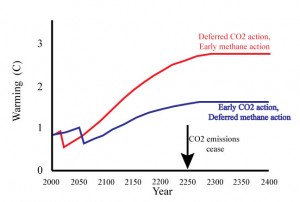
On RealClimate, Ray Pierrehumbert addressed the common policy option of focusing on cutting emissions of methane and soot in the short-term in order to “buy us time” to reduce carbon dioxide. In fact, because these emissions have such a short atmospheric lifetime, it doesn’t really matter whether we focus on them now or later – while concentrations of carbon dioxide, with a lifetime of centuries to millennia, highly depend on when we address it. Take a look at these projections comparing our options:

Michael Tobis, however, thinks that we should focus on non-CO2 emissions despite these realities. Short-term economic and population “crashes” due to sudden warming in the near term could conceivably be more damaging to human security, because it means that we won’t be able to afford any mitigation, further worsening the long-term emissions. Both articles are worth a read.

Well, off to go memorize organic functional groups. Enjoy!

The Real Story of Climategate

A year ago today, an unidentified hacker published a zipped folder in several locations online. In this folder were approximately one thousand emails and three thousand files which had been stolen from the backup server of the Climatic Research Unit in the UK, a top centre for global temperature analysis and climate change studies. As links to the folder were passed around on blogs and online communities, a small group of people sorted through the emails, picking out a handful of phrases that could be seen as controversial, and developing a narrative which they pushed to the media with all their combined strength. “A lot is happening behind the scenes,” one blog administrator wrote. “It is not being ignored. Much is being coordinated among major players and the media. Thank you very much. You will notice the beginnings of activity on other sites now. Here soon to follow.”

This was not the work of a computer-savvy teenager that liked to hack security systems for fun. Whoever the thief was, they knew what they were looking for. They knew how valuable the emails could be in the hands of the climate change denial movement.

Skepticism is a worthy quality in science, but denial is not. A skeptic will only accept a claim given sufficient evidence, but a denier will cling to their beliefs regardless of evidence. They will relentlessly attack arguments that contradict their cause, using talking points that are full of misconceptions and well-known to be false, while blindly accepting any argument that seems to support their point of view. A skeptic is willing to change their mind. A denier is not.

There are many examples of denial in our society, but perhaps the most powerful and pervasive is climate change denial. We’ve been hearing the movement’s arguments for years, ranging from illogic (“climate changed naturally in the past, so it must be natural now“) to misrepresentation (“global warming stopped in 1998“) to flat-out lies (“volcanoes emit more carbon dioxide than humans“). Of course, climate scientists thought of these objections and ruled them out long before you and I even knew what global warming was, so in recent years, the arguments of deniers were beginning to reach a dead end. The Copenhagen climate summit was approaching, and the public was beginning to understand the basic science of human-caused climate change, even realize that the vast majority of the scientific community was concerned about it. A new strategy for denial and delay was needed – ideally, for the public to lose trust in researchers. Hence, the hack at CRU, and the beginning of a disturbing new campaign to smear the reputations of climate scientists.

The contents of the emails were spun in a brilliant exercise of selective quotation. Out of context, phrases can be twisted to mean any number of things – especially if they were written as private correspondence with colleagues, rather than with public communication in mind. Think about all the emails you have sent in the past decade. Chances are, if someone tried hard enough, they could make a few sentences you had written sound like evidence of malpractice, regardless of your real actions or intentions.

Consequently, a mathematical “trick” (clever calculation) to efficiently analyse data was reframed as a conspiracy to “trick” (deceive) the public into believing the world was warming. Researchers discussed how to statistically isolate and “hide the decline” in problematic tree ring data that was no longer measuring what it used to, but this quote was immediately twisted to claim that the decline was in global temperatures: the world is cooling and scientists are hiding it from us!

Other accusations were based not on selective misquotation but on a misunderstanding of the way science works. When the researchers discussed what they felt were substandard papers that should not be published, many champions of the stolen emails shouted accusations that scientists were censoring their critics, as if all studies, no matter how weak their arguments, had a fundamental right to be published. Another email, in which a researcher privately expressed a desire to punch a notorious climate change denier, was twisted into an accusation that the scientists threatened people who disagreed with them. How was it a threat if the action was never intended to materialize, and if the supposed target was never aware of it?

These serious and potentially damaging allegations, which, upon closer examination, are nothing more than grasping at straws, were not carefully examined and evaluated by journalists – they were repeated. Early media reports bordered on the hysterical. With headlines such as “The final nail in the coffin of anthropogenic global warming” and “The worst scientific scandal of our generation“, libelous claims and wild extrapolations were published mere days after the emails were distributed. How could journalists have possibly had time to carefully examine the contents of one thousand emails? It seems much more likely that they took the short-cut of repeating the narrative of the deniers without assessing its accuracy.

Even if, for the sake of argument, all science conducted by the CRU was fraudulent, our understanding of global warming would not change. The CRU runs a global temperature dataset, but so do at least six other universities and government agencies around the world, and their independent conclusions are virtually identical. The evidence for human-caused climate change is not a house of cards that will collapse as soon as one piece is taken away. It’s more like a mountain: scrape a couple of pebbles off the top, but the mountain is still there. For respected newspapers and media outlets to ignore the many independent lines of evidence for this phenomenon in favour of a more interesting and controversial story was blatantly irresponsible, and almost no retractions or apologies have been published since.

The worldwide media attention to this so-called scandal had a profound personal impact on the scientists involved. Many of them received death threats and hate mail for weeks on end. Dr. Phil Jones, the director of CRU, was nearly driven to suicide. Another scientist, who wishes to remain anonymous, had a dead animal dumped on his doorstep and now travels with bodyguards. Perhaps the most wide-reaching impact of the issue was the realization that private correspondence was no longer a safe environment. This fear only intensified when the top climate modelling centre in Canada was broken into, in an obvious attempt to find more material that could be used to smear the reputations of climate scientists. For an occupation that relies heavily on email for cross-national collaboration on datasets and studies, the pressure to write in a way that cannot be taken out of context – a near-impossible task – amounts to a stifling of science.

Before long, the investigations into the contents of the stolen emails were completed, and one by one, they came back clear. Six independent investigations reached basically the same conclusion: despite some reasonable concerns about data archival and sharing at CRU, the scientists had shown integrity and honesty. No science had been falsified, manipulated, exaggerated, or fudged. Despite all the media hullabaloo, “climategate” hadn’t actually changed anything.

Sadly, by the time the investigations were complete, the media hullabaloo had died down to a trickle. Climategate was old news, and although most newspapers published stories on the exonerations, they were generally brief, buried deep in the paper, and filled with quotes from PR spokespeople that insisted the investigations were “whitewashed”. In fact, Scott Mandia, a meteorology professor, found that media outlets devoted five to eleven times more stories to the accusations against the scientists than they devoted to the resulting exonerations of the scientists.

Six investigations weren’t enough, though, for some stubborn American politicians who couldn’t let go of the article of faith that Climategate was proof of a vast academic conspiracy. Senator James Inhofe planned a McCarthy-like criminal prosecution of seventeen researchers, most of whom had done nothing more than occasionally correspond with the CRU scientists. The Attorney General of Virginia, Ken Cuccinelli, repeatedly filed requests to investigate Dr. Michael Mann, a prominent paleoclimatic researcher, for fraud, simply because a twelve-year-old paper by Mann had some statistical weaknesses. Ironically, the Republican Party, which prides itself on fiscal responsibility and lower government spending, continues to advocate wasting massive sums of money conducting inquiries which have already been completed multiple times.

Where are the politicians condemning the limited resources spent on the as yet inconclusive investigations into who stole these emails, and why? Who outside the scientific community is demanding apologies from the hundreds of media outlets that spread libelous accusations without evidence? Why has the ongoing smear campaign against researchers studying what is arguably the most pressing issue of our time gone largely unnoticed, and been aided by complacent media coverage?

Fraud is a criminal charge, and should be treated as such. Climate scientists, just like anyone else, have the right to be presumed innocent until proven guilty. They shouldn’t have to endure this endless harassment of being publicly labelled as frauds without evidence. However, the injustice doesn’t end there. This hate campaign is a dangerous distraction from the consequences of global climate change, a problem that becomes more difficult to solve with every year we delay. The potential consequences are much more severe, and the time we have left to successfully address it is much shorter, than the vast majority of the public realizes. Unfortunately, powerful forces are at work to keep it that way. This little tussle about the integrity of a few researchers could have consequences millennia from now – if we let it.

Update: Many other climate bloggers are doing Climategate anniversary pieces. Two great ones I read today were Bart Verheggen’s article and the transcript of John Cook’s radio broadcast. Be sure to check them out!

Some Cool Developments

I have really been enjoying the recent developments over at Skeptical Science, a dynamic site that is possibly the best example of climate science communication I have encountered, and to which I am proud to be a new contributing author!

It looks like John Cook, the creator of Skeptical Science, has been building a database of climate change links, everything from blog posts to newspaper articles to peer-reviewed papers, by everyone from Anthony Watts to Joe Romm to James Hansen. He’s also been keeping track of which common misconceptions appear the most and from which sources. Now you can subscribe to daily emails that include a dozen or so links from the database, organized and colour-coded according to source and bias. I’ve only been getting these emails for a few days, and they have already pointed me towards some fascinating articles I wouldn’t have had the time to seek out otherwise. (However, I can’t seem to stop Windows Live from putting them in my junk folder – any ideas?)

Skeptical Science has a great business relationship with Shine Technologies, the IT company that created Skeptical Science smartphone apps for free – simply because they care about the state of our climate. Now they’ve created a Firefox add-on that allows users to submit links to the database. If the page you’re on is already in the database, you can view, with one click of a mouse, which (if any) common misconceptions are in the article, complete with links to the ever-growing Skeptical Science rebuttal list. I haven’t tried this add-on yet, because I am a fan of Chrome, but it certainly looks very cool.

Skeptical Science has done a lot for my understanding of climate change. Early on, it was my first stop whenever I encountered a skeptic argument I was unfamiliar with, because I knew I could trust its citations and accountability. Now, I read the list of arguments and rebuttals just for fun, and to brush up my understanding. I love the new dynamic direction the site is taking, and I hope all of these projects continue and flourish.

What Ben Santer Has to Say

“Climate change journalism has gotten worse,” says Dr. Ben Santer, researcher at the Lawrence Livermore National Laboratory in California, and one of the world’s top scientists studying the attribution of climate change.

The decline in the quality and accuracy of climate change coverage over the years is quite a paradox. Surely, now that this issue has been in the public sphere for over twenty years, journalists and media outlets should be able to get it right. You would expect that their reporting would get better over time, not worse. That’s not so, says Dr. Santer.

“One would hope that in journalism it was similar [to science]”, he continues, “that in the midst of complex issues there would be some attempt to really get to the bottom of them. I’ve seen little of that search for understanding in the journalism on climate change.”

Coverage of ClimateGate, the scandal that wasn’t, gets Santer particularly riled up. He describes it as “reflexive, knee-jerk, reactive, not thoughtful, and rather asymmetric too: devoting a lot of publicity to the stolen emails without really trying to understand context or trying to understand issues.”

As if it wasn’t enough for the media to treat information vital to our future so lightly, they have also helped to spread unfounded accusations of fraud against climate researchers. Scientists are people just like anyone else, and should not be subject to such harassment. “These attacks on people like Phil Jones,” Dr. Santer agrees, “had tremendous personal cost. He was nearly driven to suicide by the hatred that he encountered.”

Indeed, Dr. Phil Jones, the director of CRU – the British research group that had their security system hacked and their private correspondence stolen – suffered from depression and suicidal idealation due to the barrage of hate mail and death threats he received following the media’s hostile coverage of the incident.

Who goes into scientific research expecting death threats? “[Jones] has done more than almost anyone in the world to improve our knowledge of observed changes in the temperature of planet Earth,” says Santer. “He was not deserving of this kind of treatment.

“So much attention was devoted to some incautious phrases in these emails, rather than to ask, “What kind of pressure has this guy been labouring under and operating under for years now? What sort of systematic attack by Freedom of Information Act has he been trying to deal with?

“Was Phil Jones angry and frustrated? You bet.”

Another long-standing aspect of climate change journalism that puzzles Dr. Santer is artificial balance – when neutrality is prized above all else, even above objectivity and truth. Sometimes the two sides of an issue, especially one of a scientific nature, aren’t equal, and shouldn’t be treated as such. Doing so, says Santer, “reinforces in [people’s] minds the opinion that the science is not settled, that experts are split 50-50 on human effects on climate, and that’s fundamentally wrong. That’s not the way things are. We have a few vocal individuals, who, for whatever reason, have very powerful voices in the media, and that have received attention out of all proportion to the scientific quality of their work.

“These fringe voices now have megaphones,” he continues, “and have means of amplifying their voices and trumpeting shoddy, incorrect science. We’ve seen the rise of the blogs, we’ve seen the rise of these “independent public auditors” who believe that they have carte blanche to investigate anyone who produces results they don’t agree with, and if that individual doesn’t comply with their every request, they indulge in this persecution campaign on their blogs and make your life very uncomfortable. I’ve had direct personal experience with that.

“The irony is that at a time when the public, more than ever, needs sound information on the science of climate change, needs plain English accounts of what we know and what we don’t know, there’s this cacophony, there’s this huge sea of noise – and, unfortunately, the people who shout loudest and contribute to this sea of noise are those who are often least informed.”

So where do we go from here? How do we repair public understanding of a scientific issue that many perceive as a purely political one? How will the media move past polarized reporting that misses the mark more often than not? Dr. Santer offers his two cents.

“I think that the media have to decide, ultimately, whether their goal is making money and satisfying their shareholders, or whether it’s reporting in the public interest, on issues that are of overwhelming importance to our generation and to future generations.

“I would argue that climate change is one of those issues, and the media have a civic responsibility to get it right, to get the reporting right, to get the science right, to devote resources to these issues… and they’re failing. They’re not living up to that responsibility.

“I don’t see an easy way of changing it; I do think that something has to change.”

One strategy could be to build the dwindling pool of science journalists back up. Santer stresses the importance of having such specialized reporters, rather than sending out general reporters to cover complex scientific issues. “Just like you can’t build a computer model of the climate system overnight from scratch, you can’t create a science reporter overnight from scratch either,” he says. “That familiarity with the issues and with the people, and with the right questions to ask. That takes time.”

Our future hangs on information and understanding, as it has ever since our species gained the ability to destroy what supports us. The only thing that can save us from ourselves is ourselves. “If people are to do the right thing about climate change,” says, Santer, “then they need good information, not wishful thinking, not disinformation.

“The sad thing is that many folks don’t want to know about the science at all. They just want to have business as usual and really not consider even the possibility that we might be changing the climate of planet Earth, that they might be culpable in that, and that they might need to think about the future.

“Lots of folks really don’t want to be confronted by the future,” he concludes. “It’s scary.”
Odds and Ends

I must thank Michael Tobis for two pieces of reading that his blog recently pointed me to. First, a fantastic article by Bill McKibben, which everyone should print out and stick to their fridge. Here’s a taste:

Read the comments on one of the representative websites: Global warming is a “fraud” or a “plot.” Scientists are liars out to line their pockets with government grants. Environmentalism is nothing but a money-spinning “scam.” These people aren’t reading the science and thinking, I have some questions about this. They’re convinced of a massive conspiracy.

The odd and troubling thing about this stance is not just that it prevents action. It’s also profoundly unconservative. If there was ever a radical project, monkeying with the climate would surely qualify. Had the Soviet Union built secret factories to pour carbon dioxide into the atmosphere and threatened to raise the sea level and subvert the Grain Belt, the prevailing conservative response would have been: Bomb them. Bomb them back to the Holocene—to the 10,000-year period of climatic stability now unraveling, the period that underwrote the rise of human civilization that conservatism has taken as its duty to protect. Conservatism has always stressed stability and continuity; since Burke, the watchwords have been tradition, authority, heritage. The globally averaged temperature of the planet has been 57 degrees, give or take, for most of human history; we know that works, that it allows the world we have enjoyed. Now, the finest minds, using the finest equipment, tell us that it’s headed toward 61 or 62 or 63 degrees unless we rapidly leave fossil fuel behind, and that, in the words of NASA scientists, this new world won’t be “similar to that on which civilization developed and to which life on earth is adapted.” Conservatives should be leading the desperate fight to preserve the earth we were born on.

Read the rest of the article here. Highly recommended to all.

The other link I wanted to share was a new publication entitled “Science and the Media”, just released by the American Academy of Arts and Sciences (not to be confused with the American Association for the Advancement of Science – why all the acronym duplication?)

With contributions from everyone from Donald Kennedy to Alan Alda, and essays with titles from “The Scientist as Citizen” to “Civic Scientific Literacy: The Role of the Media in the Electronic Era”, I’m virtually certain that I will enjoy this one (sorry, I can’t bring myself to say things like “certain” without caveats any more). The 109-page pdf is available free of charge and can be accessed from this page, which also includes information on ordering hard copies.

In other news, the La Niña conditions in the eastern Pacific (see anomaly map above) have bumped this year’s temperatures down a bit, so January-September 2010 is now tied for the warmest on record, rather than being a clear winner. This analysis is from NCDC, however, and I’m not sure how they deal with sparse data in the Arctic (for background, see this post – a summary of one of the most interesting papers I’ve read this year). Does anyone know if GISS has an up-to-date estimate for 2010 temperatures that we could compare it to? All I can find on their website are lines and lines of raw data, and I’m not really sure how to process it myself.

That’s all for today. Enjoy the week, everyone.

Ads Past and Present

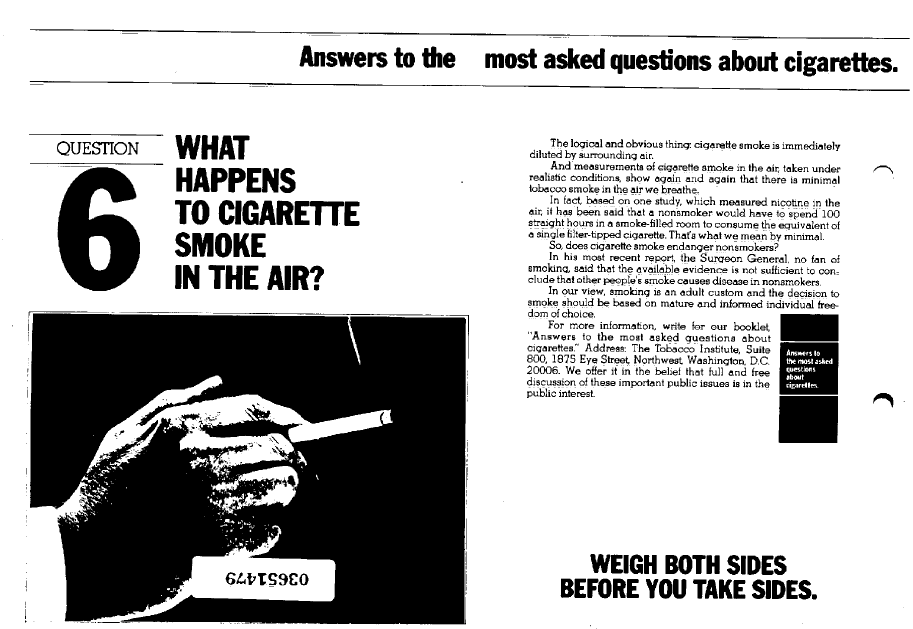
Check out these unbelievable ads from the Tobacco Institute, which I found from the Tobacco Documents database. Click to enlarge.

And here is the tamest of the Heartland Institute’s full-page ads in the Washington Post (from a year or two ago, exact date unknown):

Does Breathing Contribute to CO2 Buildup in the Atmosphere?

I was recently honoured to join Skeptical Science, a comprehensive database of rebuttals to common climate change misconceptions, as an author. Here I am republishing my first article regarding the common myth that breathing out contributes to the buildup of atmospheric carbon dioxide. It is the Intermediate version, and I have also written a very similar Basic version, which includes a diagram by John Cook. Enjoy!

The very first time you learned about carbon dioxide was probably in grade school: We breathe in oxygen and breathe out carbon dioxide. Any eight-year-old can rattle off this fact.

More specifically, the mitochondria within our cells perform cellular respiration: they burn carbohydrates (in the example shown below, glucose) in the oxygen that we breathe in to yield carbon dioxide and water, which we exhale as waste products, as well as energy, which is required to maintain our bodily processes and keep us alive.

C6H12O6 + 6O2 → 6CO2 + 6H2O + energy

carbohydrates + oxygen → carbon dixoide + water + energy

It should come as no surprise that, when confronted with the challenge of reducing our carbon emissions from the burning of fossil fuels, some people angrily proclaim, “Why should we bother? Even breathing out creates carbon emissions!”

This statement fails to take into account the other half of the carbon cycle. As you also learned in grade school, plants are the opposite to animals in this respect: Through photosynthesis, they take in carbon dioxide and release oxygen, in a chemical equation opposite to the one above. (They also perform some respiration, because they need to eat as well, but it is outweighed by the photosynthesis.) The carbon they collect from the CO2 in the air forms their tissues – roots, stems, leaves, and fruit.

These tissues form the base of the food chain, as they are eaten by animals, which are eaten by other animals, and so on. As humans, we are part of this food chain. All the carbon in our body comes either directly or indirectly from plants, which took it out of the air only recently.

Therefore, when we breathe out, all the carbon dioxide we exhale has already been accounted for. By performing cellular respiration, we are simply returning to the air the same carbon that was there to begin with. Remember, it’s a carbon cycle, not a straight line – and a good thing, too!