Climate Scientists Out in the Cold

Cross-posted from NextGen Journal

In the current economy, it’s not surprising that many countries are reducing funds for scientific research. It’s necessary to cut spending across the board these days. However, North American governments are singling out climate science as a victim – and not just reducing its funding, but, in many cases, eliminating it altogether.

Climate change research is largely supported by government money, as there aren’t many industries that recognize a vested interest in the science. Pharmaceutical companies often fund biomedical researchers, and mining companies fund geologists, but there’s no real analogue for climate scientists. Additionally, many global warming studies are particularly expensive. For example, transporting researchers and equipment to the North Pole via helicopter, and building climate models on supercomputers that stretch the limits of our data storage capacities, cost quite a bit more than injecting rats with chemicals in a lab.

In Canada, where I live, the federal government recognized these unique characteristics of climate science, and, in 2000, set up a special foundation to fund research in the field: the Canadian Foundation for Climate and Atmospheric Sciences (CFCAS). Over the past decade, it has spent $118 million supporting most of Canada’s university-based climate research, and it was assumed that it would be continually renewed as the country established itself as a leader in the field.

However, since the Conservative Party formed a minority government almost five years ago, it has only extended the foundation’s lifespan by a year, and refuses to consider long-term funding commitments. The CFCAS only has a few months left before it will run out of money and close its doors. Many of Canada’s premier climate research projects and laboratories will have to shut down as a result, as they have always relied on CFCAS, and general federal funds such as the National Science and Engineering Research Council (NSERC) simply won’t be able to fill the gap. Some researchers are leaving the country to pursue more fertile academic ground, and as an aspiring climate scientist, I am wondering whether I will have to eventually do so as well.

If it seems cruel to abandon funding for researching the greatest threat to our future, rather than simply reducing its budget until the economy recovers, take a stroll south to what my sociology professor likes to refer to as “that wild society”. The U.S. House of Representatives is becoming dominated by politicians who hate the idea of government, and wish to tear most of it down in anger. Add to that mindset a staunch denial of climate science, and you can see where this is going.

The House of Representatives just passed a bill that not only prevents the Environmental Protection Agency from regulating greenhouse gases that cause climate change, but also repeals a great deal of clean air and water protection. Other cornerstones of the bill include repealing the new American health care system and cutting off funding of Planned Parenthood.

Since not a single Democrat Member of Congress voted for this bill, it is unlikely to pass the Senate, where Democrats hold a majority. However, Republicans have threatened to take away all federal funding, effectively shutting down the entire U.S. government, if the bill is not passed into law.

An amendment to this bill, which also passed the House of Representatives, completely cuts off federal funding to the Intergovernmental Panel on Climate Change (IPCC). The IPCC, a scientific organization of the United Nations, doesn’t do any original research, but writes extensive summary reports of the academic literature on climate change. It’s hard to overestimate how important these reports, published every few years, are to governments, scientists, and citizens alike. Instead of having to dig through thousands of scientific journals and articles, with no idea where to start, people can simply read these reports to find out what science knows about climate change. They are painstakingly reviewed, are offered in several levels of technicality, and include carefully organized references to the multitude of studies whose conclusions contributed to the text. For a field of research that is quickly expanding, these reports are absolutely vital, and it’s hard to imagine how they could carry on without support from the American government.

Blaine Luetkemeyer, the Republican Member of Congress that proposed the amendment, justified cutting off the IPCC by asserting the oft-debunked, but disturbingly popular, meme that climate science is some kind of worldwide conspiracy. If the IPCC really is “corrupt” and “nefarious”, as Luetkemeyer claims, then why can’t they afford to pay any of the scientists that write the reports – not even the IPCC president? Why do they allow anyone to help review the draft reports? Why do they permit their Summary for Policymakers to be watered down by policymakers? And, most importantly, why is climate change progressing faster than the IPCC expected?

We shouldn’t have to spend time addressing paranoid conspiracy theories like Luetkemeyer’s . Sadly, the government of the most powerful country on Earth is being taken over by people who buy into these conspiracy theories, and who want to punish climate scientists as much as possible for crimes they haven’t committed. Countries like Canada, even if they refrain from public accusations, are following suit in their actions.

“It’s quite clear by their actions [with CFCAS] and its lack of funding that [the Canadian government is] basically saying ‘We don’t want your science any more’,” Andrew Weaver, Canada’s top climatologist, told the Globe and Mail.

“[Cutting off the IPCC] is like putting our heads in the sand, denying the science, and then stopping the scientists from working – because they might come to a different conclusion from the Republican Party’s ideology,” Democrat Member of Congress Henry Waxman argued.

Is this really a wise move?

Extinction and Climate

Life on Earth does not enjoy change, and climate change is something it likes least of all. Every aspect of an organism’s life depends on climate, so if that variable changes, everything else changes too – the availability of food and water, the timing of migration or hibernation, even the ability of bodily systems to keep running.

Species can adapt to gradual changes in their environment through evolution, but climate change often moves too quickly for them to do so. It’s not the absolute temperature, then, but the rate of change that matters. Woolly mammoths and saber-toothed tigers thrived during the Ice Ages, but if the world were to shift back to that climate overnight, we would be in trouble.

Put simply, if climate change is large enough, quick enough, and on a global scale, it can be the perfect ingredient for a mass extinction. This is worrying, as we are currently at the crux of a potentially devastating period of global warming, one that we are causing. Will our actions cause a mass extinction a few centuries down the line? We can’t tell the future of evolution, but we can look at the past for reference points.

There have been five major extinction events in the Earth’s history, which biologists refer to as “The Big Five”. The Ordovician-Silurian, Late Devonian, Permian-Triassic, Late Triassic, Cretaceous-Tertiary…they’re a bit of a mouthful, but all five happened before humans were around, and all five are associated with climate change. Let’s look at a few examples.

The most recent extinction event, the Cretaceous-Tertiary (K-T) extinction, is also the most well-known and extensively studied: it’s the event that killed the dinosaurs. Scientists are quite sure that the trigger for this extinction was an asteroid that crashed into the planet, leaving a crater near the present-day Yucatan Peninsula of Mexico. Devastation at the site would have been massive, but it was the indirect, climatic effects of the impact that killed species across the globe. Most prominently, dust and aerosols kicked up by the asteroid became trapped in the atmosphere, blocking and reflecting sunlight. As well as causing a dramatic, short-term cooling, the lack of sunlight reaching the Earth inhibited photosynthesis, so many plant species became extinct. This effect was carried up the food chain, as first herbivorous, then carnivorous, species became extinct. Dinosaurs, the dominant life form during the Cretaceous Period, completely died out, while insects, early mammals, and bird-like reptiles survived, as their small size and scavenging habits made it easier to find food.

However, life on Earth has been through worse than this apocalyptic scenario. The
largest extinction in the Earth’s history, the Permian-Triassic extinction, occurred about 250 million years ago, right before the time of the dinosaurs. Up to 95% of all species on Earth were killed in this event, and life in the oceans was particularly hard-hit. It took 100 million years for the remaining species to recover from this extinction, nicknamed “The Great Dying”, and we are very lucky that life recovered at all.

So what caused the Permian-Triassic extinction? After the discovery of the K-T crater, many scientists assumed that impact events were a prerequisite for extinctions, but that probably isn’t the case. We can’t rule out the possibility that an asteroid aggravated existing conditions at the end of the Permian period. However, over the past few years, scientists have pieced together a plausible explanation for the Great Dying. It points to a trigger that is quite disturbing, given our current situation – global warming from greenhouse gases.

In the late Permian, a huge expanse of active volcanoes existed in what is now Siberia. They covered 4 million square kilometres, which is fifteen times the area of modern-day Britain (White, 2002). Over the years, these volcanoes pumped out massive quantities of carbon dioxide, increasing the average temperature of the planet. However, as the warming continued, a positive feedback kicked in: ice and permafrost melted, releasing methane that was previously safely frozen in. Methane is a far stronger greenhouse gas than carbon dioxide – over 100 years, it traps approximately 21 times more heat per molecule (IPCC AR4). Consequently, the warming became much more severe.

When the planet warms a lot in a relatively short period of time, a particularly nasty condition can develop in the oceans, known as anoxia. Since the polar regions warm more than the equator, the temperature difference between latitudes decreases. As global ocean circulation is driven by this temperature difference, ocean currents weaken significantly and the water becomes relatively stagnant. Without ocean turnover, oxygen doesn’t get mixed in – and it doesn’t help that warmer water can hold less oxygen to begin with. As a result of this oxygen depletion, bacteria in the ocean begins to produce hydrogen sulfide (H2S). That’s what makes rotten eggs smell bad, and it’s actually poisonous in large enough quantities. So if an organism wasn’t killed off by abrupt global warming, and was able to survive without much oxygen in the ocean (or didn’t live in the ocean at all), it would probably soon be poisoned by the hydrogen sulfide being formed in the oceans and eventually released into the atmosphere.

The Permian-Triassic extinction wasn’t the only time anoxia developed. It may have been a factor in the Late Triassic extinction, as well as smaller extinctions between the Big Five. Overall, it’s one reason why a warm planet tends to be less favourable to life than a cold one, as a 2008 study in the UK showed. The researchers examined 520 million years of data on fossils and temperature reconstructions, which encompasses almost the entire history of multicellular life on Earth. They found that high global temperatures were correlated with low levels of biodiversity (the number of species on Earth) and high levels of extinction, while cooler periods enjoyed high biodiversity and low extinction.

Our current situation is looking worse by the minute. Not only is the climate changing, but it’s changing in the direction which could be the least favourable to life. We don’t have volcanic activity anywhere near the scale of the Siberian Traps, but we have a source of carbon dioxide that could be just as bad: ourselves. And worst of all, we could prevent much of the coming damage if we wanted to, but political will is disturbingly low.

How bad will it get? Only time, and our decisions, will tell. A significant number of the world’s species will probably become extinct. It’s conceivable that we could cause anoxia in the oceans, if we are both irresponsible and unlucky. It wouldn’t be too hard to melt most of the world’s ice, committing ourselves to an eventual sea level rise in the tens of metres. These long-range consequences would take centuries to develop, so none of us has to worry about experiencing them. Instead, they would fall to those who come after us, who would have had no part in causing – and failing to solve – the problem.

References:

Mayhew et al (2008). A long-term association between global temperature and biodiversity, origination and extinction in the fossil record. Proceedings of the Royal Society: Biological Sciences, 275: 47-53. Read online

Twitchett (2006). The paleoclimatology, paleoecology, and paleoenvironmental analysis of mass extinction events. Paleogeography, Paleoclimatology, Paleoecology, 234(2-4): 190-213. Read online

White (2002). Earth’s biggest “whodunnit”: unravelling the clues in the case of the end-Permian mass extinction. Philosophical Transactions of the Royal Society: Mathematical, Physical, & Engineering Sciences, 360: 2963-2985. Read online

Benton and Twitchett (2003). How to kill (almost) all life: the end-Permian extinction event. Trends in Ecology & Evolution, 18(7): 358-365. Read online

The Pendulum

Cross-posted from NextGen Journal

A few years ago, climate change mitigation became a major political issue. Before 2005, governments certainly knew that human-caused climate change was a serious problem – but the public knew next to nothing about it, so there was no incentive to act. However, between 2005 and 2007, a perfect storm of events splashed the reality of climate change onto the world stage.

The Kyoto Protocol, an international agreement to reduce greenhouse gas emissions, finally came into force in early 2005, after years of negotiation. The United States refused to sign, and Australia signed on a little late, but every other developed nation in the world agreed to emission targets. Here in Canada, the Liberal government enthusiastically pledged its support for Kyoto. My local newspaper ran editorials exploring the different ways we could meet our targets, through combinations of clean energy, green infrastructure, and efficiency standards.

The summer of 2005 was a wake-up call for the United States, as Hurricane Katrina mercilessly demonstrated the amount of damage that extreme weather can bring. It’s impossible to say, at least with our current technology, whether or not Katrina was caused or even worsened by a warming planet. However, such devastating storms will become the norm as climate change progresses. Scientists aren’t sure whether or not hurricanes will become more frequent in a warming world, but the average hurricane is expected to become stronger and more damaging, and we are already beginning to see this rise in storm intensity. Katrina gave us an example of what we can expect from climate change – even if it wasn’t a direct effect in itself – and the world was shocked by the suffering that ensued.

2006 marked the release of An Inconvenient Truth, Al Gore’s Academy Award-winning documentary about climate change. For scientists studying climate, the film was an admirable, up-to-date example of science communication, albeit with a few minor errors and oversimplifications. However, for citizens new to the issue (I particularly remember my classmates in grade 9 social studies discussing the film), An Inconvenient Truth was a disturbing reality check – scarier than any horror movie, because it was real.

The major scientific event of 2007 was a drastic, unexpected drop in Arctic summer sea ice. That season’s melt was exacerbated by coincidental weather conditions, so the next years weren’t quite as bad, but the trend was still worrying, to say the least. The research community had assumed that summer ice would stick around for at least a century, but this timescale was soon halved and quartered as ice melt exceeded even the worst projections.

By 2007, lead-up to the 2008 US presidential election was underway, and political awareness of climate change was obvious. It was no surprise that Democrat Barack Obama had ambitious plans to cut greenhouse gas emissions, but even the Republicans seemed to be on board. During his time in office, George W. Bush had insisted that, since climate change could be natural, any mitigating action was not worth the economic risk. Republican presidential candidates seemed to realize that continuing to adopt this attitude would be political suicide. The most extreme example, John McCain, who would eventually win the Republican presidential nomination, had emissions targets only slightly less extensive than Obama’s. As he said in 2007,

The world is already feeling the powerful effects of global warming, and far more dire consequences are predicted if we let the growing deluge of greenhouse gas emissions continue, and wreak havoc with God’s creation…The problem isn’t a Hollywood invention nor is doing something about it a vanity of Cassandra like hysterics. It is a serious and urgent economic, environmental and national security challenge.

However, McCain, once an author of a bill designed to cut greenhouse gas emissions, would soon completely change his stance. By 2010, he was asserting that cap-and-trade legislation was unnecessary and carbon dioxide posed no harm to the American people. He even went so far as to question the political motivations of science he once wholly accepted:

I think [global warming is] an inexact science, and there has been more and more questioning about some of the conclusions that were reached concerning climate change. And I believe that everybody in the world deserves correct answers whether the scientific conclusions were flawed by outside influences. There’s great questions about it that need to be resolved.

The story of John McCain isn’t too surprising. Politicians frequently base their statements on public sentiment rather than personal opinion. They say what people want to hear, rather than what they truly believe is important. This aspect of our political system is depressing, but persistent. The real question, though, regards what changed public sentiment so quickly. Why did politicians like McCain feel compelled to denounce the importance of action on this problem, or even the existence of the problem itself? What happened since 2007 that made the pendulum swing so far in the other direction?

Strike one was the economy. The global recession that began in 2008 was the largest since the Great Depression, and concern for all other problems promptly went down the drain. It’s understandable for citizens to not worry about the environment when they don’t even have the means to feed and clothe their children properly. However, for governments to not realize the long-term economic implications of allowing climate change to continue, along with the potential job-creating benefits of a new energy economy, was disappointing, even though it wasn’t surprising.

Strike two was the all-out war on climate science, spearheaded by the fossil fuel industry and the far right. This PR campaign has been underway since the early 1990s, but was kicked up a notch just over a year ago. Since public understanding of the causes and effects of global warming was growing, and the science was becoming more solid by the month, the PR tactics changed. Instead of attacking the science, they attacked the integrity of the scientists. The most extreme example occurred in November 2009, when private correspondence between top climate researchers was stolen, spread on the Internet, and spun in an attempt to cast doubt on the scientists’ motives. This event, known as “Climategate”, spurred a great deal of anger among the political right, and everything from bitter editorials to death threats against scientists ensued. Perhaps most distressingly, by the time investigations found that the scientists involved were innocent, and the reality of climate change untouched, Climategate was old news and media outlets failed to adequately follow up on the story. Citizens heard the accusations, but not the exonerations, so political will to cut greenhouse gas emissions slipped even further.

Strike three – well, there has been no strike three, and a good thing too. Strikes one and two were so bad that some are hoping the pendulum has swung as far as it can go. It’s certainly difficult to imagine how the situation could get worse. The Kyoto Protocol is set to expire next year, and the Copenhagen meetings failed to create a replacement. As it was, many developed nations failed to meet their targets, and the Canadian government backed out completely.

The possibility of federal climate legislation for the United States is laughable now that not a single Republican Senator thinks action is necessary, and most doubt the reality of the problem, choosing to believe that the entire scientific community is out to lunch and/or an agent of conspiracy. President Obama’s director of climate policy, Carol Browner, recently left her position, although none of her major goals had been met. Obama’s recent State of the Union address included lots of hopeful statements about clean energy, but absolutely no mention of climate change, as if merely acknowledging the most pressing reason for a new energy economy would be political suicide. The time-honoured tradition of saying what the public wants to hear has even reached Obama, the man who promised change.

In Canada, legislation to simply set targets for emission reduction passed the House of Commons (made of elected representatives), but the Senate (composed of appointed politicians) chose to use their newfound Conservative majority to strike down the bill with no debate whatsoever, in a blatantly undemocratic move that has not happened since the 1930s. The Canadian government is all for a new energy economy, but not one based on environmental and social responsibility. The Alberta tar sands, which are substantially more polluting and carbon-intensive than traditional oil, continue to expand, and both federal and provincial governments are worryingly enthusiastic.

From 2005 to 2007, politics was high on promises of mitigation, but low on delivery. Since then, it has been devoid of both. It’s starting to seem as if it will take a major global disaster that can be unquestionably tied to climate change for governments to get their act together.

This would all be very well if there was no lag time between cause and effect in the climate system, but it doesn’t work that way. It takes several decades for all the warming in the pipeline to show up. If we waited until climate change became unbearable, and then cut off our emissions completely, the situation would still get worse for decades before it stabilized.

The worldwide failure of governments to take action on climate change is baffling. It seems that the best they can do is occasionally promise to fix the problem, but never actually get started. If this continues for much longer, we’re all going to pay the price for their mistakes – and so will people for generations to come.

The Unofficial Climate Change Book Awards

Cross-posted from NextGen Journal

As an aspiring climate scientist, I have read dozens of books about climate change over the past few years. Here are my all-time favourites, which I present with Unofficial Climate Change Book Awards. (Unfortunately, the prizes consist entirely of bragging rights.)


Best Analysis of Future Scenarios
Climate Wars, by Gwynne Dyer
View on Amazon.com

Most of us are aware of how climate change will impact the world: more extreme weather, prolonged floods and droughts, dwindling glaciers and sea ice. In this book, renowned Canadian journalist and military historian Gwynne Dyer goes one step further, and explores how these physical impacts might affect geopolitical relations. Will India and Pakistan engage in nuclear warfare over clean water? Will the United States and Russia begin a “Colder War” over Arctic sovereignty? Many of the scenarios he writes about are, frankly, terrifying, and all have a frightening grain of plausibility to them. Read the full review


Best Introduction to Climate Science
The Discovery of Global Warming, by Spencer Weart
View on Amazon.com

Scientists overwhelmingly agree that human-caused climate change is underway, but instead of simply stating this conclusion, Weart tells the story of how it was reached: tracing the theory from the 1800s to today. This innovative approach to science education, combined with Weart’s elegant prose, makes the book a joy to read. It doesn’t feel like a textbook, although it contains as much information as one. Read the full review


Best Exposé
Climate Cover-Up, by James Hoggan and Richard Littlemore
View on Amazon.com

If scientists are so sure about the reality of anthropogenic climate change, why does so much of the public think that it’s natural/nonexistent/a global conspiracy? Why does the media present the issue as an equal-sided scientific debate? This confusion didn’t just happen by accident – it was deliberately constructed. Over the past two decades, lobby groups representing industries or ideologies that seek to delay action on climate change have engaged in a campaign to spread doubt about the reality of the problem. This book, rather than throwing around baseless accusations, methodically examines the paper trail of this widespread campaign. Reading Climate Cover-Up is an infuriating but absolutely necessary journey to take. Read the full review


Best Policy Discussion
Storms of my Grandchildren, by Dr. James Hansen
View on Amazon.com

James Hansen is possibly the most prominent climate scientist alive today, and that title is well-deserved. Throughout his career at NASA, he has frequently made discoveries that were ahead of his time. Dr. Hansen is a very intrinsic scientist who doesn’t enjoy being in the spotlight or talking about policy, but he wrote this book for fear of his grandchildren looking back at his work and saying, “Opa understood what was happening, but he did not make it clear.” Although he couldn’t resist slipping in a few chapters about the current frontiers of climate science, the bulk of the book is about policy, featuring compelling arguments for expanded nuclear power, a moratorium on coal, and a rising price on carbon. Read the full review


Best Canadian Focus
Keeping Our Cool, by Dr. Andrew Weaver
View on Amazon.com

Andrew Weaver is Canada’s top climate modeller, and a fantastic role model for science communication. This book gives a high-level, yet accessible, explanation of the mathematics of climate change – if you have some basic knowledge of calculus and statistics, you should be fine. However, what really makes this book stand out is its focus on Canadian climate journalism and politics, a rare quality in a field dominated by American research. We all know about George W. Bush’s track record of inaction, but what has Prime Minister Stephen Harper done (or not done)? High-profile studies exist on American media coverage of global warming, but how does the Canadian press compare? Read the full review


Best Insider’s Account
Science as a Contact Sport, by Dr. Stephen Schneider
View on Amazon.com

The late Stephen Schneider, who unexpectedly died last summer of a heart attack, is a true pioneer of climate modelling. He has been active in the field since the 1970s, when computers became fast enough to handle mathematical models. This memoir explains what it’s like to be a climate scientist, and how that has changed over the years. In the 70s, Schneider and his colleagues filled their mind with purely analytical questions, but today, they have to deal with the media, politicians, and hate mail as well. Science used to just be about science, but now it’s about communication as well. Read the full review


Most Gripping
Snowball Earth, by Gabrielle Walker
View on Amazon.com

Gabrielle Walker is a brilliant woman, as she possesses the ability to make a book about geology every bit as gripping as a murder mystery. Granted, Snowball Earth, a recent theory of climatic conditions during the Precambrian Era, is fascinating. In short, the continents were arranged in such a manner that the Earth would swing back and forth between “Snowball Earth” (frozen oceans and frozen land all over, even at the Equator) and “Hothouse Earth” (massive global warming from volcanic emissions of carbon dioxide). Until this period of massive climatic swings, the only thing that lived on Earth was unicellular goop…but immediately following the Snowball Earth cycles, complex life appeared. Many scientists don’t think this evolutionary timing was a coincidence. It’s possible that multicellular organisms, including us, only exist because of an accident of plate tectonics. Read the full review


If you would like to contest any of my decisions for these awards, please feel free to do so in the comments!

“It’s Just a Natural Cycle”

My second rebuttal for Skeptical Science. Thanks to all the folks who helped to review it! Further suggestions are welcome, as always. -Kate

“What if global warming is just a natural cycle?” This argument is, perhaps, one of the most common raised by the average person, rather than someone who makes a career out of denying climate change. Cyclical variations in climate are well-known to the public; we all studied the ice ages in school. However, climate isn’t inherently cyclical.

A common misunderstanding of the climate system characterizes it like a pendulum. The planet will warm up to “cancel out” a previous period of cooling, spurred by some internal equilibrium. This view of the climate is incorrect. Internal variability will move energy between the ocean and the atmosphere, causing short-term warming and cooling of the surface in events such as El Nino and La Nina, and longer-term changes when similar cycles operate on decadal scales. However, internal forces do not cause climate change. Appreciable changes in climate are the result of changes in the energy balance of the Earth, which requires “external” forcings, such as changes in solar output, albedo, and atmospheric greenhouse gases. These forcings can be cyclical, as they are in the ice ages, but they can come in different shapes entirely.

For this reason, “it’s just a natural cycle” is a bit of a cop-out argument. The Earth doesn’t warm up because it feels like it. It warms up because something forces it to. Scientists keep track of natural forcings, but the observed warming of the planet over the second half of the 20th century can only be explained by adding in anthropogenic radiative forcings, namely increases in greenhouse gases such as carbon dioxide.

Of course, it’s always possible that some natural cycle exists, unknown to scientists and their instruments, that is currently causing the planet to warm. There’s always a chance that we could be totally wrong. This omnipresent fact of science is called irreducible uncertainty, because it can never be entirely eliminated. However, it’s very unlikely that such a cycle exists.

Firstly, the hypothetical natural cycle would have to explain the observed “fingerprints” of greenhouse gas-induced warming. Even if, for the sake of argument, we were to discount the direct measurements showing an increased greenhouse effect, other lines of evidence point to anthropogenic causes. For example, the troposphere (the lowest part of the atmosphere) is warming, but the levels above, from the stratosphere up, are cooling, as less radiation is escaping out to space. This rules out cycles related to the Sun, as solar influences would warm the entire atmosphere in a uniform fashion. The only explanation that makes sense is greenhouse gases.

What about an internal cycle, perhaps from volcanoes or the ocean, that releases massive amounts of greenhouse gases? This wouldn’t make sense either, not only because scientists keep track of volcanic and oceanic emissions of CO2 and know that they are small compared to anthropogenic emissions, but also because CO2 from fossil fuels has its own fingerprints. Its isotopic signature is depleted in the carbon-13 isotope, which explains why the atmospheric ratio of carbon-12 to carbon-13 has been going down as anthropogenic carbon dioxide goes up. Additionally, atmospheric oxygen (O2) is decreasing at the same rate that CO2 is increasing, because oxygen is consumed when fossil fuels combust.

A natural cycle that fits all these fingerprints is nearly unfathomable. However, that’s not all the cycle would have to explain. It would also have to tell us why anthropogenic greenhouse gases are not having an effect. Either a century of basic physics and chemistry studying the radiative properties of greenhouse gases would have to be proven wrong, or the natural cycle would have to be unbelievably complex to prevent such dramatic anthropogenic emissions from warming the planet.

It is indeed possible that multidecadal climate variabilityespecially cycles originating in the Atlantic, could be contributing to recent warming, particularly in the Arctic. However, the amplitude of the cycles simply can’t explain the observed temperature change. Internal variability has always been superimposed on top of global surface temperature trends, but the magnitude – as well as the fingerprints – of current warming clearly indicates that anthropogenic greenhouse gases are the dominant factor.

Despite all these lines of evidence, many known climatic cycles are often trumpeted to be the real cause, on the Internet and in the media. Many of these cycles have been debunked on Skeptical Science, and all of them either aren’t in the warming phases, don’t fit the fingerprints, or both.

For example, we are warming far too fast to be coming out of the last ice age, and the Milankovitch cycles that drive glaciation show that we should be, in fact, very slowly going into a new ice age (but anthropogenic warming is virtually certain to offset that influence).

The “1500-year cycle” that S. Fred Singer attributes warming to is, in fact, a change in distribution of thermal energy between the poles, not a net increase in global temperature, which is what we observe now.

The Little Ice Age following the Medieval Warm Period ended due to a slight increase in solar output (changes in both thermohaline circulation and volcanic activity also contributed), but that increase has since reversed, and global temperature and solar activity are now going in opposite directions. This also explains why the 11-year solar cycle could not be causing global warming.

ENSO (El Nino Southern Oscillation) and PDO (Pacific Decadal Oscillation) help to explain short-term variations, but have no long-term trend, warming or otherwise. Additionally, these cycles simply move thermal energy between the ocean and the atmosphere, and do not change the energy balance of the Earth.

As we can see, “it’s just a natural cycle” isn’t just a cop-out argument – it’s something that scientists have considered, studied, and ruled out long before you and I even knew what global warming was.

Merchants of Doubt

I waited a long time to read this book – in retrospect, too long. I have long been a fan of Naomi Oreskes; I believe she is a brilliant and sensible scientist with a compelling way with words. On the other hand, nothing depresses me more quickly than reading about those who deliberately spread confusion on climate change for political reasons. After a particularly battering year for climate science in the public eye, I want to make sure I stay sane.

However, Merchants of Doubt: How a Handful of Scientists Obscured the Truth on Issues from Tobacco Smoke to Global Warming, by Naomi Oreskes and Erik Conway, was oddly comforting. How could it be so, you might ask, given the subject matter?

It’s a good question. The book traces several key players, such as Frederick Seitz, S. Fred Singer, Bill Nierenberg, and Robert Jastrow, in their fight against mainstream science. Many of them were physicists in the era of atomic bomb development, and nearly all had been deeply influenced by the Cold War – they were anti-Communist to the point of extremism.

This extremism soon extended into science: any new discovery that seemed to necessitate government action was vehemently attacked by Seitz et al. Whether it was the harmful health effects of smoking, second-hand smoking, or DDT, and the existence of anthropogenic acid rain, ozone depletion, or climate change, the same people used the same strategies to sow doubt in the public mind, delaying the cry for action. The algorithm was relatively simple:

  • construct arguments against the phenomenon, which scientists had already addressed and ruled out
  • widely publish these arguments in the popular press, rather than scientific journals
  • demand that the mainstream media be neutral and provide “equal time” for their side of the so-called controversy
  • attack the professional integrity of the scientists who discovered and studied the phenomenon; label them as frauds and/or Communists
  • claim that action on this issue would be the beginning of the “slippery slope to socialism”

It’s enough to anger anyone who has the least bit of sympathy for science. The authors say it best:

Why would scientists dedicated to uncovering the truth about the natural world deliberately misrepresent the work of their own colleagues? Why would they spread accusations with no basis? Why would they refuse to correct their arguments once they had been shown to be incorrect? And why did the press continue to quote them, year after year, even as their claims were shown, one after another, to be false?

History repeated itself many times over, within the course of just a few decades. The attack against climate science that we are currently witnessing is just a larger-scale rehash of the pro-industry, anti-Communist fight against epidemiology, environmental chemistry, and so on. Until now, few attempts have been made to connect the dots, but Oreskes and Conway present a watertight and compelling thesis in Merchants of Doubt.

The hopeful part came when I realized this: all of the previous issues that Seitz et al attempted to discredit were eventually addressed, more or less successfully, by the government, even if some of the public is still confused about the science. Restrictions and regulations on smoking, along with education regarding its harms, has made tobacco use a semi-stigmatized practice in my generation, rather than a near-universal activity. The Montreal Protocol was largely a success, and stratospheric ozone is on the rise. The world, at least so far, has managed to avoid nuclear warfare.

Climate change is undoubtedly a more inevitable and wide-ranging problem, as it strikes at the heart of our fossil-fuel based economy, and will probably surpass, both in rate and magnitude, any change our species has seen in the global environment. However, since the attack against climate science has tracked so closely with previous campaigns, I can’t help but hope it will eventually end the same way: with the public and the government realizing the problem and employing effective measures to address it. I know it’s probably not very scientific of me to make this connection, but hope doesn’t have to be rational to be effective.

An Unlikely Priority

A small news splash surfaced this week over a recent paper in Nature, regarding the prospects for Arctic sea ice and, consequently, polar bear populations. Until this paper was published, studies had only examined business-as-usual scenarios. We didn’t really know whether or not, if we pursued aggressive mitigation, it would be too late to save the polar bears from extinction.

The GCM output this paper analysed suggested that there is hope. They found the relationship between temperature and sea ice cover to be more linear, and the ice-albedo feedback in the Arctic to be weaker, than we previously thought. Tipping points where sea ice is beyond hope might not be such a problem. Therefore, we may still have a chance to limit damage to the ecosystem that experiences consequences of climate change earliest and strongest, and the polar bears might still make it. Nature News has a great summary for those who want more detail on the literature.

When the story showed up in my CBC News feed, however, I was bewildered at the angle they took:

Polar bears could be saved from extinction if greenhouse gas emissions are significantly reduced in the next decade or two, a study released Wednesday suggests.

As if that’s the most compelling reason to pursue mitigation…

Don’t get me wrong: it would be a shame to see the polar bears go. But it would be much worse to see agriculture in the subtropics go, or to see low-lying nations go. I believe that the public is wise enough to understand that sentimental notions about an oft-romanticized species are minuscule in their importance when compared to matters of human security.

Additionally, since polar bears reside at the top of the food chain, the ecological consequences of their loss – while certainly not trivial – would probably be less intense than if it were another species. Imagine the hypothetical scenario of termites going extinct – it would be much worse. Termites aren’t quite so cute and cuddly, though.

I continue to be amazed by choices that the mainstream media makes as to which studies to report on and which studies to ignore. Their picture of ordinary people’s priorities is baffling and somewhat insulting. I get it – I have a strong affinity for wildlife – but the species I care about the most is still Homo sapiens, despite its blatant shortcomings.

Just Links for Now…

I apologize for my relative silence recently. I am in the midst of studying for my first set of final exams. To tide you over until that has calmed down a bit, I will share some of the interesting pieces I have read and watched recently.

My study break today was spent watching a fantastic video that Peter Sinclair recently dug up. It’s an hour-long talk by Dr. Ben Santer (see my recent interview with him), with an introduction by the late Stephen Schneider and questions at the end. He tells a very troubling story about “science, non-science and nonsense”. Lots of great quotes in there – I highly recommend giving it a watch.

John Cook from Skeptical Science has compiled his articles and rebuttals into a gorgeous document about the evidence for anthropogenic climate change, written in accessible language with effective graphics on every page. It’s so effective, I would like to print out a few dozen of these booklets and hand them out at the university.

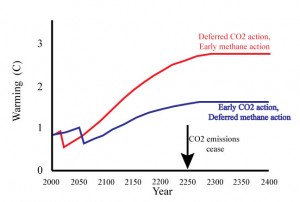
On RealClimate, Ray Pierrehumbert addressed the common policy option of focusing on cutting emissions of methane and soot in the short-term in order to “buy us time” to reduce carbon dioxide. In fact, because these emissions have such a short atmospheric lifetime, it doesn’t really matter whether we focus on them now or later – while concentrations of carbon dioxide, with a lifetime of centuries to millennia, highly depend on when we address it. Take a look at these projections comparing our options:

Michael Tobis, however, thinks that we should focus on non-CO2 emissions despite these realities. Short-term economic and population “crashes” due to sudden warming in the near term could conceivably be more damaging to human security, because it means that we won’t be able to afford any mitigation, further worsening the long-term emissions. Both articles are worth a read.

Well, off to go memorize organic functional groups. Enjoy!

The Nature of Scientific Consensus

Cross-posted from NextGen Journal

It is common for one to fail to grasp the difference between “consensus” and “unanimity”.

A consensus does not require agreement from absolutely every member involved. Rather, it is a more general measure of extremely high agreement, high enough to accept and base decisions on. It’s stronger than a majority-rules style of democracy, but does not necessarily equal unanimity. In fact, in the area of science, where the concept of consensus is particularly important, unanimity is nearly impossible.

With the exception of pure mathematics, scientific theories cannot be proven beyond a doubt. Every physical process that researchers study has some amount of irreducible uncertainty – because there is always, no matter how small, a chance that our understanding could be completely wrong. Additionally, science is never “settled”, because there is always more to learn, whatever the field. Even a law as basic as gravity is still being studied by physicists, and it turns out that it gets more complicated the more you look at it.

Despite this inherent uncertainty, scientists have developed consensuses around all sorts of topics. The Earth is approximately oblate-spherical in shape. Smoking cigarettes increases one’s risk of lung cancer. HIV causes AIDS. There’s a tiny chance that these statements are incorrect, but researchers can still have confidence in their accuracy. Incomplete knowledge is not the same as no knowledge.

However, when there is room for doubt, there will usually be doubters. Physicist Richard Lindzen continues to dispute the health risks of smoking (a conversation is recounted in a recent book by James Hansen). Peter Duesberg, an active molecular and cell biologist, prominently opposes the link between HIV and AIDS. Believe it or not, the Flat Earth Society was alive and well until the death of its leader in 2001 – and signs of the society’s renewal are emerging.

As these examples suggest, for a layperson to wait for scientific unanimity before accepting a topic would be absurd. When consensus reaches a certain point, the null hypothesis shifts: the burden of proof is on the contrarians, rather than the theory’s advocates.

Another case study that may seem surprising to many is that of anthropogenic global warming. A strong scientific consensus exists that human activity, mainly the burning of fossil fuels, is exerting a warming influence on the planet’s temperature, which is already beginning to show up in the instrumental record. This phenomenon is contested by less than 3% of publishing climatologists, a negligible amount of peer-reviewed scientific studies (so few that not one showed up in a 2004 survey’s random sample of almost one thousand papers), and no major scientific societies internationally. Additionally, scientists who dispute the existence or causes of climate change tend to have lower academic credibility than those who do not. It becomes apparent that this scientific question warrants “consensus” standing: never quite settled, never quite unanimous, but certainly good enough to go by. The mainstream media does not always reflect this consensus accurately, but it nonetheless exists.

As world leaders meet in Cancun this week to discuss a global policy to prevent or limit future climate change – a prospect that looks less likely by the day – science can only offer so much advice. Climatologists can approximate what levels of emissions cuts are required to prevent unacceptable consequences, but only when the governments of the world decide which consequences they are willing to accept. Can we deal with worldwide food shortages? Rising sea levels? What about a mass extinction? Even after we define “dangerous consequences”, scientists are unsure of exactly how much temperature change will trigger these consequences, as well as how much greenhouse gas emissions will need to be cut, and how quickly, to prevent the temperature change. All they can offer is a range of probabilities and most likely scenarios.

But remember, incomplete and uncertain knowledge is not the same as no knowledge. Of one thing climate scientists are sure: the more greenhouse gas emissions we emit, the more the world will warm, and the harder it will be to deal with the consequences. There’s no reason for you and I to doubt that simple correlation any longer.

The Real Story of Climategate

A year ago today, an unidentified hacker published a zipped folder in several locations online. In this folder were approximately one thousand emails and three thousand files which had been stolen from the backup server of the Climatic Research Unit in the UK, a top centre for global temperature analysis and climate change studies. As links to the folder were passed around on blogs and online communities, a small group of people sorted through the emails, picking out a handful of phrases that could be seen as controversial, and developing a narrative which they pushed to the media with all their combined strength. “A lot is happening behind the scenes,” one blog administrator wrote. “It is not being ignored. Much is being coordinated among major players and the media. Thank you very much. You will notice the beginnings of activity on other sites now. Here soon to follow.”

This was not the work of a computer-savvy teenager that liked to hack security systems for fun. Whoever the thief was, they knew what they were looking for. They knew how valuable the emails could be in the hands of the climate change denial movement.

Skepticism is a worthy quality in science, but denial is not. A skeptic will only accept a claim given sufficient evidence, but a denier will cling to their beliefs regardless of evidence. They will relentlessly attack arguments that contradict their cause, using talking points that are full of misconceptions and well-known to be false, while blindly accepting any argument that seems to support their point of view. A skeptic is willing to change their mind. A denier is not.

There are many examples of denial in our society, but perhaps the most powerful and pervasive is climate change denial. We’ve been hearing the movement’s arguments for years, ranging from illogic (“climate changed naturally in the past, so it must be natural now“) to misrepresentation (“global warming stopped in 1998“) to flat-out lies (“volcanoes emit more carbon dioxide than humans“). Of course, climate scientists thought of these objections and ruled them out long before you and I even knew what global warming was, so in recent years, the arguments of deniers were beginning to reach a dead end. The Copenhagen climate summit was approaching, and the public was beginning to understand the basic science of human-caused climate change, even realize that the vast majority of the scientific community was concerned about it. A new strategy for denial and delay was needed – ideally, for the public to lose trust in researchers. Hence, the hack at CRU, and the beginning of a disturbing new campaign to smear the reputations of climate scientists.

The contents of the emails were spun in a brilliant exercise of selective quotation. Out of context, phrases can be twisted to mean any number of things – especially if they were written as private correspondence with colleagues, rather than with public communication in mind. Think about all the emails you have sent in the past decade. Chances are, if someone tried hard enough, they could make a few sentences you had written sound like evidence of malpractice, regardless of your real actions or intentions.

Consequently, a mathematical “trick” (clever calculation) to efficiently analyse data was reframed as a conspiracy to “trick” (deceive) the public into believing the world was warming. Researchers discussed how to statistically isolate and “hide the decline” in problematic tree ring data that was no longer measuring what it used to, but this quote was immediately twisted to claim that the decline was in global temperatures: the world is cooling and scientists are hiding it from us!

Other accusations were based not on selective misquotation but on a misunderstanding of the way science works. When the researchers discussed what they felt were substandard papers that should not be published, many champions of the stolen emails shouted accusations that scientists were censoring their critics, as if all studies, no matter how weak their arguments, had a fundamental right to be published. Another email, in which a researcher privately expressed a desire to punch a notorious climate change denier, was twisted into an accusation that the scientists threatened people who disagreed with them. How was it a threat if the action was never intended to materialize, and if the supposed target was never aware of it?

These serious and potentially damaging allegations, which, upon closer examination, are nothing more than grasping at straws, were not carefully examined and evaluated by journalists – they were repeated. Early media reports bordered on the hysterical. With headlines such as “The final nail in the coffin of anthropogenic global warming” and “The worst scientific scandal of our generation“, libelous claims and wild extrapolations were published mere days after the emails were distributed. How could journalists have possibly had time to carefully examine the contents of one thousand emails? It seems much more likely that they took the short-cut of repeating the narrative of the deniers without assessing its accuracy.

Even if, for the sake of argument, all science conducted by the CRU was fraudulent, our understanding of global warming would not change. The CRU runs a global temperature dataset, but so do at least six other universities and government agencies around the world, and their independent conclusions are virtually identical. The evidence for human-caused climate change is not a house of cards that will collapse as soon as one piece is taken away. It’s more like a mountain: scrape a couple of pebbles off the top, but the mountain is still there. For respected newspapers and media outlets to ignore the many independent lines of evidence for this phenomenon in favour of a more interesting and controversial story was blatantly irresponsible, and almost no retractions or apologies have been published since.

The worldwide media attention to this so-called scandal had a profound personal impact on the scientists involved. Many of them received death threats and hate mail for weeks on end. Dr. Phil Jones, the director of CRU, was nearly driven to suicide. Another scientist, who wishes to remain anonymous, had a dead animal dumped on his doorstep and now travels with bodyguards. Perhaps the most wide-reaching impact of the issue was the realization that private correspondence was no longer a safe environment. This fear only intensified when the top climate modelling centre in Canada was broken into, in an obvious attempt to find more material that could be used to smear the reputations of climate scientists. For an occupation that relies heavily on email for cross-national collaboration on datasets and studies, the pressure to write in a way that cannot be taken out of context – a near-impossible task – amounts to a stifling of science.

Before long, the investigations into the contents of the stolen emails were completed, and one by one, they came back clear. Six independent investigations reached basically the same conclusion: despite some reasonable concerns about data archival and sharing at CRU, the scientists had shown integrity and honesty. No science had been falsified, manipulated, exaggerated, or fudged. Despite all the media hullabaloo, “climategate” hadn’t actually changed anything.

Sadly, by the time the investigations were complete, the media hullabaloo had died down to a trickle. Climategate was old news, and although most newspapers published stories on the exonerations, they were generally brief, buried deep in the paper, and filled with quotes from PR spokespeople that insisted the investigations were “whitewashed”. In fact, Scott Mandia, a meteorology professor, found that media outlets devoted five to eleven times more stories to the accusations against the scientists than they devoted to the resulting exonerations of the scientists.

Six investigations weren’t enough, though, for some stubborn American politicians who couldn’t let go of the article of faith that Climategate was proof of a vast academic conspiracy. Senator James Inhofe planned a McCarthy-like criminal prosecution of seventeen researchers, most of whom had done nothing more than occasionally correspond with the CRU scientists. The Attorney General of Virginia, Ken Cuccinelli, repeatedly filed requests to investigate Dr. Michael Mann, a prominent paleoclimatic researcher, for fraud, simply because a twelve-year-old paper by Mann had some statistical weaknesses. Ironically, the Republican Party, which prides itself on fiscal responsibility and lower government spending, continues to advocate wasting massive sums of money conducting inquiries which have already been completed multiple times.

Where are the politicians condemning the limited resources spent on the as yet inconclusive investigations into who stole these emails, and why? Who outside the scientific community is demanding apologies from the hundreds of media outlets that spread libelous accusations without evidence? Why has the ongoing smear campaign against researchers studying what is arguably the most pressing issue of our time gone largely unnoticed, and been aided by complacent media coverage?

Fraud is a criminal charge, and should be treated as such. Climate scientists, just like anyone else, have the right to be presumed innocent until proven guilty. They shouldn’t have to endure this endless harassment of being publicly labelled as frauds without evidence. However, the injustice doesn’t end there. This hate campaign is a dangerous distraction from the consequences of global climate change, a problem that becomes more difficult to solve with every year we delay. The potential consequences are much more severe, and the time we have left to successfully address it is much shorter, than the vast majority of the public realizes. Unfortunately, powerful forces are at work to keep it that way. This little tussle about the integrity of a few researchers could have consequences millennia from now – if we let it.

Update: Many other climate bloggers are doing Climategate anniversary pieces. Two great ones I read today were Bart Verheggen’s article and the transcript of John Cook’s radio broadcast. Be sure to check them out!