
By Your Own Logic

The typical conservative holds opinions on issues such as health care, government economics, and international relations that I may or may not agree with, but I respect as their own political beliefs.

Except one. Since when did rejecting the science of climate change become a trademark of the typical conservative? Why is science – and not just the implications of the science, the actual analysing of the graphs – such a political subject?

Think about it. Science is designed to remove political biases and follow an approved method so that repeating the same process will produce the same result. If it doesn’t, the hypothesis is proved erroneous or incomplete.

So why should political opinions influence the honest interpretation of a physical event? As Greg Craven says in his video Why There is Still Debate,

Now, you probably don’t find it surprising that more Democrats than Republicans believe in global warming, and ordinarily I wouldn’t either. But I’d been steeping myself in this question of how do you go about deciding what to believe about what’s going on with the physical world, and this split along political party lines about a physical reality just sort of blew me away. Why the heck should political belief influence one’s assessment of what is physical reality? I just got this ridiculous picture in my head of a Democrat and a Republican standing and looking out the same window—the Democrat saying “Gee, it’s pouring rain out there,” and the Republican saying “No, it’s a sunny blue day.”

The truth lies in confirmation bias. As we explain in the post Science, it is scientifically immoral – but very possible, especially with the Internet – to start with a conclusion that seems politically or socially acceptable and then build a scientific argument around it. To eliminate personal bias, scientists always start with evidence, and then choose a conclusion which seems logical.

Liberals tend to be okay with the idea of fighting climate change, because they don’t really mind regulation, and believe that the government should spend money to help as many people as possible. Preventing future natural disasters and food and water shortages seems like a good way to help people.

Conservatives, however, tend to be very opposed to regulation. Climate change is inconvenient for all of us, but especially for those on the right, as fixing the problem seems to require action that sharply contradicts their ideological beliefs.

The solution to this dilemma, of course, seems to be to decide not to believe in the problem so they won’t have to face the solutions.

Many conservatives take this quite lightly, and don’t think about the issue very much. The people whose views they support also claim that humans are not causing climate change. It seems convenient. So they accept it.

But some of the more hardcore skeptics of anthropogenic climate change make quite an amazing effort to create scientific arguments which support the conclusion they like. As Michael Tobis explains on his blog Only in it for the Gold,

The denialists are now trumpeting a very silly argument that El Nino (a quasiperiodic oscillation with energy in the 2-10 year band) is dominating secular trends in global temperature by an argument that I summarized in seven steps recently.

I would like to start the day with a shorter summary:

1) El Nino dominates interannual variability.
2) Frantic armwaving, accompanied by sciencey-looking charts and graphs.
3) Therefore, warming is predominantly due to El Nino.
4) Therefore, very not the IPCC.

Of course conclusion 4 will resonate with the Not the IPCC crowd. It is the conclusion they want, er, I mean, the conclusion that their serious thought has led them to in the past, right?

The trouble is, their argument goes like this

1) The sun is the source of atmospheric energy
2) Frantic armwaving, accompanied by sciencey-looking charts and graphs.
3) Therefore, warming is predominantly due to solar changes.
4) Therefore, very not the IPCC.

As we explained on the post All Over the Map, skeptics can’t seem to agree on a consistent explanation for why humans aren’t causing the Earth to warm. In fact, each of them seems to have a different theory. They all contradict each other, but they all support the same ultimate conclusion (“very not the IPCC”) so they all endorse each other.

Does this not show blatant confirmation bias?

So I’ll make it easy for the conservatives who refuse to accept the problem of climate change because they don’t like the solutions.

Firstly, they seem to oppose action on climate change because they don’t want to be subjected to economic costs and government regulations unless it’s absolutely necessary. They don’t want to take that chance.

(I’m leaving out the part about how action on climate change could actually help the economy and jumpstart some new industries, as well as how, if we had carbon-free energy, regulation wouldn’t be necessary. Let’s not overcomplicate things here.)

However, how would the government act in the times of a crisis, such as a natural disaster or an invasion? Would they be sure to be democratic and preserve everyone’s civil liberties? Or might they compromise these for the sake of natural security? Might they ration food? Impose a curfew? Call in the army to restrain any looters? Make quick decisions without a formal vote?

How did events such as Hurricane Katrina, World War II, or 9-11 affect people’s freedoms? What can we learn from history here? There’s nothing like a disaster to bring out the draconian side of any government.

Also recall how disasters can impact the global economy. For example, Hurricane Katrina affected the transport of oil and caused the first-ever gas prices above $1/L here in Canada. We can be pretty sure that the economy won’t handle disasters well.

Even the most die-hard conservative skeptics have to admit that they might be wrong. There might be a chance, however small it seems to them, that global warming is worth fighting. And this only covers costs for the economy and civil liberties. It doesn’t go into food security, water security, disease, refugees, continuous sea level rise, droughts and floods, or prolonged heat waves.

I would argue that the economic costs and government regulations that would be necessary for even a mid-range climate change scenario would be much worse than those from mitigating the problem and reducing our emissions. This hypothesis has been quantified in the Stern Review, which suggests that action on climate change would cost about 1% of GDP, while the consequences of inaction would cost about 20% of GDP.

And that’s only GDP. Let’s not forget that not everything in our world can be measured in dollar value. What does the life of a person cost? What is the monetary value of the oceans?

So conservatives don’t want to take action on climate change because they don’t want to run the risk of economic harm or a draconian government.

However, if they accept that they might be wrong, a picture appears of much more economic harm and a much more draconian government.

Isn’t it a better bet to take action, and avoid the much greater damage to civil liberties and the economy, rather than clinging to a strategy that will only be beneficial if all the scientific organizations in the world are totally wrong?
The Average Person

craven I first watched the Manpollo videos about a year and a half ago, when I had the flu, and ended up watching the entire six hours over two days. I don’t remember when it was that I discovered Greg Craven was writing a book based on the videos, but I’ve been excited to read it ever since.

The Manpollo videos have inspired my view on climate change and transformed my way of talking about it more than anything else I’ve read or watched. In a nutshell, Greg Craven’s process of risk management takes the pressure off us to be amateur scientists. It doesn’t require that we assess the statistical methods of people with PhDs when we only have a high school knowledge of science. Instead, it shows us how to use logic, assess credibility, and weigh the benefits and consequences of taking action vs not taking action on an uncertain threat.

I suppose I sort of expected that Greg Craven’s book would be a step up from the videos, would contain even more ideas, anecdotes and talking points that I could really sink my teeth into, would tell me more that I hadn’t already heard in the six hours of Manpollo.

But his book wasn’t like that. Greg Craven disappointed me.

And I’m grateful for that.

See, the book was not aimed at people like me who have an interest in climate change that borders on obsession. It was not aimed at the people who already know which sources are skeptical of anthropogenic climate change and which are worried about it. It was not aimed at those of us who can rattle off the current concentration of atmospheric CO2 without a second thought.

The book was aimed at the average person, who basically knows what climate change is but hears so much shouting in the media that they have no idea of its level of agreement. Who knows there are two sides and doesn’t want to offend anyone. Who has never heard of Milankovitch cycles, methane hydrates or the Goddard Institute of Space Studies.

If the average person stumbled upon most climate change blogs, most of the terms would be foreign to them. I hope they’d be able to understand most of what I write here on ClimateSight (as I try to stay away from analysing hard data) but they’d probably still need a bit of background information.

The average person, with little to no background information on climate science and policy, needs somewhere to start. They need the tools to assess the credibility of a source. They need to know where to go for more information about a topic. They need a basic knowledge of risk management, logic, and bias.

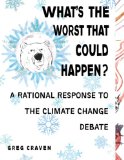
What’s the Worst that Could Happen? provides exactly that. It seems like a more concise version of the Manpollo videos, all the topics outlined in a simple process without the need for much background reading. If I were to recommend a book to start with for this anonymous average person we’re discussing, it would be hard to find one better than this one.

Instead of telling you stuff, Greg Craven tells you how to find stuff out for yourself. He doesn’t tell you how much agreement there is on climate change, he introduces you to a credibility spectrum instead. And even then, he doesn’t just give you his credibility spectrum, he shows you how to make your own.

He doesn’t tell you that oil executives are denialist trolls, he explains possible biases that could lead a person to a hasty conclusion. He gives one of the best basic explanations of the mechanics of anthropogenic climate change that I’ve ever read. Craven is possibly the least offensive, but most helpful, writer I’ve ever encountered.

My only complaint about the book was how he handled the “individual professional” and “individual layperson” sections in the chapters about statements. On the Skeptic’s side, he listed every individual prominent skeptic he could think of, I believe it was about a dozen. On the Warmer’s side, he had Hansen, Oreskes, and Gore. That was it. He explained that this was because he filled his credibility spectrum from the top down, and the statements at the top were almost exclusively weighted to the Warmer’s side. But there is something personal about an individual’s work that makes a person trust them and put faith in their arguments, rather than a report like the IPCC which is dry and anonymous. I wish that Craven had put some kind of indication, perhaps the Doran and Zimmerman report, that the opinion of individual scientists was also weighted towards the Warmer’s side. Otherwise it seems like the masses are not in agreement with the authority, which is supposed to be the source you listen to.

And because I agree with this concept so wholeheartedly, I feel compelled to share with my readers my answer to the question Craven asks at the very beginning – what would make you change your mind?

I would change my mind about dangerous anthropogenic climate change if a new discovery was made, if some new explanation came forward that gained as much agreement as the current theory holds now. If the national scientific bodies of the world, the peer-reviewed journals, and university textbooks had a complete overhaul because scientists discovered that humans were not changing the climate. If some new explanation surfaced that proved Arrhenius and Callendar wrong. It would be a discovery akin to the theory of relativity. As George Monboit said, “If you can prove these statements wrong, you should apply for a Nobel Prize. You will have turned science on its head.”

I listen to the scientists. I’m not surrending my rights and freedoms as an individual to them. I just trust their analysis more than I trust my own.

To conclude

If you already know a fair bit about climate change, and want some really fascinating dicussion points that will keep you going for literally years, watch the Manpollo videos. If you’re a really hardcore skeptic who thinks climate change is a global conspiracy, Manpollo was made especially for you.

But if you’re new to this topic, start with What’s the Worst that Could Happen? I assure you that there is no better place to begin.

When Authority is Relevant

When it is appropriate to use an argument from authority?

The most common criticism of arguments such as Doran and Zimmerman’s poll or a list of statements from organizations is, “That doesn’t mean they’re right.” Just because a topic has overwhelming agreement doesn’t mean it’s true.

I agree with that criticism. But I still believe that such arguments are appropriate at times. How can this be?

Firstly, to a scientist who has relevant experience, arguing from authority is not usually appropriate. If someone understands all the technicalities of a topic such as climatology, what others say shouldn’t necessarily influence them. If there is overwhelming agreement on an issue, they should certainly examine its evidence, but shouldn’t be subject to peer-pressure. If someone understands the science behind the issue, their own experience and analysis makes the popular opinion barely relevant.

However, to the individual with no climatology training, their own analysis can’t cut it. They simply need to trust those with relevant experience – who else are they going to trust? As Greg Craven says in Risk Management,

“Ask yourself this: does the Earth go around the sun, or does the sun go around the Earth? No one even seriously questions that anymore, right? Try this sometime. Stand and point to the sun in the sky. A few hours later, stand in the same spot, facing the same direction, and do it again. Is your arm pointing in the same direction as it was before? No! Clearly, the sun is the thing that moved, and clearly, the Earth is too large to have gone anywhere, and is right where you left it.

If your senses—and your common sense—are so easily fooled, then how do you decide what to believe about the natural world? Well, why do you so firmly believe that the Earth orbits the sun, despite all evidence and common sense to the contrary? You believe it because: smart people told you so. And you trust them, when it’s their area of expertise, and enough of them agree. Of course authority matters. That doesn’t mean it’s infallible—just ask Galileo. But it’s certainly a better bet than armchair analysis.”

Additionally, to the average non-scientist, the physical truth does not matter as much as the probability of the event in question. They don’t really care about D-O events, Milankovitch cycles, or the relative strength of different greenhouse gases. The real question they are asking is, “What do we need to do about climate change?” People care about what will impact them. For scientists, that means data and conclusions, as that’s their job. For average individuals, that means risk management and mitigation, as that determines which policies they will support and what individual action they will take.

And when over 97% of the scientific community agree that humans are causing the Earth to warm, the probability of emission reduction being worthwhile seems pretty high.

It’s important that the authority used to argue the probability of a point is large and diverse, however. It’s easy to cherry-pick one of the outspoken 3% of scientists who reject climate change and say, “See, they know more than you do, so you should vote against Waxman-Marley.” Statistics such as “97% agreement” or “every professional scientific organization that has issued a statement on climate change” gives the audience a much better sense of the mainstream scientific opinion.

Therefore, to the average person, arguing from authority is appropriate, because it reflects probability and risk management. And that’s really all that the general public cares about.

Gambling on a Lie

All right, here it is. A list of professional scientific organizations that have issued statements saying that humans are causing the Earth to warm. Thanks to Logical Science for helping in the creation of this list. Keep in mind that, since the list is several years old, it is probably longer today.

  • Academia Brasileira de Ciéncias
  • Académie des Sciences
  • Accademia Nazionale dei Lincei
  • Russian Academy of Sciences
  • National Academy of Sciences
  • Royal Society of Canada
  • Deutsche Akademie der Naturforscher Leopoldina
  • Science Council of Japan
  • Academy of Science of South Africa
  • Chinese Academy of Sciences
  • Indian National Science Academy
  • Academia Mexicana de Ciencias
  • Royal Society
  • Australian Academy of Sciences
  • Royal Flemish Academy of Belgium for  Sciences  and the Arts
  • Caribbean Academy of Sciences
  • Indonesian Academy of Sciences
  • Royal Irish Academy
  • Academy of Sciences Malaysia
  • Academy Council of the Royal Society of New Zealand
  • Royal Swedish Academy of Sciences
  • Union of Concerned Scientists
  • Woods Hole Research Center
  • Intergovernmental Panel on Climate  Change
  • United Nations Framework Convention  on Climate Change
  • American Association for the  Advancement of Science
  • American Meteorological Society
  • National Research Council
  • Canadian Meteorological and Oceanographic Society
  • Federal Climate Change Science Program
  • National Oceanic and Atmospheric  Administration
  • UN Project on Climate Variability and Predictability
  • American Geophysical Union
  • Geological Society o f America
  • American Chemical Society
  • Geological Society of London
  • Institution of Engineers Australia
  • American Association of State Climatologists
  • US Geological Survey
  • National Center for Atmospheric  Research
  • NASA
  • World Meteorological Organization
  • United Nations Environment Program
  • Canadian Foundation for Climate and Atmospheric Sciences
  • International Council on Science
  • State of the Canadian Cryosphere
  • Environmental Protection Agency
  • American Astronomical Society
  • Australian Meteorological and Oceanographic Society
  • American Institute of Physics
  • Pew Center on Climate Change
  • InterAcademy Council
  • World Health Organization
  • American Quaternary Association
  • Network of African Science Academies
  • European Science Foundation
  • American Society for Microbiology
  • American Public Health Association
  • World Federation of Public Health Associations
  • Institute of Biology
  • Society of American Foresters
  • The Wildlife Society
  • European Federation of Geologists
  • European Geosciences Union
  • International Union of Geodesy and Geophysics
  • American Physical Society

As of 2007, no professional scientific organization in the world publicly disputes that humans are causing the Earth to warm. (No, the Heartland Institute is not a professional scientific organization.)

As we discussed in Making Up Your Own Science, whatever objections an individual holds to the theory of anthropogenic climate change have almost certainly been addressed by the folks metioned above. They know that the climate has changed in the past. They know that the urban heat island effect can cause regional warming. They know that volcanoes emit carbon dioxide. And yet they are still saying that humans are causing the Earth to warm. What does this tell you?

1) They could be right. They could have satisfactory explanations for all of these objections.

2) They could be ignorant. You, the average individual who thinks global warming stopped in 1998, might be smarter and more thorough than 97.4% of climatologists and all of the aforementioned organizations put together.

3) They could be lying. The entire scientific community might be composed of liberal extremists who are plotting to destroy capitalism and free trade.

Which of these outcomes seems most likely?

How sure are you? What if you were wrong?

Are you willing to gamble that the entire scientific community is incompetent or lying?

Are you willing to bet your life, your civilization, and your species on it?

The Time We Have Left

11th hourLast Christmas, I was given the documentary The 11th Hour as a gift. I admit that I was somewhat skeptical of its legitamacy – as much as we all loved Leonardo DiCaprio in Titanic, I wasn’t sure how credible a documentary created by a movie star would be. It was also wrapped in something called BioFilm that sounded kind of sketchy (admittedly, I don’t know what the plastic was made of, but chances are that it’s corn ethanol – not the greatest of fossil fuel replacements).
However, when I watched the film, I was utterly engrossed. My favourite thing about the 11th hour is that most of the dialogue and narration comes from interviews with incredibly articulate experts. This film featured scientists, authors, First Nations leaders, CEOs of green businesses, and national security officials. David Suzuki, Stephen Schneider, Paul Hawken, and Stephen Hawking were just a few of those interviewed.

The 11th Hour dicusses many different aspects of environmental depletion, sociology, and solutions. It opened with a sort of celebration of life and the beauty of nature. I believe it was Paul Hawken that said something along the lines of, “In your body, right this very second, there are three (something with a lot of billions and trillions) things happening at once. That’s a three with twenty-four zeros after it. Right this second. And in the next second, as you sit there on the couch, one hundred times more things are happening than there are stars and planets in the universe. And that is what we call life.”

The section on climate change was brief, but quite well done. Most of the time was devoted to talking about possible impacts – how warming would affect our water security, food security…..However, Stephen Schneider delivered a fantastic quote that’s quite relevant to this blog:

“Some scientists are amazed that in the media debate and in Congress there are people who stand up and say, “I believe” or “I don’t believe in global warming,” as if it were some sort of object of religion, instead of based in evidence.”

(Check out the post Making Up Your Own Science for more on that topic.)

Following the climate change discussion were small sections devoted to forestry, aquatics, biodiversity, and hyperconsumerism. However, the discussion on extinction was so compelling to me that it dwarfed all the previous discussions. The film explored how extinction is inevitable to a species, that the demise of an entire species is as natural as the death of a single organism. It’s no secret that humans will eventually become extinct. The question is how our actions today are affecting when that extinction will happen, and how many other species we are taking down with us.

The last third of the movie was devoted to possible solutions. I applaud the filmmakers in this decision. The first part of the film was pretty darn scary, and ending on an optimistic note made me feel more motivated for action. And what an optimistic note it was! The film discussed how our current system of economics discourages environmental action, and how we could reinvent our economy so that it is more in tune with sustainability and quality of life. It discussed biomimicry, a principle of design which mimics nature, such as the incredibly strong spider’s silk, the structural (rather than pigmented) colour of the blue morpho butterfly, and self-cleaning leaves. “The generations alive today,” Paul Hawken said, “will have to reinvent everything…..what a great time to be born, what an opportunity.”

Happy things

The 11th Hour ended on such a hopeful note that I felt myself becoming more optimistic. There is time to solve the problem of climate change. If our global carbon emissions drop to zero by the middle of this century, we will never pass the 2 C warming which is estimated to be a tipping point. Some warming is inevitable, but we still have time to stop it getting out of control.

In the Discover article on climate change this June, the panel of scientists was asked how hopeful they were that humanity could solve the problem of climate change. Most of them answered that they felt very sure that we had the resources and technology to drastically reduce, or even eliminate, carbon emissions. But they weren’t so sure that we had the will. The world has known about this problem for over 40 years, but little has been done.

But to think that we still have a chance…..no matter how small….it makes me want to grab on to that chance and run with it and do all that I can to make it come true.

If it clashes with the economy, we’ll reinvent the economy. If the oil executives get mad, we’ll pay them a lot of money to develop wind power and geothermal. If the skeptics continue to argue, we’ll say to them, as we should be saying now, “The stakes are too high to base our actions on the best possible scenario.”

The fact that there still is a tangible chance, however small, that we could fix the problem of climate change altogether, is so exciting that I feel obliged to pursue it.

The Third Side of the Debate

We know about the majority of scientists  who have stated that 1) the Earth has been warming since post-industrial times, 2) the driving force is human activity, 3) it’s going to have major consequences for human civilization, and 4) action is necessary as soon as possible to fix it.

We also know about the minority group that gets a disproportional amount of air time and, at least in part, appear to be actively trying to disprove every conclusion the scientists come to. This minority group has been able to publish little to no peer-reviewed science supporting their theories. Their ideas have not been accepted in the scientific community, so they spend their time in the media instead.

But there are also some people, with more noble motives, who simply know “climate change is a problem and we need to fix it” and don’t really know much about the science behind it. That much is fine. But then they go around telling people oversimplified or totally wrong pieces of data that they make up on the spot. That CO2 levels are now around 600 ppm. That the warming will lead us into another ice age. That the world will end.

Or then there’s the Al Gore phenomenon, where their scientific explanation, even if largely correct, is so grossly oversimplified that they are shot down by the first critic and the observers go back to disregarding the problem. (Keep your eyes open for a post all about the Al Gore phenomenon – I’m just waiting until I can find a copy of An Inconvenient Truth.)

I admire the cause of these lobbyists. But, as they are calling for action just like the scientific community is, the weakness of their scientific arguements ends up hurting their cause.

We can’t afford any more confusion on this topic. We can’t afford public distrust towards the organizations at the top of the credibility spectrum.

Leave the science to the scientists. As citizens and voters, let’s use our efforts to look at action and risk management instead, which you don’t need a PhD to understand.

The Worrisome Stuff

I’m not actually interested in changing the minds of climate skeptics.

If they’re stubborn enough that the work of NASA, 32 national academies of science, the IPCC, the World Meterological Society, and every other professional scientific organization on the planet can’t change their minds, the chance of a mere student like me having any influence on them isn’t really worth the time.

What I’m worried about is the average person.

The average person, reading the newspaper, who sees dozens of editorials every year that claim climate change is nonexistent/natural/a hoax. Editorials written by scientists who, in the extreme minority, have a hard time publishing anything peer-reviewed, so they spend their time with the media instead. Scientists who seem credible until you read up a little on their background.

I worry that the average person will get the impression that the existence of anthropogenic climate change is still under scientific debate. I worry that they’ll think the two sides are equal. I worry that, having little to no background in climate science, they’ll buy claims like “temperature drives carbon dioxide, not the other way around” or “the data is skewed by the urban heat island effect” or “global warming is caused by the sun”.

I worry that this discrepancy in the media will begin to change the public opinion. I worry that, eventually, the majority of people will begin to disregard climate change. I worry that this majority will use their voting power to suppress any climate change legislation. I worry that we’ll never be able to act against this problem because most people don’t think it’s a problem at all.

And the consequences of not acting against this problem are so dire that I can’t even let myself worry about them.

I’m not jumping on any kind of green bandwagon. I’m not trying to control people with government taxes and regulation. As far as I know, I’m not part of a global scientific conspiracy.

I’m just worried about my future, and the future of the people I love.