A Summer of Extremes

Because of our emissions of greenhouse gases like carbon dioxide, a little extra energy gets trapped in our atmosphere every day. Over time, this energy builds up. It manifests itself in the form of higher temperatures, stronger storms, larger droughts, and melting ice. Global warming, then, isn’t about temperatures as much as it is about energy.

The extra energy, and its consequences, don’t get distributed evenly around the world. Weather systems, which move heat and moisture around the planet, aren’t very fair: they tend to bully some places more than others. These days, it’s almost as if the weather picks geographical targets each season to bombard with extremes, then moves on to somewhere else. This season, the main target seems to be North America.

The warmest 12 months on record for the United States recently wrapped up with a continent-wide heat wave and drought. Thousands of temperature records were broken, placing millions of citizens in danger. By the end of June, 56% of the country was experiencing at least “moderate” drought levels – the largest drought since 1956. Wildfires took over Colorado, and extreme wind storms on the East Coast knocked out power lines and communication systems for a week. Conditions have been similar throughout much of Canada, although its climate and weather reporting systems are less accessible.

“This is what global warming looks like,”, said Professor Jonathan Overpeck from the University of Arizona, a sentiment that was echoed across the scientific community in the following weeks. By the end of the century, these conditions will be the new normal.

Does that mean that these particular events were caused by climate change? There’s no way of knowing. It could have just been a coincidence, but the extra energy global warming adds to our planet certainly made them more likely. Even without climate change, temperature records get broken all the time.

However, in an unchanging climate, there would be roughly the same amount of record highs as record lows. In a country like the United States, where temperature records are well catalogued and publicly available, it’s easy to see that this isn’t the case. From 2000-2009, there were twice as many record highs as record lows, and so far this year, there have been ten times as many:

The signal of climate change on extreme weather is slowly, but surely, emerging. For those who found this summer uncomfortable, the message from the skies is clear: Get used to it. This is only the beginning.

Climate Model Acronyms

Some climate scientists go overboard when naming their models, in an effort to create really clever acronyms. Here are my favourites.

Modelling Geoengineering

Later in my career as a climate modeller, I expect to spend a lot of time studying geoengineering. Given the near-total absence of policy responses to prevent climate change, I think it’s very likely that governments will soon start thinking seriously about ways to artificially cool the planet. Who will they come to for advice? The climate modellers.

Some scientists are pre-emptively recognizing this need for knowledge, and beginning to run simulations of geoengineering. In fact, there’s an entire model intercomparison project dedicated to this area of study. There’s only a small handful of publications so far, but the results are incredibly interesting. Here I summarize two recent papers that model solar radiation management: the practice of offsetting global warming by partially blocking sunlight, whether by seeding clouds, adding sulfate aerosols to the stratosphere, or placing giant mirrors in space. As an added bonus, both of these papers are open access.

A group of scientists from Europe ran the same experiment on four of the world’s most complex climate models. The simulation involved instantaneously quadrupling CO2 from preindustrial levels, but offsetting it with a reduction in the solar constant, such that the net forcing was close to zero.

The global mean temperature remained at preindustrial levels. “Great,” you might think, “we’re home free!” However, climate is far more than just one globally averaged metric. Even though the average temperature stayed the same, there were still regional changes, with cooling in the tropics and warming at both poles (particularly in their respective winters):

There were regional changes in precipitation, too, but they didn’t all cancel out like with temperature. Global mean precipitation decreased, due to cloud feedbacks which are influenced by sunlight but not greenhouse gases. There were significant changes in the monsoons of south Asia, but the models disagreed as to exactly what those changes would be.

This intercomparison showed that even with geoengineering, we’re still going to get a different climate. We won’t have to worry about some of the big-ticket items like sea level rise, but droughts and forest dieback will remain a major threat. Countries will still struggle to feed their people, and species will still face extinction.

On the other side of the Atlantic, Damon Matthews and Ken Caldeira took a different approach. (By the way, what is it about Damon Matthews? All the awesome papers out of Canada seem to have his name on them.) Using the UVic ESCM, they performed a more realistic experiment in which emissions varied with time. They offset emissions from the A2 scenario with a gradually decreasing solar constant. They found that the climate responds quickly to geoengineering, and their temperature and precipitation results were very similar to the European paper.

They also examined some interesting feedbacks in the carbon cycle. Carbon sinks (ecosystems which absorb CO2, like oceans and forests) respond to climate change in two different ways. First, they respond directly to increases in atmospheric CO2 – i.e., the fertilization effect. These feedbacks (lumped together in a term we call beta) are negative, because they tend to increase carbon uptake. Second, they respond to the CO2-induced warming, with processes like forest dieback and increased respiration. These feedbacks (a term called gamma) are positive, because they decrease uptake. Currently we have both beta and gamma, and they’re partially cancelling each other out. However, with geoengineering, the heat-induced gamma goes away, and beta is entirely unmasked. As a result, carbon sinks became more effective in this experiment, and sucked extra CO2 out of the atmosphere.

The really interesting part of the Matthews and Caldeira paper was when they stopped the geoengineering. This scenario is rather plausible – wars, recessions, or public disapproval could force the world to abandon the project. So, in the experiment, they brought the solar constant back to current levels overnight.

The results were pretty ugly. Global climate rapidly shifted back to the conditions it would have experienced without geoengineering. In other words, all the warming that we cancelled out came back at once. Global average temperature changed at a rate of up to 4°C per decade, or 20 times faster than at present. Given that biological, physical, and social systems worldwide are struggling to keep up with today’s warming, this rate of change would be devastating. To make things worse, gamma came back in full force, and carbon sinks spit out the extra CO2 they had soaked up. Atmospheric concentrations went up further, leading to more warming.

Essentially, if governments want to do geoengineering properly, they have to make a pact to do so forever, no matter what the side effects are or what else happens in the world. Given how much legislation is overturned every time a country has a change in government, such a promise would be almost impossible to uphold. Matthews and Caldeira consider this reality, and come to a sobering conclusion:

In the case of inconsistent or erratic deployment (either because of shifting public opinions or unilateral action by individual nations), there would be the potential for large and rapid temperature oscillations between cold and warm climate states.

Yikes. If that doesn’t scare you, what does?

A New Kind of Science

Cross-posted from NextGen Journal

Ask most people to picture a scientist at work, and they’ll probably imagine someone in a lab coat and safety goggles, surrounded by test tubes and Bunsen burners. If they’re fans of The Big Bang Theory, maybe they’ll picture complicated equations being scribbled on whiteboards. Others might think of the Large Hadron Collider, or people wading through a swamp taking water samples.

All of these images are pretty accurate – real scientists, in one field or another, do these things as part of their job. But a large and growing approach to science, which is present in nearly every field, replaces the lab bench or swamp with a computer. Mathematical modelling, which essentially means programming the complicated equations from the whiteboard into a computer and solving them many times, is the science of today.

Computer models are used for all sorts of research questions. Epidemiologists build models of an avian flu outbreak, to see how the virus might spread through the population. Paleontologists build biomechanical models of different dinosaurs, to figure out how fast they could run or how high they could stretch their necks. I’m a research student in climate science, where we build models of the entire planet, to study the possible effects of global warming.

All of these models simulate systems which aren’t available in the real world. Avian flu hasn’t taken hold yet, and no sane scientist would deliberately start an outbreak just so they could study it! Dinosaurs are extinct, and playing around with their fossilized bones to see how they might move would be heavy and expensive. Finally, there’s only one Earth, and it’s currently in use. So models don’t replace lab and field work – rather, they add to it. Mathematical models let us perform controlled experiments that would otherwise be impossible.

If you’re interested in scientific modelling, spend your college years learning a lot of math, particularly calculus, differential equations, and numerical methods. The actual application of the modelling, like paleontology or climatology, is less important for now – you can pick that up later, or read about it on your own time. It might seem counter-intuitive to neglect the very system you’re planning to spend your life studying, but it’s far easier this way. A few weeks ago I was writing some computer code for our lab’s climate model, and I needed to calculate a double integral of baroclinic velocity in the Atlantic Ocean. I didn’t know what baroclinic velocity was, but it only took a few minutes to dig up a paper that defined it. My work would have been a lot harder if, instead, I hadn’t known what a double integral was.

It’s also important to become comfortable with computer programming. You might think it’s just the domain of software developers at Google or Apple, but it’s also the main tool of scientists all over the world. Two or three courses in computer science, where you’ll learn a multi-purpose language like C or Java, are all you need. Any other languages you need in the future will take you days, rather than months, to master. If you own a Mac or run Linux on a PC, spend a few hours learning some basic UNIX commands – it’ll save you a lot of time down the road. (Also, if the science plan falls through, computer science is one of the only majors which will almost definitely get you a high-paying job straight out of college.)

Computer models might seem mysterious, or even untrustworthy, when the news anchor mentions them in passing. In fact, they’re no less scientific than the equations that Sheldon Cooper scrawls on his whiteboard. They’re just packaged together in a different form.

Ten Things I Learned in the Climate Lab

  1. Scientists do not blindly trust their own models of global warming. In fact, nobody is more aware of a model’s specific weaknesses than the developers themselves. Most of our time is spent comparing model output to observations, searching for discrepancies, and hunting down bugs.
  2. If 1.5 C global warming above preindustrial temperatures really does represent the threshold for “dangerous climate change” (rather than 2 C, as some have argued), then we’re in trouble. Stabilizing global temperatures at this level isn’t just climatically difficult, it’s also mathematically difficult. Given current global temperatures, and their current rate of change, it’s nearly impossible to smoothly extend the curve to stabilize at 1.5 C without overshooting.
  3. Sometimes computers do weird things. Some bugs appear for the most illogical reasons (last week, the act of declaring a variable altered every single metric of the model output). Other bugs show up once, then disappear before you can track down the source, and you’re never able to reproduce them. It’s not uncommon to fix a problem without ever understanding why the problem occurred in the first place.
  4. For anyone working with climate model output, one of the best tools to have in your arsenal is the combination of IDL and NetCDF. Hardly an hour of work goes by when I don’t use one or both of these programming tools in some way.
  5. Developing model code for the first time is a lot like moving to a new city. At first you wander around aimlessly, clutching your map and hesitantly asking for directions. Then you begin to recognize street names and orient yourself around landmarks. Eventually you’re considered a resident of the city, as your little house is there on the map with your name on it. You feel inordinately proud of the fact that you managed to build that house without burning the entire city down in the process.
  6. The RCP 8.5 scenario is really, really scary. Looking at the output from that experiment is enough to give me a stomachache. Let’s just not let that scenario happen, okay?
  7. It’s entirely possible to get up in the morning and just decide to be enthusiastic about your work. You don’t have to pretend, or lie to yourself – all you do is consciously choose to revel in the interesting discoveries, and to view your setbacks as challenges rather than chores. It works really well, and everything is easier and more fun as a result.
  8. Climate models are fabulous experimental subjects. If you run the UVic model twice with the same code, data, options, and initial state, you get exactly the same results. (I’m not sure if this holds for more complex GCMs which include elements of random weather variation.) For this reason, if you change one factor, you can be sure that the model is reacting only to that factor. Control runs are completely free of external influences, and deconstructing confounding variables is only a matter of CPU time. Most experimental scientists don’t have this element of perfection in their subjects – it makes me feel very lucky.
  9. The permafrost is in big trouble, and scientists are remarkably calm about it.
  10. Tasks that seem impossible at first glance are often second nature by the end of the day. No bug lasts forever, and no problem goes unsolved if you exert enough effort.

Modelling the Apocalypse

Let’s all put on our science-fiction hats and imagine that humans get wiped off the face of the Earth tomorrow. Perhaps a mysterious superbug kills us all overnight, or maybe we organize a mass migration to live on the moon. In a matter of a day, we’re gone without a trace.

If your first response to this scenario is “What would happen to the climate now that fossil fuel burning has stopped?” then you may be afflicted with Climate Science. (I find myself reacting like this all the time now. I can’t watch The Lord of the Rings without imagining how one would model the climate of Middle Earth.)

A handful of researchers, particularly in Canada, recently became so interested in this question that they started modelling it. Their motive was more than just morbid fascination – in fact, the global temperature change that occurs in such a scenario is a very useful metric. It represents the amount of warming that we’ve already guaranteed, and a lower bound for the amount of warming we can expect.

Initial results were hopeful. Damon Matthews and Andrew Weaver ran the experiment on the UVic ESCM and published the results. In their simulations, global average temperature stabilized almost immediately after CO2 emissions dropped to zero, and stayed approximately constant for centuries. The climate didn’t recover from the changes we inflicted, but at least it didn’t get any worse. The “zero-emissions commitment” was more or less nothing. See the dark blue line in the graph below:

However, this experiment didn’t take anthropogenic impacts other than CO2 into account. In particular, the impacts of sulfate aerosols and additional (non-CO2) greenhouse gases currently cancel out, so it was assumed that they would keep cancelling and could therefore be ignored.

But is this a safe assumption? Sulfate aerosols have a very short atmospheric lifetime – as soon as it rains, they wash right out. Non-CO2 greenhouse gases last much longer (although, in most cases, not as long as CO2). Consequently, you would expect a transition period in which the cooling influence of aerosols had disappeared but the warming influence of additional greenhouse gases was still present. The two forcings would no longer cancel, and the net effect would be one of warming.

Damon Matthews recently repeated his experiment, this time with Kirsten Zickfeld, and took aerosols and additional greenhouse gases into account. The long-term picture was still the same – global temperature remaining at present-day levels for centuries – but the short-term response was different. For about the first decade after human influences disappeared, the temperature rose very quickly (as aerosols were eliminated from the atmosphere) but then dropped back down (as additional greenhouse gases were eliminated). This transition period wouldn’t be fun, but at least it would be short. See the light blue line in the graph below:

We’re still making an implicit assumption, though. By looking at the graphs of constant global average temperature and saying “Look, the problem doesn’t get any worse!”, we’re assuming that regional temperatures are also constant for every area on the planet. In fact, half of the world could be warming rapidly and the other half could be cooling rapidly, a bad scenario indeed. From a single global metric, you can’t just tell.

A team of researchers led by Nathan Gillett recently modelled regional changes to a sudden cessation of CO2 emissions (other gases were ignored). They used a more complex climate model from Environment Canada, which is better for regional projections than the UVic ESCM.

The results were disturbing: even though the average global temperature stayed basically constant after CO2 emissions (following the A2 scenario) disappeared in 2100, regional temperatures continued to change. Most of the world cooled slightly, but Antarctica and the surrounding ocean warmed significantly. By the year 3000, the coasts of Antarctica were 9°C above preindustrial temperatures. This might easily be enough for the West Antarctic Ice Sheet to collapse.

Why didn’t this continued warming happen in the Arctic? Remember that the Arctic is an ocean surrounded by land, and temperatures over land change relatively quickly in response to a radiative forcing. Furthermore, the Arctic Ocean is small enough that it’s heavily influenced by temperatures on the land around it. In this simulation, the Arctic sea ice actually recovered.

On the other hand, Antarctica is land surrounded by a large ocean that mixes heat particularly well. As a result, it has an extraordinarily high heat capacity, and takes a very long time to fully respond to changes in temperature. So, even by the year 3000, it was still reacting to the radiative forcing of the 21st century. The warming ocean surrounded the land and caused it to warm as well.

As a result of the cooling Arctic and warming Antarctic, the Intertropical Convergence Zone (an important wind current) shifted southward in the simulation. As a result, precipitation over North Africa continued to decrease – a situation that was already bad by 2100. Counterintuitively, even though global warming had ceased, some of the impacts of warming continued to worsen.

These experiments, assuming an overnight apocalypse, are purely hypothetical. By definition, we’ll never be able to test their accuracy in the real world. However, as a lower bound for the expected impacts of our actions, the results are sobering.

Cumulative Emissions and Climate Models

As my summer research continues, I’m learning a lot about previous experiments that used the UVic ESCM (Earth System Climate Model), as well as beginning to run my own. Over the past few years, the UVic model has played an integral role in a fascinating little niche of climate research: the importance of cumulative carbon emissions.

So far, global warming mitigation policies have focused on choosing an emissions pathway: making a graph of desired CO2 emissions vs. time, where emissions slowly reduce to safer levels. However, it turns out that the exact pathway we take doesn’t actually matter. All that matters is the area under the curve: the total amount of CO2 we emit, or “cumulative emissions” (Zickfeld et al, 2009). So if society decides to limit global warming to 2°C (a common target), there is a certain amount of total CO2 that the entire world is allowed to emit. We can use it all up in the first ten years and then emit nothing, or we can spread it out – either way, it will lead to the same amount of warming.

If you delve a little deeper into the science, it turns out that temperature change is directly proportional to cumulative emissions (Matthews et al, 2009). In other words, if you draw a graph of the total amount of warming vs. total CO2 emitted, it will be a straight line.

This is counter-intuitive, because the intermediate processes are definitely not straight lines. Firstly, the graph of warming vs. CO2 concentrations is logarithmic: as carbon dioxide builds up in the atmosphere, each extra molecule added has less and less effect on the climate.

However, as carbon dioxide builds up and the climate warms, carbon sinks (which suck up some of our emissions) become less effective. For example, warmer ocean water can’t hold as much CO2, and trees subjected to heat stress often die and stop photosynthesizing. Processes that absorb CO2 become less effective, so more of our emissions actually stay in the air. Consequently, the graph of CO2 concentrations vs. CO2 emissions is exponential.

These two relationships, warming vs. concentrations and concentrations vs. emissions, more or less cancel each other out, making total warming vs. total emissions linear. It doesn’t matter how much CO2 was in the air to begin with, or how fast the allowable emissions get used up. Once society decides how much warming is acceptable, all we need to do is nail down the proportionality constant (the slope of the straight line) in order to find out how much carbon we have to work with. Then, that number can be handed to economists, who will figure out the best way to spread out those emissions while causing minimal financial disruption.

Finding that slope is a little tricky, though. Best estimates, using models as well as observations, generally fall between 1.5°C and 2°C for every trillion tonnes of carbon emitted (Matthews et al, 2009; Allen et al, 2009; Zickfeld et al, 2009). Keep in mind that we’ve already emitted about 0.6 trillion tonnes of carbon (University of Oxford). Following a theme commonly seen in climate research, the uncertainty is larger on the high end of these slope estimates than on the low end. So if the real slope is actually lower than our best estimate, it’s probably only a little bit lower; if it’s actually higher than our best estimate, it could be much higher, and the problem could be much worse than we thought.

Also, this approach ignores other human-caused influences on global temperature, most prominently sulfate aerosols (which cause cooling) and greenhouse gases other than carbon dioxide (which cause warming). Right now, these two influences basically cancel, which is convenient for scientists because it means we can ignore both of them. Typically, we assume that they will continue to cancel far into the future, which might not be the case – there’s a good chance that developing countries like China and India will reduce their emissions of sulfate aerosols, allowing the non-CO2 greenhouse gases to dominate and cause warming. If this happened, we couldn’t even lump the extra greenhouse gases into the allowable CO2 emissions, because the warming they cause does depend on the exact pathway. For example, methane has such a short atmospheric lifetime that “cumulative methane emissions” is a useless measurement, and certainly isn’t directly proportional to temperature change.

This summer, one of my main projects at UVic is to compare what different models measure the slope of temperature change vs. cumulative CO2 emissions to be. As part of the international EMIC intercomparison project that the lab is coordinating, different modelling groups have sent us their measurements of allowable cumulative emissions for 1.5°C, 2°C, 3°C, and 4°C global warming. Right now (quite literally, as I write this) I’m running the same experiments on the UVic model. It’s very exciting to watch the results trickle in. Perhaps my excitement towards the most menial part of climate modelling, watching as the simulation chugs along, is a sign that I’m on the right career path.

Stalin believed in gravity. Do you?

Here’s a classy way to slam people you disagree with: compare them to terrorists, dictators, and mass murderers.

Such was the focus of a recent billboard campaign by the Chicago-based Heartland Institute, a PR group that denies the existence of human-caused climate change. The only billboard that was actually displayed featured Ted Kaczynski (the Unabomber) and read, “I still believe in global warming. Do you?”

The message is clear: if a monster believes something, citizens of good moral standing should believe exactly the opposite. The Internet was quick to ridicule this philosophy, with parodies such as the following:

Similar billboards featuring Charles Manson and Fidel Castro were planned, but never publicly displayed. Heartland also considered putting Osama bin Laden on a future billboard. On their website, they attempted to justify this campaign:

The people who still believe in man-made global warming are mostly on the radical fringe of society. This is why the most prominent advocates of global warming aren’t scientists. They are murderers, tyrants, and madmen.

Given that a majority of Americans accept global warming, people did not take kindly to this campaign. Public outcry and negative media coverage led Heartland to cancel the project after 24 hours. However, their statement showed little remorse:

We do not apologize for running the ad, and we will continue to experiment with ways to communicate the ‘realist’ message on the climate.

Even though the campaign has been cancelled, the Heartland Institute continues to suffer financial repercussions. Dozens of corporate donors, including State Farm Insurance and drinks firm Diego (which owns Guiness and Smirnoff) have ended their support as a direct result of this campaign. Earlier in the year, Heartland lost financial backing from General Motors after internal documents exposed some of the group’s projects, particularly the development of an alternative curriculum to teach K-12 students that global warming is fake.

Will they recover from this failed campaign? Given Heartland’s reliance on donations, their prospects look poor. It seems that the Heartland Institute, previously one of the most influential mouthpieces for climate change denial, is going out with a bang.

Summer Research

I recently started working for the summer, with Andrew Weaver’s research group at the University of Victoria. If you’re studying climate modelling in Canada, this is the place to be. They are a fairly small group, but continually churn out world-class research.

Many of the projects here use the group’s climate model, the UVic ESCM (Earth System Climate Model). I am working with the ESCM this summer, and have previously read most of the code, so I feel pretty well acquainted with it.

The climate models that most people are familiar with are the really complex ones. GCMs (General Circulation Models or Global Climate Models, depending on who you talk to) use high resolution, a large number of physical processes, and relatively few parameterizations to emulate the climate system as realistically as possible. These are the models that take weeks to run on the world’s most powerful supercomputers.

EMICs (Earth System Models of Intermediate Complexity) are a step down in complexity. They run at a lower resolution than GCMs and have more paramaterizations. Individual storms and wind patterns (and sometimes ocean currents as well) typically are not resolved – instead, the model predicts the statistics of these phenomena. Often, at least one component (such as sea ice) is two-dimensional.

The UVic ESCM is one of the most complex EMICs – it really sits somewhere between a GCM and an EMIC. It has a moderately high resolution, with a grid of 3.6° longitude by 1.8° latitude (ten thousand squares in all), and 19 vertical layers in the ocean. Its ocean, land, and sea ice component would all belong in a GCM. It even has a sediment component, which simulates processes that most GCMs ignore.

The only reason that the UVic model is considered an EMIC is because of its atmosphere component. This part of the model is two-dimensional and parameterizes most processes. For example, clouds aren’t explicitly simulated – instead, as soon as the relative humidity of a region reaches 85%, the atmospheric moisture falls out as rain (or snow). You would never see this kind of atmosphere in a GCM, and it might seem strange for scientists to deliberately build an unrealistic model. However, this simplified atmosphere gives the UVic ESCM a huge advantage over GCMs: speed.

For example, today I tested out the model with an example simulation. It ran on a Linux cluster with 32 cores, which I accessed remotely from a regular desktop. It took about 7 minutes of real time to simulate each year and record annual averages for several dozen variables. In comparison, many GCMs take an entire day of real time to simulate a year, while running on a machine with thousands of cores. Most of this work is coming from the atmospheric component, which requires short time steps. Consequently, cutting down on complexity in the atmosphere gives the best return on model efficiency.

Because the UVic model is so fast, it’s suitable for very long runs. Simulating a century is an “overnight job”, and several millennia is no big deal (especially if you run it on WestGrid). As a result, long-term processes have come to dominate the research in this lab: carbon cycle feedbacks, sensitivity studies, circulation in the North Atlantic. It simply isn’t feasible to simulate these millennial-scale processes on a GCM – so, by sacrificing complexity, we’re able to open up brand new areas of research. Perfectly emulating the real world isn’t actually the goal of most climate modelling.

Of course, the UVic ESCM is imperfect. Like all models, it has its quirks – an absolute surface temperature that’s a bit too low, projections of ocean heat uptake that are a bit too high. It doesn’t give reliable projections of regional climate, so you can only really use globally or hemispherically averaged quantities. It’s not very good at decadal-scale projection. However, other models are suitable for these short-term and small-scale simulations: the same GCMs that suffer when it comes to speed. In this way, climate models perform “division of labour”. By developing many different models of varying complexity, we can make better use of the limited computer power available to us.

I have several projects lined up for the summer, and right now I’m reading a lot of papers to familiarize myself with the relevant sub-fields. There have been some really cool discoveries in the past few years that I wasn’t aware of. I have lots of ideas for posts to write about these papers, as well as the projects I’m involved in, so check back often!

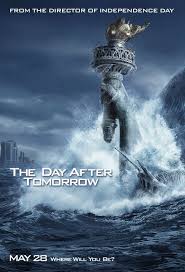
The Day After Tomorrow: A Scientific Critique

The 2004 film The Day After Tomorrow, in which global warming leads to a new ice age, has been vigorously criticized by climate scientists. Why is this? What mistakes in the film led Dr. Andrew Weaver, Canada’s top climate modeller, to claim that “the science-fiction movie The Day After Tomorrow creatively violates every known law of thermodynamics”? What prompted Dr. Gavin Schmidt, NASA climatologist, to say thatThe Day After Tomorrow was so appallingly bad, it was that that prompted me to become a more public scientist”? What could an innocent blockbuster movie have done to deserve such harsh criticisms?

A New Ice Age?

The Day After Tomorrow opens with a new scientific discovery by paleoclimatologist Jack Hall, played by Dennis Quaid. After a particularly harrowing trip to gather Antarctic ice cores, he discovers evidence of a previously unknown climate shift that occurred ten thousand years ago. Since the film is set in the early 2000s, and ice cores yielding hundreds of thousands of years of climate data have been studied extensively since the 1960s, it seems implausible that such a recent and dramatic global climatic event would have gone previously unnoticed by scientists. However, this misstep is excusable, because a brand new discovery is a vital element of many science fiction films.

Jack goes on to describe this ancient climate shift. As the world was coming out of the last glacial period, he explains, melting ice sheets added so much freshwater to the Atlantic Ocean that certain ocean circulation patterns shut down. Since thermohaline circulation is a major source of heat for the surfaces of continents, the globe was plunged back into an ice age. Jack’s portrayal of the event is surprisingly accurate: a sudden change in climate did occur around ten thousand years ago, and was most likely caused by the mechanisms he describes. To scientists, it is known as the Younger Dryas.

The world’s ascent out of the last ice age was not smooth and gradual; rather, it was punctuated by jumps in temperature coupled with abrupt returns to glacial conditions. The Younger Dryas – named after a species of flower whose pollen was preserved in ice cores during the event – was the last period of sudden cooling before the interglacial fully took over. Ice core data worldwide indicates a relatively rapid drop in global temperatures around eleven thousand years ago. The glacial conditions lasted for approximately a millennium until deglaciation resumed.

The leading hypothesis for the cause of the Younger Dryas involves a sudden influx of freshwater from the melting Laurentide Ice Sheet in North America into the Atlantic Ocean. This disruption to North Atlantic circulation likely caused North Atlantic deep water formation, a process which supplies vast amounts of heat to northern Europe, to shut down. Substantial regional cooling allowed the glaciers of Europe to expand. The ice reflected sunlight, which triggered further cooling through the ice-albedo feedback. However, the orbital changes which control glacial cycles eventually overpowered this feedback. Warming resumed, and the current interglacial period began.

While Jack Hall’s discussion of the Younger Dryas is broadly accurate, his projections for the future are far-fetched. He asserts that, since the most recent example of large-scale warming triggered glacial conditions, the global warming event currently underway will also cause an ice age. At a United Nations conference, he claims that this outcome is virtually certain and “only a matter of time”. Because it happened in the past, he reasons, it will definitely happen now. Jack seems to forget that every climate event is unique: while looking to the past can be useful to understand today’s climate system, it does not provide a perfect analogue upon which we can base predictions. Differences in continental arrangement, initial energy balance, and global ice cover, to name a few factors, guarantee that no two climate changes will develop identically.

Additionally, Jack’s statements regarding the plausibility of an imminent thermohaline shutdown due to global warming fly in the face of current scientific understanding. As the world continues to warm, and the Greenland ice sheet continues to melt, the North Atlantic circulation will probably slow down due to the added freshwater. The resulting cooling influence on parts of Europe will probably still be overwhelmed by warming due to greenhouse gases. However, a complete shutdown of North Atlantic deep water formation is extremely unlikely within this century. It’s unclear whether an eventual shutdown is even possible, largely because there is less land ice available to melt than there was during the Younger Dryas. If such an event did occur, it would take centuries and still would not cause an ice age – instead, it would simply cancel out some of the greenhouse warming that had already occurred. Cooling influences simply decrease the global energy balance by a certain amount from its initial value; they do not shift the climate into a predetermined state regardless of where it started.

Nevertheless, The Day After Tomorrow goes on to depict a complete shutdown of Atlantic thermohaline circulation in a matter of days, followed by a sudden descent into a global ice age that is spurred by physically impossible meteorological phenomena.

The Storm

Many questions about the Ice Ages remain, but the scientific community is fairly confident that the regular cycles of glacial and interglacial periods that occurred throughout the past three million years were initiated by changes in the Earth’s orbit and amplified by carbon cycle feedbacks. Although these orbital changes have been present since the Earth’s formation, they can only lead to an ice age if sufficient land mass is present at high latitudes, as has been the case in recent times. When a glacial period begins, changes in the spatial and temporal distribution of sunlight favour the growth of glaciers in the Northern Hemisphere. These glaciers reflect sunlight, which alters the energy balance of the planet. The resulting cooling decreases atmospheric concentrations of greenhouse gases, through mechanisms such as absorption by cold ocean waters and expansion of permafrost, which causes more cooling. When this complex web of feedbacks stabilizes, over tens of thousands of years, the average global temperature is several degrees lower and glaciers cover much of the Northern Hemisphere land mass.

The ice age in The Day After Tomorrow has a more outlandish origin. Following the thermohaline shutdown, a network of massive hurricane-shaped snowstorms, covering entire continents, deposits enough snow to reflect sunlight and create an ice age in a matter of days. As if that weren’t enough, the air at the eye of each storm is cold enough to freeze people instantly, placing the characters in mortal danger. Jack’s friend Terry Rapson, a climatologist from the UK, explains that cold air from the top of the troposphere is descending so quickly in the eye of each storm that it does not warm up as expected. He estimates that the air must be -150°F (approximately -100°C) or colder, since it is instantly freezing the fuel lines in helicopters.

There are two main problems with this description of the storm. Firstly, the tropopause (the highest and coldest part of the troposphere) averages -60°C, and nowhere does it reach -100°C. Secondly, the eye of a hurricane – and presumably of the hurricane-shaped snowstorms – has the lowest pressure of anywhere in the storm. This fundamental characteristic indicates that air should be rising in the eye of each snowstorm, not sinking down from the tropopause.

Later in the film, NASA scientist Janet Tokada is monitoring the storms using satellite data. She notes that temperature is decreasing within the storm “at a rate of 10 degrees per second”. Whether the measurement is in Fahrenheit or Celsius, this rate of change is implausible. In under a minute (which is likely less time than the satellite reading takes) the air would reach absolute zero, a hypothetical temperature at which all motion stops.

In conclusion, there are many problems with the storm system as presented in the film, only a few of which have been summarized here. One can rest assured that such a frightening meteorological phenomenon could not happen in the real world.

Sea Level Rise

Before the snowstorms begin, extreme weather events – from hurricanes to tornadoes to giant hailstones – ravage the globe. Thrown in with these disasters is rapid sea level rise. While global warming will raise sea levels, the changes are expected to be extremely gradual. Most recent estimates project a rise of 1-2 metres by 2100 and tens of metres in the centuries following. In contrast, The Day After Tomorrow shows the ocean rising by “25 feet in a matter of seconds” along the Atlantic coast of North America. This event is not due to a tsunami, nor the storm surge of a hurricane; it is assumed to be the result of the Greenland ice sheet melting.

As the film continues and an ice age begins, the sea level should fall. The reasons for this change are twofold: first, a drop in global temperatures causes ocean water to contract; second, glacier growth over the Northern Hemisphere locks up a great deal of ice that would otherwise be present as liquid water in the ocean. However, when astronauts are viewing the Earth from space near the end of the film, the coastlines of each continent are the same as today. They have not been altered by either the 25-foot rise due to warming or the even larger fall that cooling necessitates. Since no extra water was added to the Earth from space, maintaining sea level in this manner is physically impossible.

Climate Modelling

Since the Second World War, ever-increasing computer power has allowed climate scientists to develop mathematical models of the climate system. Since there aren’t multiple Earths on which to perform controlled climatic experiments, the scientific community has settled for virtual planets instead. When calibrated, tested, and used with caution, these global climate models can produce valuable projections of climate change over the next few centuries. Throughout The Day After Tomorrow, Jack and his colleagues rely on such models to predict how the storm system will develop. However, the film’s representation of climate modelling is inaccurate in many respects.

Firstly, Jack is attempting to predict the development of the storm over the next few months, which is impossible to model accurately using today’s technology. Weather models, which project initial atmospheric conditions into the future, are only reliable for a week or two: after this time, the chaotic nature of weather causes small rounding errors to completely change the outcome of the prediction. On the other hand, climate models are concerned with average values and boundary conditions over decades, which are not affected by the principles of chaos theory. Put another way, weather modelling is like predicting the outcome of a single dice roll based on how the dice was thrown; climate modelling is like predicting the net outcome of one hundred dice rolls based on how the dice is weighted. Jack’s inquiry, though, falls right between the two: he is predicting the exact behaviour of a weather system over a relatively long time scale. Until computers become vastly more precise and powerful, this exercise is completely unreliable.

Furthermore, the characters make seemingly arbitrary distinctions between “forecast models”, “paleoclimate models”, and “grid models”. In the real world, climate models are categorized by complexity, not by purpose. For example, GCMs (General Circulation Models) represent the most processes and typically have the highest resolutions, while EMICs (Earth System Models of Intermediate Complexity) include more approximations and run at lower resolutions. All types of climate models can be used for projections (a preferred term to “forecasts” because the outcomes of global warming are dependent on emissions scenarios), but are only given credence if they can accurately simulate paleoclimatic events such as glacial cycles. All models include a “grid”, which refers to the network of three-dimensional cells used to split the virtual Earth’s surface, atmosphere, and ocean into discrete blocks.

Nevertheless, Jack gets to work converting his “paleoclimate model” to a “forecast model” so he can predict the path of the storm. It is likely that this conversion involves building a new high-resolution grid and adding dozens of new climatic processes to the model, a task which would take months to years of work by a large team of scientists. However, Jack appears to have superhuman programming abilities: he writes all the code by himself in 24 hours!

When he has finished, he decides to get some rest until the simulation has finished running. In the real world, this would take at least a week, but Jack’s colleagues wake him up after just a few hours. Evidently, their lab has access to computing resources more powerful than anything known to science today. Then, Jack’s colleagues hand him “the results” on a single sheet of paper. Real climate model output comes in the form of terabytes of data tables, which can be converted to digital maps, animations, and time plots using special software. Jack’s model appeared to simply spit out a few numbers, and what these numbers may have referred to is beyond comprehension.

If The Day After Tomorrow was set several hundred years in the future, the modelling skill of climate scientists and the computer power available to them might be plausible. Indeed, it would be very exciting to be able to build, run, and analyse models as quickly and with as much accuracy as Jack and his colleagues can. Unfortunately, in the present day, the field of climate modelling works quite differently.

Conclusions

The list of serious scientific errors in The Day After Tomorrow is unacceptably long. The film depicts a sudden shutdown of thermohaline circulation due to global warming, an event that climate scientists say is extremely unlikely, and greatly exaggerates both the severity and the rate of the resulting cooling. When a new ice age begins in a matter of days, it isn’t caused by the well-known mechanisms that triggered glacial periods in the past – rather, massive storms with physically impossible characteristics radically alter atmospheric conditions. The melting Greenland ice sheet causes the oceans to rise at an inconceivable rate, but when the ice age begins, sea level does not fall as the laws of physics dictate it should. Finally, the film depicts the endeavour of science, particularly the field of climate modelling, in a curious and inaccurate manner.

It would not have been very difficult or expensive for the film’s writing team to hire a climatologist as a science advisor – in fact, given that the plot revolves around global warming, it seems strange that they did not do so. One can only hope that future blockbuster movies about climate change will be more rigorous with regards to scientific accuracy.