Merchants of Doubt

I waited a long time to read this book – in retrospect, too long. I have long been a fan of Naomi Oreskes; I believe she is a brilliant and sensible scientist with a compelling way with words. On the other hand, nothing depresses me more quickly than reading about those who deliberately spread confusion on climate change for political reasons. After a particularly battering year for climate science in the public eye, I want to make sure I stay sane.

However, Merchants of Doubt: How a Handful of Scientists Obscured the Truth on Issues from Tobacco Smoke to Global Warming, by Naomi Oreskes and Erik Conway, was oddly comforting. How could it be so, you might ask, given the subject matter?

It’s a good question. The book traces several key players, such as Frederick Seitz, S. Fred Singer, Bill Nierenberg, and Robert Jastrow, in their fight against mainstream science. Many of them were physicists in the era of atomic bomb development, and nearly all had been deeply influenced by the Cold War – they were anti-Communist to the point of extremism.

This extremism soon extended into science: any new discovery that seemed to necessitate government action was vehemently attacked by Seitz et al. Whether it was the harmful health effects of smoking, second-hand smoking, or DDT, and the existence of anthropogenic acid rain, ozone depletion, or climate change, the same people used the same strategies to sow doubt in the public mind, delaying the cry for action. The algorithm was relatively simple:

  • construct arguments against the phenomenon, which scientists had already addressed and ruled out
  • widely publish these arguments in the popular press, rather than scientific journals
  • demand that the mainstream media be neutral and provide “equal time” for their side of the so-called controversy
  • attack the professional integrity of the scientists who discovered and studied the phenomenon; label them as frauds and/or Communists
  • claim that action on this issue would be the beginning of the “slippery slope to socialism”

It’s enough to anger anyone who has the least bit of sympathy for science. The authors say it best:

Why would scientists dedicated to uncovering the truth about the natural world deliberately misrepresent the work of their own colleagues? Why would they spread accusations with no basis? Why would they refuse to correct their arguments once they had been shown to be incorrect? And why did the press continue to quote them, year after year, even as their claims were shown, one after another, to be false?

History repeated itself many times over, within the course of just a few decades. The attack against climate science that we are currently witnessing is just a larger-scale rehash of the pro-industry, anti-Communist fight against epidemiology, environmental chemistry, and so on. Until now, few attempts have been made to connect the dots, but Oreskes and Conway present a watertight and compelling thesis in Merchants of Doubt.

The hopeful part came when I realized this: all of the previous issues that Seitz et al attempted to discredit were eventually addressed, more or less successfully, by the government, even if some of the public is still confused about the science. Restrictions and regulations on smoking, along with education regarding its harms, has made tobacco use a semi-stigmatized practice in my generation, rather than a near-universal activity. The Montreal Protocol was largely a success, and stratospheric ozone is on the rise. The world, at least so far, has managed to avoid nuclear warfare.

Climate change is undoubtedly a more inevitable and wide-ranging problem, as it strikes at the heart of our fossil-fuel based economy, and will probably surpass, both in rate and magnitude, any change our species has seen in the global environment. However, since the attack against climate science has tracked so closely with previous campaigns, I can’t help but hope it will eventually end the same way: with the public and the government realizing the problem and employing effective measures to address it. I know it’s probably not very scientific of me to make this connection, but hope doesn’t have to be rational to be effective.

The Real Story of Climategate

A year ago today, an unidentified hacker published a zipped folder in several locations online. In this folder were approximately one thousand emails and three thousand files which had been stolen from the backup server of the Climatic Research Unit in the UK, a top centre for global temperature analysis and climate change studies. As links to the folder were passed around on blogs and online communities, a small group of people sorted through the emails, picking out a handful of phrases that could be seen as controversial, and developing a narrative which they pushed to the media with all their combined strength. “A lot is happening behind the scenes,” one blog administrator wrote. “It is not being ignored. Much is being coordinated among major players and the media. Thank you very much. You will notice the beginnings of activity on other sites now. Here soon to follow.”

This was not the work of a computer-savvy teenager that liked to hack security systems for fun. Whoever the thief was, they knew what they were looking for. They knew how valuable the emails could be in the hands of the climate change denial movement.

Skepticism is a worthy quality in science, but denial is not. A skeptic will only accept a claim given sufficient evidence, but a denier will cling to their beliefs regardless of evidence. They will relentlessly attack arguments that contradict their cause, using talking points that are full of misconceptions and well-known to be false, while blindly accepting any argument that seems to support their point of view. A skeptic is willing to change their mind. A denier is not.

There are many examples of denial in our society, but perhaps the most powerful and pervasive is climate change denial. We’ve been hearing the movement’s arguments for years, ranging from illogic (“climate changed naturally in the past, so it must be natural now“) to misrepresentation (“global warming stopped in 1998“) to flat-out lies (“volcanoes emit more carbon dioxide than humans“). Of course, climate scientists thought of these objections and ruled them out long before you and I even knew what global warming was, so in recent years, the arguments of deniers were beginning to reach a dead end. The Copenhagen climate summit was approaching, and the public was beginning to understand the basic science of human-caused climate change, even realize that the vast majority of the scientific community was concerned about it. A new strategy for denial and delay was needed – ideally, for the public to lose trust in researchers. Hence, the hack at CRU, and the beginning of a disturbing new campaign to smear the reputations of climate scientists.

The contents of the emails were spun in a brilliant exercise of selective quotation. Out of context, phrases can be twisted to mean any number of things – especially if they were written as private correspondence with colleagues, rather than with public communication in mind. Think about all the emails you have sent in the past decade. Chances are, if someone tried hard enough, they could make a few sentences you had written sound like evidence of malpractice, regardless of your real actions or intentions.

Consequently, a mathematical “trick” (clever calculation) to efficiently analyse data was reframed as a conspiracy to “trick” (deceive) the public into believing the world was warming. Researchers discussed how to statistically isolate and “hide the decline” in problematic tree ring data that was no longer measuring what it used to, but this quote was immediately twisted to claim that the decline was in global temperatures: the world is cooling and scientists are hiding it from us!

Other accusations were based not on selective misquotation but on a misunderstanding of the way science works. When the researchers discussed what they felt were substandard papers that should not be published, many champions of the stolen emails shouted accusations that scientists were censoring their critics, as if all studies, no matter how weak their arguments, had a fundamental right to be published. Another email, in which a researcher privately expressed a desire to punch a notorious climate change denier, was twisted into an accusation that the scientists threatened people who disagreed with them. How was it a threat if the action was never intended to materialize, and if the supposed target was never aware of it?

These serious and potentially damaging allegations, which, upon closer examination, are nothing more than grasping at straws, were not carefully examined and evaluated by journalists – they were repeated. Early media reports bordered on the hysterical. With headlines such as “The final nail in the coffin of anthropogenic global warming” and “The worst scientific scandal of our generation“, libelous claims and wild extrapolations were published mere days after the emails were distributed. How could journalists have possibly had time to carefully examine the contents of one thousand emails? It seems much more likely that they took the short-cut of repeating the narrative of the deniers without assessing its accuracy.

Even if, for the sake of argument, all science conducted by the CRU was fraudulent, our understanding of global warming would not change. The CRU runs a global temperature dataset, but so do at least six other universities and government agencies around the world, and their independent conclusions are virtually identical. The evidence for human-caused climate change is not a house of cards that will collapse as soon as one piece is taken away. It’s more like a mountain: scrape a couple of pebbles off the top, but the mountain is still there. For respected newspapers and media outlets to ignore the many independent lines of evidence for this phenomenon in favour of a more interesting and controversial story was blatantly irresponsible, and almost no retractions or apologies have been published since.

The worldwide media attention to this so-called scandal had a profound personal impact on the scientists involved. Many of them received death threats and hate mail for weeks on end. Dr. Phil Jones, the director of CRU, was nearly driven to suicide. Another scientist, who wishes to remain anonymous, had a dead animal dumped on his doorstep and now travels with bodyguards. Perhaps the most wide-reaching impact of the issue was the realization that private correspondence was no longer a safe environment. This fear only intensified when the top climate modelling centre in Canada was broken into, in an obvious attempt to find more material that could be used to smear the reputations of climate scientists. For an occupation that relies heavily on email for cross-national collaboration on datasets and studies, the pressure to write in a way that cannot be taken out of context – a near-impossible task – amounts to a stifling of science.

Before long, the investigations into the contents of the stolen emails were completed, and one by one, they came back clear. Six independent investigations reached basically the same conclusion: despite some reasonable concerns about data archival and sharing at CRU, the scientists had shown integrity and honesty. No science had been falsified, manipulated, exaggerated, or fudged. Despite all the media hullabaloo, “climategate” hadn’t actually changed anything.

Sadly, by the time the investigations were complete, the media hullabaloo had died down to a trickle. Climategate was old news, and although most newspapers published stories on the exonerations, they were generally brief, buried deep in the paper, and filled with quotes from PR spokespeople that insisted the investigations were “whitewashed”. In fact, Scott Mandia, a meteorology professor, found that media outlets devoted five to eleven times more stories to the accusations against the scientists than they devoted to the resulting exonerations of the scientists.

Six investigations weren’t enough, though, for some stubborn American politicians who couldn’t let go of the article of faith that Climategate was proof of a vast academic conspiracy. Senator James Inhofe planned a McCarthy-like criminal prosecution of seventeen researchers, most of whom had done nothing more than occasionally correspond with the CRU scientists. The Attorney General of Virginia, Ken Cuccinelli, repeatedly filed requests to investigate Dr. Michael Mann, a prominent paleoclimatic researcher, for fraud, simply because a twelve-year-old paper by Mann had some statistical weaknesses. Ironically, the Republican Party, which prides itself on fiscal responsibility and lower government spending, continues to advocate wasting massive sums of money conducting inquiries which have already been completed multiple times.

Where are the politicians condemning the limited resources spent on the as yet inconclusive investigations into who stole these emails, and why? Who outside the scientific community is demanding apologies from the hundreds of media outlets that spread libelous accusations without evidence? Why has the ongoing smear campaign against researchers studying what is arguably the most pressing issue of our time gone largely unnoticed, and been aided by complacent media coverage?

Fraud is a criminal charge, and should be treated as such. Climate scientists, just like anyone else, have the right to be presumed innocent until proven guilty. They shouldn’t have to endure this endless harassment of being publicly labelled as frauds without evidence. However, the injustice doesn’t end there. This hate campaign is a dangerous distraction from the consequences of global climate change, a problem that becomes more difficult to solve with every year we delay. The potential consequences are much more severe, and the time we have left to successfully address it is much shorter, than the vast majority of the public realizes. Unfortunately, powerful forces are at work to keep it that way. This little tussle about the integrity of a few researchers could have consequences millennia from now – if we let it.

Update: Many other climate bloggers are doing Climategate anniversary pieces. Two great ones I read today were Bart Verheggen’s article and the transcript of John Cook’s radio broadcast. Be sure to check them out!
What If…?

Cross-posted from NextGen Journal

Let’s start with the obvious – the U.S. midterm elections are upon us, and it’s quite likely that the Republicans will win a majority. (My American friends tell me that this is possible even with Barack Obama remaining president. Please bear with my limited knowledge of the American political system. It works very differently in Canada.)

I’m not going to comment on partisan issues – health care, immigration, economic stimulus. What I am here to talk about is an issue that should not be partisan, but has become partisan regardless: science, specifically climate science.

Climate change is not a theory – it is the logical result of several theories, based in physics and chemistry, that scientists have understood since the 1800s. What’s political about that? Exactly what part of the equation dF = 5.35 ln(C/Co) is an opinion that differs based on ideological factors?

The political part comes when we ask the question, “What do we do to stop climate change?” A carbon tax? Cap-and-trade? Regulation? Some of these solutions are more liberal or conservative than others. The only decision that doesn’t adhere to U.S. politics is to do nothing. Absence of action is a decision in itself, and the overwhelming scientific evidence (based not just on computer models, but also observations of past climate changes) shows us that doing nothing will allow this problem to spiral out of control, causing damages that no amount of money will be able to repair. What U.S. party advocates leaving that kind of world to their grandchildren? As Bill McKibben says, you wouldn’t expect it to be the Republicans:

If there was ever a radical project, monkeying with the climate would surely qualify. Had the Soviet Union built secret factories to pour carbon dioxide into the atmosphere and threatened to raise the sea level and subvert the Grain Belt, the prevailing conservative response would have been: Bomb them. Bomb them back to the Holocene—to the 10,000-year period of climatic stability now unraveling, the period that underwrote the rise of human civilization that conservatism has taken as its duty to protect. Conservatism has always stressed stability and continuity; since Burke, the watchwords have been tradition, authority, heritage. The globally averaged temperature of the planet has been 57 degrees, give or take, for most of human history; we know that works, that it allows the world we have enjoyed. Now, the finest minds, using the finest equipment, tell us that it’s headed toward 61 or 62 or 63 degrees unless we rapidly leave fossil fuel behind, and that, in the words of NASA scientists, this new world won’t be “similar to that on which civilization developed and to which life on earth is adapted.” Conservatives should be leading the desperate fight to preserve the earth we were born on.

But they’re not. Instead, many are choosing a psychological easy way out: if every solution seems imperfect, deny that the problem exists. Out of all the Republican contenders for the Senate, none support action on climate change, and most deny the existence of anthropogenic global warming.

It is questionable whether all of these statements are sincere. Politicians, after all, will say whatever they need to say to get elected. If these Republicans feel that their voting base denies climate change, they will adjust their public statements accordingly. Look at John McCain – during the 2008 presidential election, his promises for clean energy were nearly as strong as Obama’s. Now, he rejects cap-and-trade, and views the anthropogenic cause of climate change in the Arctic as an “opinion”.

Admittedly, a new, but growing, segment of the Republican voting base overwhelmingly denies climate change. As the New York Times reports, Tea Party supporters have all kinds of convoluted arguments against a field of science they know virtually nothing about. It contradicts “the preaching of Rush Limbaugh and the teaching of Scripture”, and it could be caused by “the normal cycles of nature” (whatever those are), so thousands of scientists spending their lives studying this problem must be missing something. Or they could be part of a massive conspiracy.

Republican candidates are catering to the extreme segments of their party, and, arguably, to their party as a whole. However, their plans to base action (or lack thereof) on the fervent hope that the scientific community is out to lunch may alienate voters who understand what a risk that would be.

Or so we hope. If Republicans get their way, climate science will not just be disregarded: the men and women who study it will be criminally investigated, for no reason other than that their research supports the existence of anthropogenic climate change. And since James Inhofe can’t find any gaping holes in the math, that means the scientists must be fraudulent, right?

The Republican Party also hopes to conduct yet another investigation into the private correspondence of scientists, stolen and distributed a year ago. Although these emails show that climate scientists are not always very nice, it does not undermine one iota of our understanding of the climate system, as five independent investigations have concluded. But that’s not the answer Republican officials want, so they will waste taxpayers’ money and researchers’ time with their own investigation. Kind of hypocritical for a party that promises fiscal responsibility.

I’m a Canadian. I don’t get a vote in this election. I am also eighteen years old. I, unlike most Republican Senators, will be around to witness the effects of climate change. We have wasted twenty years in the fight against climate change, and if we continue to let petty politics and finger-pointing delay us more, the whole world will suffer.

It’s no secret that American politics disproportionately influence the world. The same is true for American emissions of greenhouse gases, and American agreements to reduce these emissions, and American patterns of energy use and energy sources. So please, when you go to vote this week, think about not just yourself and your country but other young people and other countries too.

And please vote. I’ll leave you with some wise words from Seth Godin:

If you don’t vote because you’re trying to teach politicians a lesson, you’re tragically misguided in your strategy. The very politicians you’re trying to send a message to don’t want you to vote.

Voting is free. It’s fairly fast. It doesn’t make you responsible for the outcome, but it sure has an impact on what we have to live with going forward. The only thing that would make it better is free snacks.

Even if you’re disgusted, vote. Vote for your least unfavorite choice. But go vote.

Odds and Ends

I must thank Michael Tobis for two pieces of reading that his blog recently pointed me to. First, a fantastic article by Bill McKibben, which everyone should print out and stick to their fridge. Here’s a taste:

Read the comments on one of the representative websites: Global warming is a “fraud” or a “plot.” Scientists are liars out to line their pockets with government grants. Environmentalism is nothing but a money-spinning “scam.” These people aren’t reading the science and thinking, I have some questions about this. They’re convinced of a massive conspiracy.

The odd and troubling thing about this stance is not just that it prevents action. It’s also profoundly unconservative. If there was ever a radical project, monkeying with the climate would surely qualify. Had the Soviet Union built secret factories to pour carbon dioxide into the atmosphere and threatened to raise the sea level and subvert the Grain Belt, the prevailing conservative response would have been: Bomb them. Bomb them back to the Holocene—to the 10,000-year period of climatic stability now unraveling, the period that underwrote the rise of human civilization that conservatism has taken as its duty to protect. Conservatism has always stressed stability and continuity; since Burke, the watchwords have been tradition, authority, heritage. The globally averaged temperature of the planet has been 57 degrees, give or take, for most of human history; we know that works, that it allows the world we have enjoyed. Now, the finest minds, using the finest equipment, tell us that it’s headed toward 61 or 62 or 63 degrees unless we rapidly leave fossil fuel behind, and that, in the words of NASA scientists, this new world won’t be “similar to that on which civilization developed and to which life on earth is adapted.” Conservatives should be leading the desperate fight to preserve the earth we were born on.

Read the rest of the article here. Highly recommended to all.

The other link I wanted to share was a new publication entitled “Science and the Media”, just released by the American Academy of Arts and Sciences (not to be confused with the American Association for the Advancement of Science – why all the acronym duplication?)

With contributions from everyone from Donald Kennedy to Alan Alda, and essays with titles from “The Scientist as Citizen” to “Civic Scientific Literacy: The Role of the Media in the Electronic Era”, I’m virtually certain that I will enjoy this one (sorry, I can’t bring myself to say things like “certain” without caveats any more). The 109-page pdf is available free of charge and can be accessed from this page, which also includes information on ordering hard copies.

In other news, the La Niña conditions in the eastern Pacific (see anomaly map above) have bumped this year’s temperatures down a bit, so January-September 2010 is now tied for the warmest on record, rather than being a clear winner. This analysis is from NCDC, however, and I’m not sure how they deal with sparse data in the Arctic (for background, see this post – a summary of one of the most interesting papers I’ve read this year). Does anyone know if GISS has an up-to-date estimate for 2010 temperatures that we could compare it to? All I can find on their website are lines and lines of raw data, and I’m not really sure how to process it myself.

That’s all for today. Enjoy the week, everyone.

Ads Past and Present

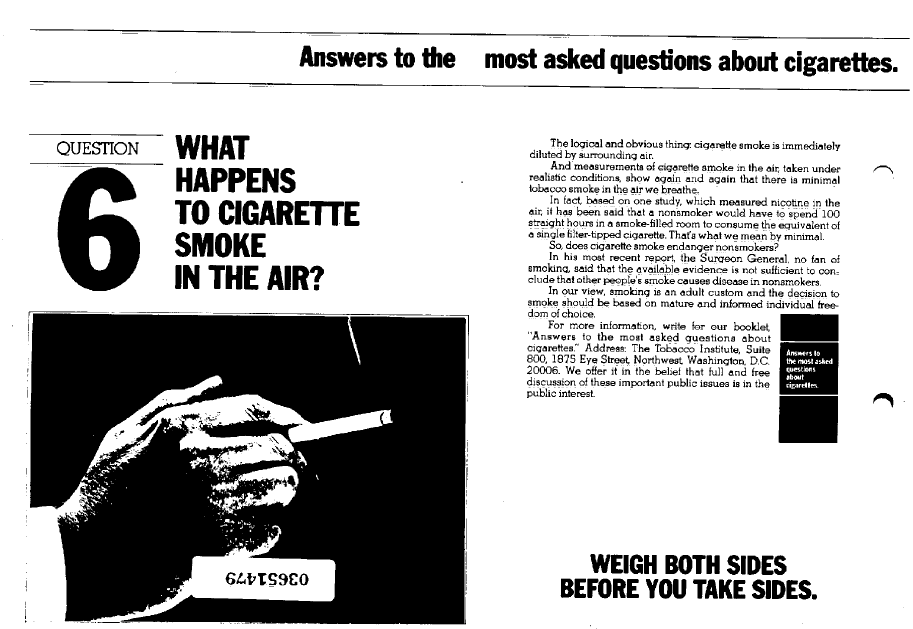
Check out these unbelievable ads from the Tobacco Institute, which I found from the Tobacco Documents database. Click to enlarge.

And here is the tamest of the Heartland Institute’s full-page ads in the Washington Post (from a year or two ago, exact date unknown):

Party Line

Brad Johnson from The Wonk Room recently released a comprehensive list of what Republican contenders for the U.S. Senate understand about climate change, inferred from their public statements. The result? 47 of the 48 deny the existence of anthropogenic climate change and/or oppose mitigating action to curb greenhouse gas emissions.

Take a look – many of the statements are what you would expect from trolling YouTube commenters, not politicians aspiring to run the most powerful country in the world. Through a combination of framing science as personal opinion, promoting artificial balance, and re-iterating the same misconceptions that people like you and I have been fighting to correct for years now, the Republican party has adopted a position that, frankly, terrifies me.

“There are dramatic environmental changes happening the Arctic region – whether one believes they are man-made or natural.” – John McCain, Arizona

“While I think the earth is warming, I don’t think that man-made causes are the primary factor.” – Ken Buck, Colorado

“The climate is always changing. The climate is never static. The question is whether it’s caused by man-made activity and whether it justifies economically destructive government regulation.” -Marco Rubio, Florida

“[Scientists] are making up their facts to fit their conclusions. They’ve already caught them doing this.” – Rand Paul, Kentucky

“There isn’t any real science to say we are altering the climate path of the Earth.” -Roy Blunt, Missouri

“I don’t buy into the whole man-caused global warming, man-caused climate change mantra of the left. I believe that there’s not sound science to back that up.” -Sharron Angle, Nevada

“There is much debate in the scientific community as to the precise sources of global warming.” -Pat Toomey, Pennsylvania

“It’s going to keep snowing in DC until Al Gore cries ‘uncle’.” -Jim DeMint, South Carolina

“If you have one volcano in the world, that one volcano puts out more carbon dioxide than everything man puts out.” -John Raese, West Virginia

“I absolutely do not believe that the science of man-caused climate change is proven. Not by any stretch of the imagination. I think it’s far more likely that it’s just sunspot activity, or something just in the geologic eons of time where we have changes in the climate.” -Ron Johnson, Wisconsin

Who are these people to make statements about what the scientific community knows and does not know about climate change, when organizations like the NAS are quite capable of doing that themselves, and tell a very different story to these prospective Senators when they do?

Who are they to make informal analyses on the attribution of recent temperature change – assessing the likelihood of different causes via gut instinct, rather than looking at fingerprints like stratospheric temperature and tropopause height?

Who are they to spread around blatant mistruths like “a single volcano puts out more CO2 than people do”? Who are they to make damaging accusations about scientific fraud and false data, especially when these accusations have already been investigated multiple times, coming up completely clear?

I had hoped that politicians would be slightly more informed than the general public on scientific matters that have implications for policy. However, I must now change my mind, and hope instead that the American public realizes how off the mark this position is. If they don’t, there could be consequences up to millenia from now.

A Fabulous Contribution

I’ve really been enjoying the Advanced versions of Skeptical Science’s rebuttals to common misconceptions about climate change. So far, they have all been written by someone going by the name of dana1981, who I would like to give a huge shout-out to. I am a new B.Sc. student who is interested in pursuing a career in climate change research, and these articles have been very helpful in giving me a taste of basic atmospheric science.

In “How do we know more CO2 is causing warming?”, I was introduced to the relatively simple equation required to calculate the radiative forcing of increased atmospheric carbon dioxide, as well as the expected equilibrium temperature change from CO2, using the range of values for climate sensitivity provided by the IPCC (as calculating climate sensitivity is not quite so simple!)

In “The human fingerprint in global warming”, dana1981 discussed different attribution studies, and explained how anthropogenic warming has certain “fingerprints” – more warming at night than during the day, a cooling of the stratosphere, and a rise in tropopause height – all of which have been observed. I had a basic understanding of these fingerprints and why they occurred, but it was great to read about the current research in attribution studies, with impeccable citations.

“How sensitive is our climate?” was similar to the first article, but also addressed the common misconception that climate sensitivity is specific to different forcings. If the climate has low sensitivity to CO2, it also has low sensitivity to solar radiation, cosmic ray feedback, etc. The equilibrium temperature change doesn’t care if the extra few W/m2 is from the greenhouse effect or planetary albedo – it changes with the same speed either way, which disproves many skeptical arguments. Additionally, since the prehistoric record shows large swings in climate resulting from relatively small forcings, scientists are confident that climate sensitivity is not very low.

“Solar activity & climate: is the sun causing global warming?” was absolutely fascinating. The equations required to calculate solar forcing using total solar irradiance were new to me, and dana1981 went so far as to analyze early 20th-century warming, calculating how much was due to an upswing in solar irradiance and how much was due to anthropogenic greenhouse gases. During the latter half of the 20th century, solar irradiance has dropped back down, but warming has only accelerated.

Skeptical Science’s recent efforts to expand their rebuttals to include beginner, intermediate, and advanced levels of explanation were inspired by a RealClimate post written by Dr. Gavin Schimdt. He thoughtfully wrote,

I think we should be explicitly thinking about information levels and explicitly catering to different audiences with different needs and capabilities. One metaphor that might work well is that of an alpine ski hill. There we have (in the US for instance) green runs for beginners wanting a gentle introduction and where hopefully nothing too bad can happen. Blue runs where the technical level is a little more ambitious and a little more care needs to be taken. Black expert runs for those who know what they are doing and are doing it well, and finally, double black diamond runs for the true masters. No-one accuses ski resorts of being patronising when they have green runs interspersed with the more difficult ones, and neither do they get accused of elitism when one peak has only black runs going down (as I recall all too painfully on my first ski outing). People self-segregate and generally find their way to the level at which the feel comfortable – whether they want a easy or challenging ride – and there is nothing stopping them varying the levels as their mood or inclination takes them.

Skeptical Science took up this challenge, and although their efforts have largely been focused on creating “plain-English” beginner articles, as a huge target audience for climate change communication is the general public, I’m extremely grateful that they’re also catering to new science enthusiasts such as myself with the advanced articles. Please, keep them coming!

While we’re on the topic, I should also mention a great new post by Skeptical Science, which is not part of their argument database – “The contradictory nature of global warming skepticism”. You can’t hold the objection that the world isn’t warming and then turn around and say that global warming is natural, but these and other self-disproving arguments reach us on a daily basis. Deniers can’t seem to agree on a single unified objection to anthropogenic global climate change, and some individuals, as the post shows, contradict themselves up to five times in six months.

And hey, I just realized right now – that post was also written by dana1981. Whoever this writer is, he or she is doing a great job.

Priorities

I’m sick of all the politics surrounding climate science.

I wish it could go back to just being science, the way it was in the 1970s, without all these people trying to sabotage it for us. I wish we could concentrate on the joy and fascination we feel when we learn about the climate system, without having to deal with hate mail and quotes taken out of context.

I’m tired of the game of Broken Telephone in science journalism, the game that somehow always allows Fox News to make claims like “melting Arctic sea ice isn’t caused by warming temperatures”. I’m tired of the outright falsehoods that are permitted to circulate around the world, in respected publications, without consequences.

I’m tired of unnecessary investigations into the integrity of climatology researchers and organizations. I’m tired of the accusations of “whitewash” when these investigations invariably come up clear. I’m tired of scientists being portrayed as frauds if they don’t achieve a 100% success rate in their projections.

I’m tired of the politicians that attempt to subject innocent scientists to criminal prosecution. They’re so unwilling to accept the reality of anthropogenic global climate change that they think scientific fraud on an unprecedented scale is more likely than well-established properties of physics playing out as expected. It frightens and astounds me that people with such an upside-down understanding of the scientific process hold immense power in the American government.

I first became interested in climate science because of the science, not because of all the politics surrounding it. The earliest thing I can remember sparking my interest is learning about the different isotopes of oxygen, and how they can be used to reconstruct temperature.

These days, however, it’s nearly impossible to learn about climate science without running into silly arguments and widespread misconceptions and stubborn denialism. I started writing this blog so that I would have an outlet to keep myself sane as I waded through all the muddle. As time went on, an element of public education developed, along with priceless learning opportunities and collaboration. This blog has grown to so much more than I ever anticipated.

I don’t really have the heart to read Naomi Oreskes’ new book quite yet, or to re-read Climate Cover-Up, or to scroll down to the comment section when CBC publishes online articles about climate change. I know what a dire situation we are in, not only ecologically and climatologically, but also socially – in terms of public understanding and science communication. I know what a mess we’re in, and I don’t need reminding. I don’t know how we’re going to get out of the mess, but I try to do my part by continuing to pour my sociological musings into this sanity-inducing and morale-raising outlet.

I just want to work my way through David Archer’s book, Global Warming: Understanding the Forecast, and learn how to use all the atmospheric science equations within it. I want to download papers from Nature and Science and read them on the bus. I want to keep a close eye on the “Advanced” versions of Skeptical Science rebuttals, because isn’t it just amazing that we have a simple logarithmic equation for the relationship between radiative forcing and atmospheric CO2 concentration?

Many people might find it strange that I see straight science as a break, some sort of retreat from that which is more difficult to stomach. But then, we’re in a strange situation here.

The Best Cartoons Ever

Over the past year, I have seen far too many political cartoons on the editorial pages of newspapers accusing climate scientists of fraud. It amazes me what is allowed to be published without evidence in respected media publications.

However, there are still some great cartoons about climate change, sans libel. Here are two of my favourite, that I haven’t seen featured on any other blogs.

From Lee Judge of Cartoonist Group:

From Nick Anderson of the Houston Chronicle:

Please comment with your thoughts on these cartoons, and include your favourites! If you would like them embedded directly in the comment (img tags require administrator rights, as Colin Reynolds discovered) include the link and I’ll embed it for you.

Deniers?

I really enjoyed New Scientist’s Special Report: Living in Denial. What a fascinating phenomenon, and a fascinating batch of articles exploring it.

The denial of science is a growing problem. It’s not restricted to a particular ideology – while denying the harmful effects of smoking or the existence of climate change is typically a position of the far right, vaccine denial and H1N1 conspiracy theories are largely restricted to the left.

It occurs even among the well-educated, or among youth who are still immersed in up-to-date curricula. For example, this year at the university, a student group put up signs saying “Don’t get the swine flu shot – it contains mercury!” The chemistry students got mad, and said that labelling thimerosal as toxic mercury was comparable to saying “Don’t eat table salt, it contains chlorine gas!”

As Michael Shermer’s article explains, the defining mark of science denial is a refusal to change one’s mind based on evidence. This is easy to identify for something like Holocaust denial, where evidence is abundant in the public sphere.

It gets a little harder for more technical issues like climate change or vaccines. Scientific opinion is overwhelmingly on one “side”, but the average person does not know or understand the evidence to support this consensus. An article about the thermodynamics of the stratosphere won’t sell a lot of papers. Most people unconsciously follow the credibility spectrum and trust what their doctor or NASA scientists say.

However, some don’t realize that scientific credibility is not the same as an appeal to authority, and so express contrarian opinions. Vaccines cause autism. Global warming is nonexistent/natural/inconsequential. The way that the Twin Towers fell proves that it was orchestrated by the US government.

There are two groups of contrarians: the skeptics, and the deniers. The skeptics are the ones who will change their minds based on evidence – they just haven’t encountered that evidence yet. My favourite example of this is from the Friends episode when Phoebe declares she doesn’t believe in evolution. When Ross starts talking to her about fossils, she says, “Oh. I didn’t know there was actually evidence.”

It’s amazing how many insights you can get out of a supposedly “fluffy” sitcom. I could write an entire essay analyzing that clip…..

I have met dozens of very reasonable people who doubt climate change because they don’t know about the evidence for it. People my age throw around the phrase “it’s a natural cycle” a lot, until I explain that the climate doesn’t act like a pendulum. It doesn’t have to compensate for past periods of warming or cooling – it simply responds to forcings. If the forcing is cyclical, then the climate will be cyclical, but some forcings are a different shape altogether. Similarly, I know a teacher who previously thought that natural causation of the current warming was a legitimate scientific theory, due to a presentation from a teacher’s conference….until I did a bit of probing and discovered that this presentation was given by Tim Ball.

These people are very reasonable. They are willing to change their minds based on evidence. They’ve just been unlucky enough to be misinformed by our flawed system of science journalism.

Then there are the deniers. They call themselves skeptics, but they will not change their minds, no matter what evidence you give them. They either move the goalposts, change the subject, or continue to repeat the same claim even after you have rebutted it patiently multiple times. Go check out some YouTube comments to see what I’m talking about.

Often their ideology or worldview is extreme in some way. For many members of the far right, any problem that would be solved by the government (think cap-and-trade or smoking legislation) will be rejected out of hand. On the far left, anything that would benefit corporations (usually vaccines or traditional medicine) will face a similar reaction. As Michael Specter says, “We hate Big Pharma. We run away from Big Pharma….and leap right into the arms of Big Placebo.”

This phenomenon suggests that science communication is not the answer – for deniers. I learned long ago that trying to change the minds of deniers is a complete waste of time. However, I still feel that science communication and the rebuttal of common misconceptions is absolutely vital. The true skeptics need access to the evidence they are lacking, so that they will be more informed, and our population will move farther towards solving the many science-related problems we face.

These skeptics deserve our time, our efforts, and our respect. They are the target audience of my blog, even if my most active commenters and supporters are a different group altogether. The reason that any of us here do all this work in communication, I believe, is for the true skeptics.

Michael Fitzpatrick argues that we shouldn’t use the label “deniers” at all. I wouldn’t want to alienate the true skeptics by coming across as someone who insults others. However, I think that calling deniers “skeptics” is unfair to the skeptics. They are two completely different groups that we must distinguish between. Skepticism is a worthy quality in science, and giving the complimentary title of “skeptic” to someone who doesn’t deserve it is unfair to those who do. We need to cater to the people who are willing to learn and who don’t want to waste our time. Science communication shouldn’t have to be like No Child Left Behind.

Michael Shermer’s second article, similarly, says that we should participate in debates with deniers and give them a chance to be heard. The truth will prevail, he argues, even if the deniers refuse to give in. I would agree with this position if it were a matter of opinion or policy, which is wholly democratic. Yet science is completely different. Science isn’t about free speech and giving equal time for all views. It is about giving time to those who have the most accurate analyses and robust conclusions. In science, you shut up and listen until your ideas are strongly supported by evidence. Then you publish.

When papers skeptical of climate change get published (all three per year!), such debates are worthy. The authors passed the test of peer-review, and even if their papers are obviously sub-par and are soon to be retracted, they deserve some debate and discussion. Let’s debate contrarian science when it is actually science – when it is actually published.

By paying close attention to and publicly debating with the authors of blog science, however, we are further confusing the public’s already skewed image of science. “It doesn’t matter whether or not you publish,” we seem to be telling them, “it’s all about free speech.” The scientific process has rules, and if deniers can’t pass the necessary, but not sufficient, condition of peer-review, their work doesn’t deserve to be treated as scientific research, and we shouldn’t give them our attention.

Let’s ignore the people who aren’t worth our time, because we have limited time, and there are people out there who deserve every minute of it.