The Associated Press Gets it Right

It’s been quite the summer. Moscow has experienced several months of weather more akin to Texas, and is literally burning up. Floods in China have killed more than a thousand and left countless others displaced. Pakistan has experienced similar floods due to a massive monsoon season, and now they have to deal with cholera, too. The Arctic sea ice extent is not much larger than 2007, and, so far, it’s been the warmest year on record globally.

We can’t tie a single extreme event to climate change. We can tie long-term trends, like 30 years of declining Arctic sea ice, to a warming world, but we don’t yet have the technology to attribute a single anomalous season to a particular cause. In 2007, for example, factors other than high temperatures contributed to the lowest Arctic sea ice extent on record.

However, these events are exactly what we expect from anthropogenic climate change. We shouldn’t look at them as evidence for global warming, but as examples of what is to come. This is an important warning that most newspapers have been shying away from. After nearly a year of terrible climate change journalism across the board, they didn’t even mention the connection between extreme events and climate change, or the fact that this summer is a very real glimpse into our future.

I gave up on my local newspaper months ago, and I don’t regret that decision. On the handful of mornings that I’ve flipped through the paper instead of reading the Globe and Mail on the Internet (journalism of much higher quality, and it saves money and paper), I’ve seen far too many op-eds and letters to the editor saying very strange things about climate science.

However, a headline yesterday caught my eye. A fantastic article by Charles J. Hanley, a Pulitzer Prize winning journalist, was distributed by the Associated Press and, consequently, picked up by dozens of newspapers across the continent – including my local paper.

I became more and more pleasantly surprised as I began to read through the article:

Floods, fires, melting ice and feverish heat: From smoke-choked Moscow to water-soaked Iowa and the High Arctic, the planet seems to be having a midsummer breakdown. It’s not just a portent of things to come, scientists say, but a sign of troubling climate change already under way.
The weather-related cataclysms of July and August fit patterns predicted by climate scientists, the Geneva-based World Meteorological Organization says – although those scientists always shy from tying individual disasters directly to global warming.

Read the whole article here.

Hanley does a fantastic job of distinguishing between weather and climate, and stressing that we can’t yet attribute extreme events to specific causes while acknowledging that this summer’s wild weather fits with IPCC predictions and will become a lot more common in the future. He interviews our good friend Gavin Schmidt, and explains how rising greenhouse gases are “loading the climate dice” – changing the relative odds of different extremes, rather than eliminating all cold days entirely.

I stood there and clapped. I was so proud of the Associated Press, and of my local paper, that I clapped for them. I feel like there is a smidgen of hope for climate change journalism and public understanding of this issue again. Or perhaps it just comes in waves, and we’re riding our way to the top again.

Too Much at Every Level

I think that action to mitigate climate change has been so slow (in many cases, nonexistent) partly because the problem is just so massive. At every single level – individual, politician, government, country – people think that they can’t possibly solve it on their own, so there’s no point in trying at all.

It’s not the same kind of problem as something like world poverty, or disease in developing countries. In a way, I wish it was. It’s not really possible for a single person to solve these problems either, but at least they can solve it for someone. They can pay for a child’s education in Africa. They can build a well with clean water for an entire community. These types of problems are measured in increments, rather than gradients – just like the corpuscular theory of light. The problem comes in small packages of one person each, and even if you can’t eliminate the problem for everyone, you can chip away.

Conversely, climate change is a gradient, and one that is very resistant to reversal. Even if a family manages to completely eliminate all sources of carbon emissions in their life, they’re only preventing a fraction of a fraction of a fraction of a degree of warming. 2.999997 C warming isn’t very different to 3 C. And that difference of 0.000003 C isn’t changing the life of a child. (These are just arbitrary numbers, don’t quote me on them!) Really, it isn’t having any impact at all. So most people don’t even bother. They feel so powerless – after all, this problem is far too big for them to solve.

I believe that individual action on climate change is definitely worth it, but in a more symbolic manner. No, composting your kitchen waste isn’t going to eliminate enough methane to make a difference in the global radiative forcing of greenhouse gases. But it gets you in the right mindset. It makes you stop and think about the planet and the future. And the chance that you might inspire all your friends and neighbours to compost as well, who would then inspire all of their friends, and eventually start a chain reaction that could, conceivably, start to make a difference, is just too good to pass up. (Besides, composting is fun to watch. We get some very cool slugs hanging out around ours this time of year.)

Regardless, the feeling of powerlessness becomes the norm, to the point where even politicians don’t think they can make any difference. I have a friend who asked his MP, a Liberal, what she was going to do about climate change. Her response was, “What can I do? I’m only one person.” I find it absolutely astounding that a politician who represents tens of thousands of people, and who helps to govern the entire country, could have this attitude. It’s kind of sad when even our Members of Parliament feel powerless.

Of course, Canada’s national position on climate change action is “whatever the States decides, and we won’t do anything at all unless and until they do”. The federal government feels powerless too, because (as they constantly remind us) Canada produces only 2% of the world’s greenhouse gas emissions. What’s the point of reducing them if the U.S. isn’t going to do the same?

We all know that the U.S. isn’t going to pass cap-and-trade any time soon. It looks like the Republicans are keeping their promise of preventing Obama from passing any more sweeping legislation, after the health care bill. And a big reason (or at least a common excuse) for this lack of initiative is that India and China will soon produce most of the world’s carbon emissions. What’s the point of the U.S. making any mitigating effort if the soon-to-be-major-players won’t?

What federal governments fail to realize is that they have far more power than they give themselves credit for. If the U.S. decides that they want a global economy of clean energy, they have enough influence over the market to make that happen. If Canada decides that tar sands actually aren’t such a good idea after all, all the countries that import from us will have to find alternatives. But this hasn’t happened, because governments are far more concerned about the next election.

At times like these, I just want to look politicians in the eyes and tell them to wake up. Stop playing games, pointing fingers, and sabotaging your enemies. Remember that your job is to look out for us, and start getting serious on a crisis that is unprecedented in all of human history – one that we could all avoid, even now, if you just got your acts together.

I am now a voting member of the public, a legal adult. And I don’t have a clue who to vote for, because nearly every politician has lost my support. If they cared at all about the kind of world I will live in after they are gone, and the kind of world the children I hope to have will live in after I am gone, they would start doing their jobs. I think I will find myself voting against politicians, rather than for politicians. I will vote for those who are the least bad, so that the worst don’t get into office.

I am not optimistic about climate change, but I know that we have a chance to prevent the worst of it. I am not optimistic, but I do not feel powerless. I believe in the power of knowledge and inspiration and culture. I believe in the potential of accomplishing a great deal in a short period of time. At some point in this chain of people who are overwhelmed or apathetic, something needs to give.

Forcings

Last time, we talked about the energy budget – the process of radiation coming in from the sun, being absorbed by the Earth, and then emitted as infrared radiation, which we perceive as heat when it hits us. Remember that this outgoing emission of energy is what determines the temperature of the Earth.

So how can the temperature of the Earth be changed? Naturally, there is a lot of year-to-year variation. For example, when the oceans absorb radiation from the sun, they don’t always emit it right away. They will store energy for a long time, and sometimes release lots at once, during El Nino. This kind of internal variability makes the average global temperature very zig-zaggy.

We need to revise the question, then. The question is not about the average global surface temperature – it’s about the amount of energy on the planet. That’s generally how the climate is changed, by increasing or decreasing the amount of energy the Earth emits as infrared radiation, and consequently, the temperature.

There are two ways to do this. The simplest method is to change the amount of incoming energy. By increasing or decreasing the amount of solar radiation that hits the Earth – either directly, by changing the sun’s output, or indirectly, by increasing the albedo or reflectivity of the Earth – the amount of infrared radiation emitted by the surface will also increase or decrease, because incoming has to be equal to outgoing. The change in outgoing radiation will often take a bit of time to catch up to the change in incoming radiation. Until the two reach a new equilibrium, the Earth will warm or cool.

Another way to change the Earth’s temperature is by artificially changing the amount of incoming energy. The same amount of solar radiation reaches the Earth, but when it is absorbed and emitted, some of the emitted infrared energy gets bounced back so the Earth has to absorb and emit it again. By processing the same energy multiple times, the temperature is a lot warmer that it would be without any bouncing. We refer to this bouncing as the “greenhouse effect”, even though greenhouses work in a completely different way, and we will be discussing it a lot more later. By increasing or decreasing the greenhouse effect, the temperature of the Earth will change too.

A change in incoming energy is referred to as a radiative forcing, because it “forces” the Earth’s temperature in a certain way, by a certain amount. It is measured in watts per square meter (W/m2), and it doesn’t take very many watts per square meter to make a big difference in the Earth’s temperature. The resulting change in temperature is called a response.

My favourite analogy to explain forcing and response uses one of the most basic physics equations – F=ma. Mass (m) is constant, so force (F) is proportional to acceleration (a). Applying a forcing to the Earth is just like pushing on a box. If the force is big enough to overcome friction, you get an acceleration – a response.

It’s also very important to use net force, not just any force. If there are two people pushing on the box in different directions with different amounts of force, the acceleration you observe will be equal to the result of those forces combined. Similarly, there are often multiple forcings acting on the climate at once. The sun might be getting slightly dimmer, the albedo might be decreasing, the greenhouse effect might be on the rise. The response of the climate will not match up to any one of those, but the sum of them all together.

Here is a video I made last year, in collaboration with Climate Change Connection, about this very analogy:

In future posts, I will be discussing different forcings in more detail. Stay tuned!

Stephen Schneider – Rest in Peace

Yesterday the world lost a great man, a gifted scientist, and a wonderful communicator. Stephen Schneider has died unexpectedly at the age of 65.

Ironically, after battling with a rare form of lymphoma and winning, Dr. Schneider succumbed to a heart attack as his plane landed in London yesterday morning. He was on his way home from a conference in Sweden.

To say that Stephen Schneider was a role model for scientists and science communicators would be an understatement. He was a pioneer in the field of climate modelling, and contributed greatly to our understanding of aerosols and their radiative forcing. However, he also fought tirelessly for public understanding of climate change. For more than thirty years, he epitomized science communication through books, interviews, appearances in documentaries, and online essays. I’m sure I’m not the only person who, after reading and listening to his contributions, often thought, “There, that’s it….that’s exactly what I’ve been trying to put into words.”

Despite death threats, hate mail, and out-of-context attacks on his integrity that persisted for decades, Stephen Schneider persisted in his communication. He understood the importance of public discussion and understanding on climate change, and nobody was better qualified than him to talk about it. He is the kind of scientist I want to become. As Ben Santer wrote in a touching eulogy on RealClimate,

Some scientists have exceptional talents in pure research…Others have strengths in communicating complex scientific issues to non-scientists. It is rare to find scientists who combine these talents. Steve Schneider was such a man…[He] did for climate science what Carl Sagan did for astronomy.

My interactions with Dr. Schneider were brief, but I was amazed at how responsive and supportive he was. I emailed him when I was researching an early story on a certain infamous quote, and he responded with links and further context, despite surely being asked about this quote on a weekly basis. A year or so later, I wrote to him again to tell him how much I enjoyed his most recent book, and he replied to thank me, commend me on my career choice, and invite me to email him for advice whenever I needed it. For a scientist who is at the top of his field and continually approached by the media, he sure makes time for students and those who are interested in his work.

As Ben Santer said, we must honor Stephen Schneider by continuing the work he left for us: understanding the complexities of the climate system, communicating what we already know to the public, fighting back against those who seek to misrepresent the science, and – above all – ensuring that our future is secure on this beautiful and fragile planet.

My condolences to his family, friends, and colleagues. He will truly be missed, and his contributions will not be forgotten.

Snowball Earth

Of all the books I have read about climate change, Snowball Earth, by Gabrielle Walker, is definitely one of the best – and it’s not even about the current climate change.
Part of what makes it so good is the style of writing. As the Los Angeles Times said about her later book, An Ocean of Air, “Walker has a Ph.D. in chemistry, but she writes like a poet.” And, indeed, after an education at Cambridge, Walker has spent most of her career as a science journalist. It’s sort of sad that this doesn’t happen more often. Usually, those who understand a subject best are not the ones who communicate it. Walker is the exception to this rule.

Take, for example, this passage about the history of life on Earth:

Stretch your arms out wide to encompass all the time on Earth. Let’s say that time runs from left to right, so Earth was born at the tip of the middle finger on your left hand. Slime arose just before your left elbow and ruled for the remaining length of your left arm, across to the right, past your right shoulder, your right elbow, on down your forearm, and eventually ceded somewhere around your right wrist. For sheer Earth-gripping longevity, nothing else comes close. The dinosaurs reigned for barely a finger’s length. And a judicious swipe of a nail file on the middle finger of your right hand would wipe out the whole of human history.

Another impressive aspect of Walker’s writing is her characterization. Wacky, stubborn, and exuberant scientists are brought to life. Instead of just hearing about their work and accomplishments, you feel like you’re getting to know them as people. She writes about arguing scientists particularly well. Arguing scientists are so much fun to read about – that’s one reason I loved The Lost World by Arthur Conan Doyle.

However, the best part of this book, by far, is the subject matter. The theory of Snowball Earth is possibly the most awesome thing I have ever heard about. Here’s how the story goes:

From what paleontologists can see preserved in fossils, complex life arose at a very specific point in prehistory: the end of the Precambrian. For several billion years before that, the only thing that lived on Earth was unicellular goop. But then, suddenly, all at once, complex organisms burst onto the evolutionary stage.

Something must have caused this dramatic appearance, and a series of scientists from the 1940s on – most prominently, Paul Hoffman – likely have discovered what. At the end of the Precambrian, there are signs of ice in rocks all over the world – scratches, rock deposits, everything that led Agassiz to discover the ice ages.

Because plate tectonics moves everything around so much, though, rocks were not necessarily formed at the location they sit today. Their magnetic field is what discloses their birthplace. Tiny bits of magnetic material, such as iron, line their field up with the Earth’s. The Earth’s magnetic field is perpendicular to the surface at the poles and parallel to the surface at the Equator, like this:

So, if a rock’s magnetic field is vertical, it was formed at the poles. If it is horizontal, it was formed at the equator. Incredibly, scientists found Precambrian rocks, with signs of ice, with horizontal magnetic fields. During that period of prehistory, the equator was covered in ice – and, therefore, the whole planet, because it’s not really possible to freeze the equator without freezing all the other latitudes too.

The scientists determined that, for several instances on the Precambrian, the continents were arranged in a way that was very conducive to ice-albedo feedback. With the smallest trigger, ice from the poles would creep across the temperature zones and meet at the equator. Frozen oceans, frozen land, the whole bit.

And now CO2 comes into the story. Volcanic eruptions naturally release carbon dioxide, but the amount is so small that the oceans have no trouble soaking them up – unless they’re frozen on the surface and cut off from the air. CO2 would gradually build up, in that case, and millions of years later, the greenhouse effect would be so strong that all the ice would melt and the planet would plunge into a state referred to as Hothouse Earth. Then the oceans would start absorbing all the extra CO2, and ice would reappear at the poles, and the cycle would begin again.

Many scientists believe that these Precambrian cycles of extreme heat and extreme cold provided such a strong pressure on organisms that natural selection was pushed to new boundaries. Complex life had an advantage in these extreme conditions, and it flourished. The most catastrophic climatic event our planet has ever experienced, in our knowledge, was what led to the evolution of multicellular organisms, and eventually, us.

It makes me feel very small, the same way that attempting to comprehend the vastness of the universe makes me feel very small. The life we see all around us only exists because of a series of coincidences. Human beings, one of the youngest of the millions of animal species that have ever existed, are alive because of continental drift lining things up in the right way. And who knows what would have happened if things had been slightly different?

So What Happened with ClimateGate?

Remember back in December, when the news was buzzing each day about the stolen emails from top climate researchers? They were described as “the final nail in the coffin of anthropogenic global warming”, or worse. Apparently, the scientists had written things that severely compromised the underpinnings for the idea that human activity was causing the Earth to warm. We could now all stop worrying and forget about cap-and-trade.

But that wasn’t the end of the story. There were no less than four independent investigations into the contents of these emails – conducted by scientists, universities, and governments, not general reporters rushing off a story about an area of science with which they were unfamiliar, and trying to make it sound interesting and controversial in the process.

So what did these investigations find? Is the Earth still warming? Are humans still responsible? Can we trust the scientific process any more, or should we throw peer-review out the window and practice Blog Science instead?

Actually, all four of the investigations concluded that absolutely no science was compromised by the contents of the emails. The CRU scientists weren’t as good as they should have been about making data easily accessible to others, but that was the only real criticism. These scientists are not frauds, although they are accused of it on a daily basis.

Pennsylvania State University, over a series of two reports, investigated the actions of their employee, Dr. Michael Mann, who is arguably at the top of the field of paleoclimatology. They found that, contrary to most accounts in the mainstream media, he did not hide or manipulate any data to exaggerate global warming, delete any emails that might seem suspicious and be subject to Freedom of Information requests, or unjustly suppress skeptical papers from publication. After a second investigation, following up on the catch-all accusation of “seriously deviating from accepted practices within the academic community”, Penn State exonerated Mann. They criticized him for occasionally sharing unpublished manuscripts with his colleagues without first obtaining the express permission of the authors, but besides that minor (and somewhat unrelated) reprimand, they found absolutely nothing wrong.

The British House of Commons investigated the actions of CRU director Phil Jones, and came to a similar conclusion. They found that his “actions were in line with common practice in the climate science community”, that he was “not part of a systematic attempt to mislead” or “subvert the peer review process”, and that “the focus on CRU….has been largely misplaced”. They criticized CRU’s lack of openness with their data, but said that the responsibility should lie with the University of East Anglia, which CRU is a part of. So these scientists should really catch up to the climate research team at NASA, for example, which publishes all of their raw data, methodologies, and computer codes online, with impeccable archives.

The University of East Anglia conducted their own investigation into the actions of CRU as a whole. They found no hint of tailoring results to a particular agenda”, and asserted thatallegations of deliberate misrepresentation and unjustified selection of data are not valid”. They also explored the lack of transparency in CRU, but were more sympathetic. “CRU accepts with hindsight”, they write, “that they should have devoted more attention in the past to archiving data and algorithms and recording exactly what they did. At the time the work was done, they had no idea that these data would assume the importance they have today and that the Unit would have to answer detailed inquiries on earlier work.” They also note that CRU should not have had to respond to Freedom of Information requests for data which they did not own (such as weather station records).

Just last week, the final investigation, headed by Sir Muir Russell on behalf of UEA, found that “their rigour and honesty as scientists are not in doubt.” Is this starting to seem a bit repetitive? To illustrate their point, over the course of two days, they independently reconstructed the global temperature record using publicly available data, and came to the same conclusion as CRU. Again, there was the criticism that CRU was not as open as it should have been. They also noted that an obscure cover figure for a 1999 World Meteorological Organization report, constructed by Phil Jones, did not include enough caveats about what was proxy data and what was instrumental data. However, the more formally published, and much more iconic, graphs in Mann 98 and the IPCC TAR, were fine.

There have been some great comments on the results of these investigations since they were released, especially by scientists. Here are some samples:

[The CRU researchers] are honest, hardworking scientists whose reputations have been unjustifiably smeared by allegations of unscrupulous behaviour…I hope that the media will devote as much attention to this comprehensive dismissal of the allegations as it did to promoting the hysteria surrounding the email theft in the first place. Will the Daily Telegraph now retract its claim that the emails revealed “the greatest scientific scandal of our age” and apologize unreservedly to Phil Jones? Will there now be a public inquiry about the erroneous, shallow and repetitive nonsense promulgated in the media over this affair? If there is a scandal to be reported at all, it is this: the media stoked a controversy without properly investigating the issues, choosing to inflate trivialities to the level of an international scandal, without regard for the facts or individuals affected. This was a shameful chapter in the history of news reporting. -Raymond Bradley, director of the Climate System Research Center at the University of Massachusetts

The call for greater transparency and openness among scientists and their institutions is necessary and welcomed, but certainly they aren’t the only ones who deserve that reminder. What institution on the planet would pass muster under such intense scrutiny? Certainly not the U.S. government agencies, which often deny or impede FOIA requests, or global corporations like BP, Massey Energy and Koch Industries, which seem to revel in hiding information from the public all the time. More transparency is needed everywhere, not just among scientists in lab coats. -Brendan DeMelle, freelance journalist, DeSmogBlog

[The Muir-Russell report] makes a number of recommendations for improvements in processes and practices at the CRU, and so can be taken as mildly critical, especially of CRU governance. But in so doing, it never really acknowledges the problems a small research unit (varying between 3.5 to 5 FTE staff over the last decade) would have in finding the resources and funding to be an early adopter in open data and public communication, while somehow managing to do cutting edge research in its area of expertise too. -Steve Easterbrook, computer science professor at the University of Toronto

I agree with these statements. I think that we are holding scientists in general, but especially climate scientists, to a far higher standard than any other group of people in the world. We need to relax a bit and realize that scientists make mistakes, and that innocent mistakes are not evidence of fraud that will bring a long-standing theory tumbling down. We need to realize that scientists are employees like any others, who don’t always follow ideal actions in every professional situation, especially when they are under intense pressure that includes death threats and accusations of criminal activity.

However, at the same time, we need to start holding other groups of people, especially journalists, to a higher standard. Why has the media been able to get away with perpetuating serious allegations without first investigating the what really happened, and without publishing explicit retractions and apologies when the people whose reputations they smeared are found innocent? Why haven’t there been four official investigations into who stole these emails, and why?

All Is Not Lost

I really enjoyed reading two recent polls conducted by George Mason University’s Center for Climate Communication. In particular, the results made me wonder why the US government still hasn’t passed a climate bill.

For example, US presidents have been saying for over a decade that it is unfair to force their industries to reduce emissions if developing countries do not have similar targets. However, only 8% of American adults share this view, and 65% believe that “the United States should reduce its greenhouse gas emissions regardless of what other countries do.” 77% agree that CO2 should be regulated, and 65% would like to see an international treaty signed.

The only solution which had less than 50% support was a tax on gasoline, even if it was revenue-neutral: offset by a decrease in income tax rates. This opposition can’t really be a case of people worrying about money. In this hypothetical situation, taxes aren’t being increased – they’re just being moved around, in a way that actually gives people more control over how much they are charged. Perhaps the public would prefer a more laissez-faire approach, or perhaps they had a knee-jerk reaction to the word “tax”. It’s not like the revenue-neutral aspect of this solution is well-known to most.

When the poll was broken down by political party, there were some surprising results that ran contrary to what one hears in the halls of Congress. 64% of Republicans support regulating CO2. Only 30% think that protecting the environment reduces economic growth and costs jobs.

Overall, the poll showed very strong support among Americans for action that still hasn’t happened, largely because a very vocal minority has had a disproportionate influence on the policy debate. If there was a referendum today, Kyoto targets and the cap-and-trade bill would pass with flying colours.

This support was even more interesting when compared to the questions regarding science. Only 61% of Americans think that the Earth is warming, and only 50% think that it is due to human activities. 45% think “there is a lot of disagreement among scientists about whether or not global warming is happening”, and only 34% were aware of the existing consensus.

The discrepancy between scientific understanding of the issue and support for mitigation shows that Americans, in general, practice risk management when it comes to climate change. Even if they’re not sure whether or not there is a problem, they understand what is at risk, and are willing to take action to prevent major consequences. Greg Craven, you got your wish.

I think that the misconception of a voracious scientific debate, apart from being perpetrated by the media, stems partly from the fact that most of the public lacks the experience to distinguish between scientific and quasi-scientific debates. Competing hypotheses, published in leading journals, seen as the frontier of the field….that’s a scientific debate. Editorials, written by anyone other than a scientist publishing in the field, claiming to refute an overwhelming consensus? Can’t even come close. However, I suspect that many would categorize the second as “scientific debate”, simply because it’s their only encounter with science.

All is not lost, though. 81% of Americans trust scientists as a source of information about global warming. That’s more than they trust any other source that was mentioned in the question. And 20%, 27%, and 29% say that they need a lot more, some more, or a little more information, respectively. Maybe all that needs to happen is for us to speak louder – because people are ready and willing to listen.

How We Should Communicate

I really enjoyed this post by Andrew Freedman on the Washington Post blog Capital Weather Gang. I think it is written at the perfect level – basic enough for new readers to catch up on current events, while including enough creative insights to keep the interest of climate science enthusiasts.

The article covers the attempts of Dr Andrew Weaver, a top Canadian climate modeler, to fight back at the misinformation that has been willingly spread by top media outlets throughout the past few months. Here is an excerpt:

In late April Weaver filed suit against the National Post, a Canadian newspaper that has run numerous articles extremely critical of Weaver’s work and those of his colleagues. For example, according to Wihbey, the Post has called Weaver “Canada’s warmist spinner in chief,” and “generally impute[ed] to Weaver various views that he claims he doesn’t have.” (Weaver’s requests that the newspaper correct the record by issuing retractions/corrections were unsuccessful).

In the lawsuit, Weaver, who was a lead author of one of the IPCC’s working groups for its 2007 report, claims the articles include “grossly irresponsible falsehoods that have gone viral on the Internet.” Among those claims is that Weaver has turned against the IPCC and its conclusions, as trumpeted in this story in late January.

“If I sit back and do nothing to clear my name, these libels will stay on the Internet forever,” Weaver stated. “They’ll poison the factual record, misleading people who are looking for reliable scientific information about global warming.”

I am impressed at Dr Weaver’s courage and persistence to improve the accuracy of science journalism. For an issue that has potential consequences of an unprecedented scale in human history, we should be able to trust what the media tells us.

Something else I enjoyed was a sketch by Mitchell and Webb, a British comedy duo, making fun of how politicians pretend to promise action on climate change. Enjoy.

The Discovery of Global Warming

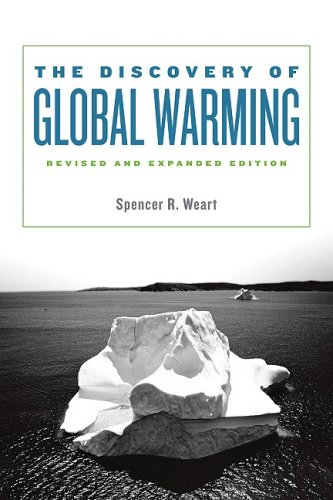
A common remark I make about climate change books I like is that “it wasn’t like a textbook”. I like non-fiction books that I can carry around and read cover-to-cover just like I would a novel. I like them to draw me in and catch my interest as if they were a suspenseful PD James or just a comfortable Maeve Binchy.

The Discovery of Global Warming, by Spencer Weart, had all of these qualities and more: It contained as much information as a textbook, even if it didn’t read like one. That, I think, is the benefit of science history. It can be written in a way that is compelling as fiction, but it’s all true.

I think I will place this book near the top of my list of resources for concerned citizens who are looking for more information on climate change. It is so helpful because, instead of saying “scientists are confident that humans are causing the Earth to warm”, it traces back through history and follows this discovery all the way through, from Fourier to the AR4. We see the top of the credibility spectrum in action, and examine exactly where the conclusions of the scientific community came from.

There are lots of great details in this book to sink your teeth into. How did the Cold War pave the way for much of our knowledge about the atmosphere? Why does chaos theory apply to weather models much more than climate models? And, of course, my very favourite – the 1970s aerosol debate. How did scientists realize that the warming force of greenhouse gases would overpower the cooling force of aerosols, long before the warming was actually observed?

All of this is written in an incredibly elegant and engaging tone. Weart’s style of writing somehow reminds me of Sir Arthur Conan Doyle in The Lost World – succinct characterization, unintended (or just well-hidden) satire, a calm detachment from the story that somehow makes it all the more fascinating.

I read the “Revised and Expanded Edition”, so I’m not sure if all editions of The Discovery of Global Warming contain all the extras in the back: a timeline, an index, and a chapter entitled “Reflections” that is full of Weart’s musings about risk management and science communication. “Unlike, say, the orbits of planets,” he writes, “the climate in the future actually does depend in part on what we think about it. For what we think will determine what we do.”

A tangible alternative to the more comprehensive online version (really, who wants to read a book by navigating a web of links and scrolling through chapters on a computer screen?), The Discovery of Global Warming is worth every cent, and every minute of your time it takes to read it. I look forward to future volumes as this story continues to unfold.

A Must-Read Letter to Science

I must say that I feel proud of the mainstream media when CBC News picks this up before any of the blogs I read.

A letter to be published in tomorrow’s edition of Science, defending the integrity of climate science and calling for an end to “McCarthy-like threats” to scientists, has been signed by 225 members of the National Academy of Sciences. I guess they weren’t joking around in their correspondence.

Here are some excerpts:

We are deeply disturbed by the recent escalation of political assaults on scientists in general and on climate scientists in particular.

Many recent assaults on climate science and, more disturbingly, on climate scientists by climate change deniers, are typically driven by special interests or dogma, not by an honest effort to provide an alternative theory that credibly satisfies the evidence. The Intergovernmental Panel on Climate Change (IPCC) and other scientific assessments of climate change, which involve thousands of scientists producing massive and comprehensive reports, have, quite expectedly and normally, made some mistakes. When errors are pointed out, they are corrected. But there is nothing remotely identified in the recent events that changes the fundamental conclusions about climate change.

We also call for an end to McCarthy-like threats of criminal prosecution against our colleagues based on innuendo and guilt by association, the harassment of scientists by politicians seeking distractions to avoid taking action, and the outright lies being spread about them.

Read the whole letter here, it’s well worth it.

I don’t find this letter particularly surprising, because I’m quite aware of the scientific community’s attitudes toward recent events (RC collectively refers to them as Whatevergate), and I’m sure that many regular readers and commenters won’t be surprised either. However, we need to look at this not as news, but as an example of the communication that scientists are starting to come out with. This is exactly the kind of letter that needs to get out to the public.

What I’m wondering is, why will it be published in Science and not somewhere like the New York Times, a publication that is actually read outside of the scientific community? Anyone who keeps up with Science will know just how solid the theory of anthropogenic climate change is. So why is it being used for public communication?

Whatever the reason, and whatever its effectiveness, I’m pleased. It’s a good first step that we need much more of.