Global Surface Temperature Change

I really enjoyed reading “Global Surface Temperature Change“, by James Hansen and his team at GISS. Keep in mind that it’s still in the draft stages – they haven’t submitted to a journal yet, but they certainly plan to, and it’s a very credible team of scientists that will almost definitely get it published.

The paper is mostly about the methods of global temperature analysis. It’s more of a review paper than an account of a single experiment. However, their main discussion point was that even by using the same data, problems can be addressed in different ways. The two main problems with temperature analysis are:

  • “incomplete spatial and temporal coverage” (sparse data)
  • “non-climatic influences on measurement station environment” (urban heat island effect).

The authors explain the methods they use and why, and explore the impacts that different methods have on their results.

GISS measures anomalies in the temperatures, largely because they are much smoother and more consistent, geographically, than absolute temperatures. In 1987, they determined that anomalies could be safely extrapolated for a radius of 1200 km from a station and still be accurate. GISS smooths the whole map out by extrapolating everything and averaging the overlapping bits.

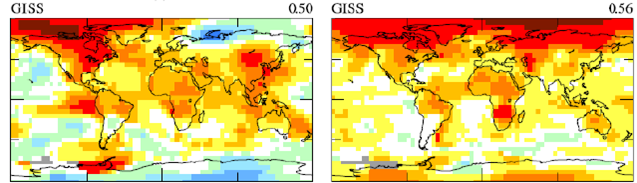
Extrapolating is also very useful in areas with very few stations, such as the polar regions and parts of Africa. In this map, grey indicates missing data:


The Arctic is particularly problematic, not only because its data is so sparse, but also because it has the largest anomaly of any region in the world. If you have incomplete coverage of an area that is warming so dramatically, it won’t pull its full weight in the global trend, and your result will almost certainly be too low.

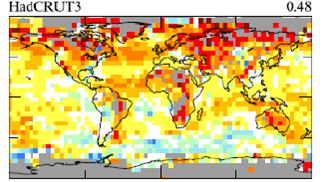
This difficulty with the Arctic is the reason that GISS says 2005 is the warmest year on record, while HadCRUT, the team in England, says that 1998 is. GISS extrapolates from the stations they have, and end up getting pretty good coverage of the Arctic:

They’re assuming that areas with missing data have the same anomaly as whatever temperature stations are within 1200 km, which, as they determined in 1987, is a pretty fair assumption.

However, HadCRUT doesn’t do this extrapolating thing. When they don’t have data for an area, they just leave it out:

This might sound safer, in a way, but this method also makes an assumption. It assumes that the area has the same anomaly as the global average. And as we all know, the Arctic is warming a lot more and a lot faster than the global average. So it’s quite possible that GISS is right on this one.

Another adjustment that NASA makes is for local, anthropogenic, non-climatic effects on temperature data. The most obvious of these is the urban heat island effect. As an area becomes more urban, it gets more pavement, less vegetation, and its albedo goes down – it absorbs more heat. This often makes cities substantially warmer than the surrounding rural areas, which can obviously contaminate the temperature record. However, there are ways of eliminating urban influences from the data so we can see what the real trend is.

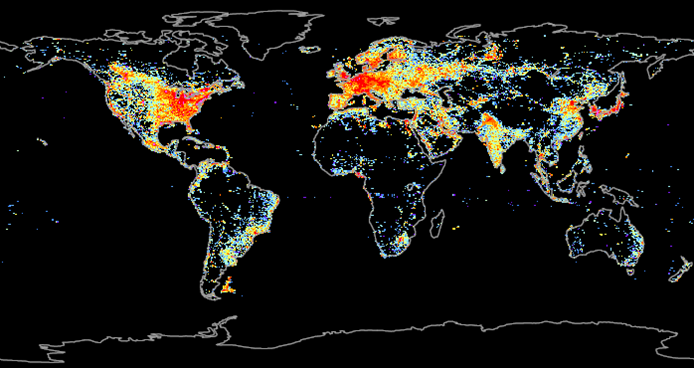
The first step is determining what stations are considered urban. The obvious way to do this is through population, but that’s actually not very accurate. Think of somewhere like Africa, where, even if there are thousands of people living in a small area, the urban influences such as concrete, absence of vegetation, or exhaust aren’t usually present. A much better indication is energy use, and a good proxy for energy use, that’s easy to measure, is lights at night-time.

So GISS put a bit of code into their analysis that singles out stations where nightlight brightness is greater than 32 µW/m2/sr/µm, and adjusts their trends to agree with rural stations within 1200 km. If there aren’t enough rural stations within that radius, they’ll just exclude the station from the analysis.

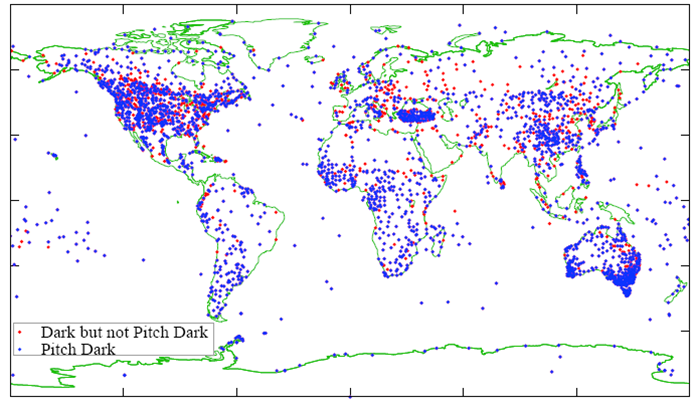
They did an even more rigorous test for this paper, to test just how much urban influences were contaminating the long-term trend, and it was pretty interesting.

There were enough stations considered “pitch-dark” at night, where they couldn’t detect any light, to run a global analysis all by themselves. The trend that came out was <0.01 °C/century smaller than GISS’s normal calculation, an amount of error that they described as “immeasurably small”.

The result of all this temperature analysis is a graph, with one new point every year, that is “eagerly awaited by some members of the public and the media”:

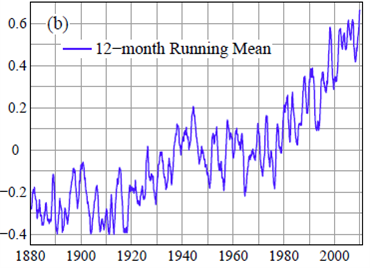
However, this graph isn’t actually as useful as this one – the 12-month running mean:

“From a climate standpoint there is nothing special about the time  of year at which the calendar begins”, so instead of only measuring January-December, you can also do February-January, March-February, and so on. This way, you get a data point every month instead of every year, and more data means more accuracy. It also solves problems with short-term influences, such as El Nino, La Nina, and volcanic eruptions, that the annual graph was having. These fleeting, but fairly substantial, influences can fall completely into one calendar year or be split between two – so their influence on global temperature could be overestimated or underestimated, depending on the starting month of the calendar. The 12-month running mean is much less misleading in this fashion.

As it is, we just set a new record for the 12-month running mean, and unless La Nina really takes off, 2010 will likely set a new record for the annual graph as well. But the authors argue that we need to start moving away from the annual graph, because it isn’t as useful.

The authors also discuss public perception of climate change, and media coverage of the issue. They say, “Our comments here about communication of this climate science to the public are our opinion…[We offer it] because it seems inappropriate to ignore the vast range of claims appearing in the media and in hopes that open discussion of these matters may help people distinguish the reality of global change sooner than would otherwise be the case.”

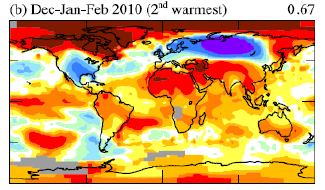
They make the very good point that “Lay people’s perception tends to be strongly influenced by the latest local fluctuation”, and use this winter as a case study, where a strongly negative Arctic Oscillation index caused significantly cooler-than-normal conditions across the United States and Europe. Consequently, a lot of people, especially in the US, began to doubt the reality of global warming – even though, in the world as a whole, it was the second warmest winter on record:

The authors also talk about data sharing. GISS likes to make everything freely available to the public – temperature station data, computer code, everything. However, putting it out there immediately, so that anyone can help check for flaws, has “a practical disadvantage: it allows any data flaws to be interpreted and misrepresented as machinations.” Multiple times in the past few years, when there have been minor errors that didn’t actually change anything, GISS was widely accused of making these mistakes deliberately, to “intentionally exaggerate the magnitude of global warming”. They realized this wasn’t working, so they changed their system: Before releasing the data to everyone, they first put it up on a private site so that only select scientists can examine it for flaws. And, of course, this “has resulted in the criticism that GISS now “hides” their data”.

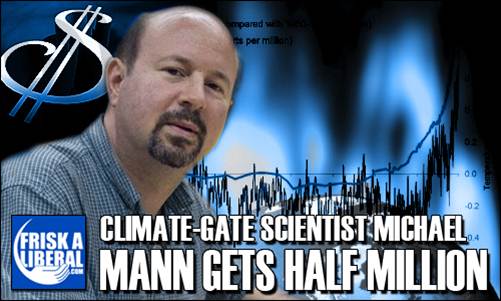
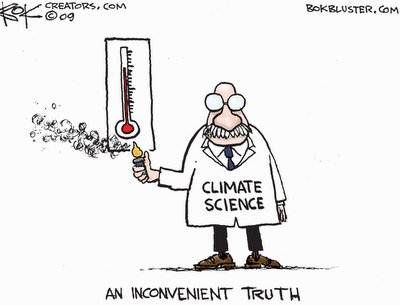
Personally, I find the range and prevalence of these accusations against scientists absolutely terrifying. Look at what has become mainstream:

Scientific fraud is a very serious allegation, and it’s one thing for citizens to make it without evidence, but it’s another thing altogether for the media to repeat such claims without first investigating their validity:

I have been disgusted by the media coverage of climate science, especially over the past year, especially in the United States, and I worry what this will mean for our ability to solve the problem.

However, there is still fantastic science going on that is absolutely fascinating and essential to our understanding of global climate change. This paper was a very interesting read, and it helped me to better understand a lot of aspects of global temperature analysis.

Too Much at Every Level

I think that action to mitigate climate change has been so slow (in many cases, nonexistent) partly because the problem is just so massive. At every single level – individual, politician, government, country – people think that they can’t possibly solve it on their own, so there’s no point in trying at all.

It’s not the same kind of problem as something like world poverty, or disease in developing countries. In a way, I wish it was. It’s not really possible for a single person to solve these problems either, but at least they can solve it for someone. They can pay for a child’s education in Africa. They can build a well with clean water for an entire community. These types of problems are measured in increments, rather than gradients – just like the corpuscular theory of light. The problem comes in small packages of one person each, and even if you can’t eliminate the problem for everyone, you can chip away.

Conversely, climate change is a gradient, and one that is very resistant to reversal. Even if a family manages to completely eliminate all sources of carbon emissions in their life, they’re only preventing a fraction of a fraction of a fraction of a degree of warming. 2.999997 C warming isn’t very different to 3 C. And that difference of 0.000003 C isn’t changing the life of a child. (These are just arbitrary numbers, don’t quote me on them!) Really, it isn’t having any impact at all. So most people don’t even bother. They feel so powerless – after all, this problem is far too big for them to solve.

I believe that individual action on climate change is definitely worth it, but in a more symbolic manner. No, composting your kitchen waste isn’t going to eliminate enough methane to make a difference in the global radiative forcing of greenhouse gases. But it gets you in the right mindset. It makes you stop and think about the planet and the future. And the chance that you might inspire all your friends and neighbours to compost as well, who would then inspire all of their friends, and eventually start a chain reaction that could, conceivably, start to make a difference, is just too good to pass up. (Besides, composting is fun to watch. We get some very cool slugs hanging out around ours this time of year.)

Regardless, the feeling of powerlessness becomes the norm, to the point where even politicians don’t think they can make any difference. I have a friend who asked his MP, a Liberal, what she was going to do about climate change. Her response was, “What can I do? I’m only one person.” I find it absolutely astounding that a politician who represents tens of thousands of people, and who helps to govern the entire country, could have this attitude. It’s kind of sad when even our Members of Parliament feel powerless.

Of course, Canada’s national position on climate change action is “whatever the States decides, and we won’t do anything at all unless and until they do”. The federal government feels powerless too, because (as they constantly remind us) Canada produces only 2% of the world’s greenhouse gas emissions. What’s the point of reducing them if the U.S. isn’t going to do the same?

We all know that the U.S. isn’t going to pass cap-and-trade any time soon. It looks like the Republicans are keeping their promise of preventing Obama from passing any more sweeping legislation, after the health care bill. And a big reason (or at least a common excuse) for this lack of initiative is that India and China will soon produce most of the world’s carbon emissions. What’s the point of the U.S. making any mitigating effort if the soon-to-be-major-players won’t?

What federal governments fail to realize is that they have far more power than they give themselves credit for. If the U.S. decides that they want a global economy of clean energy, they have enough influence over the market to make that happen. If Canada decides that tar sands actually aren’t such a good idea after all, all the countries that import from us will have to find alternatives. But this hasn’t happened, because governments are far more concerned about the next election.

At times like these, I just want to look politicians in the eyes and tell them to wake up. Stop playing games, pointing fingers, and sabotaging your enemies. Remember that your job is to look out for us, and start getting serious on a crisis that is unprecedented in all of human history – one that we could all avoid, even now, if you just got your acts together.

I am now a voting member of the public, a legal adult. And I don’t have a clue who to vote for, because nearly every politician has lost my support. If they cared at all about the kind of world I will live in after they are gone, and the kind of world the children I hope to have will live in after I am gone, they would start doing their jobs. I think I will find myself voting against politicians, rather than for politicians. I will vote for those who are the least bad, so that the worst don’t get into office.

I am not optimistic about climate change, but I know that we have a chance to prevent the worst of it. I am not optimistic, but I do not feel powerless. I believe in the power of knowledge and inspiration and culture. I believe in the potential of accomplishing a great deal in a short period of time. At some point in this chain of people who are overwhelmed or apathetic, something needs to give.

All Is Not Lost

I really enjoyed reading two recent polls conducted by George Mason University’s Center for Climate Communication. In particular, the results made me wonder why the US government still hasn’t passed a climate bill.

For example, US presidents have been saying for over a decade that it is unfair to force their industries to reduce emissions if developing countries do not have similar targets. However, only 8% of American adults share this view, and 65% believe that “the United States should reduce its greenhouse gas emissions regardless of what other countries do.” 77% agree that CO2 should be regulated, and 65% would like to see an international treaty signed.

The only solution which had less than 50% support was a tax on gasoline, even if it was revenue-neutral: offset by a decrease in income tax rates. This opposition can’t really be a case of people worrying about money. In this hypothetical situation, taxes aren’t being increased – they’re just being moved around, in a way that actually gives people more control over how much they are charged. Perhaps the public would prefer a more laissez-faire approach, or perhaps they had a knee-jerk reaction to the word “tax”. It’s not like the revenue-neutral aspect of this solution is well-known to most.

When the poll was broken down by political party, there were some surprising results that ran contrary to what one hears in the halls of Congress. 64% of Republicans support regulating CO2. Only 30% think that protecting the environment reduces economic growth and costs jobs.

Overall, the poll showed very strong support among Americans for action that still hasn’t happened, largely because a very vocal minority has had a disproportionate influence on the policy debate. If there was a referendum today, Kyoto targets and the cap-and-trade bill would pass with flying colours.

This support was even more interesting when compared to the questions regarding science. Only 61% of Americans think that the Earth is warming, and only 50% think that it is due to human activities. 45% think “there is a lot of disagreement among scientists about whether or not global warming is happening”, and only 34% were aware of the existing consensus.

The discrepancy between scientific understanding of the issue and support for mitigation shows that Americans, in general, practice risk management when it comes to climate change. Even if they’re not sure whether or not there is a problem, they understand what is at risk, and are willing to take action to prevent major consequences. Greg Craven, you got your wish.

I think that the misconception of a voracious scientific debate, apart from being perpetrated by the media, stems partly from the fact that most of the public lacks the experience to distinguish between scientific and quasi-scientific debates. Competing hypotheses, published in leading journals, seen as the frontier of the field….that’s a scientific debate. Editorials, written by anyone other than a scientist publishing in the field, claiming to refute an overwhelming consensus? Can’t even come close. However, I suspect that many would categorize the second as “scientific debate”, simply because it’s their only encounter with science.

All is not lost, though. 81% of Americans trust scientists as a source of information about global warming. That’s more than they trust any other source that was mentioned in the question. And 20%, 27%, and 29% say that they need a lot more, some more, or a little more information, respectively. Maybe all that needs to happen is for us to speak louder – because people are ready and willing to listen.

A Must-Read Letter to Science

I must say that I feel proud of the mainstream media when CBC News picks this up before any of the blogs I read.

A letter to be published in tomorrow’s edition of Science, defending the integrity of climate science and calling for an end to “McCarthy-like threats” to scientists, has been signed by 225 members of the National Academy of Sciences. I guess they weren’t joking around in their correspondence.

Here are some excerpts:

We are deeply disturbed by the recent escalation of political assaults on scientists in general and on climate scientists in particular.

Many recent assaults on climate science and, more disturbingly, on climate scientists by climate change deniers, are typically driven by special interests or dogma, not by an honest effort to provide an alternative theory that credibly satisfies the evidence. The Intergovernmental Panel on Climate Change (IPCC) and other scientific assessments of climate change, which involve thousands of scientists producing massive and comprehensive reports, have, quite expectedly and normally, made some mistakes. When errors are pointed out, they are corrected. But there is nothing remotely identified in the recent events that changes the fundamental conclusions about climate change.

We also call for an end to McCarthy-like threats of criminal prosecution against our colleagues based on innuendo and guilt by association, the harassment of scientists by politicians seeking distractions to avoid taking action, and the outright lies being spread about them.

Read the whole letter here, it’s well worth it.

I don’t find this letter particularly surprising, because I’m quite aware of the scientific community’s attitudes toward recent events (RC collectively refers to them as Whatevergate), and I’m sure that many regular readers and commenters won’t be surprised either. However, we need to look at this not as news, but as an example of the communication that scientists are starting to come out with. This is exactly the kind of letter that needs to get out to the public.

What I’m wondering is, why will it be published in Science and not somewhere like the New York Times, a publication that is actually read outside of the scientific community? Anyone who keeps up with Science will know just how solid the theory of anthropogenic climate change is. So why is it being used for public communication?

Whatever the reason, and whatever its effectiveness, I’m pleased. It’s a good first step that we need much more of.

Uncertain Science….Uncertain World

Several months ago, I wrote a generally favourable review of geophysicist Dr. Henry Pollack’s newest book, A World Without Ice. So when I came across his earlier book, which was about the nature of the scientific process  – something that fascinates me – I couldn’t wait to read it.

Uncertain Science, Uncertain World is about uncertainty in science, as you may have guessed from the title, and it is absolutely fantastic. If you’re pressed for time, just read the first three chapters – they’re the best. They discuss how the public’s tendency to “equate science with certainty, rather than uncertainty” has been fed by the American school system and the mass media, and what the consequences are.

He talks about how everyone is born a scientist, how children observe the world around them with a fierce curiosity, instinctively exploring and experimenting. Then they go to school, and decide that science is boring. In elementary school, and to some extent in high school, science is presented as a memorization of facts and theories, rather than an exploration of the boundaries of and barriers to our knowledge, which is what scientists actually study. “Science is presented as answers rather than questions,” Pollack writes.

I couldn’t agree more. I wasn’t always the self-professed science addict that I am now. Until I reached high school, I thought that science was dry and boring, and until I started researching climate change, I didn’t see the creativity and problem-solving in it. In science class you memorize facts and do calculations, so it’s very hard for students to realize how cool it is to discover facts and derive calculations, rather than just repeating what someone else did before you. Intelligence is defined as how many facts you can stuff into your head, not how good you are at figuring things out for yourself.

The media doesn’t help, either. Pollack explores the well-known ails of science journalism, and the stigma against public communication in the scientific community. He shares a great example of how the media turned an amateur earthquake prediction, with no support from geologists, into a national frenzy that led to evacuations and the closure of schools. Mainstream journalists, in general, are not good at assessing credibility for scientific issues, but their influence on the public is so great that frequent mistakes by journalists lead to worldwide misconceptions.

This public illusion of certainty, in a field that actually thrives on uncertainty, can be easily exploited by vested interests. “When scientists acknowledge that they do not know everything about a complex natural phenomenon,” writes Pollack, “the public sometimes translates that to mean that scientists do not know anything about the subject,” and, for issues such as climate change, there are many people actively encouraging this jump in logic.

After the stellar beginning, the rest of the book is somewhat more mediocre, albeit still enjoyable. Pollack uses a series of examples and metaphors to explain irreducible measurement error, confidence expressed as statistical probability, conceptual and numerical models, experimentation, and forecasting vs hindcasting. As Pollack is currently studying how rocks retain heat and provide a record of past temperatures that can be used as proxy paleo data, facets of climate science are used as examples in nearly every chapter, and the last chapter of the book is devoted to climate change. However, he also uses examples from economics, plate tectonics, election polling, and the legal system. It is truly a multidisciplinary approach that will appeal to scientists and science enthusiasts from every field. Highly recommended to all.

We Have Slides!

After a marathon PowerPoint-session yesterday I finally got my 63 slides out of the way. Here is the presentation for anyone who is interested. The script is written in the notes beneath the slides.

I like to have things fading in and out of my slides, so sometimes the text boxes and images are stacked on top of each other and it won’t make sense until you view the animation.

Researching the median lethal dose of arsenic during my spare at school was really awkward. I had to do a lot of hasty explaining to my friends about how it was a metaphor for small concentrations having large effects, and no, I wasn’t planning to poison anyone.

Anyway, enjoy.

Mind the Gap (12 MB)

Illogic

Here’s a great quote from a great article posted on the Nation. Thanks to Tim Lambert for the link.

Yet when it comes to coverage of global warming, we are trapped in the logic of a guerrilla insurgency. The climate scientists have to be right 100 percent of the time, or their 0.01 percent error becomes Glaciergate, and they are frauds. By contrast, the deniers only have to be right 0.01 percent of the time for their narrative–See! The global warming story is falling apart!–to be reinforced by the media.

Open Letter from U.S. Scientists on the IPCC

Joining the push for better climate science communication are over 300 US scientists. On March 13, they sent an open letter to US federal agencies about why a few errors in the IPCC AR4 do not impact our understanding of the climate system and the changes occurring, and should not impact our efforts to mitigate and adapt to such changes.

The introduction to the letter reads:

Many in the popular press and other media, as well as some in the halls of Congress, are seizing on a few errors that have been found in the Fourth Assessment Report (AR4) of the Intergovernmental Panel on Climate Change (IPCC) in an attempt to discredit the entire report.  None of the handful of mis-statements (out of hundreds and hundreds of unchallenged statements) remotely undermines the conclusion that “warming of the climate system is unequivocal” and that most of the observed increase in global average temperatures since the mid-twentieth century is very likely due to observed increase in anthropogenic greenhouse gas concentrations. Despite its excellent performance for accurately reporting the state-of-the-science, we certainly acknowledge that the IPCC should become more forthcoming in openly acknowledging errors in a timely fashion, and continuing to improve its assessment procedures to further lower the already very low rate of error.

Read the full text here.

Over 300 US scientists have signed the letter, and signatures are still being collected. You can view the list of signatures here. I see a few familiar names already (eg Scott Mandia)!

However, I must say that I am profoundly disappointed that the letter can only be signed by American scientists. Although it is intended for American federal agencies, what the US does about climate change will impact the whole world. Firstly, many countries (*cough*cough* Canada) plan to delay action on climate change until the US has a clear plan, so they can follow suit. And, perhaps most importantly, having the largest per-capita emissions and cumulative emissions, as well as the second-largest annual emissions, the US is driving the changes in the climate system with disproportionate responsibility. As its actions will have international repercussions, both politically and environmentally, I believe that the list of signatures should be open to scientists worldwide.

The Antithesis to Nitpicking

Sometimes we have to step back and look at the big picture. We have to remember that not everyone has heard or believed the one about global warming stopping in 1998. Denialists centre around nitpicking and ideas that global warming is a “house of cards”, so we respond the same way: countering all the “mistakes” they claim to have found.

In reality, climate change is an incredibly robust phenomenon that we’ve known about for decades – and the basic physics behind it, for over a century. It’s not some new, shaky discovery. It’s not going to be overturned because scientists at CRU do not always say nice things about their critics.

So I was very pleased when I opened up YouTube today to see that Peter Sinclair’s latest video was all about this big picture. If I had to choose just one of his videos to share with everyone I knew, this would certainly be it. This is the kind of message we need to get out there; this is the kind of angle we need to take.

Manufacturing Doubt

I recently wrote this term paper for my world issues course. Enjoy.

There are many questions which remain controversial among scientists, but the existence of human-caused climate change is not one of them. Over 97% of publishing climatologists (Doran and Zimmerman, 2009), virtually 100% of peer-reviewed studies (Oreskes, 2004), and every scientific organization in the world (Logical Science, 2006) agree that humans are causing the Earth to warm. As Donald Kennedy, former editor-in-chief of the prestigious journal Science, says, “Consensus as strong as the one that has developed around this topic is rare in science.”

However, this consensus does not extend to the general public. On a particularly cold day, the cashier at the grocery store will say to you, “So much for global warming.” Over Thanksgiving dinner, your uncle will openly wonder if the warming in the Arctic is just part of a natural cycle. Your local newspaper will print letters to the editor almost daily claiming that, as CO2 is natural and essential to life, we shouldn’t worry about climate change.

What is the reason for this disconnection between scientific opinion and public opinion? There are obviously many factors involved, but it is probable that this discrepancy exists partly because of the widespread media coverage of scientists who do not accept anthropogenic climate change. Anyone with an Internet connection or a newspaper subscription will be able to tell you that many scientists think global warming is natural or nonexistent. As we know, these scientists are in the vast minority, and they have been unable to support their views in the peer-reviewed literature. The key question, therefore, is this: Why are so many of them still publicizing their beliefs so prominently?

Two plausible outcomes exist. Firstly, a scientist who could not prove a hypothesis could still feel that it was an idea worth consideration, and would want to capture the imagination of other scientists so it would be studied more closely. Alternatively, a scientist might be willing to keep the public confused about climate change. For example, scientists employed by the fossil fuel industry, or by organizations with strong laissez-faire agendas, could be motivated to spread rumours about weaknesses in the anthropogenic climate change theory. So, do these skeptics honestly doubt the integrity of climate science? Or are they being paid to manufacture doubt?

To distinguish between these two motives, it is important to understand a distinct difference in the formation of scientific opinions and political opinions. In science, one should examine all the evidence and then develop a logical conclusion. However, it is all too common in politics, lobbying, and the media for one to choose a convenient conclusion, then build evidence around it. This process is akin to an “ends justify the means” approach. The means (evidence and methods) are justified as long as they support the ends (a preconceived conclusion). In contrast, science, which is continually striving for a hypothetical physical truth, works the other way around – the means justify the ends. The conclusion is less important than the evidence and analysis used to reach it. Therefore, to tell the difference between an honest scientific argument and one that was constructed for political means, one simply has to distinguish between the ends and the means, and decide which is more central to the structure of the argument.

Let us now apply this strategy to the arguments of three of the skeptics who are most visible in the media. In articles from the popular press and news segments from major television stations, the names of these skeptics appear more than any others. Firstly, S. Fred Singer is an atmospheric physicist and retired environmental science professor. He has rarely published in scientific journals since the 1960s, but he is very visible in the media. In the past five years, he has claimed that the Earth has been cooling since 1998 (Avery, 2006), that the Earth is warming, but it is natural and unstoppable (Avery and Singer, 2007), and that the warming is artificial and due to the urban heat island effect (Singer, 2005).

Richard Lindzen, also an atmospheric physicist, is far more active in the scientific community than Singer. However, most of his publications, including the prestigious IPCC report to which he contributed, conclude that climate change is real and caused by humans. His only published theory that disputed climate change was met with vigorous criticism, and he has publicly retracted it, referring to it as “an old view” (Seed Magazine, 2006). Therefore, in his academic life, Lindzen appears to be a mainstream climate scientist – contributing to assessment reports, abandoning theories that are disproved, and publishing work that affirms the theory of anthropogenic climate change. However, when Lindzen talks to the media, his statements change. He has implied that the world is not warming by calling attention to the lack of warming in the Antarctic (Bailey, 2004) and the thickening of some parts of the Greenland ice sheet (Beam, 2006), without explaining that both of these apparent contradictions are well understood by scientists and in no way disprove warming. He has also claimed that the observed warming is minimal and natural (Fox News, 2006).

Finally, Patrick Michaels is an ecological climatologist who occasionally publishes peer-reviewed studies, but none that support his more outlandish claims. In statements to the media, Michaels has said that the observed warming is below what computer models predicted (Chatterjee, 2009), that natural variations in oceanic cycles such as El Niño explain most of the warming (Knappenberger and Michaels, 2009), and that human activity explains most of the warming but it’s nothing to worry about because technology will save us (Miller, 2009).

While examining these arguments from skeptical scientists, something quickly becomes apparent: many of the arguments are contradictory. For example, how can the world be cooling if it is also warming naturally? Not only do the skeptics as a group seem unable to agree on a consistent explanation, some of the individuals either change their mind every year or believe two contradictory theories at the same time. Additionally, none of these arguments are supported by the peer-reviewed literature. They are all elementary misconceptions which were proven erroneous long ago.

With a little bit of research, the claims of these skeptics quickly fall apart. It does not seem possible that they are attempting to capture the attention of other researchers, as their arguments are so weak and inconsistent. However, their pattern of arguments does work as a media strategy, as most people will trust what a scientist says in the newspaper, and not research his reputation or remember his name. Over time, the public will start to remember dozens of so-called problems with the anthropogenic climate change theory. From this perspective, it certainly seems that prominent skeptics are focusing on the ends, rather than the means. They are simply collecting as many arguments as they can to denounce global warming, and publicizing them vigorously. But why?

Earlier, we identified that organizations with a laissez-faire agenda would have reason to spread doubt on climate change, as the most effective form of mitigation would involve government regulation of fossil fuels. Many of these organizations, known as conservative think tanks, exist. Think tanks are supposed to be centres of independent, policy-related research, but conservative think tanks have migrated into an entirely new category. Over the past forty years, they have evolved into lobby groups that denounce any threat to the free market or laissez-faire economics. This objective often leads to the denial of established science, such as the relationship between smoking and cancer (which, if accepted, would lead to government regulation of tobacco and controls on where people could smoke), the destructive effects of CFCs on ozone (which could ban the products of an entire chemical industry), and, most recently, the climatic forcing of fossil fuel combustion, and the attribution of late-20th-century warming to this forcing.

The tactics that conservative think tanks (CTTs) use to manufacture doubt on climate change are often questionable and dishonest. On the rare occasion that their citations are peer-reviewed, they are discredited, cherry-picked, or misrepresented. For example, CTTs repeatedly cite data that shows slight cooling of the Earth – but only from before mechanical flaws in the satellites were corrected and the data began to show warming. They also cite a 2003 study by Sallie Baliunas and Willie Soon, claiming that the recent warming is attributable to sunspots. What CTTs don’t say is that, following the publication of this paper, 13 of the authors of data sets it incorporated refuted Baliunas’ interpretation of their work, and half of the editorial board resigned in protest against failure of the peer-review process. Additionally, CTTs argue that the wavelength band of CO2 absorption is already saturated, so adding more CO2 to the atmosphere wouldn’t cause any more warming – a theory that scientists proved wrong when spectroscopes improved in the 1950s.

Again, note the inconsistency of these statements, all of which were present at the same time on the Heartland Institute’s website. This CTT simultaneously claims that the world is cooling, that the world is warming naturally, and that the world is warming anthropogenically, but has maximized its potential. Evidently, these arguments were chosen because they fit with a preconceived conclusion, not with our understanding of science.

When their arguments are so similar, it should come as no surprise that most skeptics have ties to CTTs. Many of the most prominent skeptics write books – S. Fred Singer has written at least eight books skeptical of climate change, and Patrick Michaels has written at least five (Amazon). In 2008, a survey was conducted of books skeptical of climate change or other environmental issues, and found that an incredible 92% of the authors were affiliated with a CTT (Jacques, Dunlap, and Freeman, 2008). Additionally, some of the authors had connections to more than one CTT. For example, S. Fred Singer has been a part of ten different CTTs throughout his career. Patrick Michaels has been part of two, and Richard Lindzen has been part of three (Greenpeace USA).

It is obvious that CTTs want “experts” on their staff, because they want to sound scientific and credible. Additionally, the CTTs are willing to pay generous sums of money for expertise with a convenient conclusion. In 2006, the American Enterprise Institute offered ten thousand dollars plus expenses to any scientist who wrote a critique of the IPCC (Hoggan and Littlemore, 2009). Sure enough, a handful of scientists responded, and with good reason – they wouldn’t get a ten-thousand-dollar bonus for publishing a regular old peer-reviewed study.

What do these ties with CTTs tell us about skeptics? Have they decided to switch careers from researchers to PR representatives, trading in their scientific integrity for the promise of monetary gain? After all, if they work for a CTT, their arguments don’t have to be accurate – they just have to be effective in manufacturing doubt.

Another interesting fact about publicized skepticism is that it did not appear until governments started promising action on climate change – George  HW Bush in 1988 (Hoggan and Littlemore, 2009), Margaret Thatcher in 1990 (Thatcher, 1990), and Brian Mulroney in 1992 (United Nations). In fact, 87% of the books from the Jacques, Dunlap, and Freeman survey were published in or before 1988. Those published before likely did not even mention climate change – many of their titles suggested skepticism about toxic chemicals, the environmental concern of the 1970s. Therefore, it is very easy to pinpoint a short period of years and political events that sparked mass PR coverage of skeptical viewpoints. This trigger provides yet more evidence that skeptics are publicizing their views not to further scientific knowledge, but to manufacture public doubt and delay action.

So, when skepticism started in response to political promises, where were its roots? Unsurprisingly, the manufacture of doubt started with fossil fuel companies. In 1991, the Western Fuel Association, the National Coal Association, and the Edison Electric Institute formed a PR coalition named, ironically, the Information Council on the Environment (ICE). ICE launched a major advertising campaign denouncing the idea of anthropogenic global warming. The campaign’s objective, in ICE’s own words, was “to reposition global warming as a theory (not fact)” and “to supply alternative facts that suggest global warming will be good” (Hoggan and Littlemore, 2009). These objectives are a blatant example of manufacturing doubt, because they are based on the ends, not the means. ICE chose a conclusion that was convenient for their industry, and cherry-picked “alternative facts” to support it.

Several years later, a leaked document from another fossil fuel company, the American Petroleum Institute, gave away the organization’s entire game plan. The document laid out an ideal scenario in which the media reflected climate change as an equal-sided, unsettled debate, citizens began to accept this framing, and public support for the Kyoto Protocol fell apart. To achieve this utopia, API planned to “produce, distribute via syndicate and directly to newspapers nationwide a steady stream of op-ed columns and letters to the editor authored by scientists” (Walker, 1998). By manipulating how the media framed climate change, API could push public opinion in a predetermined direction. This document shows that fossil fuel companies such as the API have stopped caring about science anymore, otherwise the objectives would be “to publish our latest discovery that invalidates global warming in a prestigious journal”. Rather, their efforts are focused on the media, the public, and policymakers. They are consistently promoting ends that don’t have means to support them.

Over the last decade, however, fossil fuels have gradually shifted away from creating their own propaganda, choosing to fund CTTs instead. ExxonMobil, for example, has spent $20 million since 1998 funding CTTs that express climate change skepticism (Hoggan and Littlemore, 2009), and it releases annual breakdowns of its funding. Let’s look at some of the CTTs that our three major skeptics are a part of. Firstly, the Science and Environmental Policy Project, of which S. Fred Singer is president, has received $20 000 from Exxon since 1998. The Cato Institute, which has Patrick Michaels as a senior fellow, Richard Lindzen as a contributing expert, and S. Fred Singer as an advisory board member, has received $125 000. The Heartland Institute, which lists all three as “HeartlandGlobalWarming.org experts”, has received $676 500. (Greenpeace USA). At times, Exxon specifically notes that this funding is for “climate change efforts”, so it’s pretty obvious what kind of message they’re pushing.

Fossil fuel companies are some of the largest businesses in the world, and they are using their money and power to promote messages that are convenient for their further domination. Conservative think tanks – and, therefore, the experts they employ – are being paid, by vested interests, to say that global warming isn’t real. It provides yet another motive for skeptics to give more weight to the ends, rather than the means.

It seems quite obvious that these skeptics should not be trusted, as their arguments are inconsistent and unsupported, and they have potential fortunes resting on what they say, not how they prove it. However, the vested interests of CTTs and fossil fuel companies have been wildly successful in using these skeptics as their spokespeople. For example, the majority of articles from well-respected newspapers present the issue as an equal-sided debate, giving equal time to arguments for and against the idea of human-caused climate change (Boykoff and Boykoff, 2004). This framing has permeated to the public, as 39% of American adults think humans are not changing the climate (Gallup, 2007), and 42% think scientists disagree a lot about the issue (Newsweek, 2007). The constant presence of manufactured doubt in the media has taken its toll.

Additionally, since the skeptical view exploded following the near-action in the late 1980s, our society has spent 20 years without any significant plans for mitigation. The Kyoto Protocol failed in both Canada and the US. The Copenhagen summit did not lead to any politically binding targets. US President Barack Obama is finding it difficult to pass even the most meagre cap-and-trade legislation through the Senate, and the position of the Canadian government is to wait and see what the Americans do.

A democracy cannot function without an electorate that is accurately informed. We see an example of this scenario with regards to climate change legislation. Even though the scientific community is, essentially, as sure as it can get about the existence of human-caused climate change, the manufacture of doubt has prevented the public opinion from following suit, and prevented voters from demanding necessary political action. A well-funded campaign has led us astray from the ideals of democracy.

It’s not over yet, though. Climate change action is not a question of all or nothing. Even if we fail to keep the warming at a tolerable level, there is still a wide range of outcomes. Three degrees of warming is better than five, and five degrees is better than eight. We should never throw up our hands and say that all is lost, because we can always prevent the situation from getting worse.

To pull our society together in order to minimize global warming, we need the public to be better informed about climate change. This does not require everyone to know climate science – rather, all that is needed is for the public to be able to recognize whether or not they can trust an argument. Everyone needs to understand the importance of peer-review and the difference between the ends and the means. People do not need to know science – they just need to know how the system of scientific opinion works. Once this literacy becomes widespread, people will understand the urgency of action, and they will stop listening to those skeptical scientists on the news.

Works Cited

Amazon. “Patrick Michaels.” Amazon.com. Web. 7 Jan. 2010.

Amazon. “S. Fred Singer.” Amazon.com. Web. 7 Jan. 2010.

Bailey, Ronald. “Two Sides to Global Warming.” Weblog post. Reason.com. 10 Nov. 2004. Web. 9 Dec. 2009. <http://reason.com/archives/2004/11/10/two-sides-to-global-warming&gt;.

Beam, Alex. “MIT’s Inconvenient Scientist.” Boston Globe. 30 Aug. 2006. Web. 9 Dec. 2009. <http://www.boston.com/news/globe/living/articles/2006/08/30/mits_inconvenient_scientist&gt;.

Boykoff, Maxwell, and Jules Boykoff. “Balance as bias: global warming and the US prestige press.” Global Environmental Change 14 (2004): 125-36. Print.

Chatterjee, Neera. “Prof. says climate change exaggerated.” The Dartmouth. 24 Feb. 2009. Web. 10 Dec. 2009. <http://thedartmouth.com/2009/02/24/news/climate&gt;.

Dennis, Avery. “Global Cooling?” Web log post. Free Republic. 30 June 2006. Web. 9 Dec. 2009. <http://www.freerepublic.com/focus/f-news/1658580/posts&gt;.

Doran, Peter, and Maggie Zimmerman. “Examining the Scientific Consensus on Climate Change.” EOS 90.3 (2009): 22-23. Print.

Exxon Secrets. Greenpeace USA. Web. 10 Nov. 2009. <http://www.exxonsecrets.org/maps.php&gt;.

Fox News. “Global Warming: Climate of Fear?” Fox News. 25 May 2006. Web. 9 Dec. 2009. <http://www.foxnews.com/story/0,2933,195551,00.html&gt;.

Gallup. Environment Poll. 2007. Raw data.

Heartland Institute. Heartland Institute. Web. 13 Dec. 2009. <http://heartland.org&gt;.

Hoggan, James, and Richard Littlemore. Climate Cover-Up. Vancouver: Greystone, 2009. Print.

Jacques, Peter, Riley Dunlap, and Mark Freeman. “The organisation of denial: Conservative think tanks and environmental scepticism.” Environmental Politics 17.3 (2008): 349-85. Print.

Kennedy, Donald. “An Unfortunate U-Turn on Carbon.” Science 291.5513 (2001): 2515. Print.

Logical Science. “The Consensus on Global Warming/Climate Change: From Science to Industry & Religion.” Logical Science. 2006. Web. 9 Nov. 2009.

Luntz, Frank. “Straight Talk: The Environment: A Cleaner, Safer, Healthier America.” Letter to Republican Party. 2002. Political Strategy. Web. 10 Nov. 2009. <http://www.politicalstrategy.org/archives/001330.php&gt;.

Miller, Dan. “Look Who’s Talking.” Heartland Institute. 28 May 2009. Web. 10 Dec. 2009.

Miller, Dan. “Look Who’s Talking.” Heartland Institute. 28 May 2009. Web. 10 Dec. 2009.

Newsweek. Environment Poll. 2007. Raw data.

Oreskes, Naomi. “Beyond the Ivory Tower: The Scientific Consensus on Climate Change.” Science 306.5702 (2004): 1686. Print.

Oreskes, Naomi. “You CAN Argue with the Facts.” Stanford University. Apr. 2008. Lecture.

Paul, Knappenberger C., and Michaels J. Patrick. “Scientific Shortcomings in the EPA’s Endangerment Finding from Greenhouse Gases.” Cato Journal. Cato Institute, 2009. Web. 9 Dec. 2009. <http://www.cato.org/pubs/journal/cj29n3/cj29n3-8.pdf&gt;.

Revkin, Andrew. “Industry Ignored Its Scientists on Climate.” New York Times. 23 Apr. 2009. Web. 10 Nov. 2009. <http://www.nytimes.com/2009/04/24/science/earth/24deny.html&gt;.

Seed Magazine. “The Contrarian.” SeedMagazine.com. 24 Aug. 2006. Web. 3 Jan. 2010. <http://seedmagazine.com/content/article/the_contrarian/?page=all&gt;.

Singer, S. Fred, and Dennis Avery. Unstoppable Global Warming: Every 1500 Years. Lanham: Rowman & Littlefield,, 2007. Print.

Singer, S. Fred. “British Documentary Counters Gore Movie.” Heartland Institute. 1 June 2005. Web. 9 Dec. 2009.

SourceWatch. “Global Climate Coalition.” SourceWatch. Web. 7 Nov. 2009. <http://www.sourcewatch.org/index.php?title=Global_Climate_Coalition&gt;.

Thatcher, Margaret. “Speech at 2nd World Climate Conference.” Speech. 2nd World Climate Conference. Geneva. 1990. Margaret Thatcher Foundation. Web. 9 Nov. 2009. <http://www.margaretthatcher.org/speeches/displaydocument.asp?docid=108237&gt;.

United Nations. “Country Profile – Canada.” United Nations. Web. 9 Nov. 2009. <http://www.un.org/esa/earthsummit/cnda-cp.htm&gt;.

Walker, Joe. “Draft Global Climate Science Communications plan.” Letter to Global Climate Science Team. Apr. 1998. Web. 9 Nov. 2009. <http://euronet.nl/users/e_wesker/ew@shell/API-prop.html&gt;.

Weart, Spencer. The Discovery of Global Warming. Harvard UP, 2004. Print.