Unknown's avatar

About climatesight

Kaitlin Naughten is an ocean-ice modeller at the British Antarctic Survey in Cambridge.

Ads Past and Present

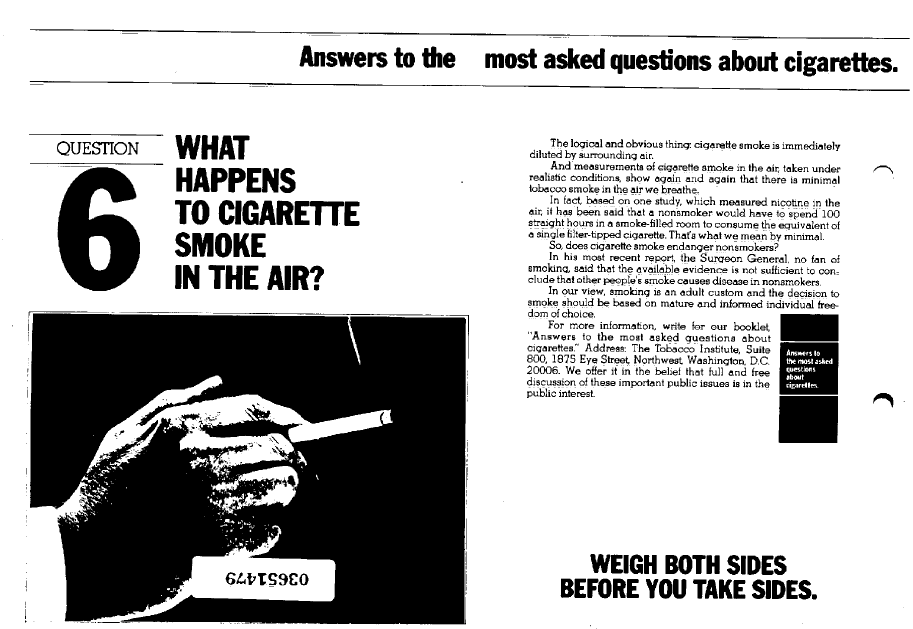
Check out these unbelievable ads from the Tobacco Institute, which I found from the Tobacco Documents database. Click to enlarge.

And here is the tamest of the Heartland Institute’s full-page ads in the Washington Post (from a year or two ago, exact date unknown):

Does Breathing Contribute to CO2 Buildup in the Atmosphere?

I was recently honoured to join Skeptical Science, a comprehensive database of rebuttals to common climate change misconceptions, as an author. Here I am republishing my first article regarding the common myth that breathing out contributes to the buildup of atmospheric carbon dioxide. It is the Intermediate version, and I have also written a very similar Basic version, which includes a diagram by John Cook. Enjoy!

The very first time you learned about carbon dioxide was probably in grade school: We breathe in oxygen and breathe out carbon dioxide. Any eight-year-old can rattle off this fact.

More specifically, the mitochondria within our cells perform cellular respiration: they burn carbohydrates (in the example shown below, glucose) in the oxygen that we breathe in to yield carbon dioxide and water, which we exhale as waste products, as well as energy, which is required to maintain our bodily processes and keep us alive.

C6H12O6 + 6O2 → 6CO2 + 6H2O + energy

carbohydrates + oxygen → carbon dixoide + water + energy

It should come as no surprise that, when confronted with the challenge of reducing our carbon emissions from the burning of fossil fuels, some people angrily proclaim, “Why should we bother? Even breathing out creates carbon emissions!”

This statement fails to take into account the other half of the carbon cycle. As you also learned in grade school, plants are the opposite to animals in this respect: Through photosynthesis, they take in carbon dioxide and release oxygen, in a chemical equation opposite to the one above. (They also perform some respiration, because they need to eat as well, but it is outweighed by the photosynthesis.) The carbon they collect from the CO2 in the air forms their tissues – roots, stems, leaves, and fruit.

These tissues form the base of the food chain, as they are eaten by animals, which are eaten by other animals, and so on. As humans, we are part of this food chain. All the carbon in our body comes either directly or indirectly from plants, which took it out of the air only recently.

Therefore, when we breathe out, all the carbon dioxide we exhale has already been accounted for. By performing cellular respiration, we are simply returning to the air the same carbon that was there to begin with. Remember, it’s a carbon cycle, not a straight line – and a good thing, too!

Don’t Listen to the Newspapers

This article of mine was published in the newsletter of Sisters of Our Lady of the Missions, a Catholic group that is doing a great deal of work in sustainability issues. Enjoy!

The mainstream media portrays the existence of human-caused climate change as a much fiercer scientific debate than it actually is. Scientists are still working out the details of how much warming we can expect, how it will be distributed, and what the consequences will be. However, the “big questions” have very solid answers. The idea that emissions of carbon dioxide from human activities would eventually warm the planet was first proposed in 1896, and since then, agreement on the issue has grown to a staggering level: 97.6% of publishing climatologists, 100% of studies in scientific journals, and every scientific organization in the world now agree that humans are changing the climate.

Compare this to the media coverage of climate change. The majority of articles in respected newspapers like The New York Times or The Wall Street Journal give roughly equal time to the “two sides” of the so-called “scientific debate”. Balance in journalism is all very well when the issue is one of political or social nature, but for matters of science, giving fringe opinions the same weight as a robust consensus is misleading. Being objective is not always the same as being neutral.

Over the past year, climate change reporting has taken a disturbing turn, as attacks on the integrity of individual scientists have been spread by nearly every media outlet in the developed world. Private correspondence taken out of context (in which the scientists involved have subsequently been cleared of any wrongdoing, by five independent investigations) as well as minor referencing errors in a scientific report (the worst of which gave the wrong date for when a specific glacier was expected to melt) led to widespread accusations of fraud and conspiracy by advocacy groups opposed to climate change action. Rather than investigate these potentially libellous claims, the media repeated them. As a result, many scientists have received death threats, and countless others have been subject to hate mail. One scientist in particular has had a dead animal dumped on his doorstep, and now travels with a bodyguard. Although their scientific reputations have not been damaged, the personal lives of these innocent men and women have been forever altered.

As the popular press reinforces myths and misconceptions about climate change, public understanding of the issue has fallen apart. Only 61% of American adults think that the Earth is warming, and only 50% think that it is caused by human activity (up-to-date Canadian statistics are not available). Most worryingly, only 34% are aware that most scientists think climate change is happening. A vast chasm has opened between scientific and public understanding of climate change, and powerful forces are at work to keep it open.

As we live in a democracy, action on climate change will only happen when voters demand it – and they won’t demand a solution if they don’t understand the problem. The best thing that you and I can do to stop climate change is to spread around accurate information. Scientific reports are often too technical for easy understanding, but major journals, such as Nature, often have a news section where they summarize new studies for the public. Many scientists are also stepping up to the challenge of climate change communication, and casting light on common misconceptions. A website called Skeptical Science is one of the best sources. There are many people working to fix this problem, but we need many more. Slowly but surely, the tide will turn.

Party Line

Brad Johnson from The Wonk Room recently released a comprehensive list of what Republican contenders for the U.S. Senate understand about climate change, inferred from their public statements. The result? 47 of the 48 deny the existence of anthropogenic climate change and/or oppose mitigating action to curb greenhouse gas emissions.

Take a look – many of the statements are what you would expect from trolling YouTube commenters, not politicians aspiring to run the most powerful country in the world. Through a combination of framing science as personal opinion, promoting artificial balance, and re-iterating the same misconceptions that people like you and I have been fighting to correct for years now, the Republican party has adopted a position that, frankly, terrifies me.

“There are dramatic environmental changes happening the Arctic region – whether one believes they are man-made or natural.” – John McCain, Arizona

“While I think the earth is warming, I don’t think that man-made causes are the primary factor.” – Ken Buck, Colorado

“The climate is always changing. The climate is never static. The question is whether it’s caused by man-made activity and whether it justifies economically destructive government regulation.” -Marco Rubio, Florida

“[Scientists] are making up their facts to fit their conclusions. They’ve already caught them doing this.” – Rand Paul, Kentucky

“There isn’t any real science to say we are altering the climate path of the Earth.” -Roy Blunt, Missouri

“I don’t buy into the whole man-caused global warming, man-caused climate change mantra of the left. I believe that there’s not sound science to back that up.” -Sharron Angle, Nevada

“There is much debate in the scientific community as to the precise sources of global warming.” -Pat Toomey, Pennsylvania

“It’s going to keep snowing in DC until Al Gore cries ‘uncle’.” -Jim DeMint, South Carolina

“If you have one volcano in the world, that one volcano puts out more carbon dioxide than everything man puts out.” -John Raese, West Virginia

“I absolutely do not believe that the science of man-caused climate change is proven. Not by any stretch of the imagination. I think it’s far more likely that it’s just sunspot activity, or something just in the geologic eons of time where we have changes in the climate.” -Ron Johnson, Wisconsin

Who are these people to make statements about what the scientific community knows and does not know about climate change, when organizations like the NAS are quite capable of doing that themselves, and tell a very different story to these prospective Senators when they do?

Who are they to make informal analyses on the attribution of recent temperature change – assessing the likelihood of different causes via gut instinct, rather than looking at fingerprints like stratospheric temperature and tropopause height?

Who are they to spread around blatant mistruths like “a single volcano puts out more CO2 than people do”? Who are they to make damaging accusations about scientific fraud and false data, especially when these accusations have already been investigated multiple times, coming up completely clear?

I had hoped that politicians would be slightly more informed than the general public on scientific matters that have implications for policy. However, I must now change my mind, and hope instead that the American public realizes how off the mark this position is. If they don’t, there could be consequences up to millenia from now.

A Fabulous Contribution

I’ve really been enjoying the Advanced versions of Skeptical Science’s rebuttals to common misconceptions about climate change. So far, they have all been written by someone going by the name of dana1981, who I would like to give a huge shout-out to. I am a new B.Sc. student who is interested in pursuing a career in climate change research, and these articles have been very helpful in giving me a taste of basic atmospheric science.

In “How do we know more CO2 is causing warming?”, I was introduced to the relatively simple equation required to calculate the radiative forcing of increased atmospheric carbon dioxide, as well as the expected equilibrium temperature change from CO2, using the range of values for climate sensitivity provided by the IPCC (as calculating climate sensitivity is not quite so simple!)

In “The human fingerprint in global warming”, dana1981 discussed different attribution studies, and explained how anthropogenic warming has certain “fingerprints” – more warming at night than during the day, a cooling of the stratosphere, and a rise in tropopause height – all of which have been observed. I had a basic understanding of these fingerprints and why they occurred, but it was great to read about the current research in attribution studies, with impeccable citations.

“How sensitive is our climate?” was similar to the first article, but also addressed the common misconception that climate sensitivity is specific to different forcings. If the climate has low sensitivity to CO2, it also has low sensitivity to solar radiation, cosmic ray feedback, etc. The equilibrium temperature change doesn’t care if the extra few W/m2 is from the greenhouse effect or planetary albedo – it changes with the same speed either way, which disproves many skeptical arguments. Additionally, since the prehistoric record shows large swings in climate resulting from relatively small forcings, scientists are confident that climate sensitivity is not very low.

“Solar activity & climate: is the sun causing global warming?” was absolutely fascinating. The equations required to calculate solar forcing using total solar irradiance were new to me, and dana1981 went so far as to analyze early 20th-century warming, calculating how much was due to an upswing in solar irradiance and how much was due to anthropogenic greenhouse gases. During the latter half of the 20th century, solar irradiance has dropped back down, but warming has only accelerated.

Skeptical Science’s recent efforts to expand their rebuttals to include beginner, intermediate, and advanced levels of explanation were inspired by a RealClimate post written by Dr. Gavin Schimdt. He thoughtfully wrote,

I think we should be explicitly thinking about information levels and explicitly catering to different audiences with different needs and capabilities. One metaphor that might work well is that of an alpine ski hill. There we have (in the US for instance) green runs for beginners wanting a gentle introduction and where hopefully nothing too bad can happen. Blue runs where the technical level is a little more ambitious and a little more care needs to be taken. Black expert runs for those who know what they are doing and are doing it well, and finally, double black diamond runs for the true masters. No-one accuses ski resorts of being patronising when they have green runs interspersed with the more difficult ones, and neither do they get accused of elitism when one peak has only black runs going down (as I recall all too painfully on my first ski outing). People self-segregate and generally find their way to the level at which the feel comfortable – whether they want a easy or challenging ride – and there is nothing stopping them varying the levels as their mood or inclination takes them.

Skeptical Science took up this challenge, and although their efforts have largely been focused on creating “plain-English” beginner articles, as a huge target audience for climate change communication is the general public, I’m extremely grateful that they’re also catering to new science enthusiasts such as myself with the advanced articles. Please, keep them coming!

While we’re on the topic, I should also mention a great new post by Skeptical Science, which is not part of their argument database – “The contradictory nature of global warming skepticism”. You can’t hold the objection that the world isn’t warming and then turn around and say that global warming is natural, but these and other self-disproving arguments reach us on a daily basis. Deniers can’t seem to agree on a single unified objection to anthropogenic global climate change, and some individuals, as the post shows, contradict themselves up to five times in six months.

And hey, I just realized right now – that post was also written by dana1981. Whoever this writer is, he or she is doing a great job.

Priorities

I’m sick of all the politics surrounding climate science.

I wish it could go back to just being science, the way it was in the 1970s, without all these people trying to sabotage it for us. I wish we could concentrate on the joy and fascination we feel when we learn about the climate system, without having to deal with hate mail and quotes taken out of context.

I’m tired of the game of Broken Telephone in science journalism, the game that somehow always allows Fox News to make claims like “melting Arctic sea ice isn’t caused by warming temperatures”. I’m tired of the outright falsehoods that are permitted to circulate around the world, in respected publications, without consequences.

I’m tired of unnecessary investigations into the integrity of climatology researchers and organizations. I’m tired of the accusations of “whitewash” when these investigations invariably come up clear. I’m tired of scientists being portrayed as frauds if they don’t achieve a 100% success rate in their projections.

I’m tired of the politicians that attempt to subject innocent scientists to criminal prosecution. They’re so unwilling to accept the reality of anthropogenic global climate change that they think scientific fraud on an unprecedented scale is more likely than well-established properties of physics playing out as expected. It frightens and astounds me that people with such an upside-down understanding of the scientific process hold immense power in the American government.

I first became interested in climate science because of the science, not because of all the politics surrounding it. The earliest thing I can remember sparking my interest is learning about the different isotopes of oxygen, and how they can be used to reconstruct temperature.

These days, however, it’s nearly impossible to learn about climate science without running into silly arguments and widespread misconceptions and stubborn denialism. I started writing this blog so that I would have an outlet to keep myself sane as I waded through all the muddle. As time went on, an element of public education developed, along with priceless learning opportunities and collaboration. This blog has grown to so much more than I ever anticipated.

I don’t really have the heart to read Naomi Oreskes’ new book quite yet, or to re-read Climate Cover-Up, or to scroll down to the comment section when CBC publishes online articles about climate change. I know what a dire situation we are in, not only ecologically and climatologically, but also socially – in terms of public understanding and science communication. I know what a mess we’re in, and I don’t need reminding. I don’t know how we’re going to get out of the mess, but I try to do my part by continuing to pour my sociological musings into this sanity-inducing and morale-raising outlet.

I just want to work my way through David Archer’s book, Global Warming: Understanding the Forecast, and learn how to use all the atmospheric science equations within it. I want to download papers from Nature and Science and read them on the bus. I want to keep a close eye on the “Advanced” versions of Skeptical Science rebuttals, because isn’t it just amazing that we have a simple logarithmic equation for the relationship between radiative forcing and atmospheric CO2 concentration?

Many people might find it strange that I see straight science as a break, some sort of retreat from that which is more difficult to stomach. But then, we’re in a strange situation here.

What Kevin Trenberth Has to Say

A comment from Steve Bloom several months ago got me thinking about a new kind of post that would be a lot of fun: interviewing top climate scientists, both on their research and their views of climate science journalism and communication. When I emailed Dr. Kevin Trenberth to see if he would be interested in such an interview, he responded with an entire essay that he had written about recent events in climate change communication. Although this essay is unpublished as of yet, he graciously suggested that I quote it for a post here.

It’s no surprise that Dr. Trenberth, head of the Climate Analysis Section at the National Center for Atmospheric Research in Colorado, is angry about the way stolen emails between researchers were trumpeted around the world in an attempt to make them seem like something they were not. He was “involved in just over 100” of the emails, and from the looks of things, hasn’t heard the end of it since they were stolen.

One oft-quoted statement of his went viral: The fact is that we can’t account for the lack of warming at the moment and it is a travesty that we can’t. Climate change deniers portrayed this quote as an admission that the world wasn’t warming after all, or even that scientists were trying to cover up a cooling trend. Taken in the full context of the email in which it was written, however, it’s clear that Trenberth was referring to a recent paper of his, which discussed our incomplete understanding of the factors affecting short-term variability in the Earth’s temperature. There were a couple years between 2004 and 2008 that weren’t quite as warm as scientists expected after looking at all the forcings, such as solar irradiance and ENSO. The paper and the subsequent email in no way mean that global warming has stopped. In fact, we’re well on our way to the warmest year on record. “It is amazing to see this particular quote lambasted so often,” says Trenberth.

Another quote, this time from a stolen email he was not even a recipient of, was written by Phil Jones, the director of CRU. I can’t see either of these papers being in the next IPCC report, wrote Jones, referring to several studies that were not regarded very highly by the climate science community, one of which was later retracted. Kevin and I will keep them out somehow – even if we have to redefine what the peer-reviewed literature is!

Dr. Trenberth offers an insight for this comment that was previously unknown to me. The IPCC’s 2007 report “was the first time Jones was on the writing team of an IPCC Assessment,” he says. “The comment was naive and sent before he understood the process and before any lead author meetings were held…As a veteran of 3 previous IPCC assessments, I was well aware that we do not keep any papers out, and none were kept out.” Indeed, both studies were discussed in the 2007 report, offering proof that the private emails of scientists do not always correspond to their ultimate actions.

To date, four independent investigations (five if you count the two Penn State reports as separate) “have confirmed what climate scientists have never seriously doubted: established scientists depend on their credibility and have no motivation in purposely misleading the public and their colleagues.” Referring to the only major criticism that the investigations had for CRU, Trenberth notes that scientists “are also understandably, but inadvisably, reluctant to share complex data sets with non-experts that they perceive as charlatans.”

Despite the complete absence of evidence for scientific fraud, the fact that no papers were changed or retracted due to these emails, and the obvious innocence of scientists like Dr. Trenberth, public confusion over climate change has grown in recent months. Almost everyone who keeps up with the news will remember hearing something about climate researchers accused of malpractice. “There should be condemnation of the abuse, misuse and downright lies about the emails,” says Trenberth. “That should be the real ClimateGate!”

After all this experience as the subject of libelous attacks and campaigns of misinformation, Kevin Trenberth can offer suggestions for other scientists in the same position. He does not recommend debating the conclusions of climate change research in the public sphere, as “scientific facts are not open to debate and opinion because they are evidence and/or physically based.” He has learned, like so many of us here at ClimateSight, that “in a debate it is impossible to counter lies [and] loudly proclaimed confident statements that often have little or no basis.”

“Moreover,” he adds, “a debate actually gives alternative views credibility,” something that climate change deniers haven’t earned. He and his colleagues “find it disturbing that blogs by uninformed members of the public are given equal weight with carefully researched information backed up with extensive observational facts and physical understanding.”

Much of the online climate change community has lost faith with climate journalism in recent months, and Dr. Trenberth is no exception. He asserts that the mass media has been “complicit in this disinformation campaign of the deniers”, and has some explanations as to why. “Climate varies slowly,” he says, “and so the message remains similar, year after year — something not exciting for journalists as it is not “news”.” He also notes the stubborn phenomenon of artificial balance, as “controversy is the fodder of the media, not truth, and so the media amplify the view that there are two sides and give unwarranted attention to views of a small minority or those with vested interests or ideologies.”

“The media are a part of the problem,” says Trenberth. “But they have to be part of the solution.”
10 Tips for Journalists Writing about Climate Change

This list could be applied to any area of science. I chose climate science because it’s what I’m interested in, and because its reporting is the most obviously abysmal at present.

  1. Try to get hired as a specialized science reporter. It might not be as cost-effective for a  media outlet as having general reporters cover everything – but what kind of a price are they willing to put on accuracy? As Stephen Schneider wrote in his last book, newspapers would never allow general reporters to cover the Super Bowl, so why would they allow them to cover recent topics in science, which are far more complex than football?
  2. Keep up with the scientific literature. Subscribe to Science, Nature, and PNAS. Many important papers are published in one of these three journals. See if the media outlet you work for can cover the cost.
  3. Learn about common climate change misconceptions. The best website to help with this is Skeptical Science. Their database of arguments and rebuttals is detailed, comprehensive, and impeccably cited. It’s also available as an app for various smartphones, so you can read it on the bus.
  4. Get to know the local climate scientists. At virtually every university, there is someone who studies some aspect of climate change, usually in the geography department. In my experience, climate science professors are easy to get a hold of (email is usually their favourite mode of communication) and more than willing to discuss their work  (although that might just be because I’m an over-enthusiastic student). Don’t just email them when you’re writing a story about climate change – try to keep up a steady thread of conversation. You will learn an incredible amount.
  5. Talk to people you know about climate change and find out what confuses them. This will give you more direction as to what to focus on in your stories.
  6. Be diligent about assessing credibility. In a topic such as climate change, where there are people out there trying to mislead you, this is more important than ever. Refer to the credibility spectrum for more.
  7. Be very, very careful with quotes. Try to only quote primary sources. If you’re quoting a secondary source – usually a quote that was published in another newspaper somewhere – contact the person who said it, so you can double-check the accuracy as well as get some more quotes from them while you’re at it. If the quote is from a written source, such as scientific reports or stolen emails, try to find it in its original context. You might be surprised.
  8. Send the finished article to the scientists you quote before it’s printed. If the British media had done this before they started the Whatevergate rumours, a lot of confusion would have been avoided. Remember that the reputations of scientists could be on the line if you misrepresent what they say.
  9. Don’t let the hate mail get to you. Honest reporting of climate science will doubtlessly lead to lots of angry emails and letters to the editor about how global warming is a vast conspiracy because it’s not happening, it’s caused by the sun, the climate has changed before, and the climate has internal negative feedbacks which prevent it from changing. You’ll also receive personal attacks about how you are a pathological liar, a Communist, and a quasi-religious zealot. I have endured a lot of this myself, and I have found that the most effective way of dealing with it is by looking at the humorous side. Some of it is just priceless. My favourite is the comment from the guy who stocked up on incandescent lightbulbs just to spite me.
  10. Remember the importance of what you’re doing. This is the best motivator for improving your climate change journalism. Maybe you won’t be around for the worst of climate change, but your kids will, and their kids will, and all these future generations will look back at ours, as the time when this problem could have been solved and wasn’t. Even though we can’t completely solve it at this point, as some amount of future warming is guaranteed, we can always stop it from getting worse. Riding our bikes and composting isn’t enough any more. We need major international action if we want to have a chance to keep this problem at bay. However, because we live in a democracy, action will only be taken if voters demand it, and voters won’t demand a solution if they don’t understand the problem. And they won’t understand the problem unless dedicated people like you show them the way.