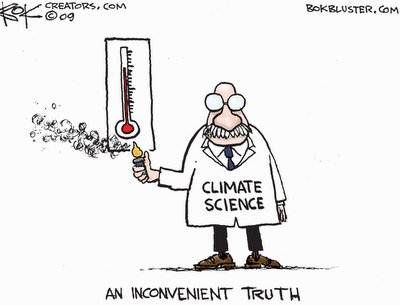
10 Tips for Journalists Writing about Climate Change

This list could be applied to any area of science. I chose climate science because it’s what I’m interested in, and because its reporting is the most obviously abysmal at present.

  1. Try to get hired as a specialized science reporter. It might not be as cost-effective for a  media outlet as having general reporters cover everything – but what kind of a price are they willing to put on accuracy? As Stephen Schneider wrote in his last book, newspapers would never allow general reporters to cover the Super Bowl, so why would they allow them to cover recent topics in science, which are far more complex than football?
  2. Keep up with the scientific literature. Subscribe to Science, Nature, and PNAS. Many important papers are published in one of these three journals. See if the media outlet you work for can cover the cost.
  3. Learn about common climate change misconceptions. The best website to help with this is Skeptical Science. Their database of arguments and rebuttals is detailed, comprehensive, and impeccably cited. It’s also available as an app for various smartphones, so you can read it on the bus.
  4. Get to know the local climate scientists. At virtually every university, there is someone who studies some aspect of climate change, usually in the geography department. In my experience, climate science professors are easy to get a hold of (email is usually their favourite mode of communication) and more than willing to discuss their work  (although that might just be because I’m an over-enthusiastic student). Don’t just email them when you’re writing a story about climate change – try to keep up a steady thread of conversation. You will learn an incredible amount.
  5. Talk to people you know about climate change and find out what confuses them. This will give you more direction as to what to focus on in your stories.
  6. Be diligent about assessing credibility. In a topic such as climate change, where there are people out there trying to mislead you, this is more important than ever. Refer to the credibility spectrum for more.
  7. Be very, very careful with quotes. Try to only quote primary sources. If you’re quoting a secondary source – usually a quote that was published in another newspaper somewhere – contact the person who said it, so you can double-check the accuracy as well as get some more quotes from them while you’re at it. If the quote is from a written source, such as scientific reports or stolen emails, try to find it in its original context. You might be surprised.
  8. Send the finished article to the scientists you quote before it’s printed. If the British media had done this before they started the Whatevergate rumours, a lot of confusion would have been avoided. Remember that the reputations of scientists could be on the line if you misrepresent what they say.
  9. Don’t let the hate mail get to you. Honest reporting of climate science will doubtlessly lead to lots of angry emails and letters to the editor about how global warming is a vast conspiracy because it’s not happening, it’s caused by the sun, the climate has changed before, and the climate has internal negative feedbacks which prevent it from changing. You’ll also receive personal attacks about how you are a pathological liar, a Communist, and a quasi-religious zealot. I have endured a lot of this myself, and I have found that the most effective way of dealing with it is by looking at the humorous side. Some of it is just priceless. My favourite is the comment from the guy who stocked up on incandescent lightbulbs just to spite me.
  10. Remember the importance of what you’re doing. This is the best motivator for improving your climate change journalism. Maybe you won’t be around for the worst of climate change, but your kids will, and their kids will, and all these future generations will look back at ours, as the time when this problem could have been solved and wasn’t. Even though we can’t completely solve it at this point, as some amount of future warming is guaranteed, we can always stop it from getting worse. Riding our bikes and composting isn’t enough any more. We need major international action if we want to have a chance to keep this problem at bay. However, because we live in a democracy, action will only be taken if voters demand it, and voters won’t demand a solution if they don’t understand the problem. And they won’t understand the problem unless dedicated people like you show them the way.

The Applause Continues

The New York Times deserves a clap too. Thanks to toby and Eli for the hat tip.

An article just as good as the Associated Press piece made the front page of the New York Times. Justin Gillis wrote In Weather Chaos, a Case for Global Warming, and, as Eli pointed out, there wasn’t even a question mark in the title.

Gillis does a great job explaining how, for example, there will still be record cold days with climate change – just fewer of them. Here’s one of my favourite passages from the article:

The warming has moved in fits and starts, and the cumulative increase may sound modest. But it is an average over the entire planet, representing an immense amount of added heat, and is only the beginning of a trend that most experts believe will worsen substantially.

If the earth were not warming, random variations in the weather should cause about the same number of record-breaking high temperatures and record-breaking low temperatures over a given period. But climatologists have long theorized that in a warming world, the added heat would cause more record highs and fewer record lows.

The statistics suggest that is exactly what is happening. In the United States these days, about two record highs are being set for every record low, telltale evidence that amid all the random variation of weather, the trend is toward a warmer climate.

Read the full article here.

The Associated Press Gets it Right

It’s been quite the summer. Moscow has experienced several months of weather more akin to Texas, and is literally burning up. Floods in China have killed more than a thousand and left countless others displaced. Pakistan has experienced similar floods due to a massive monsoon season, and now they have to deal with cholera, too. The Arctic sea ice extent is not much larger than 2007, and, so far, it’s been the warmest year on record globally.

We can’t tie a single extreme event to climate change. We can tie long-term trends, like 30 years of declining Arctic sea ice, to a warming world, but we don’t yet have the technology to attribute a single anomalous season to a particular cause. In 2007, for example, factors other than high temperatures contributed to the lowest Arctic sea ice extent on record.

However, these events are exactly what we expect from anthropogenic climate change. We shouldn’t look at them as evidence for global warming, but as examples of what is to come. This is an important warning that most newspapers have been shying away from. After nearly a year of terrible climate change journalism across the board, they didn’t even mention the connection between extreme events and climate change, or the fact that this summer is a very real glimpse into our future.

I gave up on my local newspaper months ago, and I don’t regret that decision. On the handful of mornings that I’ve flipped through the paper instead of reading the Globe and Mail on the Internet (journalism of much higher quality, and it saves money and paper), I’ve seen far too many op-eds and letters to the editor saying very strange things about climate science.

However, a headline yesterday caught my eye. A fantastic article by Charles J. Hanley, a Pulitzer Prize winning journalist, was distributed by the Associated Press and, consequently, picked up by dozens of newspapers across the continent – including my local paper.

I became more and more pleasantly surprised as I began to read through the article:

Floods, fires, melting ice and feverish heat: From smoke-choked Moscow to water-soaked Iowa and the High Arctic, the planet seems to be having a midsummer breakdown. It’s not just a portent of things to come, scientists say, but a sign of troubling climate change already under way.
The weather-related cataclysms of July and August fit patterns predicted by climate scientists, the Geneva-based World Meteorological Organization says – although those scientists always shy from tying individual disasters directly to global warming.

Read the whole article here.

Hanley does a fantastic job of distinguishing between weather and climate, and stressing that we can’t yet attribute extreme events to specific causes while acknowledging that this summer’s wild weather fits with IPCC predictions and will become a lot more common in the future. He interviews our good friend Gavin Schmidt, and explains how rising greenhouse gases are “loading the climate dice” – changing the relative odds of different extremes, rather than eliminating all cold days entirely.

I stood there and clapped. I was so proud of the Associated Press, and of my local paper, that I clapped for them. I feel like there is a smidgen of hope for climate change journalism and public understanding of this issue again. Or perhaps it just comes in waves, and we’re riding our way to the top again.

Global Surface Temperature Change

I really enjoyed reading “Global Surface Temperature Change“, by James Hansen and his team at GISS. Keep in mind that it’s still in the draft stages – they haven’t submitted to a journal yet, but they certainly plan to, and it’s a very credible team of scientists that will almost definitely get it published.

The paper is mostly about the methods of global temperature analysis. It’s more of a review paper than an account of a single experiment. However, their main discussion point was that even by using the same data, problems can be addressed in different ways. The two main problems with temperature analysis are:

  • “incomplete spatial and temporal coverage” (sparse data)
  • “non-climatic influences on measurement station environment” (urban heat island effect).

The authors explain the methods they use and why, and explore the impacts that different methods have on their results.

GISS measures anomalies in the temperatures, largely because they are much smoother and more consistent, geographically, than absolute temperatures. In 1987, they determined that anomalies could be safely extrapolated for a radius of 1200 km from a station and still be accurate. GISS smooths the whole map out by extrapolating everything and averaging the overlapping bits.

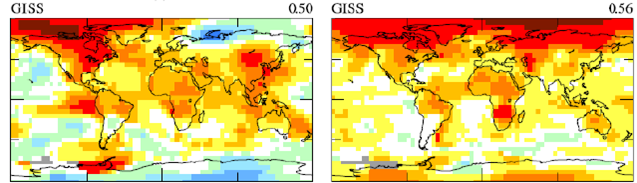
Extrapolating is also very useful in areas with very few stations, such as the polar regions and parts of Africa. In this map, grey indicates missing data:


The Arctic is particularly problematic, not only because its data is so sparse, but also because it has the largest anomaly of any region in the world. If you have incomplete coverage of an area that is warming so dramatically, it won’t pull its full weight in the global trend, and your result will almost certainly be too low.

This difficulty with the Arctic is the reason that GISS says 2005 is the warmest year on record, while HadCRUT, the team in England, says that 1998 is. GISS extrapolates from the stations they have, and end up getting pretty good coverage of the Arctic:

They’re assuming that areas with missing data have the same anomaly as whatever temperature stations are within 1200 km, which, as they determined in 1987, is a pretty fair assumption.

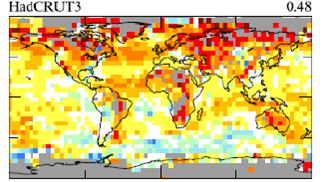
However, HadCRUT doesn’t do this extrapolating thing. When they don’t have data for an area, they just leave it out:

This might sound safer, in a way, but this method also makes an assumption. It assumes that the area has the same anomaly as the global average. And as we all know, the Arctic is warming a lot more and a lot faster than the global average. So it’s quite possible that GISS is right on this one.

Another adjustment that NASA makes is for local, anthropogenic, non-climatic effects on temperature data. The most obvious of these is the urban heat island effect. As an area becomes more urban, it gets more pavement, less vegetation, and its albedo goes down – it absorbs more heat. This often makes cities substantially warmer than the surrounding rural areas, which can obviously contaminate the temperature record. However, there are ways of eliminating urban influences from the data so we can see what the real trend is.

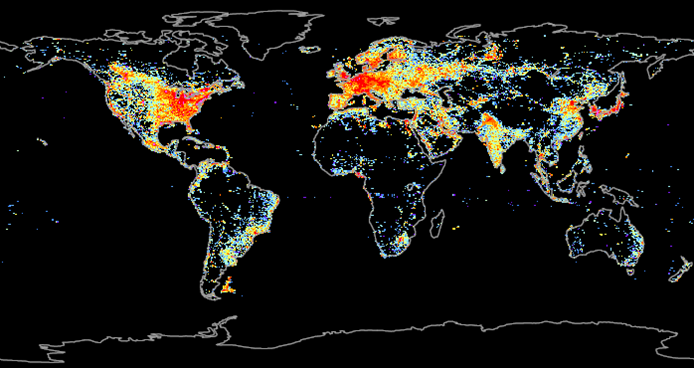
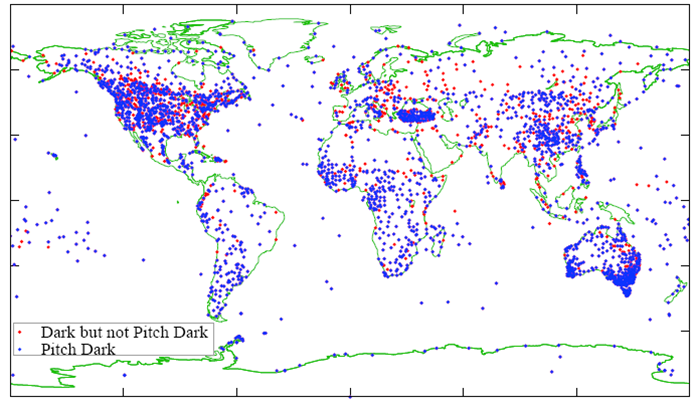
The first step is determining what stations are considered urban. The obvious way to do this is through population, but that’s actually not very accurate. Think of somewhere like Africa, where, even if there are thousands of people living in a small area, the urban influences such as concrete, absence of vegetation, or exhaust aren’t usually present. A much better indication is energy use, and a good proxy for energy use, that’s easy to measure, is lights at night-time.

So GISS put a bit of code into their analysis that singles out stations where nightlight brightness is greater than 32 µW/m2/sr/µm, and adjusts their trends to agree with rural stations within 1200 km. If there aren’t enough rural stations within that radius, they’ll just exclude the station from the analysis.

They did an even more rigorous test for this paper, to test just how much urban influences were contaminating the long-term trend, and it was pretty interesting.

There were enough stations considered “pitch-dark” at night, where they couldn’t detect any light, to run a global analysis all by themselves. The trend that came out was <0.01 °C/century smaller than GISS’s normal calculation, an amount of error that they described as “immeasurably small”.

The result of all this temperature analysis is a graph, with one new point every year, that is “eagerly awaited by some members of the public and the media”:

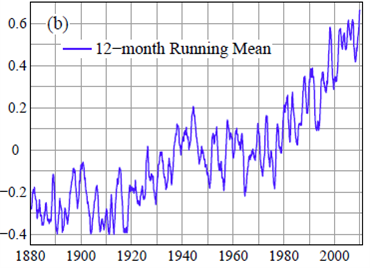
However, this graph isn’t actually as useful as this one – the 12-month running mean:

“From a climate standpoint there is nothing special about the time  of year at which the calendar begins”, so instead of only measuring January-December, you can also do February-January, March-February, and so on. This way, you get a data point every month instead of every year, and more data means more accuracy. It also solves problems with short-term influences, such as El Nino, La Nina, and volcanic eruptions, that the annual graph was having. These fleeting, but fairly substantial, influences can fall completely into one calendar year or be split between two – so their influence on global temperature could be overestimated or underestimated, depending on the starting month of the calendar. The 12-month running mean is much less misleading in this fashion.

As it is, we just set a new record for the 12-month running mean, and unless La Nina really takes off, 2010 will likely set a new record for the annual graph as well. But the authors argue that we need to start moving away from the annual graph, because it isn’t as useful.

The authors also discuss public perception of climate change, and media coverage of the issue. They say, “Our comments here about communication of this climate science to the public are our opinion…[We offer it] because it seems inappropriate to ignore the vast range of claims appearing in the media and in hopes that open discussion of these matters may help people distinguish the reality of global change sooner than would otherwise be the case.”

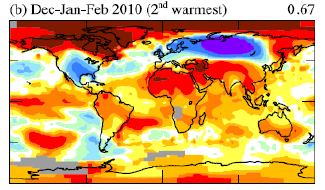
They make the very good point that “Lay people’s perception tends to be strongly influenced by the latest local fluctuation”, and use this winter as a case study, where a strongly negative Arctic Oscillation index caused significantly cooler-than-normal conditions across the United States and Europe. Consequently, a lot of people, especially in the US, began to doubt the reality of global warming – even though, in the world as a whole, it was the second warmest winter on record:

The authors also talk about data sharing. GISS likes to make everything freely available to the public – temperature station data, computer code, everything. However, putting it out there immediately, so that anyone can help check for flaws, has “a practical disadvantage: it allows any data flaws to be interpreted and misrepresented as machinations.” Multiple times in the past few years, when there have been minor errors that didn’t actually change anything, GISS was widely accused of making these mistakes deliberately, to “intentionally exaggerate the magnitude of global warming”. They realized this wasn’t working, so they changed their system: Before releasing the data to everyone, they first put it up on a private site so that only select scientists can examine it for flaws. And, of course, this “has resulted in the criticism that GISS now “hides” their data”.

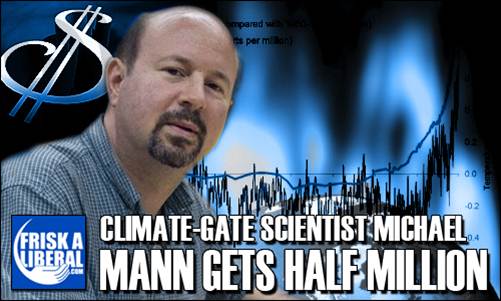
Personally, I find the range and prevalence of these accusations against scientists absolutely terrifying. Look at what has become mainstream:

Scientific fraud is a very serious allegation, and it’s one thing for citizens to make it without evidence, but it’s another thing altogether for the media to repeat such claims without first investigating their validity:

I have been disgusted by the media coverage of climate science, especially over the past year, especially in the United States, and I worry what this will mean for our ability to solve the problem.

However, there is still fantastic science going on that is absolutely fascinating and essential to our understanding of global climate change. This paper was a very interesting read, and it helped me to better understand a lot of aspects of global temperature analysis.

All Is Not Lost

I really enjoyed reading two recent polls conducted by George Mason University’s Center for Climate Communication. In particular, the results made me wonder why the US government still hasn’t passed a climate bill.

For example, US presidents have been saying for over a decade that it is unfair to force their industries to reduce emissions if developing countries do not have similar targets. However, only 8% of American adults share this view, and 65% believe that “the United States should reduce its greenhouse gas emissions regardless of what other countries do.” 77% agree that CO2 should be regulated, and 65% would like to see an international treaty signed.

The only solution which had less than 50% support was a tax on gasoline, even if it was revenue-neutral: offset by a decrease in income tax rates. This opposition can’t really be a case of people worrying about money. In this hypothetical situation, taxes aren’t being increased – they’re just being moved around, in a way that actually gives people more control over how much they are charged. Perhaps the public would prefer a more laissez-faire approach, or perhaps they had a knee-jerk reaction to the word “tax”. It’s not like the revenue-neutral aspect of this solution is well-known to most.

When the poll was broken down by political party, there were some surprising results that ran contrary to what one hears in the halls of Congress. 64% of Republicans support regulating CO2. Only 30% think that protecting the environment reduces economic growth and costs jobs.

Overall, the poll showed very strong support among Americans for action that still hasn’t happened, largely because a very vocal minority has had a disproportionate influence on the policy debate. If there was a referendum today, Kyoto targets and the cap-and-trade bill would pass with flying colours.

This support was even more interesting when compared to the questions regarding science. Only 61% of Americans think that the Earth is warming, and only 50% think that it is due to human activities. 45% think “there is a lot of disagreement among scientists about whether or not global warming is happening”, and only 34% were aware of the existing consensus.

The discrepancy between scientific understanding of the issue and support for mitigation shows that Americans, in general, practice risk management when it comes to climate change. Even if they’re not sure whether or not there is a problem, they understand what is at risk, and are willing to take action to prevent major consequences. Greg Craven, you got your wish.

I think that the misconception of a voracious scientific debate, apart from being perpetrated by the media, stems partly from the fact that most of the public lacks the experience to distinguish between scientific and quasi-scientific debates. Competing hypotheses, published in leading journals, seen as the frontier of the field….that’s a scientific debate. Editorials, written by anyone other than a scientist publishing in the field, claiming to refute an overwhelming consensus? Can’t even come close. However, I suspect that many would categorize the second as “scientific debate”, simply because it’s their only encounter with science.

All is not lost, though. 81% of Americans trust scientists as a source of information about global warming. That’s more than they trust any other source that was mentioned in the question. And 20%, 27%, and 29% say that they need a lot more, some more, or a little more information, respectively. Maybe all that needs to happen is for us to speak louder – because people are ready and willing to listen.

Deniers?

I really enjoyed New Scientist’s Special Report: Living in Denial. What a fascinating phenomenon, and a fascinating batch of articles exploring it.

The denial of science is a growing problem. It’s not restricted to a particular ideology – while denying the harmful effects of smoking or the existence of climate change is typically a position of the far right, vaccine denial and H1N1 conspiracy theories are largely restricted to the left.

It occurs even among the well-educated, or among youth who are still immersed in up-to-date curricula. For example, this year at the university, a student group put up signs saying “Don’t get the swine flu shot – it contains mercury!” The chemistry students got mad, and said that labelling thimerosal as toxic mercury was comparable to saying “Don’t eat table salt, it contains chlorine gas!”

As Michael Shermer’s article explains, the defining mark of science denial is a refusal to change one’s mind based on evidence. This is easy to identify for something like Holocaust denial, where evidence is abundant in the public sphere.

It gets a little harder for more technical issues like climate change or vaccines. Scientific opinion is overwhelmingly on one “side”, but the average person does not know or understand the evidence to support this consensus. An article about the thermodynamics of the stratosphere won’t sell a lot of papers. Most people unconsciously follow the credibility spectrum and trust what their doctor or NASA scientists say.

However, some don’t realize that scientific credibility is not the same as an appeal to authority, and so express contrarian opinions. Vaccines cause autism. Global warming is nonexistent/natural/inconsequential. The way that the Twin Towers fell proves that it was orchestrated by the US government.

There are two groups of contrarians: the skeptics, and the deniers. The skeptics are the ones who will change their minds based on evidence – they just haven’t encountered that evidence yet. My favourite example of this is from the Friends episode when Phoebe declares she doesn’t believe in evolution. When Ross starts talking to her about fossils, she says, “Oh. I didn’t know there was actually evidence.”

It’s amazing how many insights you can get out of a supposedly “fluffy” sitcom. I could write an entire essay analyzing that clip…..

I have met dozens of very reasonable people who doubt climate change because they don’t know about the evidence for it. People my age throw around the phrase “it’s a natural cycle” a lot, until I explain that the climate doesn’t act like a pendulum. It doesn’t have to compensate for past periods of warming or cooling – it simply responds to forcings. If the forcing is cyclical, then the climate will be cyclical, but some forcings are a different shape altogether. Similarly, I know a teacher who previously thought that natural causation of the current warming was a legitimate scientific theory, due to a presentation from a teacher’s conference….until I did a bit of probing and discovered that this presentation was given by Tim Ball.

These people are very reasonable. They are willing to change their minds based on evidence. They’ve just been unlucky enough to be misinformed by our flawed system of science journalism.

Then there are the deniers. They call themselves skeptics, but they will not change their minds, no matter what evidence you give them. They either move the goalposts, change the subject, or continue to repeat the same claim even after you have rebutted it patiently multiple times. Go check out some YouTube comments to see what I’m talking about.

Often their ideology or worldview is extreme in some way. For many members of the far right, any problem that would be solved by the government (think cap-and-trade or smoking legislation) will be rejected out of hand. On the far left, anything that would benefit corporations (usually vaccines or traditional medicine) will face a similar reaction. As Michael Specter says, “We hate Big Pharma. We run away from Big Pharma….and leap right into the arms of Big Placebo.”

This phenomenon suggests that science communication is not the answer – for deniers. I learned long ago that trying to change the minds of deniers is a complete waste of time. However, I still feel that science communication and the rebuttal of common misconceptions is absolutely vital. The true skeptics need access to the evidence they are lacking, so that they will be more informed, and our population will move farther towards solving the many science-related problems we face.

These skeptics deserve our time, our efforts, and our respect. They are the target audience of my blog, even if my most active commenters and supporters are a different group altogether. The reason that any of us here do all this work in communication, I believe, is for the true skeptics.

Michael Fitzpatrick argues that we shouldn’t use the label “deniers” at all. I wouldn’t want to alienate the true skeptics by coming across as someone who insults others. However, I think that calling deniers “skeptics” is unfair to the skeptics. They are two completely different groups that we must distinguish between. Skepticism is a worthy quality in science, and giving the complimentary title of “skeptic” to someone who doesn’t deserve it is unfair to those who do. We need to cater to the people who are willing to learn and who don’t want to waste our time. Science communication shouldn’t have to be like No Child Left Behind.

Michael Shermer’s second article, similarly, says that we should participate in debates with deniers and give them a chance to be heard. The truth will prevail, he argues, even if the deniers refuse to give in. I would agree with this position if it were a matter of opinion or policy, which is wholly democratic. Yet science is completely different. Science isn’t about free speech and giving equal time for all views. It is about giving time to those who have the most accurate analyses and robust conclusions. In science, you shut up and listen until your ideas are strongly supported by evidence. Then you publish.

When papers skeptical of climate change get published (all three per year!), such debates are worthy. The authors passed the test of peer-review, and even if their papers are obviously sub-par and are soon to be retracted, they deserve some debate and discussion. Let’s debate contrarian science when it is actually science – when it is actually published.

By paying close attention to and publicly debating with the authors of blog science, however, we are further confusing the public’s already skewed image of science. “It doesn’t matter whether or not you publish,” we seem to be telling them, “it’s all about free speech.” The scientific process has rules, and if deniers can’t pass the necessary, but not sufficient, condition of peer-review, their work doesn’t deserve to be treated as scientific research, and we shouldn’t give them our attention.

Let’s ignore the people who aren’t worth our time, because we have limited time, and there are people out there who deserve every minute of it.

The Celebrity Phenomenon

It is a very small subset of people that actually reads the scientific literature on climate change.

Even publishing scientists don’t usually follow research outside of their field. Few of us climate science enthusiasts read about the role of low hepatic copper concentrations in nonalcoholic fatty liver disease, so why should we be surprised when medical researchers, flipping through Nature, don’t stop to read about the sea level during the last interglacial and its relevance to today?

For the 99% of us who are not publishing scientists in any area, and do not have a subscription to Nature, and don’t really find it too riveting anyway, we get all of our climate science news from the media. The mainstream media is generally mediocre when it comes to reporting science, but when it comes to climate science they do an abysmal job.

Many people know this – you shouldn’t trust the media, especially when it comes to stories of impending disaster.  You should take every such story with a grain of salt. However, it’s no good to stop there, and never do any research into its validity. Because what if it’s actually true? Then you’ll just be shrugging it off and going “maybe, maybe not” for no reason.

This happens a lot with celebrity climate science communicators, like Al Gore, or, in Canada, David Suzuki.

I’ve written about Al Gore before, and the important thing to stress is that he doesn’t matter. In general, his communication of climate science is very accurate – he has a few minor errors in his book and movie, but the overarching message that humans are causing dangerous warming of the planet is fully supported by science.

But it couldn’t matter less if Al Gore was or wasn’t telling the truth, because absolutely no scientific research rests on him. He hasn’t published any peer-reviewed papers about anything even remotely related to climate. He is purely a communicator.

A lot of people don’t like Al Gore, and therefore think that global warming is bunk. This kind of reasoning is very unfortunate. They recognize that they are hearing scientific information from a partisan source, so they assume that it’s wrong without researching what credible, nonpartisan sources say about it. All you need is a credibility spectrum, and you’re good to go.

There’s somewhat less of a problem when it comes to David Suzuki – after all, he’s not a former politician, he has more scientific training (a biology doctorate) than Gore, and according to a Reader’s Digest poll, Canadians trust him more than any other celebrity. It’s still easy, though, to find people who don’t like him for one reason or another. If it comes from David Suzuki, it has to be an extremist environmental craze, so they brush off what he says without looking at more credible sources.

Celebrities like Gore and Suzuki don’t matter. What matters, though, is people with severely limited knowledge of the scientific process, access to credible sources, or motivation to do a little research. What matters is the factors shaping society that have allowed so many of us to be this way. Why do schools frame science as answers, not questions? Why is literature vital to public communication hidden behind paywalls? And why do so many people assume that entire fields of science are dependent on one or two celebrity communicators?

A Better Credibility Spectrum

It’s been over a year since I wrote The Credibility Spectrum, my first post ever. Since then I’ve learned a lot, and have altered the credibility spectrum in my own mind – so I thought I’d alter it here, too.

This credibility spectrum is sort of split into two: the scientific community, and the non-scientific community. The scientific community starts with scientists, and I want to stress that this category only includes scientists with experience in the issue at hand. Just because someone has a PhD in one area of science doesn’t mean that they are an expert in all areas. For example, it’s very easy for a computer scientist to go through ten years of university without studying any biology at all.  Treating them as an expert in evolution, therefore, would be illogical.

These scientists write peer-reviewed papers, published in journals like Nature and Science, which are another step up the credibility spectrum. Instead of just having the name of an expert attached to them, their methods and conclusions have been evaluated for robustness and accuracy. This is the minimum level of credibility from which I recommend citing scientific claims.

However, as thousands of papers are published every month, and they’re generally studying the frontier of their field, it’s inevitable that some of them will be proven wrong later. As Gavin Schmidt and Michael Mann wisely said, peer review is a necessary but not sufficient condition.

That’s why there are scientific organizations and assessment reports, like NASA or the IPCC, which compile peer-reviewed knowledge which has stood the test of time into consensus statements. Even the top level of the credibility spectrum isn’t infallible, but it sure has a low error rate compared to other sources.

Everyone who isn’t a scientist, which is most of us, falls into the lower half of the credibility spectrum. The category I refer to as “communicators” includes the mainstream media, projects like Manpollo or 350.org, high school teachers, politicians…….They’re not part of the scientific community, so you should always always always check their citations, but they’re held more accountable for what they say than just any random person on the street. If they make glaring errors, people will be more upset than if the same errors were made by individuals – comments on YouTube, discussions with your neighbours – which make up the lowest rung of our credibility spectrum.

Something that I found really interesting  when I put this together was the general flow of information between different sources. In the scientific community, research starts with scientists, and the best research is published in journals, and the best journal articles are picked up by major organizations. As the scientific knowledge progresses through the different sources, the weaker assertions are weeded out along the way. The flow of information is going up the pyramid, towards the narrower part of the pyramid, so that only the best is retained.

However, in the non-scientific community, the flow of information goes the other way. Communicators present information to individuals, which is a much larger group. Information travelling down the pyramid, instead of up, allow rumours and misconceptions to flourish much more easily.

This isn’t to say that, when they come head-to-head, organizations are always right and individuals are always wrong. But given the history of such disagreements, and the levels of credibility involved, you’ll know where to place your bets.

We Have Slides!

After a marathon PowerPoint-session yesterday I finally got my 63 slides out of the way. Here is the presentation for anyone who is interested. The script is written in the notes beneath the slides.

I like to have things fading in and out of my slides, so sometimes the text boxes and images are stacked on top of each other and it won’t make sense until you view the animation.

Researching the median lethal dose of arsenic during my spare at school was really awkward. I had to do a lot of hasty explaining to my friends about how it was a metaphor for small concentrations having large effects, and no, I wasn’t planning to poison anyone.

Anyway, enjoy.

Mind the Gap (12 MB)

Mind the Gap

This is the script of a presentation I will make to several groups of high school students on Earth Day. I was originally going to use the same script from my PowerShift presentation, but in light of recent developments and my ever-expanding thoughts on climate change, I decided to create an entirely new presentation.

I would greatly appreciate any thoughts, input, suggestions, etc. Keep in mind that I don’t have my PowerPoint created yet, so some of the text may seem a little confusing without the visuals I’ll be pointing to.

Enjoy!

Update: Thanks for all the helpful comments and critiques. I’ve made some changes here, but feel free to keep them coming.

Welcome everyone, nice to see you all here. My name is Kate, I’m in my last year of high school, and I am here to talk to you about climate change, or global warming. After I graduate I want to be a climate scientist, so until then, I’m channelling my obsession into a website. For the past year, I’ve been writing the blog ClimateSight.org, which has allowed me to meet a lot of cool people and correspond with a lot of scientists.

I’ve spent several years doing a lot of research on climate change, and something that’s been really interesting to me is the link between climate scientists and the public – the communication between these two groups. And the very first thing I want to talk about is assessing credibility, which is probably the most important tool I can give you. How much weight should you give different statements from different sources about scientific issues?

The scientific community that is actually studying the issue is going to be more credible than the media and the public. And that scientific research starts with scientists. They write peer-reviewed articles, published in journals like Nature or Science. Anything that is a serious scientific idea will be in one of these journals at some time or other. But there are thousands of journal articles published every month, and because they’re generally studying the frontier of their field, it’s inevitable that some of them are going to be proven wrong later. That’s why there are scientific organizations and assessment reports that look back at all these papers and compile what we know about the major issues. So statements from organizations like NASA, or from assessment reports like the IPCC, means that something has stood the test of time.

Among all the people who are not scientists, some know more than others. People who communicate science, like journalists and high school teachers and some politicians, are held a little more accountable for what they say than just any random person on the street.

So let’s see what the different levels of the credibility spectrum say about global warming. Who would disagree – who would say that humans are not causing the Earth to warm? 0% of scientific organizations say no. Pretty much 0% of peer-reviewed articles say no – there is the odd one out there, but they’re so small in number that they round right down to zero. And less than 3% of publishing climatologists say no. But 57% of articles in leading newspapers say no (or probably not, or maybe, maybe not), and 53% of the public says no.

As you can see, there is a big gap right here. The top half of the credibility spectrum is very confident about human-caused global warming, and the bottom half is very confused. Why is this? How can an issue that is so important to public policy have such drastically different levels of support between those who study it and everyone else?

There are all kinds of common objections that you and I hear about global warming. What if it’s a natural cycle and we’re just coming out of an ice age? What if the Sun is heating up? And how could there possibly be global warming when it is so cold outside? There are all kinds of arguments against the idea of climate change that everybody knows. But the scientific community is still saying this. They are still sure that yes, it’s going on and yes, it’s us.

So there are three possible explanations. Scientists could be ignorant and overconfident. Maybe they never considered the idea it could be a natural cycle. Scientists could be frauds, part of some Communist conspiracy to take over the world somehow. Or, maybe scientists know what they’re doing, and have evidence to say what they’re saying. So let’s look at the evidence that they do have.

We’ve been studying this problem for a long time, and it all started in the 1800s, when the greenhouse effect was discovered – the gases in the atmosphere that trap heat and keep the planet warm enough for life. The idea that emissions of carbon dioxide from our burning of fossil fuels – like coal, oil, and natural gas – would eventually cause warming was first proposed in 1896. So this is not a new theory by any means.

We began measuring the carbon dioxide content of the atmosphere in the 1950s, and we can see that it’s steadily going up. Over the last 2.1 million years, CO2 never exceeded 300 ppm, but right now it’s at 390. This might not seem like a lot, but 390 ppm of arsenic in your coffee would kill you.

We can confirm that this increase in CO2 is due to human activity because of its isotopes. The carbon in CO2 from fossil fuels has fewer neutrons, on average, than CO2 from natural sources like volcanoes or the ocean. That makes it lighter, so we can tell the difference in samples from the air.

So we know that an increase in greenhouse gases causes warming, and we know that we are increasing greenhouse gases. So it’s not really a surprise that we’re starting to see the warming show up. There are five independent research teams worldwide that measure the average global temperature, some from weather stations and some from satellites, and all five of them are finding a very similar pattern of warming since about 1975.

But what if it’s a coincidence? What if something else was causing the warming, and it just happened to be at the same time that we were dumping fossil fuels into the air? Something that a lot of people don’t know is that there are ways that we can confirm that the warming is caused by us. First of all, there’s nothing else going on that could be causing it. Actually, if you took human activity out of the picture, we would be slowly cooling: the cycles of the Earth’s orbit show that we should be very very slowly going into a new ice age.

There is also a specific pattern of warming we can look at. If warming were caused by the sun, the entire atmosphere would warm in a uniform fashion. But if greenhouse gases were causing global warming, the first layer of the atmosphere (the troposphere) would be warming, but the next layer up, the stratosphere, would be cooling. This is referred to as the “fingerprint” of greenhouse warming, because it’s like DNA evidence or the smoking gun. And that’s exactly what we’re seeing – stratospheric cooling. (Randel et al, 2009).

So we can be very sure that yes, our activities are causing the Earth to warm, at a rate that we haven’t seen for at least the past 55 million years, which was before humans even existed. That’s really the problem – the rate of change. It’s not the actual temperature that poses a threat, it’s all about how much it changes and how fast. The world has been plenty warmer than this at times, like when dinosaurs were around. And dinosaurs were okay with that because it had been like that for a really long time and they had adapted to it. But a change in temperature at the rate we’re seeing now? It might seem slow to you and me, but on a geological timescale, it’s incredibly quick, too quick for species – including humans – to adapt. Yes, the climate has changed many times before, but it never really ended well.

For example, the largest extinction in our Earth’s history, the Permian extinction 250 million years ago, was most likely caused by warming from greenhouse gases that came out of supervolcanoes much larger than anything we have today. It got so warm that the ocean couldn’t hold any oxygen and produced hydrogen sulphide instead. That’s what makes rotten eggs smell bad, and it’s actually poisonous in large enough quantities. It killed 97% of species in the ocean and 70% of species on land. It has been nicknamed “The Great Dying”. So this is the absolute worst-case scenario of what can happen when too many greenhouse gases go into the atmosphere at once. It means a whole lot more than just nicer Winnipeg winters.

So, to the people who really look at this issue, the evidence is undeniable. In academic circles, there really is no argument. All the objections that we have – they thought of them long ago, and covered them all, and ruled all of them out, before you and I even knew what global warming was. The evidence for climate change is not a house of cards, where you take one piece out and the whole theory falls apart. It’s more like a mountain. Scrape a handful of pebbles off the top, but the mountain is still there.

As for the second option, that scientists are part of a conspiracy – if you stop and think about it, like, really? Scientific fraud happens, but on the scale of one paper, or at the most one scientist, not an entire field stretching back for over a century. Scientists are not that organized. And that only leaves one explanation – that the field of climatology does know what it’s doing, and does have evidence to say what it’s saying: that humans are causing the Earth to warm, and it’s not going to be good.

We’ve established that the top half of the credibility spectrum is the one that we can trust on this issue. So what’s going on in the communication between the top and the bottom so that the public has got totally the wrong idea? This is what I spend most of my time working on, and there are a lot of factors involved, but it really comes down to three points.

Firstly, climatology is a complex science, and it’s not a required course in high school, so the public doesn’t understand it the way they understand Newton’s Laws of Motion. Most people do not know all this stuff I just told you, and that’s only scratching the surface; there is so much more science and so many more lines of evidence. And when you only have bits and pieces of this story, it’s easy to fall prey to these kinds of misconceptions.

Second, there are, sadly, a lot of people out there trying to exploit number one. There are a lot of very prominent people in the media, politics, and industry who will use whatever they can get – whether or not it’s legitimate, whether or not it’s honest – as proof that global warming is not real. You’ll hear them say that all scientists said an ice age was coming in the 70s, so we shouldn’t trust them now. In reality, most scientists were predicting warming by the 70s, and the single paper to talk about an ice age was proven wrong almost immediately after its publication. You’ll hear them say that volcanoes emit more CO2 than humans, but volcanoes only emit about 1% of what we do. They’ll say that the Greenland ice sheet is getting thicker, so therefore, it cannot be warming. But the reason that Greenland is getting thicker is that it’s getting more snow, caused by warmer temperatures that are still below zero.

Some of these questionable sources are organizations, like a dozen or so lobby groups that have been paid a lot of money by oil companies to say that global warming is fake (Hoggan and Littlemore, 2009). Some of them are individuals, like US Senator James Inhofe, who was the environment chair under George W. Bush, and says that “global warming is the greatest hoax ever imposed upon the American people.” Some of them have financial motivations, and some of them have ideological motivations, but their motivations don’t really matter – all that matters is that they are saying things that are inaccurate, and misleading, and just plain wrong.

The third reason that the public is so confused about climate change is that the media has been very compliant in spreading the message of these guys. You would expect that newspapers and journalists would do their research about scientific issues, and make sure that they were writing science stories that were accurate, but sadly, that’s not what’s happening.

One of the major problems is that there are fewer journalists than there used to be, and there are almost no science journalists in the mainstream media – general reporters cover science issues instead. Also, a few decades ago, journalists used to get a week or two to write a story. Now they often have less than one day, because speed and availability of news has become more important than quality.

And, finally, when it comes to climate change, journalists follow the rule of balance, or presenting “two equal sides”, staying neutral, letting the reader form their own opinion. This works really well when the so-called controversy is one of political or social nature, like tax levels, a federal election, how we should develop infrastructure. In those cases, there is no real right answer, and people usually are split into two camps. But when the question at hand is one of science, there is a right answer, and some explanations are better than others. Sometimes the scientists are split into two equal groups, but sometimes they’re split into three or four or even a dozen. And sometimes, like we see with climate change, pretty much all the scientists are in agreement, and the two or three percent which aren’t don’t really publish, because they can’t prove what they’re saying and nobody really takes them seriously. So framing these two groups as having equal weight in the scientific community is completely wrong. It exaggerates this extreme minority, and suppresses everyone else.

All these problems are perfectly explained by a man named James Hrynyshyn, a journalist himself. He says, “Science journalism….is too often practiced by journalists who know so little about the subject they’re covering that they can’t properly evaluate the reliability or trustworthiness of potential sources. The result is that sources with no credibility in the field routinely appear alongside genuine experts as part of an effort to provide balance.”

One of the best examples of how this kind of journalism can really go wrong happened quite recently. Someone hacked into the email server of the Climatic Research Unit in the UK, stole thirteen years of emails between scientists, sifted through them all to find the juiciest ones, and put them on the Internet. The police are trying to figure out who did this, because it’s quite illegal, but it wasn’t some teenage kid in their basement.

Some of the emails certainly were embarrassing, the scientists said some things that weren’t very nice and insulted some people. But can you imagine if all of your email was released to the world? Scientists are people too, and they say stupid stuff that they don’t mean over email just the same as you and I do – especially when there are so many people actively spreading lies about their work.

The most important thing, though, is that there was nothing in there that compromised any science, any data sets, anything that we know about climate change. Nothing actually changed…..but the scary part was that a striking amount of the media reported that the entire field of climate science was potentially a political scam.

For example, some scientists are working on reconstructing temperatures from before we had thermometers, using tree rings or ice cores or ocean sediment. In one of the most widely circulated emails, the scientists discussed how to “hide the decline” in a set of tree ring data that’s known to have some serious problems – the tree growth is going down while thermometers show local temperatures going up, which is the opposite of what you’d expect. It probably means there was a drought or something. So they were trying to see if they could still use the first part and cut out the useless part at the end. They’re only hiding it in a mathematical sense, they’re not hiding it from their colleagues or from the media. In fact, they’ve written about this decline in one of the most prestigious scientific journals in the world, so if they’re trying to pull off a conspiracy here, they’re not doing a very good job.

But somehow, in the media, the story changed. Instead of saying that scientists were “removing regional tree ring data known to be erroneous,” the media said they were “covering up the decline in global temperatures”. That’s so fundamentally different, so removed from the facts – these scientists don’t even work with global temperatures! – but you heard it everywhere. The story that reached virtually every newspaper in the world was that the world is cooling and scientists are trying to hide it from us.

That’s only one example of how a single phrase can be taken out of context and have its meaning completely twisted. It doesn’t surprise me, you see it from these guys all the time, but what absolutely amazes me is how the media just sat and lapped it right up without doing any research into the validity of these serious allegations.

Subsequently, two independent investigations into the contents of these emails have been released, and the scientists involved were basically cleared in both cases. The British Parliament found that “the focus on CRU has been largely misplaced”, that the scientists’ “actions were in line with common practice”, that “they were not part of a systematic attempt to mislead”, and that all of the CRU’s “analyses have been repeated and the conclusions have been verified”. (British House of Commons, 2010). The University of East Anglia found “no evidence of any deliberate scientific malpractice in any of the work of the CRU”, “no hint of tailoring results to a particular agenda”, and that “allegations of deliberate misrepresentation and unjustified selection of data are not valid”. (UEA, 2010) So this affirms what the climate science community already knew: the stolen emails do not change the science one bit.

But look at what newspapers told us for weeks on end. Every time the Winnipeg Free Press mentioned the emails, they would say something along the lines of, “The correspondence appears to suggest researchers may have manipulated data to exaggerate global warming.” These are very serious allegations to make, and they were made without evidence in serious, credible and widely read newspapers, and they’re not being retracted or corrected in the media now that the investigations are coming up clear.

Spencer Weart, who is a science historian, had some great words to say on this issue: “The media coverage represents a new low. There are plenty of earlier examples of media making an uproar without understanding the science….but this is the first time the media has reported that an entire community of scientists has been accused of actual dishonesty. Such claims….would normally require serious investigation. But even in leading newspapers like The New York Times, critics with a long public record for animosity and exaggeration are quoted as experts.”

Many of the scientists featured in the emails received death threats. Phil Jones, the director of CRU, says that he’s been suicidal. The story of these stolen emails is not a story of scientists engaged in conspiracy – it is a story of how desperate some people are to make it seem that way, and how gullible and irresponsible the mainstream media can be.

And not long after that, story after story broke that the IPCC, which is a huge UN publication about everything we know about the science of climate change, had all kinds of mistakes in it. So what were these mistakes? In 3 000 pages, two examples of overestimating climate change were found. First, the report said that the Himalayan glaciers would disappear by 2035, and we now know that it’s going to take a lot longer than that. Second, it said that 55% of the Netherlands is below sea level, when in fact 55% of the Netherlands is susceptible to flooding, and only some of that is below sea level. This last one is background information. It really isn’t all that relevant.

So should that have happened? No. But does it actually matter to our understanding of the science? No.

Then several British journalists managed to invent five or six other “IPCC scandals”. When these were investigated more seriously, they were found to be completely false. But they were still reported in virtually every newspaper around the world. Again.

However, the IPCC has made a lot of mistakes, much more serious than these, that none of the newspapers are reporting. The difference is that the mistakes that make the media scream scandal are examples of overestimating climate change, while the ones you don’t hear about are examples of underestimating climate change. There was recently a report published that evaluated the last IPCC report, and this is what it found:

Over the past three years, there was about 40% less Arctic summer sea ice than the IPCC predicted, and melting in the Arctic is far exceeding its worst case scenarios. Recent observed sea level rise is about 80% more than the IPCC predicted.  Global sea level by 2100 is expected to rise at least twice as much as the IPCC predicted. (Copenhagen Diagnosis, 2009)

So which seems more important? The exact date at which a specific glacier is expected to melt? Or the amount of sea level rise we can expect all over the world? I have yet to find a newspaper in the world that covered this, but I have yet to find a newspaper in the world that did not cover this. Yes, the IPCC makes mistakes, but they are almost always mistakes that say, “oops, it’s going to be worse than we thought.”

So, as you can see, the real message about the reality and severity of climate change is not getting through. Communication of science is always important, but it’s especially important for climate change, because it could potentially screw up our civilization pretty bad, and we want to minimize that risk.

Scientists, in general, are not that great at public communication – that’s why they’re scientists and not journalists or salesmen or whatever. They want to sit in the lab and crunch numbers. And there’s always been sort of a stigma in the scientific community against talking to the media or the public. But the one good thing about all these rumours and all this awful journalism is that it’s finally making the scientific community wake up and realize how bad things are and how much their voice and their input is needed.

In the period of just a few months, over 300 American climate scientists signed an open letter to the US government about how two small mistakes in the IPCC do not impact the overall message that humans cause climate change, and should not impact our efforts to stop it.

And the National Academy of Sciences, which is one of the most prestigious organizations in the world – 1 out of 10 members have a Nobel Prize – has all sorts of plans for public lectures and articles in newspapers and a science show on prime time television.

The one good thing about things getting this bad is that it makes the people involved mad enough to step up and finally try to stop it. To finally narrow this gap that has existed for so long. That’s why I’m here today, that’s why I’ve been writing my blog for over a year, because I’m mad, and if I don’t do anything about it my head is going to explode. I cannot just sit and watch while these rumours threaten our ability to preserve a good future for me and for us and for everyone who will come after us. And I sincerely hope that all of you will not just sit and watch it happen either. We need to fix this together.