10 Tips for Journalists Writing about Climate Change

This list could be applied to any area of science. I chose climate science because it’s what I’m interested in, and because its reporting is the most obviously abysmal at present.

  1. Try to get hired as a specialized science reporter. It might not be as cost-effective for a  media outlet as having general reporters cover everything – but what kind of a price are they willing to put on accuracy? As Stephen Schneider wrote in his last book, newspapers would never allow general reporters to cover the Super Bowl, so why would they allow them to cover recent topics in science, which are far more complex than football?
  2. Keep up with the scientific literature. Subscribe to Science, Nature, and PNAS. Many important papers are published in one of these three journals. See if the media outlet you work for can cover the cost.
  3. Learn about common climate change misconceptions. The best website to help with this is Skeptical Science. Their database of arguments and rebuttals is detailed, comprehensive, and impeccably cited. It’s also available as an app for various smartphones, so you can read it on the bus.
  4. Get to know the local climate scientists. At virtually every university, there is someone who studies some aspect of climate change, usually in the geography department. In my experience, climate science professors are easy to get a hold of (email is usually their favourite mode of communication) and more than willing to discuss their work  (although that might just be because I’m an over-enthusiastic student). Don’t just email them when you’re writing a story about climate change – try to keep up a steady thread of conversation. You will learn an incredible amount.
  5. Talk to people you know about climate change and find out what confuses them. This will give you more direction as to what to focus on in your stories.
  6. Be diligent about assessing credibility. In a topic such as climate change, where there are people out there trying to mislead you, this is more important than ever. Refer to the credibility spectrum for more.
  7. Be very, very careful with quotes. Try to only quote primary sources. If you’re quoting a secondary source – usually a quote that was published in another newspaper somewhere – contact the person who said it, so you can double-check the accuracy as well as get some more quotes from them while you’re at it. If the quote is from a written source, such as scientific reports or stolen emails, try to find it in its original context. You might be surprised.
  8. Send the finished article to the scientists you quote before it’s printed. If the British media had done this before they started the Whatevergate rumours, a lot of confusion would have been avoided. Remember that the reputations of scientists could be on the line if you misrepresent what they say.
  9. Don’t let the hate mail get to you. Honest reporting of climate science will doubtlessly lead to lots of angry emails and letters to the editor about how global warming is a vast conspiracy because it’s not happening, it’s caused by the sun, the climate has changed before, and the climate has internal negative feedbacks which prevent it from changing. You’ll also receive personal attacks about how you are a pathological liar, a Communist, and a quasi-religious zealot. I have endured a lot of this myself, and I have found that the most effective way of dealing with it is by looking at the humorous side. Some of it is just priceless. My favourite is the comment from the guy who stocked up on incandescent lightbulbs just to spite me.
  10. Remember the importance of what you’re doing. This is the best motivator for improving your climate change journalism. Maybe you won’t be around for the worst of climate change, but your kids will, and their kids will, and all these future generations will look back at ours, as the time when this problem could have been solved and wasn’t. Even though we can’t completely solve it at this point, as some amount of future warming is guaranteed, we can always stop it from getting worse. Riding our bikes and composting isn’t enough any more. We need major international action if we want to have a chance to keep this problem at bay. However, because we live in a democracy, action will only be taken if voters demand it, and voters won’t demand a solution if they don’t understand the problem. And they won’t understand the problem unless dedicated people like you show them the way.

The Best Cartoons Ever

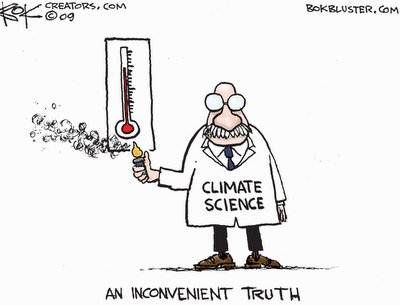
Over the past year, I have seen far too many political cartoons on the editorial pages of newspapers accusing climate scientists of fraud. It amazes me what is allowed to be published without evidence in respected media publications.

However, there are still some great cartoons about climate change, sans libel. Here are two of my favourite, that I haven’t seen featured on any other blogs.

From Lee Judge of Cartoonist Group:

From Nick Anderson of the Houston Chronicle:

Please comment with your thoughts on these cartoons, and include your favourites! If you would like them embedded directly in the comment (img tags require administrator rights, as Colin Reynolds discovered) include the link and I’ll embed it for you.

The Applause Continues

The New York Times deserves a clap too. Thanks to toby and Eli for the hat tip.

An article just as good as the Associated Press piece made the front page of the New York Times. Justin Gillis wrote In Weather Chaos, a Case for Global Warming, and, as Eli pointed out, there wasn’t even a question mark in the title.

Gillis does a great job explaining how, for example, there will still be record cold days with climate change – just fewer of them. Here’s one of my favourite passages from the article:

The warming has moved in fits and starts, and the cumulative increase may sound modest. But it is an average over the entire planet, representing an immense amount of added heat, and is only the beginning of a trend that most experts believe will worsen substantially.

If the earth were not warming, random variations in the weather should cause about the same number of record-breaking high temperatures and record-breaking low temperatures over a given period. But climatologists have long theorized that in a warming world, the added heat would cause more record highs and fewer record lows.

The statistics suggest that is exactly what is happening. In the United States these days, about two record highs are being set for every record low, telltale evidence that amid all the random variation of weather, the trend is toward a warmer climate.

Read the full article here.

The Associated Press Gets it Right

It’s been quite the summer. Moscow has experienced several months of weather more akin to Texas, and is literally burning up. Floods in China have killed more than a thousand and left countless others displaced. Pakistan has experienced similar floods due to a massive monsoon season, and now they have to deal with cholera, too. The Arctic sea ice extent is not much larger than 2007, and, so far, it’s been the warmest year on record globally.

We can’t tie a single extreme event to climate change. We can tie long-term trends, like 30 years of declining Arctic sea ice, to a warming world, but we don’t yet have the technology to attribute a single anomalous season to a particular cause. In 2007, for example, factors other than high temperatures contributed to the lowest Arctic sea ice extent on record.

However, these events are exactly what we expect from anthropogenic climate change. We shouldn’t look at them as evidence for global warming, but as examples of what is to come. This is an important warning that most newspapers have been shying away from. After nearly a year of terrible climate change journalism across the board, they didn’t even mention the connection between extreme events and climate change, or the fact that this summer is a very real glimpse into our future.

I gave up on my local newspaper months ago, and I don’t regret that decision. On the handful of mornings that I’ve flipped through the paper instead of reading the Globe and Mail on the Internet (journalism of much higher quality, and it saves money and paper), I’ve seen far too many op-eds and letters to the editor saying very strange things about climate science.

However, a headline yesterday caught my eye. A fantastic article by Charles J. Hanley, a Pulitzer Prize winning journalist, was distributed by the Associated Press and, consequently, picked up by dozens of newspapers across the continent – including my local paper.

I became more and more pleasantly surprised as I began to read through the article:

Floods, fires, melting ice and feverish heat: From smoke-choked Moscow to water-soaked Iowa and the High Arctic, the planet seems to be having a midsummer breakdown. It’s not just a portent of things to come, scientists say, but a sign of troubling climate change already under way.
The weather-related cataclysms of July and August fit patterns predicted by climate scientists, the Geneva-based World Meteorological Organization says – although those scientists always shy from tying individual disasters directly to global warming.

Read the whole article here.

Hanley does a fantastic job of distinguishing between weather and climate, and stressing that we can’t yet attribute extreme events to specific causes while acknowledging that this summer’s wild weather fits with IPCC predictions and will become a lot more common in the future. He interviews our good friend Gavin Schmidt, and explains how rising greenhouse gases are “loading the climate dice” – changing the relative odds of different extremes, rather than eliminating all cold days entirely.

I stood there and clapped. I was so proud of the Associated Press, and of my local paper, that I clapped for them. I feel like there is a smidgen of hope for climate change journalism and public understanding of this issue again. Or perhaps it just comes in waves, and we’re riding our way to the top again.

Global Surface Temperature Change

I really enjoyed reading “Global Surface Temperature Change“, by James Hansen and his team at GISS. Keep in mind that it’s still in the draft stages – they haven’t submitted to a journal yet, but they certainly plan to, and it’s a very credible team of scientists that will almost definitely get it published.

The paper is mostly about the methods of global temperature analysis. It’s more of a review paper than an account of a single experiment. However, their main discussion point was that even by using the same data, problems can be addressed in different ways. The two main problems with temperature analysis are:

  • “incomplete spatial and temporal coverage” (sparse data)
  • “non-climatic influences on measurement station environment” (urban heat island effect).

The authors explain the methods they use and why, and explore the impacts that different methods have on their results.

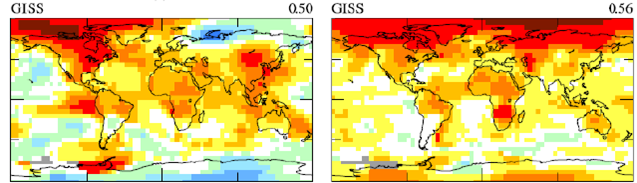
GISS measures anomalies in the temperatures, largely because they are much smoother and more consistent, geographically, than absolute temperatures. In 1987, they determined that anomalies could be safely extrapolated for a radius of 1200 km from a station and still be accurate. GISS smooths the whole map out by extrapolating everything and averaging the overlapping bits.

Extrapolating is also very useful in areas with very few stations, such as the polar regions and parts of Africa. In this map, grey indicates missing data:


The Arctic is particularly problematic, not only because its data is so sparse, but also because it has the largest anomaly of any region in the world. If you have incomplete coverage of an area that is warming so dramatically, it won’t pull its full weight in the global trend, and your result will almost certainly be too low.

This difficulty with the Arctic is the reason that GISS says 2005 is the warmest year on record, while HadCRUT, the team in England, says that 1998 is. GISS extrapolates from the stations they have, and end up getting pretty good coverage of the Arctic:

They’re assuming that areas with missing data have the same anomaly as whatever temperature stations are within 1200 km, which, as they determined in 1987, is a pretty fair assumption.

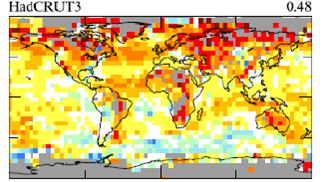
However, HadCRUT doesn’t do this extrapolating thing. When they don’t have data for an area, they just leave it out:

This might sound safer, in a way, but this method also makes an assumption. It assumes that the area has the same anomaly as the global average. And as we all know, the Arctic is warming a lot more and a lot faster than the global average. So it’s quite possible that GISS is right on this one.

Another adjustment that NASA makes is for local, anthropogenic, non-climatic effects on temperature data. The most obvious of these is the urban heat island effect. As an area becomes more urban, it gets more pavement, less vegetation, and its albedo goes down – it absorbs more heat. This often makes cities substantially warmer than the surrounding rural areas, which can obviously contaminate the temperature record. However, there are ways of eliminating urban influences from the data so we can see what the real trend is.

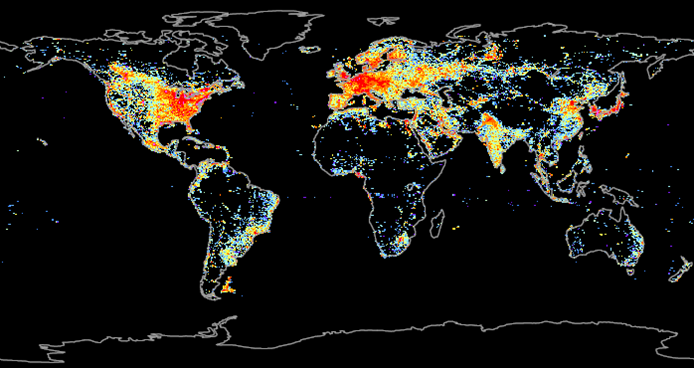
The first step is determining what stations are considered urban. The obvious way to do this is through population, but that’s actually not very accurate. Think of somewhere like Africa, where, even if there are thousands of people living in a small area, the urban influences such as concrete, absence of vegetation, or exhaust aren’t usually present. A much better indication is energy use, and a good proxy for energy use, that’s easy to measure, is lights at night-time.

So GISS put a bit of code into their analysis that singles out stations where nightlight brightness is greater than 32 µW/m2/sr/µm, and adjusts their trends to agree with rural stations within 1200 km. If there aren’t enough rural stations within that radius, they’ll just exclude the station from the analysis.

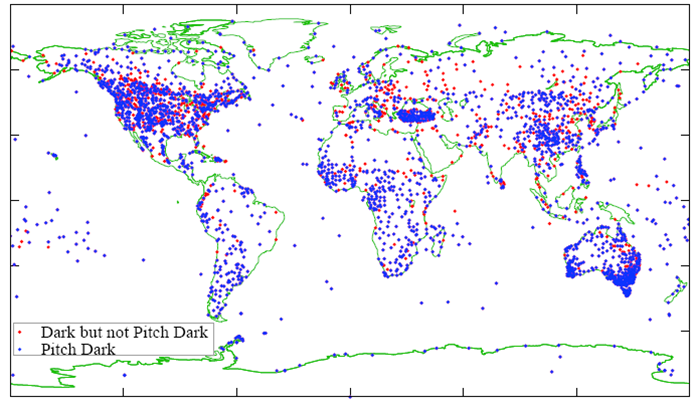
They did an even more rigorous test for this paper, to test just how much urban influences were contaminating the long-term trend, and it was pretty interesting.

There were enough stations considered “pitch-dark” at night, where they couldn’t detect any light, to run a global analysis all by themselves. The trend that came out was <0.01 °C/century smaller than GISS’s normal calculation, an amount of error that they described as “immeasurably small”.

The result of all this temperature analysis is a graph, with one new point every year, that is “eagerly awaited by some members of the public and the media”:

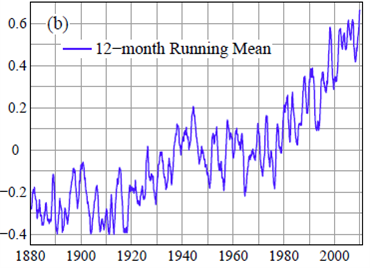
However, this graph isn’t actually as useful as this one – the 12-month running mean:

“From a climate standpoint there is nothing special about the time  of year at which the calendar begins”, so instead of only measuring January-December, you can also do February-January, March-February, and so on. This way, you get a data point every month instead of every year, and more data means more accuracy. It also solves problems with short-term influences, such as El Nino, La Nina, and volcanic eruptions, that the annual graph was having. These fleeting, but fairly substantial, influences can fall completely into one calendar year or be split between two – so their influence on global temperature could be overestimated or underestimated, depending on the starting month of the calendar. The 12-month running mean is much less misleading in this fashion.

As it is, we just set a new record for the 12-month running mean, and unless La Nina really takes off, 2010 will likely set a new record for the annual graph as well. But the authors argue that we need to start moving away from the annual graph, because it isn’t as useful.

The authors also discuss public perception of climate change, and media coverage of the issue. They say, “Our comments here about communication of this climate science to the public are our opinion…[We offer it] because it seems inappropriate to ignore the vast range of claims appearing in the media and in hopes that open discussion of these matters may help people distinguish the reality of global change sooner than would otherwise be the case.”

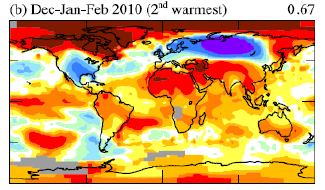
They make the very good point that “Lay people’s perception tends to be strongly influenced by the latest local fluctuation”, and use this winter as a case study, where a strongly negative Arctic Oscillation index caused significantly cooler-than-normal conditions across the United States and Europe. Consequently, a lot of people, especially in the US, began to doubt the reality of global warming – even though, in the world as a whole, it was the second warmest winter on record:

The authors also talk about data sharing. GISS likes to make everything freely available to the public – temperature station data, computer code, everything. However, putting it out there immediately, so that anyone can help check for flaws, has “a practical disadvantage: it allows any data flaws to be interpreted and misrepresented as machinations.” Multiple times in the past few years, when there have been minor errors that didn’t actually change anything, GISS was widely accused of making these mistakes deliberately, to “intentionally exaggerate the magnitude of global warming”. They realized this wasn’t working, so they changed their system: Before releasing the data to everyone, they first put it up on a private site so that only select scientists can examine it for flaws. And, of course, this “has resulted in the criticism that GISS now “hides” their data”.

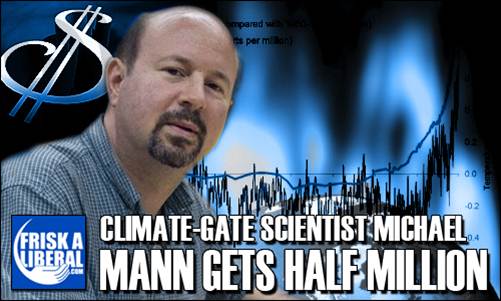
Personally, I find the range and prevalence of these accusations against scientists absolutely terrifying. Look at what has become mainstream:

Scientific fraud is a very serious allegation, and it’s one thing for citizens to make it without evidence, but it’s another thing altogether for the media to repeat such claims without first investigating their validity:

I have been disgusted by the media coverage of climate science, especially over the past year, especially in the United States, and I worry what this will mean for our ability to solve the problem.

However, there is still fantastic science going on that is absolutely fascinating and essential to our understanding of global climate change. This paper was a very interesting read, and it helped me to better understand a lot of aspects of global temperature analysis.

So What Happened with ClimateGate?

Remember back in December, when the news was buzzing each day about the stolen emails from top climate researchers? They were described as “the final nail in the coffin of anthropogenic global warming”, or worse. Apparently, the scientists had written things that severely compromised the underpinnings for the idea that human activity was causing the Earth to warm. We could now all stop worrying and forget about cap-and-trade.

But that wasn’t the end of the story. There were no less than four independent investigations into the contents of these emails – conducted by scientists, universities, and governments, not general reporters rushing off a story about an area of science with which they were unfamiliar, and trying to make it sound interesting and controversial in the process.

So what did these investigations find? Is the Earth still warming? Are humans still responsible? Can we trust the scientific process any more, or should we throw peer-review out the window and practice Blog Science instead?

Actually, all four of the investigations concluded that absolutely no science was compromised by the contents of the emails. The CRU scientists weren’t as good as they should have been about making data easily accessible to others, but that was the only real criticism. These scientists are not frauds, although they are accused of it on a daily basis.

Pennsylvania State University, over a series of two reports, investigated the actions of their employee, Dr. Michael Mann, who is arguably at the top of the field of paleoclimatology. They found that, contrary to most accounts in the mainstream media, he did not hide or manipulate any data to exaggerate global warming, delete any emails that might seem suspicious and be subject to Freedom of Information requests, or unjustly suppress skeptical papers from publication. After a second investigation, following up on the catch-all accusation of “seriously deviating from accepted practices within the academic community”, Penn State exonerated Mann. They criticized him for occasionally sharing unpublished manuscripts with his colleagues without first obtaining the express permission of the authors, but besides that minor (and somewhat unrelated) reprimand, they found absolutely nothing wrong.

The British House of Commons investigated the actions of CRU director Phil Jones, and came to a similar conclusion. They found that his “actions were in line with common practice in the climate science community”, that he was “not part of a systematic attempt to mislead” or “subvert the peer review process”, and that “the focus on CRU….has been largely misplaced”. They criticized CRU’s lack of openness with their data, but said that the responsibility should lie with the University of East Anglia, which CRU is a part of. So these scientists should really catch up to the climate research team at NASA, for example, which publishes all of their raw data, methodologies, and computer codes online, with impeccable archives.

The University of East Anglia conducted their own investigation into the actions of CRU as a whole. They found no hint of tailoring results to a particular agenda”, and asserted thatallegations of deliberate misrepresentation and unjustified selection of data are not valid”. They also explored the lack of transparency in CRU, but were more sympathetic. “CRU accepts with hindsight”, they write, “that they should have devoted more attention in the past to archiving data and algorithms and recording exactly what they did. At the time the work was done, they had no idea that these data would assume the importance they have today and that the Unit would have to answer detailed inquiries on earlier work.” They also note that CRU should not have had to respond to Freedom of Information requests for data which they did not own (such as weather station records).

Just last week, the final investigation, headed by Sir Muir Russell on behalf of UEA, found that “their rigour and honesty as scientists are not in doubt.” Is this starting to seem a bit repetitive? To illustrate their point, over the course of two days, they independently reconstructed the global temperature record using publicly available data, and came to the same conclusion as CRU. Again, there was the criticism that CRU was not as open as it should have been. They also noted that an obscure cover figure for a 1999 World Meteorological Organization report, constructed by Phil Jones, did not include enough caveats about what was proxy data and what was instrumental data. However, the more formally published, and much more iconic, graphs in Mann 98 and the IPCC TAR, were fine.

There have been some great comments on the results of these investigations since they were released, especially by scientists. Here are some samples:

[The CRU researchers] are honest, hardworking scientists whose reputations have been unjustifiably smeared by allegations of unscrupulous behaviour…I hope that the media will devote as much attention to this comprehensive dismissal of the allegations as it did to promoting the hysteria surrounding the email theft in the first place. Will the Daily Telegraph now retract its claim that the emails revealed “the greatest scientific scandal of our age” and apologize unreservedly to Phil Jones? Will there now be a public inquiry about the erroneous, shallow and repetitive nonsense promulgated in the media over this affair? If there is a scandal to be reported at all, it is this: the media stoked a controversy without properly investigating the issues, choosing to inflate trivialities to the level of an international scandal, without regard for the facts or individuals affected. This was a shameful chapter in the history of news reporting. -Raymond Bradley, director of the Climate System Research Center at the University of Massachusetts

The call for greater transparency and openness among scientists and their institutions is necessary and welcomed, but certainly they aren’t the only ones who deserve that reminder. What institution on the planet would pass muster under such intense scrutiny? Certainly not the U.S. government agencies, which often deny or impede FOIA requests, or global corporations like BP, Massey Energy and Koch Industries, which seem to revel in hiding information from the public all the time. More transparency is needed everywhere, not just among scientists in lab coats. -Brendan DeMelle, freelance journalist, DeSmogBlog

[The Muir-Russell report] makes a number of recommendations for improvements in processes and practices at the CRU, and so can be taken as mildly critical, especially of CRU governance. But in so doing, it never really acknowledges the problems a small research unit (varying between 3.5 to 5 FTE staff over the last decade) would have in finding the resources and funding to be an early adopter in open data and public communication, while somehow managing to do cutting edge research in its area of expertise too. -Steve Easterbrook, computer science professor at the University of Toronto

I agree with these statements. I think that we are holding scientists in general, but especially climate scientists, to a far higher standard than any other group of people in the world. We need to relax a bit and realize that scientists make mistakes, and that innocent mistakes are not evidence of fraud that will bring a long-standing theory tumbling down. We need to realize that scientists are employees like any others, who don’t always follow ideal actions in every professional situation, especially when they are under intense pressure that includes death threats and accusations of criminal activity.

However, at the same time, we need to start holding other groups of people, especially journalists, to a higher standard. Why has the media been able to get away with perpetuating serious allegations without first investigating the what really happened, and without publishing explicit retractions and apologies when the people whose reputations they smeared are found innocent? Why haven’t there been four official investigations into who stole these emails, and why?

A Quick Poll

I really enjoy books about climate change. When you’re as new to the subject as I am, they’re a great way to catch up on what is now common knowledge in the climate science community, and thus hasn’t been discussed recently in the peer-reviewed literature. I suppose I could also read the entire IPCC report to catch up, but that’s a little dry, to say the least.

Of course, this is assuming that the books actually reflect the peer-reviewed literature. Scientists in the field, like Andrew Weaver, Stephen Schneider, and Henry Pollack, write many of the popular books on climate change, so they’re pretty good about citing their sources. However, while tracking these down at the bookstore, one often encounters a lot of “Big Green and Global Warming Hysteria will Destroy our Freedoms and Create a Communist World Government!” publications.

All in all, though, I love this area of publishing. I frequently come out of the library with most of their climate science section under my arm, and now I’m frantically trying to finish reading before they realize how many times I’ve renewed some of the books. Exams got in the way of reading….

Here’s a quick poll – what’s your favourite book on climate change or climate science? Leave your responses in the comments, I’d love to read them.

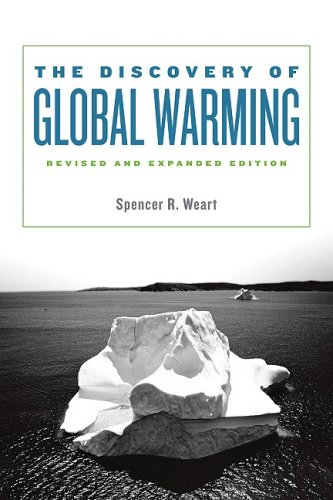
I think I would place The Discovery of Global Warming, by Spencer Weart, at the top of my list – read my recent review of it here. It’s basic enough to appeal to people new to the issue, while detailed and comprehensive enough for scientists and long-time enthusiasts to enjoy. It contains as much information as a textbook, but is written like a compelling novel. Highly recommended to all.

All Is Not Lost

I really enjoyed reading two recent polls conducted by George Mason University’s Center for Climate Communication. In particular, the results made me wonder why the US government still hasn’t passed a climate bill.

For example, US presidents have been saying for over a decade that it is unfair to force their industries to reduce emissions if developing countries do not have similar targets. However, only 8% of American adults share this view, and 65% believe that “the United States should reduce its greenhouse gas emissions regardless of what other countries do.” 77% agree that CO2 should be regulated, and 65% would like to see an international treaty signed.

The only solution which had less than 50% support was a tax on gasoline, even if it was revenue-neutral: offset by a decrease in income tax rates. This opposition can’t really be a case of people worrying about money. In this hypothetical situation, taxes aren’t being increased – they’re just being moved around, in a way that actually gives people more control over how much they are charged. Perhaps the public would prefer a more laissez-faire approach, or perhaps they had a knee-jerk reaction to the word “tax”. It’s not like the revenue-neutral aspect of this solution is well-known to most.

When the poll was broken down by political party, there were some surprising results that ran contrary to what one hears in the halls of Congress. 64% of Republicans support regulating CO2. Only 30% think that protecting the environment reduces economic growth and costs jobs.

Overall, the poll showed very strong support among Americans for action that still hasn’t happened, largely because a very vocal minority has had a disproportionate influence on the policy debate. If there was a referendum today, Kyoto targets and the cap-and-trade bill would pass with flying colours.

This support was even more interesting when compared to the questions regarding science. Only 61% of Americans think that the Earth is warming, and only 50% think that it is due to human activities. 45% think “there is a lot of disagreement among scientists about whether or not global warming is happening”, and only 34% were aware of the existing consensus.

The discrepancy between scientific understanding of the issue and support for mitigation shows that Americans, in general, practice risk management when it comes to climate change. Even if they’re not sure whether or not there is a problem, they understand what is at risk, and are willing to take action to prevent major consequences. Greg Craven, you got your wish.

I think that the misconception of a voracious scientific debate, apart from being perpetrated by the media, stems partly from the fact that most of the public lacks the experience to distinguish between scientific and quasi-scientific debates. Competing hypotheses, published in leading journals, seen as the frontier of the field….that’s a scientific debate. Editorials, written by anyone other than a scientist publishing in the field, claiming to refute an overwhelming consensus? Can’t even come close. However, I suspect that many would categorize the second as “scientific debate”, simply because it’s their only encounter with science.

All is not lost, though. 81% of Americans trust scientists as a source of information about global warming. That’s more than they trust any other source that was mentioned in the question. And 20%, 27%, and 29% say that they need a lot more, some more, or a little more information, respectively. Maybe all that needs to happen is for us to speak louder – because people are ready and willing to listen.

The Discovery of Global Warming

A common remark I make about climate change books I like is that “it wasn’t like a textbook”. I like non-fiction books that I can carry around and read cover-to-cover just like I would a novel. I like them to draw me in and catch my interest as if they were a suspenseful PD James or just a comfortable Maeve Binchy.

The Discovery of Global Warming, by Spencer Weart, had all of these qualities and more: It contained as much information as a textbook, even if it didn’t read like one. That, I think, is the benefit of science history. It can be written in a way that is compelling as fiction, but it’s all true.

I think I will place this book near the top of my list of resources for concerned citizens who are looking for more information on climate change. It is so helpful because, instead of saying “scientists are confident that humans are causing the Earth to warm”, it traces back through history and follows this discovery all the way through, from Fourier to the AR4. We see the top of the credibility spectrum in action, and examine exactly where the conclusions of the scientific community came from.

There are lots of great details in this book to sink your teeth into. How did the Cold War pave the way for much of our knowledge about the atmosphere? Why does chaos theory apply to weather models much more than climate models? And, of course, my very favourite – the 1970s aerosol debate. How did scientists realize that the warming force of greenhouse gases would overpower the cooling force of aerosols, long before the warming was actually observed?

All of this is written in an incredibly elegant and engaging tone. Weart’s style of writing somehow reminds me of Sir Arthur Conan Doyle in The Lost World – succinct characterization, unintended (or just well-hidden) satire, a calm detachment from the story that somehow makes it all the more fascinating.

I read the “Revised and Expanded Edition”, so I’m not sure if all editions of The Discovery of Global Warming contain all the extras in the back: a timeline, an index, and a chapter entitled “Reflections” that is full of Weart’s musings about risk management and science communication. “Unlike, say, the orbits of planets,” he writes, “the climate in the future actually does depend in part on what we think about it. For what we think will determine what we do.”

A tangible alternative to the more comprehensive online version (really, who wants to read a book by navigating a web of links and scrolling through chapters on a computer screen?), The Discovery of Global Warming is worth every cent, and every minute of your time it takes to read it. I look forward to future volumes as this story continues to unfold.

The Celebrity Phenomenon

It is a very small subset of people that actually reads the scientific literature on climate change.

Even publishing scientists don’t usually follow research outside of their field. Few of us climate science enthusiasts read about the role of low hepatic copper concentrations in nonalcoholic fatty liver disease, so why should we be surprised when medical researchers, flipping through Nature, don’t stop to read about the sea level during the last interglacial and its relevance to today?

For the 99% of us who are not publishing scientists in any area, and do not have a subscription to Nature, and don’t really find it too riveting anyway, we get all of our climate science news from the media. The mainstream media is generally mediocre when it comes to reporting science, but when it comes to climate science they do an abysmal job.

Many people know this – you shouldn’t trust the media, especially when it comes to stories of impending disaster.  You should take every such story with a grain of salt. However, it’s no good to stop there, and never do any research into its validity. Because what if it’s actually true? Then you’ll just be shrugging it off and going “maybe, maybe not” for no reason.

This happens a lot with celebrity climate science communicators, like Al Gore, or, in Canada, David Suzuki.

I’ve written about Al Gore before, and the important thing to stress is that he doesn’t matter. In general, his communication of climate science is very accurate – he has a few minor errors in his book and movie, but the overarching message that humans are causing dangerous warming of the planet is fully supported by science.

But it couldn’t matter less if Al Gore was or wasn’t telling the truth, because absolutely no scientific research rests on him. He hasn’t published any peer-reviewed papers about anything even remotely related to climate. He is purely a communicator.

A lot of people don’t like Al Gore, and therefore think that global warming is bunk. This kind of reasoning is very unfortunate. They recognize that they are hearing scientific information from a partisan source, so they assume that it’s wrong without researching what credible, nonpartisan sources say about it. All you need is a credibility spectrum, and you’re good to go.

There’s somewhat less of a problem when it comes to David Suzuki – after all, he’s not a former politician, he has more scientific training (a biology doctorate) than Gore, and according to a Reader’s Digest poll, Canadians trust him more than any other celebrity. It’s still easy, though, to find people who don’t like him for one reason or another. If it comes from David Suzuki, it has to be an extremist environmental craze, so they brush off what he says without looking at more credible sources.

Celebrities like Gore and Suzuki don’t matter. What matters, though, is people with severely limited knowledge of the scientific process, access to credible sources, or motivation to do a little research. What matters is the factors shaping society that have allowed so many of us to be this way. Why do schools frame science as answers, not questions? Why is literature vital to public communication hidden behind paywalls? And why do so many people assume that entire fields of science are dependent on one or two celebrity communicators?