Unknown's avatar

About climatesight

Kaitlin Naughten is an ocean-ice modeller at the British Antarctic Survey in Cambridge.

An Unmeasured Forcing

“It is remarkable and untenable that the second largest forcing
that drives global climate change remains unmeasured,” writes Dr. James Hansen, the head of NASA’s climate change research team, and arguably the world’s top climatologist.

The word “forcing” refers to a factor, such as changes in the Sun’s output or in atmospheric composition, that exerts a warming or cooling influence on the Earth’s climate. The climate doesn’t magically change for no reason – it is always driven by something. Scientists measure these forcings in Watts per square metre – imagine a Christmas tree lightbulb over every square metre of the Earth’s surface, and you have 1 W/m2 of positive forcing.

Currently, the largest forcing on the Earth’s climate is that of increasing greenhouse gases from burning fossil fuels. These exert a positive, or warming, forcing, hence the term “global warming”. However, a portion of this positive forcing is being cancelled out by the second-largest forcing, which is also anthropogenic. Many forms of air pollution, collectively known as aerosols, exert a negative (cooling) forcing on the Earth’s climate. They do this in two ways: the direct albedo effect (scattering solar radiation so it never reaches the planet), and the indirect albedo effect (providing surfaces for clouds to form and scatter radiation by themselves). A large positive forcing and a medium negative forcing sums out to a moderate increase in global temperatures.

Unfortunately, a catch-22 exists with aerosols. As many aerosols are directly harmful to human health, the world is beginning to regulate them through legislation such as the American Clean Air Act. As this pollution decreases, its detrimental health effects will lessen, but so will its ability to partially cancel out global warming.

The problem is that we don’t know how much warming the aerosols are cancelling – that is, we don’t know the magnitude of the forcing. So, if all air pollution ceased tomorrow, the world could experience a small jump in net forcing, or a large jump. Global warming would suddenly become much worse, but we don’t know just how much.

The forcing from greenhouse gases is known with a high degree of accuracy – it’s just under 3 W/m2. However, all we know about aerosol forcing is that it’s somewhere around -1 or -2 W/m2 – an estimate is the best we can do. The reason for this dichotomy lies in the ease of measurement. Greenhouse gases last a long time (on the order of centuries) in the atmosphere, and mix through the air, moving towards a uniform concentration. An air sample from a remote area of the world, such as Antarctica or parts of Hawaii, will be uncontaminated by cars and factories nearby, and will contain an accurate value of the global atmospheric carbon dioxide concentration (the same can be done for other greenhouse gases, such as methane) . From these measurements, molecular physics can tell us how large the forcing is. Direct records of carbon dioxide concentrations have been kept since the late 1950s:

However, aerosols only stay in the troposphere for a few days, as precipitation washes them out of the air. For this reason, they don’t have time to disperse evenly, and measurements are not so simple. The only way to gain accurate measurements of their concentrations is with a satellite. NASA recently launched the Glory satellite for just this purpose. Unfortunately, it failed to reach orbit (an inherent risk for satellites), and given the current political climate in the United States, it seems overly optimistic to hope for funding for a new one any time soon. Luckily, if this project was carried out by the private sector, without the need for money-draining government review panels, James Hansen estimates that it could be achieved with a budget of around $100 million.

An accurate value for aerosol forcing can only be achieved with accurate measurements of aerosol concentration. Knowing this forcing would be immensely helpful for climate researchers, as it impacts not only the amount of warming we can expect, but also how long it will take to play out, until the planet reaches thermal equilibrium. Aimed with better knowledge of these details will allow policymakers to better plan for the future, regarding both mitigation of and adaptation to climate change. Finally measuring the impact of aerosols, instead of just estimating, could give our understanding of the climate system the biggest bang for its buck.


Where Activism Fails

Cross-posted from NextGen Journal

This weekend, 10 000 young people converged in Washington, D.C. and protested the American government’s inaction on climate change. Students stood in front of government buildings wearing green hard hats, holding signs saying “Make Polluters Pay, Not the EPA”. Students stormed the House of Representatives and sang a song about climate change, to the tune of the American national anthem. Fifteen minutes with President Obama, who agreed with their concerns but said “I can’t do this alone”, was PowerShift 2011’s biggest accomplishment.

This isn’t working.

The climate change mitigation lobby is currently a fringe group, at least in North America. It’s mostly made up of university students who mimic the campus protests of the 1960s, creating images that scream “socialism” to baby boomers who witnessed the original events. Governments, which are mostly made up of said baby boomers, largely ignore such fringe groups. Elected officials say what they think people want to hear, and most people don’t seem to care about climate change.

So what should we do instead? We don’t have a lot of money or connections to wealthy businesses. Youth don’t even vote in large enough numbers for governments to care what they want. What we do have, however, are facts on our side. We have the weight of the entire scientific community, agreeing that humans are causing a potentially catastrophic climate change which will only be stopped by major international action.

Instead of attempting to communicate with elected officials by marching around in front of their offices with our faces painted, I think we should focus our efforts on the public. If governments think people don’t care about climate change, we have to reverse that trend.

I believe that anyone who truly understands this issue will care about it and want to fix it. Who could honestly examine the overwhelming evidence for anthropogenic climate change and still have reasonable doubts about its existence? Who wouldn’t want to prevent future wars, famines, extinctions, and waves of environmental refugees? Of course, there are the crazies who will scream about “climate scientists in Al Gore’s pocket” and “the world needs more CO2” no matter what we tell them, but we shouldn’t bother engaging with these people. Instead, we should engage with those who are constantly exposed to the crazies, and who are at risk of dismissing climate change because they think people are still debating its existence.

We need public education to create a social movement, but not like the “Green Movement” in 2007 when magazines everywhere advertised “10 easy ways to reduce your carbon footprint”. We need people to understand the severity of climate change, and to see that planting a tree and buying organic lettuce will not solve the problem. We need people to understand that meaningful action, such as putting a price on carbon, is necessary to solve the problem.

Climate change education will spread most easily through the media, whether it is mass media or new media. People need to be aware of the level of scientific support surrounding this issue, and the reality that climate scientists are not ignorant or fraudulent. Researchers know that correlation does not equal causation, and they know that the climate has changed in the past. Many people still take these arguments seriously, though, because they are thrown around and not challenged. We need to challenge the media outlets that have spread dangerous, libelous misinformation regarding climate change for years. We need to challenge them on the level of lawsuits, not on the level of writing letters to the editor.

It is vital to engage with the apathetic and show them why they should care. Apathetic youth are particularly problematic. Why should the government care about the needs of the next generation when most of its members don’t even vote? We have to make the youth vote strong enough that political parties will compete for its support, just like they do with the ethnic vote and the women’s vote. As Canadian comedian and political analyst Rick Mercer said, “If you are between the ages of 18 and 25, and want to scare the hell out of the people who run this country – this time around, do the unexpected: vote.”

When faced with a depressing reality, many will turn away and ignore the problem. However, the only way to prevent the scary stuff from happening is to suck it up and face it. Just because we wasted 20 years of potential action and got ourselves into a bad situation doesn’t mean we should throw up our hands and give up. It’s never too late to act, because this bad situation can always get worse if we let it.

Climate Change Communicator of the Year Award

There’s just over a week left to vote in the Climate Change Communicator of the Year awards, run by the Centre for Climate Change Communication at George Mason University.

There are several familiar names among the nominees, including meteorology professor and frequent ClimateSight commenter Scott Mandia, the ever-brilliant Naomi Oreskes, and the growing organization of Skeptical Science.

Voting is quick and easy, and only requires an email address. Please be sure to cast your vote before April 15th and support the community!

The Rest of the World

Here in North America, we are surrounded with rhetoric denouncing the feasibility of climate change mitigation. It’s not possible to reduce our emissions, people say. It’s not worth it.

The situation in the U.S. Congress regarding this issue is becoming so bizarre that hopes for an international agreement to reduce greenhouse gas emissions have grown faint. Without the U.S. on board, many countries (see: Canada) will bail out entirely.

Not all countries are waiting for everyone else, however. Many developed countries, particularly in Europe, have gone ahead and achieved significant cuts in their emissions. Let’s take a step out of the little bubble of North America and see what the rest of the world managed to do while we bickered about whether or not there was even a problem.

***

Countries: the European Union (EU), representing most of Europe

Emission Targets: 20% below 1990 levels by 2020

How They’ll Get There: The EU started a cap-and-trade system in 2005. They also plan to target energy efficiency and develop the use of renewable energy.

How They’re Doing : The total emissions of the EU have declined slightly since 1990. This is partly because many Eastern European countries are still transitioning from communism, and their emissions are fairly low while their economies recover. However, some rich countries such as Germany, Sweden, Denmark, and the UK have made significant cuts in their emissions, and, as of 2008, were already around 10-20% below 1990 levels.

***

Country: the United Kingdom (UK)

Emission Targets: 12.5% below 1990 levels by 2012, as per their Kyoto targets. Through their Climate Change Acts, the UK has also set a goal of 80% below 1990 levels by 2050.

How They’ll Get There: The government is aiming for 40% of their energy to come from low-carbon sources (both renewable and nuclear). They are also focusing on efficiency, and planning a cap-and-trade system.

How They’re Doing: The UK is well on track to meet, and even exceed, their Kyoto agreements. By 2010, their emissions were predicted to be 11% below their Kyoto targets.

***

Country: Norway

Emission Targets: Norway has some of the most ambitious targets in the world. Not only are they aiming for emissions to be 30% below 1990 levels by 2020, they are planning a carbon-neutral economy – 100% cuts – by 2050. If a major international agreement comes to pass, like Copenhagen was supposed to be, they will pledge for carbon neutrality by 2030.

How They’ll Get There: In addition to their cap and trade system, Norway is investing a lot of money into carbon capture and storage (CCS). They have also introduced taxes on natural gas and stricter efficiency standards for new houses.

How They’re Doing: Norway’s emissions have increased by 8% since 1990. Hopefully their extensive plans will reverse that trend.

***

Country: Australia

Emission targets: If an international agreement comes to pass, Australia will reduce their emissions to 25% below 2000 levels by 2020. Otherwise, they will shift that target to 5-15%. Normally, using a baseline that’s later than the standard 1990 is a warning sign, a clever trick that governments use to make their targets look stricter than they are (see: Canada). However, since Australia’s emissions fell slightly between 1990 and 2000, the equivalent target with respect to 1990 is actually more than 25%.

How They’ll Get There: The Australian Parliament has had difficulty passing cap-and-trade legislation. They are hoping to implement this eventually, but will focus on energy efficiency and renewables in the mean time.

How They’re Doing: Originally, Australia refused to sign Kyoto, but in 2007 a new Prime Minister, Kevin Rudd, was elected. He committed the country to Kyoto targets, just a little late. So far, it looks like Australia will easily meet their targets of 8% over 1990 levels by 2012.

***

Country: Japan

Emission targets: Japan has set solid targets of 25% below 1990 levels by 2020, and 80% by 2050.

How They’ll Get There: Japan has a cap-and-trade system, and is considering a carbon tax. They also want 10% of their energy to come from renewables by 2020.

How They’re Doing: Japan’s emissions have increased slightly since 1990. As of 2008, they were about 6% above 1990 levels.

***

Country: Canada

Emission targets: The Canadian government has pledged to reduce emissions to 17% below 2005 levels by 2020. However, emissions in 2005 were quite a bit higher than they were in 1990. When you adjust this estimate to the standard baseline, it’s actually a 2.5% increase. The Environment Canada website describes this as an “ambitious target”. Go figure!

How They’ll Get There: So far, the Canadian government has tightened up fuel efficiency standards for passenger vehicles, but that’s about it. The current administration refuses to consider meaningful action until the United States does. In fact, the House of Commons recently passed a bill setting meaningful emission targets (20% below 1990 levels by 2020, and 80% by 2050)…but the Senate, which has a Conservative majority, voted the bill down with absolutely no debate. Given the fact that Senators are appointed by Prime Ministers, not elected by citizens, it’s hard to see this action as anything less than anti-democratic.

How They’re Doing:By 2008, Canadian emissions had soared to 24% above 1990 levels.

***

This data almost makes me feel ashamed to be Canadian, to be a part of such an obstructionist country. Look at what countries in Europe have managed to do. It wasn’t impossible, like so many North American politicians warned. And then look at countries like the United States and Canada, that have not only failed to reduce their emissions, but have actively worked against any kind of a plan to do so.

Future generations will not look on us kindly. We will become the villains of our own history books.

***

Update: By popular request:

Country: United States of America

Emission targets: None

How They’ll Get There: Despite not having a formal target for emissions, the Environmental Protection Agency (EPA) began to regulate emissions from fossil-fuel fired power plants and refineries in late December. The Republican Party is resorting to all sorts of silliness to try to change this.

How They’re Doing: As of 2008, US emissions were 14% above 1990 levels.

Ozone Depletion and Climate Change

“Global warming…doesn’t that have something to do with the ozone?” Well, no. Environmental issues are not all the same. It’s common for people to confuse climate change and ozone depletion, but they are separate issues – although they are indirectly connected in some interesting ways.

Ozone, which is made of three oxygen atoms stuck together (instead of two, which is what normal oxygen gas is made of), is vital to life on Earth. It forms a layer in the stratosphere, the second layer up in the atmosphere, that is very good at absorbing ultraviolet (UV) radiation from the Sun. UV radiation severely damages organisms if enough of it reaches the surface. The 3% or less that gets through the ozone already gives us sunburns and skin cancer, so you can imagine what the situation would be like if the ozone layer wasn’t there at all.

In the middle of the 20th century, synthetic gases known as chlorofluorocarbons (CFCs) became popular for use in refrigerators and aerosol products, among other applications. They were non-toxic, and did not react easily with other substances, so they were used widely. However, their chemical stability allowed them to last long enough to drift into the stratosphere after they were emitted.

Once in the stratosphere, the CFCs were exposed to UV radiation, which was able to break them down. Free chlorine atoms (Cl) were liberated, a substance that is very reactive indeed. In fact, Cl acts as a catalyst in the decomposition of ozone, allowing two ozone molecules to become three oxygen molecules, losing their UV absorbing power in the process. Since catalysts are not used up in a reaction, the same Cl radical can continue to destroy ozone until it reacts with something else in the atmosphere and is removed.

Over the poles, the stratosphere is cold enough for polar stratospheric clouds (PSCs) to form. These PSCs provided optimum conditions for the most reactive chlorine gas of all to form: ClO (chlorine monoxide). Now there wasn’t just a catalytic cycle of free Cl radicals depleting the ozone, there was also a cycle of ClO. It turns out that Antarctica was more favourable for ozone depletion than the Arctic, both because its temperatures were lower and because its system of wind currents prevented the ozone-depleting substances from drifting out of the area.

Before long, there was a hole in the ozone layer over Antarctica (due to the PSCs), and concentrations were declining in other locations too (due to the basic Cl reactions). The issue became a frontier for scientific research, and scientists Crutzen, Rowland, and Molina won the 1995 Nobel Prize in Chemistry for their work with atmospheric ozone.

In 1987, politicians worldwide decided to ban CFCs under the Montreal Protocol. This movement was largely successful, and the use of CFCs has become nearly negligible, especially in developed nations. They have been replaced with gases that safely decompose before they reach the stratosphere, so they don’t interfere with ozone. The regulations are working: the ozone hole in Antarctica has stabilized, and global stratospheric ozone concentrations have been on the rise since 1993.

In contrast, climate change is a product of greenhouse gases such as carbon dioxide. Unlike CFCs, most of them are not synthetic, and they are released from the burning of fossil fuels (coal, oil, and natural gas), not specific products such as refrigerators. Rather than destroying a natural process, like CFCs do, they strengthen one to the point of harm: the greenhouse effect. This phenomenon, which traps heat in the atmosphere, is absolutely vital, as the Earth would be too cold to support life without it. Increasing the concentrations of greenhouse gases with fossil fuels becomes too much of a good thing, though, as the greenhouse effect traps more heat, warming the planet up.

Just a few degrees Celsius of warming can cause major problems, as agricultural zones, wind and ocean currents, and precipitation patterns shift. The sea level rises, submerging coastal cities. Many species go extinct, as the climate changes faster than they can adapt. Basically, the definition of “normal” in which our civilization has developed and thrived is changing, and we can’t count on that stability any more.

Unlike the Montreal Protocol, efforts to reduce greenhouse gas emissions have more or less failed. Fossil fuels permeate every part of our lives, and until we shift the economy to run on clean energy instead, convincing governments to commit to reductions will be difficult at best. It remains to be seen whether or not we can successfully address this problem, like we did with ozone depletion.

Although these two issues are separate, they have some interesting connections. For example, PSCs form in cold areas of the stratosphere. That’s why the ozone hole is over Antarctica, and not somewhere else. Unfortunately, global warming is, paradoxically, cooling the stratosphere, as a stronger greenhouse effect means that less heat reaches the stratosphere. Therefore, as climate change progresses, it will make it easier for the ozone depletion reactions to occur, even though there are fewer CFCs.

Additionally, CFCs are very strong greenhouse gases, but their use has drastically reduced so their radiative effects are of lesser concern to us. However, some of their replacements, HFCs, are greenhouse gases of similar strength. They don’t deplete the ozone, but, per molecule, they can be thousands of times stronger than carbon dioxide at trapping heat. Currently, their atmospheric concentrations are low enough that they contribute far less forcing than carbon dioxide, but it wouldn’t take a large increase in HFCs to put us in a bad situation, simply because they are so potent.

Finally, these two issues are similar in that ozone depletion provides a smaller-scale analogue for the kinds of political and economic changes we will have to make to address climate change:

  1. Unintended chemical side effects of our economy posed a serious threat to all species, including our own.
  2. Industry representatives and free-market fundamentalists fought tooth and nail against conclusive scientific findings, and the public became bewildered in a sea of misinformation.
  3. Governments worked together to find sensible alternatives and more or less solved the problem.

We’ve already seen the first two events happen with climate change. Will we see the third as well?

In Other News…

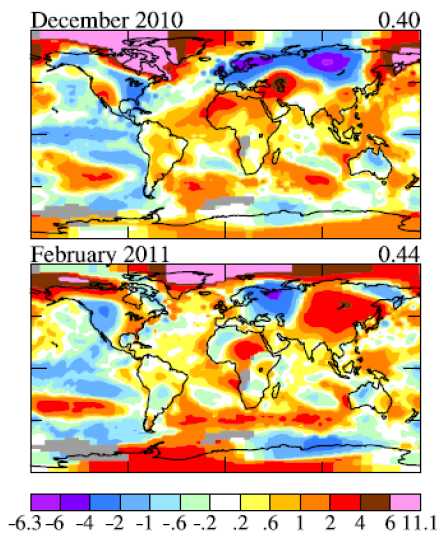
The Arctic is getting so warm in winter that James Hansen had to add a new colour to the standard legend – pink, which is even warmer than dark red:

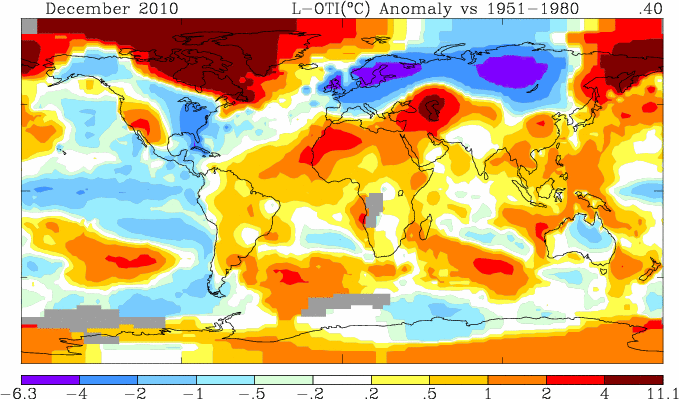
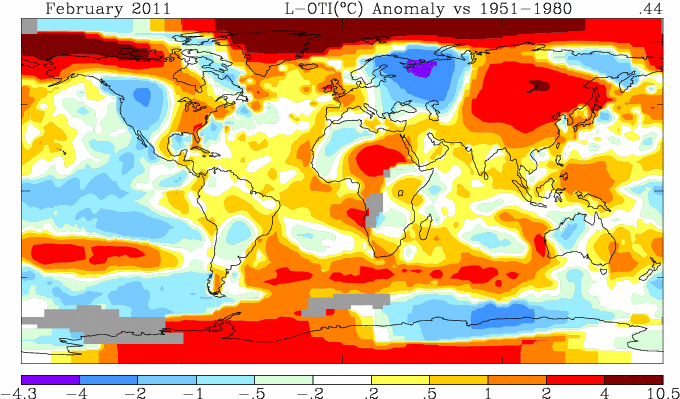
The official NASA maps – the ones you can generate yourself – didn’t add this new colour, though. They simply extended the range of dark red on the legend to whatever the maximum anomaly is – in some cases, as much as 11.1 C:

The legend goes up in small, smooth steps: a range of 0.3 C, 0.5 C, 1 C, 2 C. Then, suddenly, 6 or 7 C.

I’m sure this is a result of algorithms that haven’t been updated to accommodate such extreme anomalies. However, since very few people examine the legend beyond recognizing that red is warm and blue is cold, the current legend seems sort of misleading. Am I the only one who feels this way?

Legislating Scientific Truth

Cross-posted from NextGen Journal

Scientific statements rely on uncertainty and error bars. If our understanding changes, the scientific consensus changes accordingly, in a more or less implicit manner. There’s no official process that needs to be followed to update our knowledge.

Laws passed by governments work in the opposite way. Official technicalities are paramount, and acknowledgements that the government’s understanding could be wrong are rare.

Why, then, are attempts to legislate scientific truth – an archaic practice to any reasonable person – becoming far more common in the United States?

One of the most early, and infamous, incidents of this manner occurred in 1897, when the government of Indiana attempted to legislate the value of pi (∏). The text of the bill, describing a circle, clearly says “the ratio of the diameter and circumference is as five-fourths to four”. If you do a bit of simple fractional algebra, this comes out to ∏ = 3.2, rather than 3.1415952…and so on. The scary part is that this bill passed the House without a single nay vote. Luckily, it was postponed in the Senate indefinitely.

More recently – in fact, just last month – Joe Read, a member of the Montana House of Representatives, penned a bill that is equally disturbing. Let’s take a look at what he is planning to turn into state law:

“The legislature finds:

(a) global warming is beneficial to the welfare and business climate of Montana;

(b) reasonable amounts of carbon dioxide released into the atmosphere have no verifiable impacts on the environment; and

(c) global warming is a natural occurrence and human activity has not accelerated it.”

At least ∏ = 3.2 was moderately close to the correct value. This bill, however, proclaims exactly the opposite of what the scientific consensus tells us. I would argue that it is even more dangerous. A fundamental constant that is 0.1 or so inaccurate could cause a couple buildings to fall down in Indiana, but a law that orders the government to believe the opposite of what the scientific community says – a law that outright denies any possibility of a problem which, if not addressed, will likely harm the citizens of Montana for generations to come – could cause political ripples leading to mass destruction.

It looks like a case of government officials burying their heads in the sand, refusing to acknowledge a problem because the solutions are politically problematic. The physical world, though, does not obey the Thomas Theorem, a sociological theory of self-fulfilling prophecies. No matter how passionately people like Joe Read believe that climate change is natural/nonexistent/a global conspiracy, the problem won’t go away. In fact, it’s more of an inverse prophecy: if enough politicians refuse to acknowledge the reality of climate change, no action will be taken to address it, and the problem will get worse. It doesn’t seem like Joe Read et al have thought through this line of logic, though. Peter Sinclair wittily describes their mindset as “[s]o simple. Just pass a law. Command the seas to stop rising.”

Dana Nuccitelli goes one step further, claiming “Republicans have decided that they can repeal the laws of physics with the laws of the USA”. In this instance, he is referring to a second, similar, bill that the Republican Party is attempting to pass, this time at the federal level. Basically, Republicans are desperate to prevent the Environmental Protection Agency (EPA) from regulating  greenhouse gas emissions – which they have the authority to do, under the Clean Air Act, as they can “reasonably be anticipated to endanger public health or welfare”.

There are two ways to take away this responsibility of the EPA. First, Congress could create a system of their own to control emissions, such as cap-and-trade or a carbon tax – both more capitalist than standard regulation. Republicans aren’t too chuffed about this option, as they don’t want to have to control emissions at all. So they are invoking desperate measures by choosing the second option: if greenhouse gases were found to no longer pose a danger, regulation by the EPA would be unnecessary.

Legitimately reaching this conclusion would call over a century’s worth of physics and chemistry into question. If they could actually do it, the Republicans would probably win a Nobel Prize. Apparently, though, they aren’t interested in legitimacy. The “Energy Tax Prevention Act of 2011”, by Members of Congress Fred Upton and James Inhofe, claims to overturn the EPA’s endangerment finding and, therefore, takes away their authority to regulate greenhouse gases. The justification for such an unusual scientific finding consisted of a couple of testimonies from climate change deniers, spouting out the usual long-debunked myths that scientists thought of, considered, and ruled out long before you and I even knew what global warming was. They offered no new information.

Ed Markey, the Representative from Massachusetts, took the opportunity to openly wonder what field of science Republicans will “excommunicate” next: will it be gravity, the heliocentric solar system, or special relativity? Watch and listen to his brief remarks. (Aside: I am amazed at how quiet and civil the House of Congress is. In Canada, Members of Parliament from opposing parties like to shout and pound their desks when others make speeches.)

http://www.youtube.com/watch?v=QHVrE1NTgxI&feature=player_embedded

The Democrats on the House Energy and Commerce Committee invoked amendments to this bill that, instead of repealing the scientific consensus, acknowledged it:

Congress accepts the scientific finding … that “warming of the climate system is unequivocal”; that the scientific evidence regarding climate change “is compelling”; and that “human-caused climate change is a threat to public health and welfare.”

Zero Republicans on the committee voted in favour of these amendments. Why am I not surprised?

I wouldn’t place these words of legislation in the same category as the others. Instead of saying “this is how the physical world works”, the amendments state, “we, as politicians, accept what our scientists tell us.” Most importantly, the Members of Congress aren’t trying to outsmart experts in a field in which they have no experience.

However, I agree with Henry Waxman, the Representative from California, who says that such amendments shouldn’t be necessary – not because they’re wrong, but because the “finding is so obviously correct”. To me, governments accepting what their scientists tell them is the null hypothesis. The idea of politicians stamping down ideas that they don’t like, by attempting to legislate scientific truth, seems unspeakably bizarre. How did the most powerful and developed nation in the world reach this point?

Nuclear Power in Context

Since its birth, nuclear power has been a target of environmental activism. To be fair, when nuclear power goes wrong, it goes wrong in a bad way. Take a look at what’s happening in Japan right now. Friday’s tsumani damaged the Fukushima Daiichi power plant, and several of its reactors have experienced partial meltdowns. Radiation from the nuclear reactions has been released into the surrounding environment, and could endanger public health in the immediate area, causing cancer and birth defects.

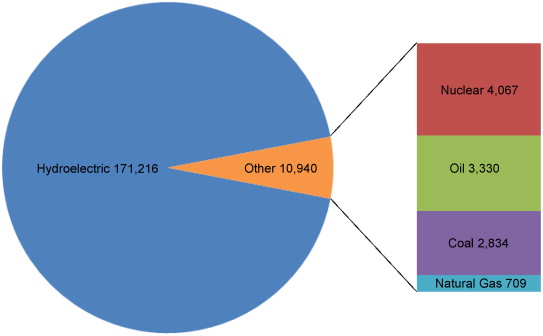
Nuclear disasters are horrifying, and this is by no means the worst that has happened. However, nuclear isn’t the only form of energy that experiences periodic disasters. In fact, over the past century, hydroelectric disasters have killed more people than all other forms of energy disasters combined.

(Sovacool et al, 2008, Fig. 1).

So why do we worry so much more about nuclear power disasters? Is it because the idea of the resulting radiation is more disturbing than the prospect of a dam breaking, even if it’s far less common?

However, an energy source can kill people without a large-scale disaster occurring. Let’s look at fossil fuels. Think of all the miners killed by coal accidents, all the people killed by smog inhalation or exposure to toxic chemicals (such as heavy metals) that are present in fossil fuels, deaths due to gas leaks, civilians killed by wars over oil, and so on. It’s difficult to quantify these numbers, because fossil fuels have been in use for centuries, but they clearly exceed the 4,000 or so deaths due to nuclear power accidents (as well as any other deaths due to nuclear power, such as uranium mining).

We must also look at the deaths due to climate change, which fossil fuel burning has induced. The World Health Organization estimates that over 150 000 people died as a result of climate change in 2000 alone. This annual rate will increase as the warming progresses. If we don’t step away from fossil fuels in time, they could lead to a devastating amount of death and suffering.

Fossil fuels are silent, passive, indirect killers which end up being far more destructive to human life than nuclear power. However, much of the public remains opposed to nuclear energy, and I believe this is a case of “letting perfect be the enemy of good”. I feel that we hold nuclear power to an impossible standard, that we expect it to be perfect. It’s certainly not perfect, but it’s far better than the existing system, which desperately needs to be replaced.

There are also exciting developments in nuclear technology that could make it safer and more efficient. In his recent book, top climatologist James Hansen described “fast reactors“, which are a vast improvement over the previous generations of nuclear reactors. It’s also possible to use uranium-238 as fuel, which makes up 99.3% of all natural uranium, and is usually thrown away as nuclear waste because reactors aren’t equipped to use it. Another alternative is to use thorium, a safer and more common element. If we pursue these technologies, the major downsides of nuclear power – safety and waste concerns – could diminish substantially.

Renewable sources of energy, such as solar, wind, and geothermal, are safer than nuclear power, and also have a lower carbon footprint per kWh (Sovacool, 2008b, Table 8). They are clearly the ideal choice in the long run, but they can’t solve the problem completely, at least not yet. Cost is a barrier, as is the problem of storing and transporting the electricity they generate. Maybe a few decades down the line smart grids will become a reality, and we will be able to have an energy economy that is fully renewable. If we wait for that perfect situation before doing anything, though, we will overshoot and cause far more climate change than we can deal with.

I don’t know if I would describe myself as “pro-nuclear”, but I am definitely “anti-fossil-fuel”. I am aware of the risks nuclear power poses, and feel that, from a risk management perspective, it is still preferable to coal and oil by a long shot. Solving climate change will require a multi-faceted energy economy, and it would be foolish to rule out one viable option simply because it isn’t perfect.

Technology as Communication

The relationship between technology and climate change is complex and multi-faceted. It was technology, in the form of fossil fuel combustion, that got us into this problem. Many uninformed politicians hold out hope that technology will miraculously save us in the future, so we can continue burning fossil fuels at our current rate. However, if we keep going along with such an attitude, risky geoengineering technologies may be required to keep the warming at a tolerable level.

However, we should never throw our hands in the air and give up, because we can always prevent the warming from getting worse. 2 C warming would be bad, but 3 or 4 C would be much worse, and 5 or 6 C would be devastating. We already possess many low-carbon, or even zero-carbon, forms of energy that could begin to replace the fossil fuel economy. The only thing missing is political will, and the only reason it’s missing, in my opinion, is that not enough people understand the magnitude and urgency of the problem.

Here is where technology comes in again – for purposes of communication. We live in an age of information and global interconnection, so ideas can travel at an unprecedented rate. It’s one thing for scientists to write an article about climate change and distribute it online, but there are many other, more engaging, forms of communication that harness today’s software and graphic technologies. Let’s look at a few recent examples.

Data clearly shows that the world is warming, but spreadsheets of temperature measurements are a little dry for public consumption. Graphs are better, but still cater to people with very specific kinds of intelligence. Since not everyone likes math, the climate team at NASA compressed all of their data into a 26-second video that shows changes in surface temperature anomalies (deviations from the average) from 1880 to 2010. The sudden warming over the past few decades even catches me by surprise.

Take a look – red is warm and blue is cool:

A more interactive visual expression of data comes from Penn State University. In this Flash application, you can play around with the amount of warming, latitude range, and type of crop, and see how yields change both with and without adaptation (changing farming practices to suit the warmer climate). Try it out here. A similar approach, where the user has control over the data selection, has been adopted by NOAA’s Climate Services website. Scroll down to “Climate Dashboard”, and you can compare temperature, carbon dioxide levels, energy from the sun, sea level, and Arctic sea ice on any timescale from 1880 to the present.

Even static images can be effective expressions of data. Take a look at this infographic, which examines the social dimensions of climate change. It does a great job of showing the problem we face: public understanding depends on media coverage, which doesn’t accurately reflect the scientific consensus. Click for a larger version:

Global Warming - the debate

Finally, a new computer game called Fate of the World allows you to try your hand at solving climate change. It adopts the same data and projections used by scientists to demonstrate to users what we can expect in the coming century, and how that changes based on our actions. Changing our lightbulbs and riding our bikes isn’t going to be enough, and, as PC Gamer discovered, even pulling out all the stops – nuclear power, a smart grid, cap-and-trade – doesn’t get us home free. You can buy the game for about $10 here (PC only, a Mac version is coming in April). I haven’t tried this game, but it looks pretty interesting – sort of like Civilization. Here is the trailer:

Take a look at these non-traditional forms of communication. Pass them along, and make your own if you’re so inclined. We need all the help we can get.

Self-Taught Climate Science

If you haven’t already guessed, I am a real math and science geek (and rapidly becoming a computer programming geek as well). So, when I got my first taste of quantitative climate analysis from Dana’s articles over at Skeptical Science, I was really interested. It will be a while before my education takes me in that direction, and I’m starting to think I’m not that patient. I would like to learn some relevant physics and programming ahead of time.

Here is my list of plans and resources, roughly in order of priority:

  • Learn Fortran. The majority of code in climate models is written in Fortran, and this probably isn’t going to change any time soon. I have begun studying an online Fortran 77 tutorial, and am finding that learning a second programming language is far easier than the first (Java, in my case). The major concepts are virtually identical – it’s all a case of syntax.
  • Read and do problems from some relevant chapters in my physics textbook that we will not be covering in the course: fluid dynamics and thermodynamics.
  • Follow through, in detail, a derivation of a zero-dimensional energy balance model for the Earth that was kindly sent to me by a reader.
  • Read David Archer’s textbook, Global Warming: Understanding the Forecast. I attempted to read it a year or two ago, but I hadn’t done very much physics yet and consequently became kind of lost (“Electrons are waves?!” the younger Kate said incredulously). Dr. Archer has also posted accompanying video lectures from the University of Chicago course the book is based on, which will help.
  • Try to find a copy of Ray Pierrehumbert’s new book, Principles of Planetary Climate. From what I have heard, this will involve learning some Python.
  • I have several textbooks on loan or second hand, two regarding climate physics, and one about general atmospheric dynamics.

That will probably keep me busy for some time, but I would appreciate recommendations for additions/changes!