The Day After Tomorrow: A Scientific Critique

The 2004 film The Day After Tomorrow, in which global warming leads to a new ice age, has been vigorously criticized by climate scientists. Why is this? What mistakes in the film led Dr. Andrew Weaver, Canada’s top climate modeller, to claim that “the science-fiction movie The Day After Tomorrow creatively violates every known law of thermodynamics”? What prompted Dr. Gavin Schmidt, NASA climatologist, to say thatThe Day After Tomorrow was so appallingly bad, it was that that prompted me to become a more public scientist”? What could an innocent blockbuster movie have done to deserve such harsh criticisms?

A New Ice Age?

The Day After Tomorrow opens with a new scientific discovery by paleoclimatologist Jack Hall, played by Dennis Quaid. After a particularly harrowing trip to gather Antarctic ice cores, he discovers evidence of a previously unknown climate shift that occurred ten thousand years ago. Since the film is set in the early 2000s, and ice cores yielding hundreds of thousands of years of climate data have been studied extensively since the 1960s, it seems implausible that such a recent and dramatic global climatic event would have gone previously unnoticed by scientists. However, this misstep is excusable, because a brand new discovery is a vital element of many science fiction films.

Jack goes on to describe this ancient climate shift. As the world was coming out of the last glacial period, he explains, melting ice sheets added so much freshwater to the Atlantic Ocean that certain ocean circulation patterns shut down. Since thermohaline circulation is a major source of heat for the surfaces of continents, the globe was plunged back into an ice age. Jack’s portrayal of the event is surprisingly accurate: a sudden change in climate did occur around ten thousand years ago, and was most likely caused by the mechanisms he describes. To scientists, it is known as the Younger Dryas.

The world’s ascent out of the last ice age was not smooth and gradual; rather, it was punctuated by jumps in temperature coupled with abrupt returns to glacial conditions. The Younger Dryas – named after a species of flower whose pollen was preserved in ice cores during the event – was the last period of sudden cooling before the interglacial fully took over. Ice core data worldwide indicates a relatively rapid drop in global temperatures around eleven thousand years ago. The glacial conditions lasted for approximately a millennium until deglaciation resumed.

The leading hypothesis for the cause of the Younger Dryas involves a sudden influx of freshwater from the melting Laurentide Ice Sheet in North America into the Atlantic Ocean. This disruption to North Atlantic circulation likely caused North Atlantic deep water formation, a process which supplies vast amounts of heat to northern Europe, to shut down. Substantial regional cooling allowed the glaciers of Europe to expand. The ice reflected sunlight, which triggered further cooling through the ice-albedo feedback. However, the orbital changes which control glacial cycles eventually overpowered this feedback. Warming resumed, and the current interglacial period began.

While Jack Hall’s discussion of the Younger Dryas is broadly accurate, his projections for the future are far-fetched. He asserts that, since the most recent example of large-scale warming triggered glacial conditions, the global warming event currently underway will also cause an ice age. At a United Nations conference, he claims that this outcome is virtually certain and “only a matter of time”. Because it happened in the past, he reasons, it will definitely happen now. Jack seems to forget that every climate event is unique: while looking to the past can be useful to understand today’s climate system, it does not provide a perfect analogue upon which we can base predictions. Differences in continental arrangement, initial energy balance, and global ice cover, to name a few factors, guarantee that no two climate changes will develop identically.

Additionally, Jack’s statements regarding the plausibility of an imminent thermohaline shutdown due to global warming fly in the face of current scientific understanding. As the world continues to warm, and the Greenland ice sheet continues to melt, the North Atlantic circulation will probably slow down due to the added freshwater. The resulting cooling influence on parts of Europe will probably still be overwhelmed by warming due to greenhouse gases. However, a complete shutdown of North Atlantic deep water formation is extremely unlikely within this century. It’s unclear whether an eventual shutdown is even possible, largely because there is less land ice available to melt than there was during the Younger Dryas. If such an event did occur, it would take centuries and still would not cause an ice age – instead, it would simply cancel out some of the greenhouse warming that had already occurred. Cooling influences simply decrease the global energy balance by a certain amount from its initial value; they do not shift the climate into a predetermined state regardless of where it started.

Nevertheless, The Day After Tomorrow goes on to depict a complete shutdown of Atlantic thermohaline circulation in a matter of days, followed by a sudden descent into a global ice age that is spurred by physically impossible meteorological phenomena.

The Storm

Many questions about the Ice Ages remain, but the scientific community is fairly confident that the regular cycles of glacial and interglacial periods that occurred throughout the past three million years were initiated by changes in the Earth’s orbit and amplified by carbon cycle feedbacks. Although these orbital changes have been present since the Earth’s formation, they can only lead to an ice age if sufficient land mass is present at high latitudes, as has been the case in recent times. When a glacial period begins, changes in the spatial and temporal distribution of sunlight favour the growth of glaciers in the Northern Hemisphere. These glaciers reflect sunlight, which alters the energy balance of the planet. The resulting cooling decreases atmospheric concentrations of greenhouse gases, through mechanisms such as absorption by cold ocean waters and expansion of permafrost, which causes more cooling. When this complex web of feedbacks stabilizes, over tens of thousands of years, the average global temperature is several degrees lower and glaciers cover much of the Northern Hemisphere land mass.

The ice age in The Day After Tomorrow has a more outlandish origin. Following the thermohaline shutdown, a network of massive hurricane-shaped snowstorms, covering entire continents, deposits enough snow to reflect sunlight and create an ice age in a matter of days. As if that weren’t enough, the air at the eye of each storm is cold enough to freeze people instantly, placing the characters in mortal danger. Jack’s friend Terry Rapson, a climatologist from the UK, explains that cold air from the top of the troposphere is descending so quickly in the eye of each storm that it does not warm up as expected. He estimates that the air must be -150°F (approximately -100°C) or colder, since it is instantly freezing the fuel lines in helicopters.

There are two main problems with this description of the storm. Firstly, the tropopause (the highest and coldest part of the troposphere) averages -60°C, and nowhere does it reach -100°C. Secondly, the eye of a hurricane – and presumably of the hurricane-shaped snowstorms – has the lowest pressure of anywhere in the storm. This fundamental characteristic indicates that air should be rising in the eye of each snowstorm, not sinking down from the tropopause.

Later in the film, NASA scientist Janet Tokada is monitoring the storms using satellite data. She notes that temperature is decreasing within the storm “at a rate of 10 degrees per second”. Whether the measurement is in Fahrenheit or Celsius, this rate of change is implausible. In under a minute (which is likely less time than the satellite reading takes) the air would reach absolute zero, a hypothetical temperature at which all motion stops.

In conclusion, there are many problems with the storm system as presented in the film, only a few of which have been summarized here. One can rest assured that such a frightening meteorological phenomenon could not happen in the real world.

Sea Level Rise

Before the snowstorms begin, extreme weather events – from hurricanes to tornadoes to giant hailstones – ravage the globe. Thrown in with these disasters is rapid sea level rise. While global warming will raise sea levels, the changes are expected to be extremely gradual. Most recent estimates project a rise of 1-2 metres by 2100 and tens of metres in the centuries following. In contrast, The Day After Tomorrow shows the ocean rising by “25 feet in a matter of seconds” along the Atlantic coast of North America. This event is not due to a tsunami, nor the storm surge of a hurricane; it is assumed to be the result of the Greenland ice sheet melting.

As the film continues and an ice age begins, the sea level should fall. The reasons for this change are twofold: first, a drop in global temperatures causes ocean water to contract; second, glacier growth over the Northern Hemisphere locks up a great deal of ice that would otherwise be present as liquid water in the ocean. However, when astronauts are viewing the Earth from space near the end of the film, the coastlines of each continent are the same as today. They have not been altered by either the 25-foot rise due to warming or the even larger fall that cooling necessitates. Since no extra water was added to the Earth from space, maintaining sea level in this manner is physically impossible.

Climate Modelling

Since the Second World War, ever-increasing computer power has allowed climate scientists to develop mathematical models of the climate system. Since there aren’t multiple Earths on which to perform controlled climatic experiments, the scientific community has settled for virtual planets instead. When calibrated, tested, and used with caution, these global climate models can produce valuable projections of climate change over the next few centuries. Throughout The Day After Tomorrow, Jack and his colleagues rely on such models to predict how the storm system will develop. However, the film’s representation of climate modelling is inaccurate in many respects.

Firstly, Jack is attempting to predict the development of the storm over the next few months, which is impossible to model accurately using today’s technology. Weather models, which project initial atmospheric conditions into the future, are only reliable for a week or two: after this time, the chaotic nature of weather causes small rounding errors to completely change the outcome of the prediction. On the other hand, climate models are concerned with average values and boundary conditions over decades, which are not affected by the principles of chaos theory. Put another way, weather modelling is like predicting the outcome of a single dice roll based on how the dice was thrown; climate modelling is like predicting the net outcome of one hundred dice rolls based on how the dice is weighted. Jack’s inquiry, though, falls right between the two: he is predicting the exact behaviour of a weather system over a relatively long time scale. Until computers become vastly more precise and powerful, this exercise is completely unreliable.

Furthermore, the characters make seemingly arbitrary distinctions between “forecast models”, “paleoclimate models”, and “grid models”. In the real world, climate models are categorized by complexity, not by purpose. For example, GCMs (General Circulation Models) represent the most processes and typically have the highest resolutions, while EMICs (Earth System Models of Intermediate Complexity) include more approximations and run at lower resolutions. All types of climate models can be used for projections (a preferred term to “forecasts” because the outcomes of global warming are dependent on emissions scenarios), but are only given credence if they can accurately simulate paleoclimatic events such as glacial cycles. All models include a “grid”, which refers to the network of three-dimensional cells used to split the virtual Earth’s surface, atmosphere, and ocean into discrete blocks.

Nevertheless, Jack gets to work converting his “paleoclimate model” to a “forecast model” so he can predict the path of the storm. It is likely that this conversion involves building a new high-resolution grid and adding dozens of new climatic processes to the model, a task which would take months to years of work by a large team of scientists. However, Jack appears to have superhuman programming abilities: he writes all the code by himself in 24 hours!

When he has finished, he decides to get some rest until the simulation has finished running. In the real world, this would take at least a week, but Jack’s colleagues wake him up after just a few hours. Evidently, their lab has access to computing resources more powerful than anything known to science today. Then, Jack’s colleagues hand him “the results” on a single sheet of paper. Real climate model output comes in the form of terabytes of data tables, which can be converted to digital maps, animations, and time plots using special software. Jack’s model appeared to simply spit out a few numbers, and what these numbers may have referred to is beyond comprehension.

If The Day After Tomorrow was set several hundred years in the future, the modelling skill of climate scientists and the computer power available to them might be plausible. Indeed, it would be very exciting to be able to build, run, and analyse models as quickly and with as much accuracy as Jack and his colleagues can. Unfortunately, in the present day, the field of climate modelling works quite differently.

Conclusions

The list of serious scientific errors in The Day After Tomorrow is unacceptably long. The film depicts a sudden shutdown of thermohaline circulation due to global warming, an event that climate scientists say is extremely unlikely, and greatly exaggerates both the severity and the rate of the resulting cooling. When a new ice age begins in a matter of days, it isn’t caused by the well-known mechanisms that triggered glacial periods in the past – rather, massive storms with physically impossible characteristics radically alter atmospheric conditions. The melting Greenland ice sheet causes the oceans to rise at an inconceivable rate, but when the ice age begins, sea level does not fall as the laws of physics dictate it should. Finally, the film depicts the endeavour of science, particularly the field of climate modelling, in a curious and inaccurate manner.

It would not have been very difficult or expensive for the film’s writing team to hire a climatologist as a science advisor – in fact, given that the plot revolves around global warming, it seems strange that they did not do so. One can only hope that future blockbuster movies about climate change will be more rigorous with regards to scientific accuracy.

March Migration Data

In my life outside of climate science, I am an avid fan of birdwatching, and am always eager to connect the two. Today I’m going to share some citizen science data I collected.

Last year, I started taking notes during the spring migration. Every time I saw a species for the first time that year, I made a note of the date. I planned to repeat this process year after year, mainly so I would know when to expect new arrivals at our bird feeders, but also in an attempt to track changes in migration. Of course, this process is imperfect (it simply provides an upper bound for when the species arrives, because it’s unlikely that I witness the very first arrival in the city) but it’s better than nothing.

Like much of the Prairies and American Midwest, we’ve just had our warmest March on record, a whopping 8 C above normal. Additionally, every single bird arrival I recorded in March was earlier than last year, sometimes by over 30 days.

I don’t think this is a coincidence. I haven’t been any more observant than last year – I’ve spent roughly the same amount of time outside in roughly the same places. It also seems unlikely for such a systemic change to be a product of chance, although I would need much more data to figure that out for sure. Also, some birds migrate based on hours of daylight rather than temperature. However, I find it very interesting that, so far, not a single species has been late.

Because I feel compelled to graph everything, I typed all this data into Excel and made a little scatterplot. The mean arrival date was 20.6 days earlier than last year, with a standard deviation of 8.9 days.

An Open Letter to the Future

To the citizens of the world in the year 5000:

It’s 2012, and nobody is thinking about you.

These days, Long Term Thinking means planning for 2050, and even that is unusual. Thoughts of Future Generations don’t go beyond grandchildren. If my government knew I was thinking about people three thousand years in the future, they would probably call me a “radical”.

However, three thousand years isn’t such a long time. The ancient Greeks flourished about three thousand years ago now, and we think about them all the time. Not just historians, but people in all walks of life – scientists, policymakers, teachers, and lawyers all acknowledge the contributions of this ancient civilization to today’s culture. Our society is, in many ways, modelled after the Greeks.

I was walking outside today, at the tail end of the warmest winter anyone can remember in central Canada, and thought to myself: What if the ancient Greeks had caused global climate change back in their day? What if they had not only caused it, but understood what was happening, and had actively chosen to ignore it? The effects would still be apparent today. Global temperature might have stabilized, but the biosphere would still be struggling to adapt, and the seas would still be gradually rising. What would we think of the ancient Greeks if they had bestowed this legacy upon us? Would we still look upon their civilization so favourably?

The Golden Rule is usually applied to individuals living in the same time and place, but I think we should extend it across continents and through millennia so it applies to all of human civilization. Before we make a major societal decision, like where to get our energy, we should ask ourselves: If the ancient Greeks had gone down this path, would we care?

The future is a very long time. Thinking about the future is like contemplating the size of the universe: it’s disturbing, and too abstract to fully comprehend. Time and space are analogues in this manner. 2050 is like Mars, and the year 5000 is more like Andromeda.

I can handle Andromeda. And I can handle the concept of 5000 A.D., so I think about it when I’m outside walking. My first thoughts are those of scientific curiosity. Tell me, people in 5000 – how bad did the climate get? What happened to the amphibians and the boreal forest? Did the methane hydrates give way, and if so, at what point? How much did the oceans rise?

Soon scientific curiosity gives way to societal questions. Were we smart enough to leave some coal in the ground, or did we burn it all? Did we open our doors to environmental refugees, or did we shut the borders tight and guard the food supply? How long did it take for Western civilization to collapse? What did you do then? What is life like now?

And then the inevitable guilt sets in, as I imagine what you must think of us, of this horrible thoughtless period of history that I am a part of. But with the guilt comes a desperate plea for you to understand that not everyone ignored the problem. A few of us dedicated our lives to combating denial and apathy, in a sort of Climate Change Resistance. I was one of them; I am one of them. With the guilt comes a burning desire to say that I tried.

Tar Sands vs. Coal

The term “fossil fuels” is a very large umbrella. Coal, oil, and natural gas are the usual distinctions, but there’s also unconventional oil (such as the Alberta tar sands) and unconventional gas (such as shale gas from fracking). “Unconventional” means that the fuel is produced in a roundabout way that’s less efficient and takes more energy than regular fuel. For example, oil in northern Alberta is mixed with sand and tar that’s difficult to remove. As global supplies of conventional oil and gas decline, unconventional fuels are making up a growing segment of the petroleum market.

The different types of fossil fuels are present in different amounts in the ground. Also, for each unit of energy we get from burning them, they will release different amounts of carbon emissions. Given these variables, here’s an interesting question: how much global warming would each type of fuel cause if we burned every last bit of it?

A few weeks ago, a new study addressed this question in one of the world’s top scientific journals. Neil Swart, a Ph.D. student from the University of Victoria, as well as his supervisor Andrew Weaver, one of Canada’s top climate scientists, used existing data to quantify the warming potential for each kind of fossil fuel. Observations show the relationship between carbon emissions and temperature change to be approximately linear, so they didn’t need to use a climate model – a back-of-the-envelope calculation was sufficient. Also, since both of the authors are Canadian, they were particularly interested in how burning the Alberta tar sands would contribute to global warming.

Swart and Weaver calculated that, if we burned every last drop of the tar sands, the planet would warm by about 0.36°C. This is about half of the warming that’s been observed so far. If we only burned the parts of the tar sands proven to be economically viable, that number drops to 0.03°C. If we don’t expand drilling any further, and stick to the wells that already exist, the world would only warm by 0.01°C, which is virtually undetectable.

Conventional oil and natural gas would each cause similarly small amounts of warming, if the respective global supplies were burned completely. Unconventional natural gas would cause several times more warming – even though it’s cleaner-burning than coal and oil, there’s a lot of it in the ground.

The real game-changer, though, is coal. If we burned all the coal in the ground, the world would warm by a staggering 15°C. There’s a large uncertainty range around this number, though, because the linear relationship between carbon emissions and temperature change breaks down under super-high emission levels. The warming could be anywhere from 8°C to 25°C. In the context of previous climate changes, it’s hard to overemphasize just how dramatic a double-digit rise in average temperatures would be.

The main reason why the warming potential of coal is so high is because there’s so much of it. The Alberta tar sands are a huge resource base, but they’re tiny in comparison to global coal deposits. Also, coal is more polluting than any kind of oil: if you powered a lightbulb for one hour using coal, you would produce about 30% more CO2 emissions than if you ran it using conventional oil.

The tar sands are more polluting than regular oil, but exactly how much more is a very difficult question to answer. The end product that goes into your car at the gas station is essentially the same, but the refining process takes more energy. You can supply the extra energy in many different ways, though: if you use coal, tar sands become much more polluting than regular oil; if you use renewable energy that doesn’t emit carbon, tar sands are about the same. The authors didn’t include these extra emissions in their study, but they did discuss them in a supplementary document, which estimated that, in an average case, tar sands cause 17% more emissions than regular oil. Taking this into account, the tar sands would cause 0.42°C of warming if they were burned completely, rather than 0.36°C.

Therefore, headlines like “Canada’s oil sands: Not so dirty after all” are misleading. Canada’s oil sands are still very dirty. There just isn’t very much of them. If we decide to go ahead and burn all the tar sands because they only cause a little bit of warming, the same argument could be used for every individual coal plant across the world. Small numbers add up quickly.

The authors still don’t support expansion of the tar sands, or construction of pipelines like the Keystone XL. “While coal is the greatest threat to the climate globally,” Andrew Weaver writes, “the tarsands remain the largest source of greenhouse gas emission growth in Canada and are the single largest reason Canada is failing to meet its international climate commitments and failing to be a climate leader.” Nationally, tar sands are a major climate issue, because they enable our addiction to fossil fuels and create infrastructure that locks us into a future of dirty energy. Also, a myriad of other environmental and social problems are associated with the tar sands – health impacts on nearby First Nations communities, threats to iconic species such as the woodland caribou, and toxic chemicals being released into the air and water.

Tar sands are slightly preferable to coal, but clean energy is hugely preferable to both. In order to keep the climate crisis under control, we need to transition to a clean energy economy as soon as possible. From this viewpoint, further development of the tar sands is a step in the wrong direction.

Denial in the Classroom

At one of Canada’s top comprehensive universities, a well-known climate change denier was recently discovered “educating” a class of undergraduate students about global warming.

The Instructor

Tom Harris spent much of his career acting as a PR consultant for fossil fuel companies. Today he directs the International Climate Science Coalition (ICSC), an advocacy group closely tied to the Heartland Institute. In fact, Harris is listed as a Global Warming Expert on Heartland’s website, and spoke at their 2008 conference. However, with a background in mechanical engineering, Tom Harris is hardly qualified to comment on climate science.

The ICSC’s position on climate change is, unsurprisingly, similar to Heartland’s. Their list of Core Principles includes the following gems:

  • Science is rapidly evolving away from the view that humanity’s emissions of carbon dioxide and other ‘greenhouse gases’ are a cause of dangerous climate change.
  • Climate models used by the IPCC fail to reproduce known past climates without manipulation and therefore lack the scientific integrity needed for use in climate prediction and related policy decision-making.
  • Carbon dioxide is not a pollutant – it is a necessary reactant in plant photosynthesis and so is essential for life on Earth.
  • Since science and observation have failed to substantiate the human-caused climate change hypothesis, it is premature to damage national economies with ‘carbon’ taxes, emissions trading or other schemes to control ‘greenhouse gas’ emissions.

More recently, Harris began teaching at Carleton University, an Ottawa institution that Maclean’s magazine ranks as the 7th best comprehensive university in Canada. Climate Change: An Earth Sciences Perspective looks innocuous enough, claiming to teach “the history of earth climates, geological causes of climate change and impact that rapid climate change has had on the biosphere”. As we’ll see, the real content of the course was not so benign.

The Watchdog

The Committee for the Advancement of Scientific Skepticism (CASS) is a Canadian society dedicated to scrutinizing scientific claims made in advertisements, classrooms, and the media. As part of the skeptic movement, they mainly address paranormal phenomena and alternative medicine, but have recently broadened their interests to include climate change denial.

Four members of CASS living in the Ottawa area became aware of Tom Harris’ teaching activities at Carleton, and requested access to videotapes made of his lectures. Earlier today, they published their findings in a disturbing report.

As Heard in University Lectures…

“We can’t even forecast how these clouds are going to move in the next week,” Harris remarked in the first lecture. “Our understanding of the physics is so bad that we can’t even do that. So to think that we could do a whole planet for 50 years in the future…” This kind of misconception, conflating weather and climate predictions, is understandable among laypeople whose only experience with atmospheric modelling is the 5-day forecast presented on the news each night. For a university instructor teaching a course dedicated to climate change, however, such an error is simply unacceptable.

But the next lecture, it got worse. At the time, sunspots were the lowest on record, and some scientists speculated that the Sun might return to Maunder Minimum conditions. However, this slight negative forcing would cancel out less than ten percent of global warming from greenhouse gases, were it to even occur. The numbers, though, didn’t stop Harris, who claimed that “we’re in for some real cooling come around 2030 because we’re going back to the conditions that existed at the time of Napoleon. So cold weather is coming.” Forget about global warming, his message was – global cooling is the real threat.

The misconceptions, oversimplifications, half-truths, and flat-out nonsense continued throughout every single lecture, leading to a whopping 142 “incorrect or equivocal claims” as tallied by the CASS report, which quoted and rebutted every single one. It’s as if Tom Harris was actively trying to hit every argument on the Skeptical Science list.

In the last lecture, the students were presented with “take-away slogans”:

  • The only constant about climate is change.
  • Carbon dioxide is plant food.
  • There is no scientific consensus about climate change causes.
  • Prepare for global cooling.
  • Climate science is changing quickly.

This clear exercise in creating young climate change deniers seems to have influenced some, as shown by the RateMyProfessors reviews of the course. “Interesting course,” wrote one student. “Nice to have some fresh perspectives on global warming rather than the dramatized fear mongering versions. Harris really loves to indulge in the facts and presents some pretty compelling evidence.”

Crossing the Line

There is a line between ensuring academic freedom and providing unqualified individuals with a platform for disseminating nonsense. It is clear to me that Carleton University crossed this line long ago. I am astounded that such material is being taught at a respectable Canadian university. If the Heartland Institute’s proposed curriculum comes through, similar material might be taught in select K-12 classrooms all over the world. As an undergraduate student, the same age as many of the students in the course, I am particularly disturbed.

I have encountered climate change misinformation in my university lectures, both times in the form of false balance, a strategy that I feel many professors fall back to when an area of science is debated in the media and they want to be seen to respect all viewpoints. In both cases, I printed out some articles from Science, Nature, PNAS, and the IPCC, and went to see the prof in their office hours. We had a great conversation and we both learned something from the experience. However, it took an incredible amount of courage for me to talk to my professors like this, not only because teenage girls are naturally insecure creatures, but also because a student telling their science teacher that they’ve got the science wrong just isn’t usually done.

Even by the time they reach university, most students seem to unconditionally trust what a science teacher tells them, and will not stop to question the concepts they are being taught. Although many of my professors have encouraged us to do research outside of class and read primary literature on the topic, nearly all of my peers are content to simply copy down every word of the lecture notes and memorize it all for the final exam.

By allowing Tom Harris to teach the anti-science messages of climate change denial, Carleton University is doing a great disservice to its students. They paid for a qualified instructor to teach them accurate scientific knowledge, and instead they were taken advantage of by a powerful industry seeking to indoctrinate citizens with misinformation. This should not be permitted to continue.

Recent Developments at the Heartland Institute

This Valentine’s Day, one of the most vocal lobby groups attacking the science of climate change had its internal documents leaked to the public – exposing its sources of funding, secret projects, strategies, and goals for the world to see.

Manufacturing Doubt

You’re probably aware of the influences of corporate-funded lobby groups on social issues. They seek to bring down public health insurance, lower taxes for the wealthy, and prevent environmental regulation. They publish advertisements, print op-eds, and meet with politicians, all in an attempt to advance a free-market agenda. More often than not, they’re backed by corporate interests – pharmaceutical companies, tobacco firms, and the oil industry, to name a few.

You might question the fairness of allowing certain people to amplify their voices simply because they have more money, but at least these lobby groups are spreading around legitimate ideas. Everyone’s entitled to their own opinion on matters of public policy, and nobody can be “right” or “wrong”. However, on matters of science, there is a physical reality out there, so people can be wrong. Try arguing that your incorrect answer on a physics assignment deserves full marks, because it represents your personal opinion on the photoelectric effect. You probably won’t get very far.

Unfortunately, certain lobby groups have a long history of promoting blatant falsehoods about areas of science that threaten their free-market fundamentalism. Everything from the harmful health effects of smoking to the causes of acid rain to the consequences of the pesticide DDT has been attacked by these groups. The strategy has been the same every time: repeat long-debunked myths ad nauseum, overemphasize uncertainty, and question the integrity of scientists studying the issue.

Human-caused climate change is currently the most fashionable scientific phenomenon to deny. Although 97-98% of climate scientists agree that humans are causing the Earth to warm, public acceptance lags far behind, and is heavily split along political lines. Scientists have investigated and ruled out every conceivable alternative hypothesis for global warming – so why aren’t their conclusions reaching the public? The answer is that other influences are getting in the way, muddying the message for their own financial and ideological benefit.

The Front-Runner

In recent years, the Chicago-based Heartland Institute has led the way in this crusade against climate science. Their communication style seems to be “quantity, not quality”: whatever rumour currently claims to disprove global warming will be picked up and amplified by the Heartland Institute, whether or not it contradicts previous statements from the organization. For example, they will frequently claim in the same document that 1) the world is cooling and 2) global warming is caused by the sun. Logically, you can’t have it both ways. However, doubt, not logic, is the goal here – if a message casts doubt on the scientific consensus, it qualifies for the Heartland newsletter.

This lobby group’s extreme conservative agenda is apparent in paranoid overtones about socialist conspiracies and bigger government. “If AGW [anthropogenic global warming] is true,” they write, “then stopping or preventing it requires higher taxes, more income redistribution, more wilderness preservation, more regulations on corporations, ‘smart growth,’ subsidies for renewable energy, and on and on…[we] ‘looked under the hood’ and concluded concern over the possibility of catastrophic global warming was being manufactured to advance a political agenda.”

Heartland has accepted thousands of dollars in funding from oil companies, such as ExxonMobil, and industrial giants, such as the Koch brothers. However, most of the funding for their climate change projects now comes from a single individual, who is obviously extremely wealthy, and currently anonymous.

A Scientist Steps In

Enter Dr. Peter Gleick, a prominent climate scientist and president of the Pacific Institute for Studies in Development, Environment, and Security. He has had run-ins with the Heartland Institute before, and – like many scientists in the field – is deeply disturbed by their disinformation campaigns. So when he received an anonymous package in the mail in 2012, containing a confidential memo that appeared to be from the Heartland Institute, he was intrigued.

The memo, entitled “Heartland Climate Strategy”, contained many phrases that would later raise eyebrows. Perhaps most distressingly, Heartland was planning to bring denial into the classroom, by developing a school curriculum “that shows that the topic of climate change is controversial and uncertain – two key points that are effective at dissuading teachers from teaching science”. They were also hoping to pursue funding from “corporations whose interests are threatened by climate policies” – presumably the fossil fuel industry – and to continue sponsoring the NIPCC reports, whose purpose was “to undermine the official United Nation’s IPCC reports” (widely considered to be the most authoritative reviews of climate science in existence).

Finally, Heartland discussed its “funding for high-profile individuals who regularly and publicly counter the alarmist AGW message”, and more general coordination with “groups capable of rapidly mobilizing responses to new scientific findings, news stories, or unfavorable blog posts”. To those familiar with who’s who in the world of climate denial, the list of people and groups Heartland mentioned supporting were extremely enlightening. At the end of the document, Dr. Gleick discovered why the memo had been sent to him in particular – Heartland was bemoaning the fact that Gleick had published articles in Forbes magazine. “This influential audience has usually been reliably anti-climate and it is important to keep opposing voices out,” wrote Heartland – a rather hypocritical statement from an organization that regularly accuses the mainstream media of censoring their views.

This memo was certainly very interesting, but was it authentic? It could have been faked by someone seeking to discredit Heartland. Gleick wasn’t willing to spread around the document unless and until he thought it was legitimate. And out of frustration, he went one step too far: in what he now describes as “a serious lapse of my own and professional judgment and ethics”, he pretended to be a Heartland board member, and requested that Heartland send several other documents to his “new email address”, which they did.

These actions were unethical, and possibly illegal, but they raise some interesting moral questions. Is it acceptable to lie in order to expose a bigger lie? Where does investigative journalism end and unjustified dishonesty begin? Since Gleick identified himself and apologized for his actions, he has been demonized by Heartland and its allies, but others have described him as a “whistleblower” who put his reputation on the line in order to uncover the truth. We must also consider whether scientists are being judged more harshly than lobby groups. As activist Naomi Klein tweeted, “What about the fact the Heartland Institute impersonates a scientific organization every day?”

Release and Reactions

The documents that Dr. Gleick obtained by email, including a budget, a fundraising plan, and minutes from board meetings, confirmed many of the contents of the Climate Strategy memo. Names, monetary figures, and project descriptions all matched up – with the exception of one figure that may have been a typo. Satisfied that the Climate Strategy memo was legitimate, he scanned it, and sent all the documents anonymously to DeSmogBlog, a Vancouver-based website composed of journalists that seek to expose the financial and ideological motivations behind the climate change denial movement. DeSmogBlog published the documents on Valentine’s Day, and they went viral within hours.

The Heartland Institute was outraged. They insisted that the Climate Strategy document was fake, a claim for which they provided no evidence and which has since been contested. They threatened legal action against anyone who dared report, link to, or comment on the leaked documents – an obvious scare tactic to prevent the story spreading. (Such threats have no legal basis, otherwise the media would not have been able to write about governmental memos from Wikileaks, which were illegally obtained.)

It’s interesting to note Heartland’s hypocrisy in this situation. Several years ago, when emails from climate scientists were stolen and published online, the Heartland Institute was of the first and loudest voices to report, link to, and comment on the emails (in this case, completely out of context), in a blatant attempt to discredit climate science right before the Copenhagen Summit. Where is that attitude of freedom of speech and information now?

The Fallout

Whether or not the Climate Strategy memo was faked, the contents of the other documents have spurred a public pushback against Heartland. There have been calls for federal hearings regarding the flow of money in the organization, and complaints to the IRS to revoke Heartland’s tax-free status as a charitable foundation.

Does this incident matter, in the grand scheme of things? Not really. Climate science will continue to show that the Earth is warming, humans are the cause, and the consequences will be severe. Lobby groups will continue to attack these conclusions. However, it’s high time that we looked at these lobby groups a little more closely.

The Hockey Stick and the Climate Wars

Throughout all the years of public disputes about climate change, arguably no scientist has taken as much flak as Dr. Michael Mann. This mild-mannered paleoclimatologist is frequently accused of fraud, incompetence, scientific malpractice, Communism, and orchestrating a New World Order. These charges have been proven baseless time and time again, but the accusations continue. Dr. Mann’s research on climate change is inconvenient for those who wish to deny that current global temperatures are unusual, so he has become the bulls-eye target in a fierce game of “shoot the messenger”. In “The Hockey Stick and the Climate Wars: Dispatches from the Front Lines”, a memoir of his experiences, Michael Mann finally speaks out.

The story begins quite harmlessly: an account of how he became a scientist, from childhood curiosity to graduate work in theoretical physics to choosing climate science on a whim out of the university course calendar. For those who have followed Dr. Mann’s research over the years, there is some great backstory – how he met his coauthors Ray Bradley and Malcolm Hughes, the formation of the IPCC TAR chapter about paleoclimate, and how the RealClimate blog operates. This book also filled in some more technical gaps in my understanding with a reasonably accessible explanation of principal component ananlysis, a summary of millennial paleoclimate research before 1998, and an explanation of exactly how Mann, Bradley and Hughes’ 2008 paper built on their previous work.

Dr. Mann’s 1998 paper – the “hockey stick” – was a breakthrough because it was the first millennial reconstruction of temperature that had global coverage and an annual resolution. He considered the recent dramatic rise in temperatures to be the least interesting part of their work, because it was already known from instrumental data, but that part of the paper got the most public attention.

It seems odd for a scientist to downplay the importance of his own work, but that’s what Dr. Mann does: he stresses that, without the hockey stick, the case for climate change wouldn’t be any weaker. Unfortunately, his work was overemphasized on all sides. It was never his idea to display the hockey stick graph so prominently in the IPCC TAR, or for activists to publicize his results the way they did. Soon the hockey stick became the holy grail of graphs for contrarians to destroy. As Ben Santer says, “There are people who believe that if they can bring down Mike Mann, they can bring down the IPCC,” and the entire field of climate science as a result.

Michael Mann is an eloquent writer, and does a fabulous job of building up tension. Most readers will know that he was the target of countless attacks from climate change deniers, but he withholds these experiences until halfway through the book, choosing instead to present more context to the story. The narrative keeps you on your toes, though, with frequent allusions to future events.

Then, when the full story comes out, it hits hard. Death threats, and a letter full of suspicious white powder. Lobby groups organizing student rallies against Mann on his own campus, and publishing daily attack ads in the campus newspaper. Discovering that his photo was posted as a “target” on a neo-Nazi website that insisted climate change was a Jewish conspiracy. A state politician from the education committee threatening to cut off funding to the entire university until they fired Mann.

Throughout these attacks, Dr. Mann consistently found trails to the energy industry-funded Scaife Foundation. However, I think he needs to be a bit more careful when he talks about the links between oil companies and climate change denial – the relationship is well-known, but it’s easy to come off sounding like a conspiracy theorist. Naomi Oreskes does a better job of communicating this area, in my opinion.

Despite his experiences, Michael Mann seems optimistic, and manages to end the book on a hopeful note about improvements in climate science communication. He is remarkably well-adjusted to the attacks against him, and seems willing to sacrifice his reputation for the greater good. “I can continue to live with the cynical assaults against my integrity and character by the corporate-funded denial machine,” he writes. “What I could not live with is knowing that I stood by silently as my fellow human beings, confused and misled by industry-funded propaganda, were unwittingly led down a tragic path that would mortgage future generations.”

“The Hockey Stick and the Climate Wars” leaves me with a tremendous empathy for Dr. Mann and all that he has gone through, as well as a far better understanding of the shouting match that dominates certain areas of the Internet and the media. It is among the best-written books on climate science I have read, and I would highly recommend it to all scientists and science enthusiasts.

“The Hockey Stick and the Climate Wars” will be released on March 6th, and the Kindle version is already available.

Apparently, I’m an enemy of Canada

A big story in Canada these days is oil pipelines. The federal government wants to ramp up the tar sands industry through international exports. The easiest way to transport crude is through pipelines stretching across the country, and several such projects have been proposed during the past year.

First there was the Keystone XL pipeline, which would stretch from Alberta to Texas and provide the United States with oil. Despite enormous pressure to approve the project immediately, American president Obama is refusing to make a decision until a more thorough environmental review can be conducted. This announcement left the Canadian government fuming and stomping off to look for other trading partners.

Now the Northern Gateway pipeline is on the table, which would transport oil across British Columbia to the West Coast, where tankers would transport it to Asia. I don’t personally know anyone who supports this project, and there is organized opposition from many First Nations tribes and environmental groups. Much of the opposition seems to hinge on local environmental impacts, such as oil spills or disruption to wildlife. I think it’s possible, if we’re very careful about it, to build a pipeline that more or less eliminates these risks.

I am still opposed to the Northern Gateway project, though, due to its climate impacts. Tar sands are even more carbon-intensive than regular oil, and there is no way to mitigate their emissions the way we can mitigate their effects on wildlife. I realize that it’s unreasonable to shut down the entire industry, but expanding it to massive new markets such as Asia is a mistake that my generation will have to pay for. The short-term economic benefits of building a pipeline will be overwhelmed by the long-term financial costs and human suffering due to the climate change it causes. My country is pushing the world down a path towards a worst-case climate scenario, and it makes me ashamed to call myself a Canadian.

According to our Natural Resources Minister, Joe Oliver, anyone who opposes the pipeline is “threaten[ing] to hijack our regulatory system to achieve their radical ideological agenda”. Apparently, the goal of people like me is to ensure there is “no forestry. No mining. No oil. No gas. No more hydro-electric dams”. Prime Minister Stephen Harper seems to agree, as he plans to change the public consultation process for such projects so they can’t get “hijacked” by opponents.

In case anyone needs this spelled out, I am not a radical ideologue. I am a fan of capitalism. I vote for mainstream political parties. Among 19-year-old females, it doesn’t get much more moderate than me.

I have no problem with forestry, mining, and hydro, as long as they are conducted carefully and sustainably. It’s the oil and gas I have trouble with, and that’s due to my education in climate science, a field which developed out of very conservative disciplines such as physics and applied math.

I can’t understand why Joe Oliver thinks that referring to First Nations as a “radical group” is acceptable. I also fail to see the logic in shutting down opposition to a matter of public policy in a democratic society.

If Canada’s economy, one of the most stable in the world throughout the recent recession, really needs such a boost, let’s not do it through an unethical and unsustainable industry. How about, instead of building pipelines, we build a massive grid of low-carbon energy sources? That would create at least as many jobs, and would improve the future rather than detract from it. Between wind power in Ontario, tidal power in the Maritimes, hydroelectric power throughout the boreal forest, and even uranium mining in Saskatchewan, the opportunities are in no short supply. Despite what the government might tell us, pipelines are not our only option.

How much is most?

A growing body of research is showing that humans are likely causing more than 100% of global warming: without our influences on the climate, the planet would actually be cooling slightly.

In 2007, the Intergovernmental Panel on Climate Change published its fourth assessment report, internationally regarded as the most credible summary of climate science to date. It concluded that “most of the observed increase in global average temperatures since the mid-20th century is very likely due to the observed increase in anthropogenic greenhouse gas concentrations”.

A clear question remains: How much is “most”? 51%? 75%? 99%? At the time that the IPCC report was written, the answer was unclear. However, a new frontier of climate research has emerged since, and scientists are working hard to quantify the answer to this question.

I recently attended the 2011 American Geophysical Union Fall Meeting, a conference of over 20 000 scientists, many of whom study the climate system. This new area of research was a hot topic of discussion at AGU, and a phrase that came up many times was “more than 100%”.

That’s right, humans are probably causing more than 100% of observed global warming. That means that our influences are being offset by natural cooling factors. If we had never started burning fossil fuels, the world would be cooling slightly.

In the long term, oscillations of the Earth’s orbit show that, without human activity, we would be very slowly descending into a new ice age. There are other short-term cooling influences, though. Large volcanic eruptions, such as Mount Pinatubo in 1991, have thrown dust into the upper atmosphere where it blocks a small amount of sunlight. The sun, particularly in the last few years, has been less intense than usual, due to the 11-year sunspot cycle. We have also experienced several strong La Niña events in the Pacific Ocean, which move heat out of the atmosphere and into the ocean.

However, all of these cooling influences pale in comparison to the strength of the human-caused warming influences. The climate change communication project Skeptical Science recently summarized six scientific studies in this graphic:

Most of the studies estimated that humans caused over 100% of the warming since 1950, and all six put the number over 98%. Additionally, most of the studies find natural influences to be in the direction of cooling, and all six show that number to be close to zero.

If you are interested in the methodologies and uncertainty ranges of these six studies, Skeptical Science goes into more detail, and also provides links to the original journal articles.

To summarize, the perception that humans are accelerating a natural process of warming is false. We have created this problem entirely on our own. Luckily, that means we have the power to stop the problem in its tracks. We are in control, and we choose what happens in the future.

How do climate models work?

Also published at Skeptical Science

This is a climate model:

T = [(1-α)S/(4εσ)]1/4

(T is temperature, α is the albedo, S is the incoming solar radiation, ε is the emissivity, and σ is the Stefan-Boltzmann constant)

An extremely simplified climate model, that is. It’s one line long, and is at the heart of every computer model of global warming. Using basic thermodynamics, it calculates the temperature of the Earth based on incoming sunlight and the reflectivity of the surface. The model is zero-dimensional, treating the Earth as a point mass at a fixed time. It doesn’t consider the greenhouse effect, ocean currents, nutrient cycles, volcanoes, or pollution.

If you fix these deficiencies, the model becomes more and more complex. You have to derive many variables from physical laws, and use empirical data to approximate certain values. You have to repeat the calculations over and over for different parts of the Earth. Eventually the model is too complex to solve using pencil, paper and a pocket calculator. It’s necessary to program the equations into a computer, and that’s what climate scientists have been doing ever since computers were invented.

A pixellated Earth

Today’s most sophisticated climate models are called GCMs, which stands for General Circulation Model or Global Climate Model, depending on who you talk to. On average, they are about 500 000 lines of computer code long, and mainly written in Fortran, a scientific programming language. Despite the huge jump in complexity, GCMs have much in common with the one-line climate model above: they’re just a lot of basic physics equations put together.

Computers are great for doing a lot of calculations very quickly, but they have a disadvantage: computers are discrete, while the real world is continuous. To understand the term “discrete”, think about a digital photo. It’s composed of a finite number of pixels, which you can see if you zoom in far enough. The existence of these indivisible pixels, with clear boundaries between them, makes digital photos discrete. But the real world doesn’t work this way. If you look at the subject of your photo with your own eyes, it’s not pixellated, no matter how close you get – even if you look at it through a microscope. The real world is continuous (unless you’re working at the quantum level!)

Similarly, the surface of the world isn’t actually split up into three-dimensional cells (you can think of them as cubes, even though they’re usually wedge-shaped) where every climate variable – temperature, pressure, precipitation, clouds – is exactly the same everywhere in that cell. Unfortunately, that’s how scientists have to represent the world in climate models, because that’s the only way computers work. The same strategy is used for the fourth dimension, time, with discrete “timesteps” in the model, indicating how often calculations are repeated.

It would be fine if the cells could be really tiny – like a high-resolution digital photo that looks continuous even though it’s discrete – but doing calculations on cells that small would take so much computer power that the model would run slower than real time. As it is, the cubes are on the order of 100 km wide in most GCMs, and timesteps are on the order of hours to minutes, depending on the calculation. That might seem huge, but it’s about as good as you can get on today’s supercomputers. Remember that doubling the resolution of the model won’t just double the running time – instead, the running time will increase by a factor of sixteen (one doubling for each dimension).

Despite the seemingly enormous computer power available to us today, GCMs have always been limited by it. In fact, early computers were developed, in large part, to facilitate atmospheric models for weather and climate prediction.

Cracking the code

A climate model is actually a collection of models – typically an atmosphere model, an ocean model, a land model, and a sea ice model. Some GCMs split up the sub-models (let’s call them components) a bit differently, but that’s the most common arrangement.

Each component represents a staggering amount of complex, specialized processes. Here are just a few examples from the Community Earth System Model, developed at the National Center for Atmospheric Research in Boulder, Colorado:

  • Atmosphere: sea salt suspended in the air, three-dimensional wind velocity, the wavelengths of incoming sunlight
  • Ocean: phytoplankton, the iron cycle, the movement of tides
  • Land: soil hydrology, forest fires, air conditioning in cities
  • Sea Ice: pollution trapped within the ice, melt ponds, the age of different parts of the ice

Each component is developed independently, and as a result, they are highly encapsulated (bundled separately in the source code). However, the real world is not encapsulated – the land and ocean and air are very interconnected. Some central code is necessary to tie everything together. This piece of code is called the coupler, and it has two main purposes:

  1. Pass data between the components. This can get complicated if the components don’t all use the same grid (system of splitting the Earth up into cells).
  2. Control the main loop, or “time stepping loop”, which tells the components to perform their calculations in a certain order, once per time step.

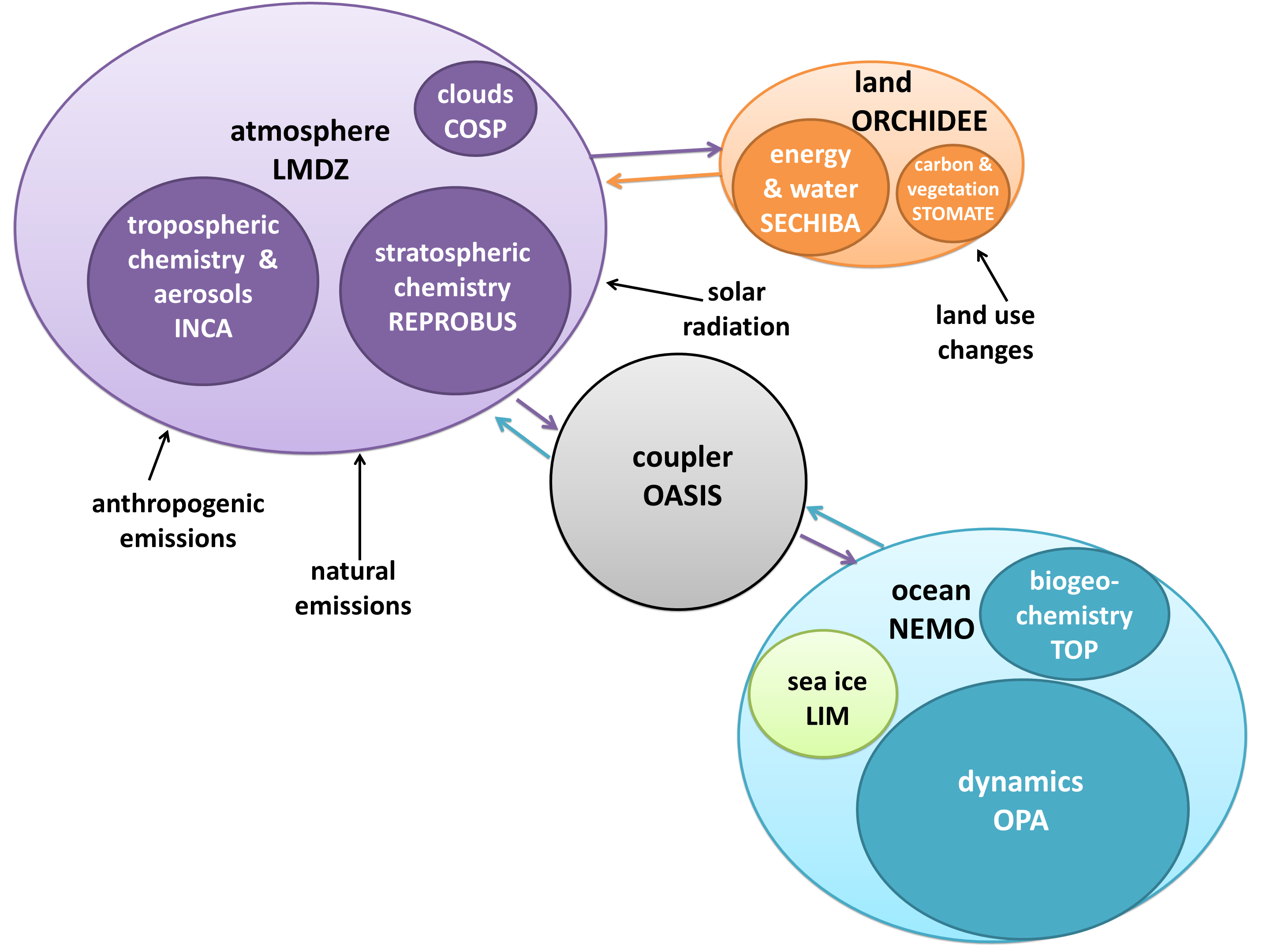
For example, take a look at the IPSL (Institut Pierre Simon Laplace) climate model architecture. In the diagram below, each bubble represents an encapsulated piece of code, and the number of lines in this code is roughly proportional to the bubble’s area. Arrows represent data transfer, and the colour of each arrow shows where the data originated:

We can see that IPSL’s major components are atmosphere, land, and ocean (which also contains sea ice). The atmosphere is the most complex model, and land is the least. While both the atmosphere and the ocean use the coupler for data transfer, the land model does not – it’s simpler just to connect it directly to the atmosphere, since it uses the same grid, and doesn’t have to share much data with any other component. Land-ocean interactions are limited to surface runoff and coastal erosion, which are passed through the atmosphere in this model.

You can see diagrams like this for seven different GCMs, as well as a comparison of their different approaches to software architecture, in this summary of my research.

Show time

When it’s time to run the model, you might expect that scientists initialize the components with data collected from the real world. Actually, it’s more convenient to “spin up” the model: start with a dark, stationary Earth, turn the Sun on, start the Earth spinning, and wait until the atmosphere and ocean settle down into equilibrium. The resulting data fits perfectly into the cells, and matches up really nicely with observations. It fits within the bounds of the real climate, and could easily pass for real weather.

Scientists feed input files into the model, which contain the values of certain parameters, particularly agents that can cause climate change. These include the concentration of greenhouse gases, the intensity of sunlight, the amount of deforestation, and volcanoes that should erupt during the simulation. It’s also possible to give the model a different map to change the arrangement of continents. Through these input files, it’s possible to recreate the climate from just about any period of the Earth’s lifespan: the Jurassic Period, the last Ice Age, the present day…and even what the future might look like, depending on what we do (or don’t do) about global warming.

The highest resolution GCMs, on the fastest supercomputers, can simulate about 1 year for every day of real time. If you’re willing to sacrifice some complexity and go down to a lower resolution, you can speed things up considerably, and simulate millennia of climate change in a reasonable amount of time. For this reason, it’s useful to have a hierarchy of climate models with varying degrees of complexity.

As the model runs, every cell outputs the values of different variables (such as atmospheric pressure, ocean salinity, or forest cover) into a file, once per time step. The model can average these variables based on space and time, and calculate changes in the data. When the model is finished running, visualization software converts the rows and columns of numbers into more digestible maps and graphs. For example, this model output shows temperature change over the next century, depending on how many greenhouse gases we emit:

Predicting the past

So how do we know the models are working? Should we trust the predictions they make for the future? It’s not reasonable to wait for a hundred years to see if the predictions come true, so scientists have come up with a different test: tell the models to predict the past. For example, give the model the observed conditions of the year 1900, run it forward to 2000, and see if the climate it recreates matches up with observations from the real world.

This 20th-century run is one of many standard tests to verify that a GCM can accurately mimic the real world. It’s also common to recreate the last ice age, and compare the output to data from ice cores. While GCMs can travel even further back in time – for example, to recreate the climate that dinosaurs experienced – proxy data is so sparse and uncertain that you can’t really test these simulations. In fact, much of the scientific knowledge about pre-Ice Age climates actually comes from models!

Climate models aren’t perfect, but they are doing remarkably well. They pass the tests of predicting the past, and go even further. For example, scientists don’t know what causes El Niño, a phenomenon in the Pacific Ocean that affects weather worldwide. There are some hypotheses on what oceanic conditions can lead to an El Niño event, but nobody knows what the actual trigger is. Consequently, there’s no way to program El Niños into a GCM. But they show up anyway – the models spontaneously generate their own El Niños, somehow using the basic principles of fluid dynamics to simulate a phenomenon that remains fundamentally mysterious to us.

In some areas, the models are having trouble. Certain wind currents are notoriously difficult to simulate, and calculating regional climates requires an unaffordably high resolution. Phenomena that scientists can’t yet quantify, like the processes by which glaciers melt, or the self-reinforcing cycles of thawing permafrost, are also poorly represented. However, not knowing everything about the climate doesn’t mean scientists know nothing. Incomplete knowledge does not imply nonexistent knowledge – you don’t need to understand calculus to be able to say with confidence that 9 x 3 = 27.

Also, history has shown us that when climate models make mistakes, they tend to be too stable, and underestimate the potential for abrupt changes. Take the Arctic sea ice: just a few years ago, GCMs were predicting it would completely melt around 2100. Now, the estimate has been revised to 2030, as the ice melts faster than anyone anticipated:

Answering the big questions

At the end of the day, GCMs are the best prediction tools we have. If they all agree on an outcome, it would be silly to bet against them. However, the big questions, like “Is human activity warming the planet?”, don’t even require a model. The only things you need to answer those questions are a few fundamental physics and chemistry equations that we’ve known for over a century.

You could take climate models right out of the picture, and the answer wouldn’t change. Scientists would still be telling us that the Earth is warming, humans are causing it, and the consequences will likely be severe – unless we take action to stop it.