In Other News…

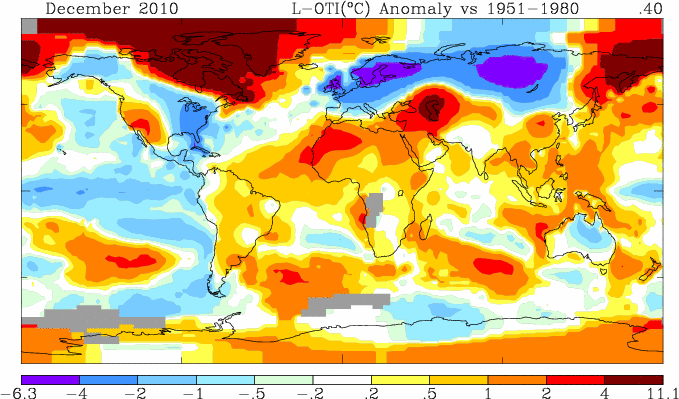
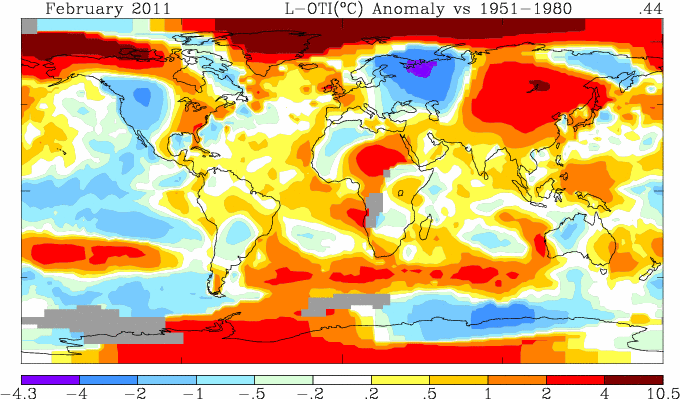
The Arctic is getting so warm in winter that James Hansen had to add a new colour to the standard legend – pink, which is even warmer than dark red:

The official NASA maps – the ones you can generate yourself – didn’t add this new colour, though. They simply extended the range of dark red on the legend to whatever the maximum anomaly is – in some cases, as much as 11.1 C:

The legend goes up in small, smooth steps: a range of 0.3 C, 0.5 C, 1 C, 2 C. Then, suddenly, 6 or 7 C.

I’m sure this is a result of algorithms that haven’t been updated to accommodate such extreme anomalies. However, since very few people examine the legend beyond recognizing that red is warm and blue is cold, the current legend seems sort of misleading. Am I the only one who feels this way?

The Pendulum

Cross-posted from NextGen Journal

A few years ago, climate change mitigation became a major political issue. Before 2005, governments certainly knew that human-caused climate change was a serious problem – but the public knew next to nothing about it, so there was no incentive to act. However, between 2005 and 2007, a perfect storm of events splashed the reality of climate change onto the world stage.

The Kyoto Protocol, an international agreement to reduce greenhouse gas emissions, finally came into force in early 2005, after years of negotiation. The United States refused to sign, and Australia signed on a little late, but every other developed nation in the world agreed to emission targets. Here in Canada, the Liberal government enthusiastically pledged its support for Kyoto. My local newspaper ran editorials exploring the different ways we could meet our targets, through combinations of clean energy, green infrastructure, and efficiency standards.

The summer of 2005 was a wake-up call for the United States, as Hurricane Katrina mercilessly demonstrated the amount of damage that extreme weather can bring. It’s impossible to say, at least with our current technology, whether or not Katrina was caused or even worsened by a warming planet. However, such devastating storms will become the norm as climate change progresses. Scientists aren’t sure whether or not hurricanes will become more frequent in a warming world, but the average hurricane is expected to become stronger and more damaging, and we are already beginning to see this rise in storm intensity. Katrina gave us an example of what we can expect from climate change – even if it wasn’t a direct effect in itself – and the world was shocked by the suffering that ensued.

2006 marked the release of An Inconvenient Truth, Al Gore’s Academy Award-winning documentary about climate change. For scientists studying climate, the film was an admirable, up-to-date example of science communication, albeit with a few minor errors and oversimplifications. However, for citizens new to the issue (I particularly remember my classmates in grade 9 social studies discussing the film), An Inconvenient Truth was a disturbing reality check – scarier than any horror movie, because it was real.

The major scientific event of 2007 was a drastic, unexpected drop in Arctic summer sea ice. That season’s melt was exacerbated by coincidental weather conditions, so the next years weren’t quite as bad, but the trend was still worrying, to say the least. The research community had assumed that summer ice would stick around for at least a century, but this timescale was soon halved and quartered as ice melt exceeded even the worst projections.

By 2007, lead-up to the 2008 US presidential election was underway, and political awareness of climate change was obvious. It was no surprise that Democrat Barack Obama had ambitious plans to cut greenhouse gas emissions, but even the Republicans seemed to be on board. During his time in office, George W. Bush had insisted that, since climate change could be natural, any mitigating action was not worth the economic risk. Republican presidential candidates seemed to realize that continuing to adopt this attitude would be political suicide. The most extreme example, John McCain, who would eventually win the Republican presidential nomination, had emissions targets only slightly less extensive than Obama’s. As he said in 2007,

The world is already feeling the powerful effects of global warming, and far more dire consequences are predicted if we let the growing deluge of greenhouse gas emissions continue, and wreak havoc with God’s creation…The problem isn’t a Hollywood invention nor is doing something about it a vanity of Cassandra like hysterics. It is a serious and urgent economic, environmental and national security challenge.

However, McCain, once an author of a bill designed to cut greenhouse gas emissions, would soon completely change his stance. By 2010, he was asserting that cap-and-trade legislation was unnecessary and carbon dioxide posed no harm to the American people. He even went so far as to question the political motivations of science he once wholly accepted:

I think [global warming is] an inexact science, and there has been more and more questioning about some of the conclusions that were reached concerning climate change. And I believe that everybody in the world deserves correct answers whether the scientific conclusions were flawed by outside influences. There’s great questions about it that need to be resolved.

The story of John McCain isn’t too surprising. Politicians frequently base their statements on public sentiment rather than personal opinion. They say what people want to hear, rather than what they truly believe is important. This aspect of our political system is depressing, but persistent. The real question, though, regards what changed public sentiment so quickly. Why did politicians like McCain feel compelled to denounce the importance of action on this problem, or even the existence of the problem itself? What happened since 2007 that made the pendulum swing so far in the other direction?

Strike one was the economy. The global recession that began in 2008 was the largest since the Great Depression, and concern for all other problems promptly went down the drain. It’s understandable for citizens to not worry about the environment when they don’t even have the means to feed and clothe their children properly. However, for governments to not realize the long-term economic implications of allowing climate change to continue, along with the potential job-creating benefits of a new energy economy, was disappointing, even though it wasn’t surprising.

Strike two was the all-out war on climate science, spearheaded by the fossil fuel industry and the far right. This PR campaign has been underway since the early 1990s, but was kicked up a notch just over a year ago. Since public understanding of the causes and effects of global warming was growing, and the science was becoming more solid by the month, the PR tactics changed. Instead of attacking the science, they attacked the integrity of the scientists. The most extreme example occurred in November 2009, when private correspondence between top climate researchers was stolen, spread on the Internet, and spun in an attempt to cast doubt on the scientists’ motives. This event, known as “Climategate”, spurred a great deal of anger among the political right, and everything from bitter editorials to death threats against scientists ensued. Perhaps most distressingly, by the time investigations found that the scientists involved were innocent, and the reality of climate change untouched, Climategate was old news and media outlets failed to adequately follow up on the story. Citizens heard the accusations, but not the exonerations, so political will to cut greenhouse gas emissions slipped even further.

Strike three – well, there has been no strike three, and a good thing too. Strikes one and two were so bad that some are hoping the pendulum has swung as far as it can go. It’s certainly difficult to imagine how the situation could get worse. The Kyoto Protocol is set to expire next year, and the Copenhagen meetings failed to create a replacement. As it was, many developed nations failed to meet their targets, and the Canadian government backed out completely.

The possibility of federal climate legislation for the United States is laughable now that not a single Republican Senator thinks action is necessary, and most doubt the reality of the problem, choosing to believe that the entire scientific community is out to lunch and/or an agent of conspiracy. President Obama’s director of climate policy, Carol Browner, recently left her position, although none of her major goals had been met. Obama’s recent State of the Union address included lots of hopeful statements about clean energy, but absolutely no mention of climate change, as if merely acknowledging the most pressing reason for a new energy economy would be political suicide. The time-honoured tradition of saying what the public wants to hear has even reached Obama, the man who promised change.

In Canada, legislation to simply set targets for emission reduction passed the House of Commons (made of elected representatives), but the Senate (composed of appointed politicians) chose to use their newfound Conservative majority to strike down the bill with no debate whatsoever, in a blatantly undemocratic move that has not happened since the 1930s. The Canadian government is all for a new energy economy, but not one based on environmental and social responsibility. The Alberta tar sands, which are substantially more polluting and carbon-intensive than traditional oil, continue to expand, and both federal and provincial governments are worryingly enthusiastic.

From 2005 to 2007, politics was high on promises of mitigation, but low on delivery. Since then, it has been devoid of both. It’s starting to seem as if it will take a major global disaster that can be unquestionably tied to climate change for governments to get their act together.

This would all be very well if there was no lag time between cause and effect in the climate system, but it doesn’t work that way. It takes several decades for all the warming in the pipeline to show up. If we waited until climate change became unbearable, and then cut off our emissions completely, the situation would still get worse for decades before it stabilized.

The worldwide failure of governments to take action on climate change is baffling. It seems that the best they can do is occasionally promise to fix the problem, but never actually get started. If this continues for much longer, we’re all going to pay the price for their mistakes – and so will people for generations to come.

What’s the Warmest Year – and Does it Matter?

Cross-posted from NextGenJournal

Climate change is a worrying phenomenon, but watching it unfold can be fascinating. The beginning of a new year brings completed analysis of what last year’s conditions were like. Perhaps the most eagerly awaited annual statistic is global temperature.

This year was no different – partway through 2010, scientists could tell that it had a good chance of being the warmest year on record. It turned out to be more or less tied for first, as top temperature analysis centres recently announced:

Why the small discrepancy in the order of  1998, 2005, and 2010? The answer is mainly due to the Arctic. Weather stations in the Arctic region are few and far between, as it’s difficult to have a permanent station on ice floes that move around, and are melting away. Scientists, then, have two choices in their analyses: extrapolate Arctic temperature anomalies from the stations they do have, or just leave the missing areas out, assuming that they’re warming at the global average rate. The first choice might lead to results that are off in either direction…but the second choice almost certainly underestimates warming, as it’s clear that climate change is affecting the Arctic much more and much faster than the global average. Currently, NASA is the only centre to do extrapolation in Arctic data. A more detailed explanation is available here.

But how useful is an annual measurement of global temperature? Not very, as it turns out. Short-term climate variability, most prominently El Nino and La Nina, impact annual temperatures significantly. Furthermore, since this oscillation occurs in the winter, the thermal influence of El Nino or La Nina can fall entirely into one calendar year, or be split between two. The result is a graph that’s rather spiky:

A far more useful analysis involves plotting a 12-month running mean. Instead of measuring only from January to December, measurements are also compiled from February to January, March to February, and so on. This results in twelve times more data points, and prevents El Nino and La Nina events from being exaggerated:

This graph is better, but still not that useful. The natural spikiness of the El Nino cycle can, in the short term, get in the way of understanding the underlying trend. Since the El Nino cycle takes between 3 and 7 years to complete, a 60-month (5-year) running mean allows the resulting ups and downs to cancel each other out. Another cycle that impacts short-term temperature is the sunspot cycle, which operates on an 11-year cycle. A 132-month running mean smooths out that influence too. Both 60- and 132- month running means are shown below:

A statistic every month that shows the average global temperature over the last 5 or 11 years may not be as exciting as an annual measurement regarding the previous year. But that’s the reality of climate change. It doesn’t make every month or even every year warmer than the last, and a short-term trend line means virtually nothing. In the climate system, trends are always obscured by noise, and the nature of human psychology means we pay far more attention to noise. Nonetheless, the long-term warming trend since around 1975 is irrefutable when one is presented with the data. A gradual, persistent change might not make the greatest headline, but that doesn’t mean it’s worth ignoring.

“It’s Just a Natural Cycle”

My second rebuttal for Skeptical Science. Thanks to all the folks who helped to review it! Further suggestions are welcome, as always. -Kate

“What if global warming is just a natural cycle?” This argument is, perhaps, one of the most common raised by the average person, rather than someone who makes a career out of denying climate change. Cyclical variations in climate are well-known to the public; we all studied the ice ages in school. However, climate isn’t inherently cyclical.

A common misunderstanding of the climate system characterizes it like a pendulum. The planet will warm up to “cancel out” a previous period of cooling, spurred by some internal equilibrium. This view of the climate is incorrect. Internal variability will move energy between the ocean and the atmosphere, causing short-term warming and cooling of the surface in events such as El Nino and La Nina, and longer-term changes when similar cycles operate on decadal scales. However, internal forces do not cause climate change. Appreciable changes in climate are the result of changes in the energy balance of the Earth, which requires “external” forcings, such as changes in solar output, albedo, and atmospheric greenhouse gases. These forcings can be cyclical, as they are in the ice ages, but they can come in different shapes entirely.

For this reason, “it’s just a natural cycle” is a bit of a cop-out argument. The Earth doesn’t warm up because it feels like it. It warms up because something forces it to. Scientists keep track of natural forcings, but the observed warming of the planet over the second half of the 20th century can only be explained by adding in anthropogenic radiative forcings, namely increases in greenhouse gases such as carbon dioxide.

Of course, it’s always possible that some natural cycle exists, unknown to scientists and their instruments, that is currently causing the planet to warm. There’s always a chance that we could be totally wrong. This omnipresent fact of science is called irreducible uncertainty, because it can never be entirely eliminated. However, it’s very unlikely that such a cycle exists.

Firstly, the hypothetical natural cycle would have to explain the observed “fingerprints” of greenhouse gas-induced warming. Even if, for the sake of argument, we were to discount the direct measurements showing an increased greenhouse effect, other lines of evidence point to anthropogenic causes. For example, the troposphere (the lowest part of the atmosphere) is warming, but the levels above, from the stratosphere up, are cooling, as less radiation is escaping out to space. This rules out cycles related to the Sun, as solar influences would warm the entire atmosphere in a uniform fashion. The only explanation that makes sense is greenhouse gases.

What about an internal cycle, perhaps from volcanoes or the ocean, that releases massive amounts of greenhouse gases? This wouldn’t make sense either, not only because scientists keep track of volcanic and oceanic emissions of CO2 and know that they are small compared to anthropogenic emissions, but also because CO2 from fossil fuels has its own fingerprints. Its isotopic signature is depleted in the carbon-13 isotope, which explains why the atmospheric ratio of carbon-12 to carbon-13 has been going down as anthropogenic carbon dioxide goes up. Additionally, atmospheric oxygen (O2) is decreasing at the same rate that CO2 is increasing, because oxygen is consumed when fossil fuels combust.

A natural cycle that fits all these fingerprints is nearly unfathomable. However, that’s not all the cycle would have to explain. It would also have to tell us why anthropogenic greenhouse gases are not having an effect. Either a century of basic physics and chemistry studying the radiative properties of greenhouse gases would have to be proven wrong, or the natural cycle would have to be unbelievably complex to prevent such dramatic anthropogenic emissions from warming the planet.

It is indeed possible that multidecadal climate variabilityespecially cycles originating in the Atlantic, could be contributing to recent warming, particularly in the Arctic. However, the amplitude of the cycles simply can’t explain the observed temperature change. Internal variability has always been superimposed on top of global surface temperature trends, but the magnitude – as well as the fingerprints – of current warming clearly indicates that anthropogenic greenhouse gases are the dominant factor.

Despite all these lines of evidence, many known climatic cycles are often trumpeted to be the real cause, on the Internet and in the media. Many of these cycles have been debunked on Skeptical Science, and all of them either aren’t in the warming phases, don’t fit the fingerprints, or both.

For example, we are warming far too fast to be coming out of the last ice age, and the Milankovitch cycles that drive glaciation show that we should be, in fact, very slowly going into a new ice age (but anthropogenic warming is virtually certain to offset that influence).

The “1500-year cycle” that S. Fred Singer attributes warming to is, in fact, a change in distribution of thermal energy between the poles, not a net increase in global temperature, which is what we observe now.

The Little Ice Age following the Medieval Warm Period ended due to a slight increase in solar output (changes in both thermohaline circulation and volcanic activity also contributed), but that increase has since reversed, and global temperature and solar activity are now going in opposite directions. This also explains why the 11-year solar cycle could not be causing global warming.

ENSO (El Nino Southern Oscillation) and PDO (Pacific Decadal Oscillation) help to explain short-term variations, but have no long-term trend, warming or otherwise. Additionally, these cycles simply move thermal energy between the ocean and the atmosphere, and do not change the energy balance of the Earth.

As we can see, “it’s just a natural cycle” isn’t just a cop-out argument – it’s something that scientists have considered, studied, and ruled out long before you and I even knew what global warming was.

Snowstorms and Sea Ice

Cross-posted from NextGen Journal

“That’s some global warming”, Fox News proudly announced. “Rare winter storm dumps several inches of snow across South.” It’s cold outside, and/or it’s snowing, so therefore global warming can’t be happening. Impeccable logic, or rampant misconception?

It happened last winter, and again so far this season: unusual snow and extreme cold thrashed the United States, Europe, and Russia. Climate change deniers, with a response as predictable as Newton’s Laws, trumpeted the conditions as undeniable proof that the world simply could not be warming. Even average people, understandably confused by conflicting media reports, started to wonder if global warming was really such a watertight theory.

But sit and think about it for a minute. If it’s cold right now in the place where you live, that doesn’t mean it’s cold everywhere else. It’s simply not possible to look at your little corner of the world and extrapolate those conditions to the entire planet. There’s a reason it’s called global warming, and not “everywhere-all-the-time warming”. Climate change increases the amount of thermal energy on our planet, but that doesn’t mean the extra energy will be distributed equally.

That said, an interesting weather condition has been prominent over the past month, telling a fascinating story that begins in the Arctic. At the recent American Geophysical Union conference in San Fransisco, the largest annual gathering of geoscientists in the world, NOAA scientist Jim Overland described the situation.

Usually in winter, the air masses above the Arctic have low pressure, and the entire area is surrounded by a circular vortex of wind currents, keeping the frigid polar air contained. Everything is what you’d expect: a cold Arctic and mild continents. These conditions are known as the positive phase of the North Atlantic Oscillation (NAO), an index of fluctuating wind and temperature patterns that impacts weather on both sides of the Atlantic.

The negative phase is different, and quite rare: high pressure over the Arctic forces the cold air to spill out over North America and Eurasia, allowing warm air to rush in to the polar region. Meteorologist Jeff Masters has a great analogy for a negative NAO: it’s “kind of like leaving the refrigerator door ajar–the refrigerator warms up, but all of the cold air spills out into the house.” The Arctic becomes unusually warm, and the temperate regions of the surrounding continents become unusually cold. Nobody visually depicts this pattern better than freelance journalist Peter Sinclair:

So what’s been causing this rare shift to the negative NAO the past two winters? In fact, global warming itself could easily be the culprit. Strong warming over the Arctic is melting the sea ice, not just in the summer, but year-round. Open water in the Arctic Ocean during the winter allows heat to flow from the ocean to the atmosphere, creating the high pressure needed for a negative NAO to materialize. Paradoxically, the cold, snowy weather many of us are experiencing could be the result of a warming planet.

An emerging debate among scientists questions which force will win out over winters in Europe and North America: the cooling influence of more negative NAO conditions, or the warming influence of climate change itself? A recent study in the Journal of Geophysical Research predicts a threefold increase in the likelihood of cold winters over “large areas including Europe” as global warming develops. On the other hand, scientists at GISS, the climate change team at NASA, counter that extreme lows in sea ice over the past decade have not always led to cold winters in Europe, as 7 out the past 10 winters there have been warmer than average.

Amid this new frontier in climate science, one thing is virtually certain: global warming has not stopped, despite what Fox News tells you. In fact, despite localized record cold, 2010 is expected to be either the warmest year on record or tied for first with 2005 (final analysis is not yet complete). What you see in your backyard isn’t always a representative sample.

Party Line

Brad Johnson from The Wonk Room recently released a comprehensive list of what Republican contenders for the U.S. Senate understand about climate change, inferred from their public statements. The result? 47 of the 48 deny the existence of anthropogenic climate change and/or oppose mitigating action to curb greenhouse gas emissions.

Take a look – many of the statements are what you would expect from trolling YouTube commenters, not politicians aspiring to run the most powerful country in the world. Through a combination of framing science as personal opinion, promoting artificial balance, and re-iterating the same misconceptions that people like you and I have been fighting to correct for years now, the Republican party has adopted a position that, frankly, terrifies me.

“There are dramatic environmental changes happening the Arctic region – whether one believes they are man-made or natural.” – John McCain, Arizona

“While I think the earth is warming, I don’t think that man-made causes are the primary factor.” – Ken Buck, Colorado

“The climate is always changing. The climate is never static. The question is whether it’s caused by man-made activity and whether it justifies economically destructive government regulation.” -Marco Rubio, Florida

“[Scientists] are making up their facts to fit their conclusions. They’ve already caught them doing this.” – Rand Paul, Kentucky

“There isn’t any real science to say we are altering the climate path of the Earth.” -Roy Blunt, Missouri

“I don’t buy into the whole man-caused global warming, man-caused climate change mantra of the left. I believe that there’s not sound science to back that up.” -Sharron Angle, Nevada

“There is much debate in the scientific community as to the precise sources of global warming.” -Pat Toomey, Pennsylvania

“It’s going to keep snowing in DC until Al Gore cries ‘uncle’.” -Jim DeMint, South Carolina

“If you have one volcano in the world, that one volcano puts out more carbon dioxide than everything man puts out.” -John Raese, West Virginia

“I absolutely do not believe that the science of man-caused climate change is proven. Not by any stretch of the imagination. I think it’s far more likely that it’s just sunspot activity, or something just in the geologic eons of time where we have changes in the climate.” -Ron Johnson, Wisconsin

Who are these people to make statements about what the scientific community knows and does not know about climate change, when organizations like the NAS are quite capable of doing that themselves, and tell a very different story to these prospective Senators when they do?

Who are they to make informal analyses on the attribution of recent temperature change – assessing the likelihood of different causes via gut instinct, rather than looking at fingerprints like stratospheric temperature and tropopause height?

Who are they to spread around blatant mistruths like “a single volcano puts out more CO2 than people do”? Who are they to make damaging accusations about scientific fraud and false data, especially when these accusations have already been investigated multiple times, coming up completely clear?

I had hoped that politicians would be slightly more informed than the general public on scientific matters that have implications for policy. However, I must now change my mind, and hope instead that the American public realizes how off the mark this position is. If they don’t, there could be consequences up to millenia from now.

The Associated Press Gets it Right

It’s been quite the summer. Moscow has experienced several months of weather more akin to Texas, and is literally burning up. Floods in China have killed more than a thousand and left countless others displaced. Pakistan has experienced similar floods due to a massive monsoon season, and now they have to deal with cholera, too. The Arctic sea ice extent is not much larger than 2007, and, so far, it’s been the warmest year on record globally.

We can’t tie a single extreme event to climate change. We can tie long-term trends, like 30 years of declining Arctic sea ice, to a warming world, but we don’t yet have the technology to attribute a single anomalous season to a particular cause. In 2007, for example, factors other than high temperatures contributed to the lowest Arctic sea ice extent on record.

However, these events are exactly what we expect from anthropogenic climate change. We shouldn’t look at them as evidence for global warming, but as examples of what is to come. This is an important warning that most newspapers have been shying away from. After nearly a year of terrible climate change journalism across the board, they didn’t even mention the connection between extreme events and climate change, or the fact that this summer is a very real glimpse into our future.

I gave up on my local newspaper months ago, and I don’t regret that decision. On the handful of mornings that I’ve flipped through the paper instead of reading the Globe and Mail on the Internet (journalism of much higher quality, and it saves money and paper), I’ve seen far too many op-eds and letters to the editor saying very strange things about climate science.

However, a headline yesterday caught my eye. A fantastic article by Charles J. Hanley, a Pulitzer Prize winning journalist, was distributed by the Associated Press and, consequently, picked up by dozens of newspapers across the continent – including my local paper.

I became more and more pleasantly surprised as I began to read through the article:

Floods, fires, melting ice and feverish heat: From smoke-choked Moscow to water-soaked Iowa and the High Arctic, the planet seems to be having a midsummer breakdown. It’s not just a portent of things to come, scientists say, but a sign of troubling climate change already under way.
The weather-related cataclysms of July and August fit patterns predicted by climate scientists, the Geneva-based World Meteorological Organization says – although those scientists always shy from tying individual disasters directly to global warming.

Read the whole article here.

Hanley does a fantastic job of distinguishing between weather and climate, and stressing that we can’t yet attribute extreme events to specific causes while acknowledging that this summer’s wild weather fits with IPCC predictions and will become a lot more common in the future. He interviews our good friend Gavin Schmidt, and explains how rising greenhouse gases are “loading the climate dice” – changing the relative odds of different extremes, rather than eliminating all cold days entirely.

I stood there and clapped. I was so proud of the Associated Press, and of my local paper, that I clapped for them. I feel like there is a smidgen of hope for climate change journalism and public understanding of this issue again. Or perhaps it just comes in waves, and we’re riding our way to the top again.

Global Surface Temperature Change

I really enjoyed reading “Global Surface Temperature Change“, by James Hansen and his team at GISS. Keep in mind that it’s still in the draft stages – they haven’t submitted to a journal yet, but they certainly plan to, and it’s a very credible team of scientists that will almost definitely get it published.

The paper is mostly about the methods of global temperature analysis. It’s more of a review paper than an account of a single experiment. However, their main discussion point was that even by using the same data, problems can be addressed in different ways. The two main problems with temperature analysis are:

  • “incomplete spatial and temporal coverage” (sparse data)
  • “non-climatic influences on measurement station environment” (urban heat island effect).

The authors explain the methods they use and why, and explore the impacts that different methods have on their results.

GISS measures anomalies in the temperatures, largely because they are much smoother and more consistent, geographically, than absolute temperatures. In 1987, they determined that anomalies could be safely extrapolated for a radius of 1200 km from a station and still be accurate. GISS smooths the whole map out by extrapolating everything and averaging the overlapping bits.

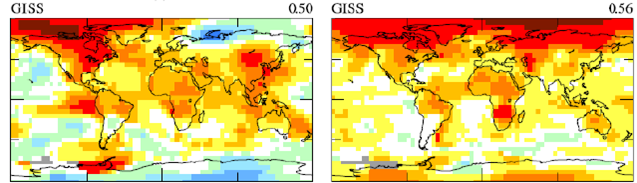
Extrapolating is also very useful in areas with very few stations, such as the polar regions and parts of Africa. In this map, grey indicates missing data:


The Arctic is particularly problematic, not only because its data is so sparse, but also because it has the largest anomaly of any region in the world. If you have incomplete coverage of an area that is warming so dramatically, it won’t pull its full weight in the global trend, and your result will almost certainly be too low.

This difficulty with the Arctic is the reason that GISS says 2005 is the warmest year on record, while HadCRUT, the team in England, says that 1998 is. GISS extrapolates from the stations they have, and end up getting pretty good coverage of the Arctic:

They’re assuming that areas with missing data have the same anomaly as whatever temperature stations are within 1200 km, which, as they determined in 1987, is a pretty fair assumption.

However, HadCRUT doesn’t do this extrapolating thing. When they don’t have data for an area, they just leave it out:
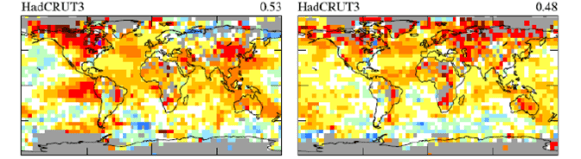
This might sound safer, in a way, but this method also makes an assumption. It assumes that the area has the same anomaly as the global average. And as we all know, the Arctic is warming a lot more and a lot faster than the global average. So it’s quite possible that GISS is right on this one.

Another adjustment that NASA makes is for local, anthropogenic, non-climatic effects on temperature data. The most obvious of these is the urban heat island effect. As an area becomes more urban, it gets more pavement, less vegetation, and its albedo goes down – it absorbs more heat. This often makes cities substantially warmer than the surrounding rural areas, which can obviously contaminate the temperature record. However, there are ways of eliminating urban influences from the data so we can see what the real trend is.

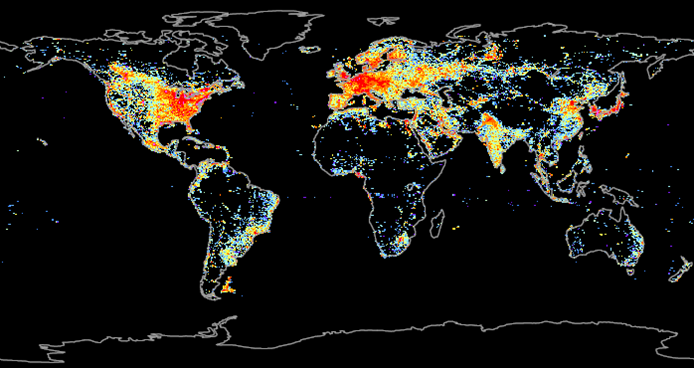
The first step is determining what stations are considered urban. The obvious way to do this is through population, but that’s actually not very accurate. Think of somewhere like Africa, where, even if there are thousands of people living in a small area, the urban influences such as concrete, absence of vegetation, or exhaust aren’t usually present. A much better indication is energy use, and a good proxy for energy use, that’s easy to measure, is lights at night-time.
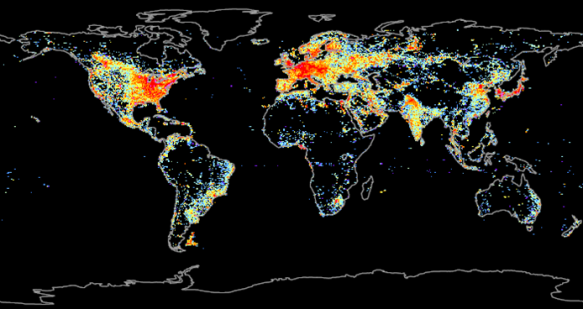
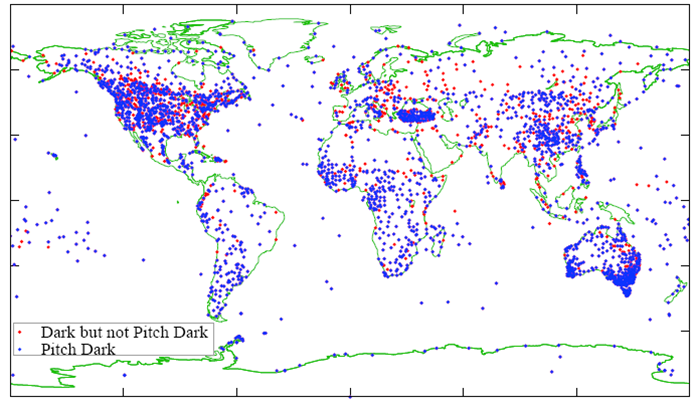
So GISS put a bit of code into their analysis that singles out stations where nightlight brightness is greater than 32 µW/m2/sr/µm, and adjusts their trends to agree with rural stations within 1200 km. If there aren’t enough rural stations within that radius, they’ll just exclude the station from the analysis.

They did an even more rigorous test for this paper, to test just how much urban influences were contaminating the long-term trend, and it was pretty interesting.

There were enough stations considered “pitch-dark” at night, where they couldn’t detect any light, to run a global analysis all by themselves. The trend that came out was <0.01 °C/century smaller than GISS’s normal calculation, an amount of error that they described as “immeasurably small”.

The result of all this temperature analysis is a graph, with one new point every year, that is “eagerly awaited by some members of the public and the media”:

However, this graph isn’t actually as useful as this one – the 12-month running mean:
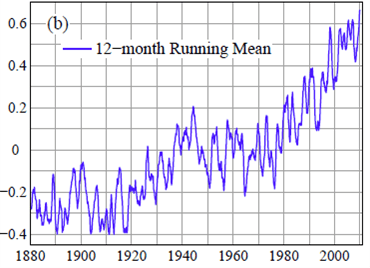
“From a climate standpoint there is nothing special about the time  of year at which the calendar begins”, so instead of only measuring January-December, you can also do February-January, March-February, and so on. This way, you get a data point every month instead of every year, and more data means more accuracy. It also solves problems with short-term influences, such as El Nino, La Nina, and volcanic eruptions, that the annual graph was having. These fleeting, but fairly substantial, influences can fall completely into one calendar year or be split between two – so their influence on global temperature could be overestimated or underestimated, depending on the starting month of the calendar. The 12-month running mean is much less misleading in this fashion.

As it is, we just set a new record for the 12-month running mean, and unless La Nina really takes off, 2010 will likely set a new record for the annual graph as well. But the authors argue that we need to start moving away from the annual graph, because it isn’t as useful.

The authors also discuss public perception of climate change, and media coverage of the issue. They say, “Our comments here about communication of this climate science to the public are our opinion…[We offer it] because it seems inappropriate to ignore the vast range of claims appearing in the media and in hopes that open discussion of these matters may help people distinguish the reality of global change sooner than would otherwise be the case.”

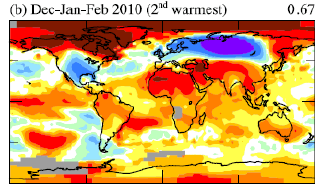
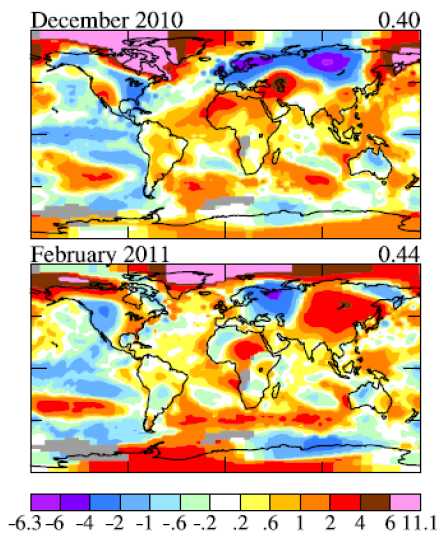
They make the very good point that “Lay people’s perception tends to be strongly influenced by the latest local fluctuation”, and use this winter as a case study, where a strongly negative Arctic Oscillation index caused significantly cooler-than-normal conditions across the United States and Europe. Consequently, a lot of people, especially in the US, began to doubt the reality of global warming – even though, in the world as a whole, it was the second warmest winter on record:
The authors also talk about data sharing. GISS likes to make everything freely available to the public – temperature station data, computer code, everything. However, putting it out there immediately, so that anyone can help check for flaws, has “a practical disadvantage: it allows any data flaws to be interpreted and misrepresented as machinations.” Multiple times in the past few years, when there have been minor errors that didn’t actually change anything, GISS was widely accused of making these mistakes deliberately, to “intentionally exaggerate the magnitude of global warming”. They realized this wasn’t working, so they changed their system: Before releasing the data to everyone, they first put it up on a private site so that only select scientists can examine it for flaws. And, of course, this “has resulted in the criticism that GISS now “hides” their data”.

Personally, I find the range and prevalence of these accusations against scientists absolutely terrifying. Look at what has become mainstream:
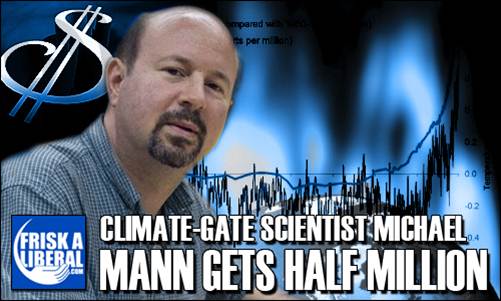
Scientific fraud is a very serious allegation, and it’s one thing for citizens to make it without evidence, but it’s another thing altogether for the media to repeat such claims without first investigating their validity:

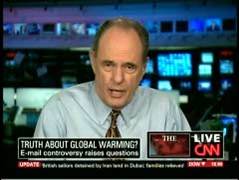
I have been disgusted by the media coverage of climate science, especially over the past year, especially in the United States, and I worry what this will mean for our ability to solve the problem.

However, there is still fantastic science going on that is absolutely fascinating and essential to our understanding of global climate change. This paper was a very interesting read, and it helped me to better understand a lot of aspects of global temperature analysis.
Very Scary Stuff

One of the most worrying positive feedbacks of our current climate change lies deep in the Arctic permafrost and the ocean – methane hydrates. Methane loosely bonds to water, which freezes and lies stable…..until it melts. When it gets warm enough, the methane breaks apart from the water and is released into the atmosphere, or is dissolved in the ocean and then slowly released.

There is an enormous amount of methane in the form of hydrates up north – using its GWP, enough to “double” the amount of CO2 (even if it doesn’t all convert to CO2), if I remember correctly. This feedback is not included in climate models, as nobody really knows when or at what point huge amounts of methane could be released.

Unfortunately, we have evidence that it’s starting to begin. CORDIS and BBC report that a study in Geophysical Research Letters has discovered methane plumes rising from the ocean floor. Right now the methane is dissolving in the water, but we don’t know whether or when it’ll reach the atmosphere. Even if the methane stays dissolved, the acidity of the ocean will increase, which can damage marine life. Even if this begins as only an impact, not a feedback, the Arctic is stressed out enough as it is.

I didn’t expect to hear news like this for quite a few years. As one of the authors says, “Our survey was designed to work out how much methane might be released by future ocean warming; we did not expect to discover such strong evidence that this process has already started.”

Reminds you a bit of Larsen-B, doesn’t it?