Odds and Ends

I must thank Michael Tobis for two pieces of reading that his blog recently pointed me to. First, a fantastic article by Bill McKibben, which everyone should print out and stick to their fridge. Here’s a taste:

Read the comments on one of the representative websites: Global warming is a “fraud” or a “plot.” Scientists are liars out to line their pockets with government grants. Environmentalism is nothing but a money-spinning “scam.” These people aren’t reading the science and thinking, I have some questions about this. They’re convinced of a massive conspiracy.

The odd and troubling thing about this stance is not just that it prevents action. It’s also profoundly unconservative. If there was ever a radical project, monkeying with the climate would surely qualify. Had the Soviet Union built secret factories to pour carbon dioxide into the atmosphere and threatened to raise the sea level and subvert the Grain Belt, the prevailing conservative response would have been: Bomb them. Bomb them back to the Holocene—to the 10,000-year period of climatic stability now unraveling, the period that underwrote the rise of human civilization that conservatism has taken as its duty to protect. Conservatism has always stressed stability and continuity; since Burke, the watchwords have been tradition, authority, heritage. The globally averaged temperature of the planet has been 57 degrees, give or take, for most of human history; we know that works, that it allows the world we have enjoyed. Now, the finest minds, using the finest equipment, tell us that it’s headed toward 61 or 62 or 63 degrees unless we rapidly leave fossil fuel behind, and that, in the words of NASA scientists, this new world won’t be “similar to that on which civilization developed and to which life on earth is adapted.” Conservatives should be leading the desperate fight to preserve the earth we were born on.

Read the rest of the article here. Highly recommended to all.

The other link I wanted to share was a new publication entitled “Science and the Media”, just released by the American Academy of Arts and Sciences (not to be confused with the American Association for the Advancement of Science – why all the acronym duplication?)

With contributions from everyone from Donald Kennedy to Alan Alda, and essays with titles from “The Scientist as Citizen” to “Civic Scientific Literacy: The Role of the Media in the Electronic Era”, I’m virtually certain that I will enjoy this one (sorry, I can’t bring myself to say things like “certain” without caveats any more). The 109-page pdf is available free of charge and can be accessed from this page, which also includes information on ordering hard copies.

In other news, the La Niña conditions in the eastern Pacific (see anomaly map above) have bumped this year’s temperatures down a bit, so January-September 2010 is now tied for the warmest on record, rather than being a clear winner. This analysis is from NCDC, however, and I’m not sure how they deal with sparse data in the Arctic (for background, see this post – a summary of one of the most interesting papers I’ve read this year). Does anyone know if GISS has an up-to-date estimate for 2010 temperatures that we could compare it to? All I can find on their website are lines and lines of raw data, and I’m not really sure how to process it myself.

That’s all for today. Enjoy the week, everyone.

Don’t Listen to the Newspapers

This article of mine was published in the newsletter of Sisters of Our Lady of the Missions, a Catholic group that is doing a great deal of work in sustainability issues. Enjoy!

The mainstream media portrays the existence of human-caused climate change as a much fiercer scientific debate than it actually is. Scientists are still working out the details of how much warming we can expect, how it will be distributed, and what the consequences will be. However, the “big questions” have very solid answers. The idea that emissions of carbon dioxide from human activities would eventually warm the planet was first proposed in 1896, and since then, agreement on the issue has grown to a staggering level: 97.6% of publishing climatologists, 100% of studies in scientific journals, and every scientific organization in the world now agree that humans are changing the climate.

Compare this to the media coverage of climate change. The majority of articles in respected newspapers like The New York Times or The Wall Street Journal give roughly equal time to the “two sides” of the so-called “scientific debate”. Balance in journalism is all very well when the issue is one of political or social nature, but for matters of science, giving fringe opinions the same weight as a robust consensus is misleading. Being objective is not always the same as being neutral.

Over the past year, climate change reporting has taken a disturbing turn, as attacks on the integrity of individual scientists have been spread by nearly every media outlet in the developed world. Private correspondence taken out of context (in which the scientists involved have subsequently been cleared of any wrongdoing, by five independent investigations) as well as minor referencing errors in a scientific report (the worst of which gave the wrong date for when a specific glacier was expected to melt) led to widespread accusations of fraud and conspiracy by advocacy groups opposed to climate change action. Rather than investigate these potentially libellous claims, the media repeated them. As a result, many scientists have received death threats, and countless others have been subject to hate mail. One scientist in particular has had a dead animal dumped on his doorstep, and now travels with a bodyguard. Although their scientific reputations have not been damaged, the personal lives of these innocent men and women have been forever altered.

As the popular press reinforces myths and misconceptions about climate change, public understanding of the issue has fallen apart. Only 61% of American adults think that the Earth is warming, and only 50% think that it is caused by human activity (up-to-date Canadian statistics are not available). Most worryingly, only 34% are aware that most scientists think climate change is happening. A vast chasm has opened between scientific and public understanding of climate change, and powerful forces are at work to keep it open.

As we live in a democracy, action on climate change will only happen when voters demand it – and they won’t demand a solution if they don’t understand the problem. The best thing that you and I can do to stop climate change is to spread around accurate information. Scientific reports are often too technical for easy understanding, but major journals, such as Nature, often have a news section where they summarize new studies for the public. Many scientists are also stepping up to the challenge of climate change communication, and casting light on common misconceptions. A website called Skeptical Science is one of the best sources. There are many people working to fix this problem, but we need many more. Slowly but surely, the tide will turn.

A Fabulous Contribution

I’ve really been enjoying the Advanced versions of Skeptical Science’s rebuttals to common misconceptions about climate change. So far, they have all been written by someone going by the name of dana1981, who I would like to give a huge shout-out to. I am a new B.Sc. student who is interested in pursuing a career in climate change research, and these articles have been very helpful in giving me a taste of basic atmospheric science.

In “How do we know more CO2 is causing warming?”, I was introduced to the relatively simple equation required to calculate the radiative forcing of increased atmospheric carbon dioxide, as well as the expected equilibrium temperature change from CO2, using the range of values for climate sensitivity provided by the IPCC (as calculating climate sensitivity is not quite so simple!)

In “The human fingerprint in global warming”, dana1981 discussed different attribution studies, and explained how anthropogenic warming has certain “fingerprints” – more warming at night than during the day, a cooling of the stratosphere, and a rise in tropopause height – all of which have been observed. I had a basic understanding of these fingerprints and why they occurred, but it was great to read about the current research in attribution studies, with impeccable citations.

“How sensitive is our climate?” was similar to the first article, but also addressed the common misconception that climate sensitivity is specific to different forcings. If the climate has low sensitivity to CO2, it also has low sensitivity to solar radiation, cosmic ray feedback, etc. The equilibrium temperature change doesn’t care if the extra few W/m2 is from the greenhouse effect or planetary albedo – it changes with the same speed either way, which disproves many skeptical arguments. Additionally, since the prehistoric record shows large swings in climate resulting from relatively small forcings, scientists are confident that climate sensitivity is not very low.

“Solar activity & climate: is the sun causing global warming?” was absolutely fascinating. The equations required to calculate solar forcing using total solar irradiance were new to me, and dana1981 went so far as to analyze early 20th-century warming, calculating how much was due to an upswing in solar irradiance and how much was due to anthropogenic greenhouse gases. During the latter half of the 20th century, solar irradiance has dropped back down, but warming has only accelerated.

Skeptical Science’s recent efforts to expand their rebuttals to include beginner, intermediate, and advanced levels of explanation were inspired by a RealClimate post written by Dr. Gavin Schimdt. He thoughtfully wrote,

I think we should be explicitly thinking about information levels and explicitly catering to different audiences with different needs and capabilities. One metaphor that might work well is that of an alpine ski hill. There we have (in the US for instance) green runs for beginners wanting a gentle introduction and where hopefully nothing too bad can happen. Blue runs where the technical level is a little more ambitious and a little more care needs to be taken. Black expert runs for those who know what they are doing and are doing it well, and finally, double black diamond runs for the true masters. No-one accuses ski resorts of being patronising when they have green runs interspersed with the more difficult ones, and neither do they get accused of elitism when one peak has only black runs going down (as I recall all too painfully on my first ski outing). People self-segregate and generally find their way to the level at which the feel comfortable – whether they want a easy or challenging ride – and there is nothing stopping them varying the levels as their mood or inclination takes them.

Skeptical Science took up this challenge, and although their efforts have largely been focused on creating “plain-English” beginner articles, as a huge target audience for climate change communication is the general public, I’m extremely grateful that they’re also catering to new science enthusiasts such as myself with the advanced articles. Please, keep them coming!

While we’re on the topic, I should also mention a great new post by Skeptical Science, which is not part of their argument database – “The contradictory nature of global warming skepticism”. You can’t hold the objection that the world isn’t warming and then turn around and say that global warming is natural, but these and other self-disproving arguments reach us on a daily basis. Deniers can’t seem to agree on a single unified objection to anthropogenic global climate change, and some individuals, as the post shows, contradict themselves up to five times in six months.

And hey, I just realized right now – that post was also written by dana1981. Whoever this writer is, he or she is doing a great job.

Priorities

I’m sick of all the politics surrounding climate science.

I wish it could go back to just being science, the way it was in the 1970s, without all these people trying to sabotage it for us. I wish we could concentrate on the joy and fascination we feel when we learn about the climate system, without having to deal with hate mail and quotes taken out of context.

I’m tired of the game of Broken Telephone in science journalism, the game that somehow always allows Fox News to make claims like “melting Arctic sea ice isn’t caused by warming temperatures”. I’m tired of the outright falsehoods that are permitted to circulate around the world, in respected publications, without consequences.

I’m tired of unnecessary investigations into the integrity of climatology researchers and organizations. I’m tired of the accusations of “whitewash” when these investigations invariably come up clear. I’m tired of scientists being portrayed as frauds if they don’t achieve a 100% success rate in their projections.

I’m tired of the politicians that attempt to subject innocent scientists to criminal prosecution. They’re so unwilling to accept the reality of anthropogenic global climate change that they think scientific fraud on an unprecedented scale is more likely than well-established properties of physics playing out as expected. It frightens and astounds me that people with such an upside-down understanding of the scientific process hold immense power in the American government.

I first became interested in climate science because of the science, not because of all the politics surrounding it. The earliest thing I can remember sparking my interest is learning about the different isotopes of oxygen, and how they can be used to reconstruct temperature.

These days, however, it’s nearly impossible to learn about climate science without running into silly arguments and widespread misconceptions and stubborn denialism. I started writing this blog so that I would have an outlet to keep myself sane as I waded through all the muddle. As time went on, an element of public education developed, along with priceless learning opportunities and collaboration. This blog has grown to so much more than I ever anticipated.

I don’t really have the heart to read Naomi Oreskes’ new book quite yet, or to re-read Climate Cover-Up, or to scroll down to the comment section when CBC publishes online articles about climate change. I know what a dire situation we are in, not only ecologically and climatologically, but also socially – in terms of public understanding and science communication. I know what a mess we’re in, and I don’t need reminding. I don’t know how we’re going to get out of the mess, but I try to do my part by continuing to pour my sociological musings into this sanity-inducing and morale-raising outlet.

I just want to work my way through David Archer’s book, Global Warming: Understanding the Forecast, and learn how to use all the atmospheric science equations within it. I want to download papers from Nature and Science and read them on the bus. I want to keep a close eye on the “Advanced” versions of Skeptical Science rebuttals, because isn’t it just amazing that we have a simple logarithmic equation for the relationship between radiative forcing and atmospheric CO2 concentration?

Many people might find it strange that I see straight science as a break, some sort of retreat from that which is more difficult to stomach. But then, we’re in a strange situation here.

What Kevin Trenberth Has to Say

A comment from Steve Bloom several months ago got me thinking about a new kind of post that would be a lot of fun: interviewing top climate scientists, both on their research and their views of climate science journalism and communication. When I emailed Dr. Kevin Trenberth to see if he would be interested in such an interview, he responded with an entire essay that he had written about recent events in climate change communication. Although this essay is unpublished as of yet, he graciously suggested that I quote it for a post here.

It’s no surprise that Dr. Trenberth, head of the Climate Analysis Section at the National Center for Atmospheric Research in Colorado, is angry about the way stolen emails between researchers were trumpeted around the world in an attempt to make them seem like something they were not. He was “involved in just over 100” of the emails, and from the looks of things, hasn’t heard the end of it since they were stolen.

One oft-quoted statement of his went viral: The fact is that we can’t account for the lack of warming at the moment and it is a travesty that we can’t. Climate change deniers portrayed this quote as an admission that the world wasn’t warming after all, or even that scientists were trying to cover up a cooling trend. Taken in the full context of the email in which it was written, however, it’s clear that Trenberth was referring to a recent paper of his, which discussed our incomplete understanding of the factors affecting short-term variability in the Earth’s temperature. There were a couple years between 2004 and 2008 that weren’t quite as warm as scientists expected after looking at all the forcings, such as solar irradiance and ENSO. The paper and the subsequent email in no way mean that global warming has stopped. In fact, we’re well on our way to the warmest year on record. “It is amazing to see this particular quote lambasted so often,” says Trenberth.

Another quote, this time from a stolen email he was not even a recipient of, was written by Phil Jones, the director of CRU. I can’t see either of these papers being in the next IPCC report, wrote Jones, referring to several studies that were not regarded very highly by the climate science community, one of which was later retracted. Kevin and I will keep them out somehow – even if we have to redefine what the peer-reviewed literature is!

Dr. Trenberth offers an insight for this comment that was previously unknown to me. The IPCC’s 2007 report “was the first time Jones was on the writing team of an IPCC Assessment,” he says. “The comment was naive and sent before he understood the process and before any lead author meetings were held…As a veteran of 3 previous IPCC assessments, I was well aware that we do not keep any papers out, and none were kept out.” Indeed, both studies were discussed in the 2007 report, offering proof that the private emails of scientists do not always correspond to their ultimate actions.

To date, four independent investigations (five if you count the two Penn State reports as separate) “have confirmed what climate scientists have never seriously doubted: established scientists depend on their credibility and have no motivation in purposely misleading the public and their colleagues.” Referring to the only major criticism that the investigations had for CRU, Trenberth notes that scientists “are also understandably, but inadvisably, reluctant to share complex data sets with non-experts that they perceive as charlatans.”

Despite the complete absence of evidence for scientific fraud, the fact that no papers were changed or retracted due to these emails, and the obvious innocence of scientists like Dr. Trenberth, public confusion over climate change has grown in recent months. Almost everyone who keeps up with the news will remember hearing something about climate researchers accused of malpractice. “There should be condemnation of the abuse, misuse and downright lies about the emails,” says Trenberth. “That should be the real ClimateGate!”

After all this experience as the subject of libelous attacks and campaigns of misinformation, Kevin Trenberth can offer suggestions for other scientists in the same position. He does not recommend debating the conclusions of climate change research in the public sphere, as “scientific facts are not open to debate and opinion because they are evidence and/or physically based.” He has learned, like so many of us here at ClimateSight, that “in a debate it is impossible to counter lies [and] loudly proclaimed confident statements that often have little or no basis.”

“Moreover,” he adds, “a debate actually gives alternative views credibility,” something that climate change deniers haven’t earned. He and his colleagues “find it disturbing that blogs by uninformed members of the public are given equal weight with carefully researched information backed up with extensive observational facts and physical understanding.”

Much of the online climate change community has lost faith with climate journalism in recent months, and Dr. Trenberth is no exception. He asserts that the mass media has been “complicit in this disinformation campaign of the deniers”, and has some explanations as to why. “Climate varies slowly,” he says, “and so the message remains similar, year after year — something not exciting for journalists as it is not “news”.” He also notes the stubborn phenomenon of artificial balance, as “controversy is the fodder of the media, not truth, and so the media amplify the view that there are two sides and give unwarranted attention to views of a small minority or those with vested interests or ideologies.”

“The media are a part of the problem,” says Trenberth. “But they have to be part of the solution.”

10 Tips for Journalists Writing about Climate Change

This list could be applied to any area of science. I chose climate science because it’s what I’m interested in, and because its reporting is the most obviously abysmal at present.

  1. Try to get hired as a specialized science reporter. It might not be as cost-effective for a  media outlet as having general reporters cover everything – but what kind of a price are they willing to put on accuracy? As Stephen Schneider wrote in his last book, newspapers would never allow general reporters to cover the Super Bowl, so why would they allow them to cover recent topics in science, which are far more complex than football?
  2. Keep up with the scientific literature. Subscribe to Science, Nature, and PNAS. Many important papers are published in one of these three journals. See if the media outlet you work for can cover the cost.
  3. Learn about common climate change misconceptions. The best website to help with this is Skeptical Science. Their database of arguments and rebuttals is detailed, comprehensive, and impeccably cited. It’s also available as an app for various smartphones, so you can read it on the bus.
  4. Get to know the local climate scientists. At virtually every university, there is someone who studies some aspect of climate change, usually in the geography department. In my experience, climate science professors are easy to get a hold of (email is usually their favourite mode of communication) and more than willing to discuss their work  (although that might just be because I’m an over-enthusiastic student). Don’t just email them when you’re writing a story about climate change – try to keep up a steady thread of conversation. You will learn an incredible amount.
  5. Talk to people you know about climate change and find out what confuses them. This will give you more direction as to what to focus on in your stories.
  6. Be diligent about assessing credibility. In a topic such as climate change, where there are people out there trying to mislead you, this is more important than ever. Refer to the credibility spectrum for more.
  7. Be very, very careful with quotes. Try to only quote primary sources. If you’re quoting a secondary source – usually a quote that was published in another newspaper somewhere – contact the person who said it, so you can double-check the accuracy as well as get some more quotes from them while you’re at it. If the quote is from a written source, such as scientific reports or stolen emails, try to find it in its original context. You might be surprised.
  8. Send the finished article to the scientists you quote before it’s printed. If the British media had done this before they started the Whatevergate rumours, a lot of confusion would have been avoided. Remember that the reputations of scientists could be on the line if you misrepresent what they say.
  9. Don’t let the hate mail get to you. Honest reporting of climate science will doubtlessly lead to lots of angry emails and letters to the editor about how global warming is a vast conspiracy because it’s not happening, it’s caused by the sun, the climate has changed before, and the climate has internal negative feedbacks which prevent it from changing. You’ll also receive personal attacks about how you are a pathological liar, a Communist, and a quasi-religious zealot. I have endured a lot of this myself, and I have found that the most effective way of dealing with it is by looking at the humorous side. Some of it is just priceless. My favourite is the comment from the guy who stocked up on incandescent lightbulbs just to spite me.
  10. Remember the importance of what you’re doing. This is the best motivator for improving your climate change journalism. Maybe you won’t be around for the worst of climate change, but your kids will, and their kids will, and all these future generations will look back at ours, as the time when this problem could have been solved and wasn’t. Even though we can’t completely solve it at this point, as some amount of future warming is guaranteed, we can always stop it from getting worse. Riding our bikes and composting isn’t enough any more. We need major international action if we want to have a chance to keep this problem at bay. However, because we live in a democracy, action will only be taken if voters demand it, and voters won’t demand a solution if they don’t understand the problem. And they won’t understand the problem unless dedicated people like you show them the way.

Global Surface Temperature Change

I really enjoyed reading “Global Surface Temperature Change“, by James Hansen and his team at GISS. Keep in mind that it’s still in the draft stages – they haven’t submitted to a journal yet, but they certainly plan to, and it’s a very credible team of scientists that will almost definitely get it published.

The paper is mostly about the methods of global temperature analysis. It’s more of a review paper than an account of a single experiment. However, their main discussion point was that even by using the same data, problems can be addressed in different ways. The two main problems with temperature analysis are:

  • “incomplete spatial and temporal coverage” (sparse data)
  • “non-climatic influences on measurement station environment” (urban heat island effect).

The authors explain the methods they use and why, and explore the impacts that different methods have on their results.

GISS measures anomalies in the temperatures, largely because they are much smoother and more consistent, geographically, than absolute temperatures. In 1987, they determined that anomalies could be safely extrapolated for a radius of 1200 km from a station and still be accurate. GISS smooths the whole map out by extrapolating everything and averaging the overlapping bits.

Extrapolating is also very useful in areas with very few stations, such as the polar regions and parts of Africa. In this map, grey indicates missing data:


The Arctic is particularly problematic, not only because its data is so sparse, but also because it has the largest anomaly of any region in the world. If you have incomplete coverage of an area that is warming so dramatically, it won’t pull its full weight in the global trend, and your result will almost certainly be too low.

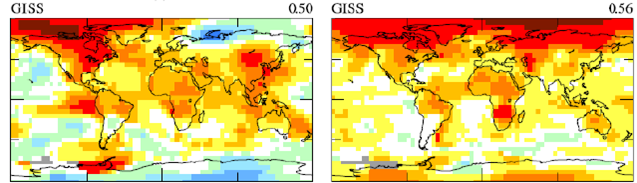
This difficulty with the Arctic is the reason that GISS says 2005 is the warmest year on record, while HadCRUT, the team in England, says that 1998 is. GISS extrapolates from the stations they have, and end up getting pretty good coverage of the Arctic:

They’re assuming that areas with missing data have the same anomaly as whatever temperature stations are within 1200 km, which, as they determined in 1987, is a pretty fair assumption.

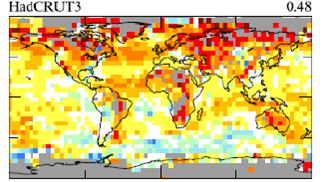
However, HadCRUT doesn’t do this extrapolating thing. When they don’t have data for an area, they just leave it out:
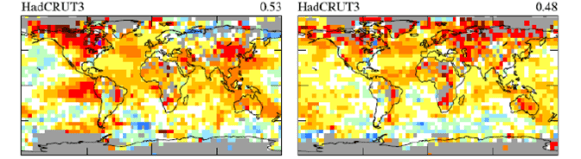
This might sound safer, in a way, but this method also makes an assumption. It assumes that the area has the same anomaly as the global average. And as we all know, the Arctic is warming a lot more and a lot faster than the global average. So it’s quite possible that GISS is right on this one.

Another adjustment that NASA makes is for local, anthropogenic, non-climatic effects on temperature data. The most obvious of these is the urban heat island effect. As an area becomes more urban, it gets more pavement, less vegetation, and its albedo goes down – it absorbs more heat. This often makes cities substantially warmer than the surrounding rural areas, which can obviously contaminate the temperature record. However, there are ways of eliminating urban influences from the data so we can see what the real trend is.

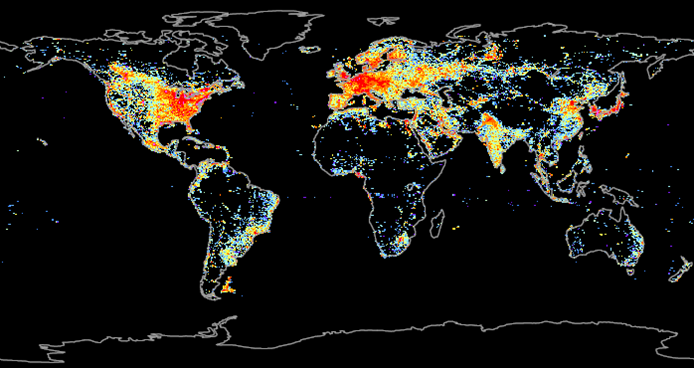
The first step is determining what stations are considered urban. The obvious way to do this is through population, but that’s actually not very accurate. Think of somewhere like Africa, where, even if there are thousands of people living in a small area, the urban influences such as concrete, absence of vegetation, or exhaust aren’t usually present. A much better indication is energy use, and a good proxy for energy use, that’s easy to measure, is lights at night-time.
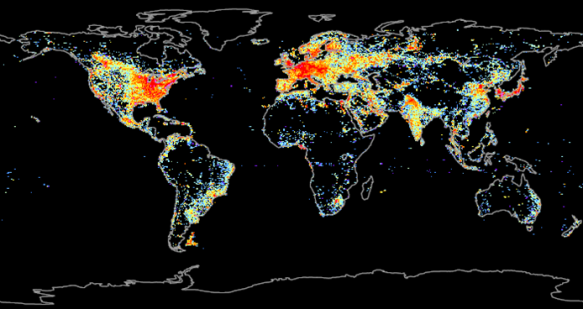
So GISS put a bit of code into their analysis that singles out stations where nightlight brightness is greater than 32 µW/m2/sr/µm, and adjusts their trends to agree with rural stations within 1200 km. If there aren’t enough rural stations within that radius, they’ll just exclude the station from the analysis.

They did an even more rigorous test for this paper, to test just how much urban influences were contaminating the long-term trend, and it was pretty interesting.

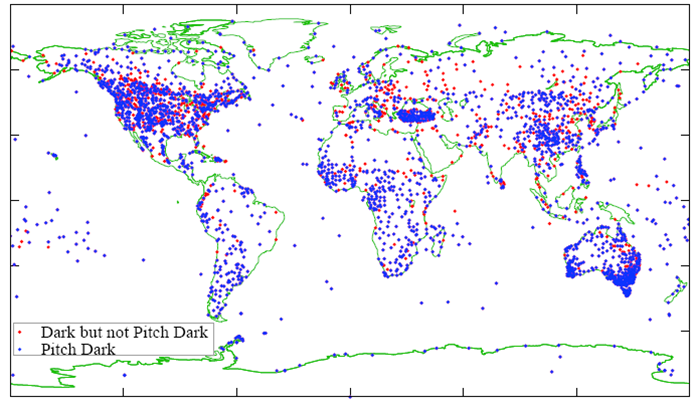
There were enough stations considered “pitch-dark” at night, where they couldn’t detect any light, to run a global analysis all by themselves. The trend that came out was <0.01 °C/century smaller than GISS’s normal calculation, an amount of error that they described as “immeasurably small”.

The result of all this temperature analysis is a graph, with one new point every year, that is “eagerly awaited by some members of the public and the media”:

However, this graph isn’t actually as useful as this one – the 12-month running mean:
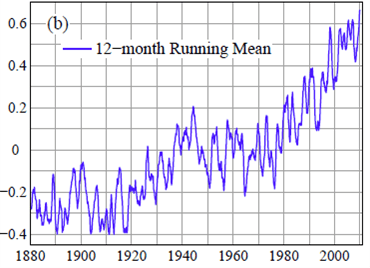
“From a climate standpoint there is nothing special about the time  of year at which the calendar begins”, so instead of only measuring January-December, you can also do February-January, March-February, and so on. This way, you get a data point every month instead of every year, and more data means more accuracy. It also solves problems with short-term influences, such as El Nino, La Nina, and volcanic eruptions, that the annual graph was having. These fleeting, but fairly substantial, influences can fall completely into one calendar year or be split between two – so their influence on global temperature could be overestimated or underestimated, depending on the starting month of the calendar. The 12-month running mean is much less misleading in this fashion.

As it is, we just set a new record for the 12-month running mean, and unless La Nina really takes off, 2010 will likely set a new record for the annual graph as well. But the authors argue that we need to start moving away from the annual graph, because it isn’t as useful.

The authors also discuss public perception of climate change, and media coverage of the issue. They say, “Our comments here about communication of this climate science to the public are our opinion…[We offer it] because it seems inappropriate to ignore the vast range of claims appearing in the media and in hopes that open discussion of these matters may help people distinguish the reality of global change sooner than would otherwise be the case.”

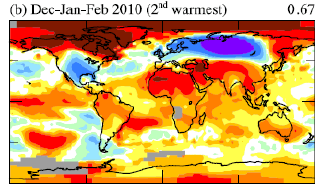
They make the very good point that “Lay people’s perception tends to be strongly influenced by the latest local fluctuation”, and use this winter as a case study, where a strongly negative Arctic Oscillation index caused significantly cooler-than-normal conditions across the United States and Europe. Consequently, a lot of people, especially in the US, began to doubt the reality of global warming – even though, in the world as a whole, it was the second warmest winter on record:
The authors also talk about data sharing. GISS likes to make everything freely available to the public – temperature station data, computer code, everything. However, putting it out there immediately, so that anyone can help check for flaws, has “a practical disadvantage: it allows any data flaws to be interpreted and misrepresented as machinations.” Multiple times in the past few years, when there have been minor errors that didn’t actually change anything, GISS was widely accused of making these mistakes deliberately, to “intentionally exaggerate the magnitude of global warming”. They realized this wasn’t working, so they changed their system: Before releasing the data to everyone, they first put it up on a private site so that only select scientists can examine it for flaws. And, of course, this “has resulted in the criticism that GISS now “hides” their data”.

Personally, I find the range and prevalence of these accusations against scientists absolutely terrifying. Look at what has become mainstream:
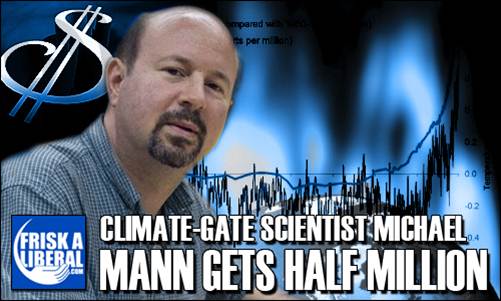
Scientific fraud is a very serious allegation, and it’s one thing for citizens to make it without evidence, but it’s another thing altogether for the media to repeat such claims without first investigating their validity:

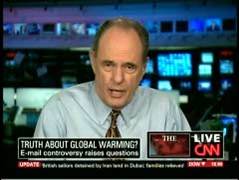
I have been disgusted by the media coverage of climate science, especially over the past year, especially in the United States, and I worry what this will mean for our ability to solve the problem.

However, there is still fantastic science going on that is absolutely fascinating and essential to our understanding of global climate change. This paper was a very interesting read, and it helped me to better understand a lot of aspects of global temperature analysis.
Deniers?

I really enjoyed New Scientist’s Special Report: Living in Denial. What a fascinating phenomenon, and a fascinating batch of articles exploring it.

The denial of science is a growing problem. It’s not restricted to a particular ideology – while denying the harmful effects of smoking or the existence of climate change is typically a position of the far right, vaccine denial and H1N1 conspiracy theories are largely restricted to the left.

It occurs even among the well-educated, or among youth who are still immersed in up-to-date curricula. For example, this year at the university, a student group put up signs saying “Don’t get the swine flu shot – it contains mercury!” The chemistry students got mad, and said that labelling thimerosal as toxic mercury was comparable to saying “Don’t eat table salt, it contains chlorine gas!”

As Michael Shermer’s article explains, the defining mark of science denial is a refusal to change one’s mind based on evidence. This is easy to identify for something like Holocaust denial, where evidence is abundant in the public sphere.

It gets a little harder for more technical issues like climate change or vaccines. Scientific opinion is overwhelmingly on one “side”, but the average person does not know or understand the evidence to support this consensus. An article about the thermodynamics of the stratosphere won’t sell a lot of papers. Most people unconsciously follow the credibility spectrum and trust what their doctor or NASA scientists say.

However, some don’t realize that scientific credibility is not the same as an appeal to authority, and so express contrarian opinions. Vaccines cause autism. Global warming is nonexistent/natural/inconsequential. The way that the Twin Towers fell proves that it was orchestrated by the US government.

There are two groups of contrarians: the skeptics, and the deniers. The skeptics are the ones who will change their minds based on evidence – they just haven’t encountered that evidence yet. My favourite example of this is from the Friends episode when Phoebe declares she doesn’t believe in evolution. When Ross starts talking to her about fossils, she says, “Oh. I didn’t know there was actually evidence.”

It’s amazing how many insights you can get out of a supposedly “fluffy” sitcom. I could write an entire essay analyzing that clip…..

I have met dozens of very reasonable people who doubt climate change because they don’t know about the evidence for it. People my age throw around the phrase “it’s a natural cycle” a lot, until I explain that the climate doesn’t act like a pendulum. It doesn’t have to compensate for past periods of warming or cooling – it simply responds to forcings. If the forcing is cyclical, then the climate will be cyclical, but some forcings are a different shape altogether. Similarly, I know a teacher who previously thought that natural causation of the current warming was a legitimate scientific theory, due to a presentation from a teacher’s conference….until I did a bit of probing and discovered that this presentation was given by Tim Ball.

These people are very reasonable. They are willing to change their minds based on evidence. They’ve just been unlucky enough to be misinformed by our flawed system of science journalism.

Then there are the deniers. They call themselves skeptics, but they will not change their minds, no matter what evidence you give them. They either move the goalposts, change the subject, or continue to repeat the same claim even after you have rebutted it patiently multiple times. Go check out some YouTube comments to see what I’m talking about.

Often their ideology or worldview is extreme in some way. For many members of the far right, any problem that would be solved by the government (think cap-and-trade or smoking legislation) will be rejected out of hand. On the far left, anything that would benefit corporations (usually vaccines or traditional medicine) will face a similar reaction. As Michael Specter says, “We hate Big Pharma. We run away from Big Pharma….and leap right into the arms of Big Placebo.”

This phenomenon suggests that science communication is not the answer – for deniers. I learned long ago that trying to change the minds of deniers is a complete waste of time. However, I still feel that science communication and the rebuttal of common misconceptions is absolutely vital. The true skeptics need access to the evidence they are lacking, so that they will be more informed, and our population will move farther towards solving the many science-related problems we face.

These skeptics deserve our time, our efforts, and our respect. They are the target audience of my blog, even if my most active commenters and supporters are a different group altogether. The reason that any of us here do all this work in communication, I believe, is for the true skeptics.

Michael Fitzpatrick argues that we shouldn’t use the label “deniers” at all. I wouldn’t want to alienate the true skeptics by coming across as someone who insults others. However, I think that calling deniers “skeptics” is unfair to the skeptics. They are two completely different groups that we must distinguish between. Skepticism is a worthy quality in science, and giving the complimentary title of “skeptic” to someone who doesn’t deserve it is unfair to those who do. We need to cater to the people who are willing to learn and who don’t want to waste our time. Science communication shouldn’t have to be like No Child Left Behind.

Michael Shermer’s second article, similarly, says that we should participate in debates with deniers and give them a chance to be heard. The truth will prevail, he argues, even if the deniers refuse to give in. I would agree with this position if it were a matter of opinion or policy, which is wholly democratic. Yet science is completely different. Science isn’t about free speech and giving equal time for all views. It is about giving time to those who have the most accurate analyses and robust conclusions. In science, you shut up and listen until your ideas are strongly supported by evidence. Then you publish.

When papers skeptical of climate change get published (all three per year!), such debates are worthy. The authors passed the test of peer-review, and even if their papers are obviously sub-par and are soon to be retracted, they deserve some debate and discussion. Let’s debate contrarian science when it is actually science – when it is actually published.

By paying close attention to and publicly debating with the authors of blog science, however, we are further confusing the public’s already skewed image of science. “It doesn’t matter whether or not you publish,” we seem to be telling them, “it’s all about free speech.” The scientific process has rules, and if deniers can’t pass the necessary, but not sufficient, condition of peer-review, their work doesn’t deserve to be treated as scientific research, and we shouldn’t give them our attention.

Let’s ignore the people who aren’t worth our time, because we have limited time, and there are people out there who deserve every minute of it.

The Energy Budget

I’ve decided to take this blog more in the direction of communicating science – there are only so many sociological musings to come up with. This is the first of many planned posts explaining basic climate science so people have better context for what they read in the newspaper.

Every post is a work in progress, and will be continuously edited when necessary, so please leave comments with suggestions on how to improve the accuracy or clarity. Enjoy!

What determines the temperature of the Earth?

The temperature in your backyard, the warmth of the equator, the frigid polar regions, the average global temperature for the whole planet…..they might seem like very different things to measure, but they’re all caused by the same process. It all comes back to energy.

This energy comes from the Sun, but it’s not as simple as a single transfer. Remember, at any time of the day or night, the Sun is shining on some part of the Earth. That energy can’t just stay on our planet, otherwise it would keep building up and up and we would fry after a couple of weeks.

Therefore, incoming energy from the Sun has to be balanced by outgoing energy from the Earth for the planet’s temperature to stay relatively constant. So when the Sun’s rays hit the ground, as a mixture of light, infrared, and UV radiation, the Earth absorbs the energy. Then it converts it to all to infrared radiation, which we perceive as heat when it hits us, and releases it upward.

All objects perform this absorption and emission when they are hit with radiation. If they receive enough energy, they can release some of it in the form of light – think of how a stove element glows when it’s turned on. However, the energy hitting the Earth is nowhere near this level, so it all comes out as infrared.

It is this emission of infrared radiation that determines the temperature of the Earth. The second step, not the first, is the important one, the one that we actually feel and experience. So on a hot summer’s day, it isn’t actually energy coming down from the Sun that’s making the air warm. It’s energy coming up from the Earth.

The air doesn’t warm up instantly, either – there’s a bit of a lag. This allows warm air to be transported away from the Equator and towards the poles, in the global circulation system of wind currents. Without this lag time, many regions of our world would have far more extreme temperatures.

Additionally, not all the radiation the Sun sends down gets absorbed by the Earth. Some of it is bounced back by clouds, which is why sunny days tend to be warmer than cloudy days. Some of it reaches the surface of the planet, but is bounced back too, before it’s even absorbed. This reflection of energy is particularly common when the surface is light in colour. That’s why it seems so bright outside after a snowstorm – because the snow is bouncing the energy back up as light, instead of absorbing it and releasing it upward as heat. It also explains why dark concrete, which absorbs almost all the radiation that hits it, is so much warmer than a light-coloured deck.

The amount of energy that the Sun sends down to us is greater than the amount that the surface of the Earth actually absorbs. However, the amount absorbed has to be equal to the amount released, and the amount released is what we witness as the temperature outside.

Uncertain Science….Uncertain World

Several months ago, I wrote a generally favourable review of geophysicist Dr. Henry Pollack’s newest book, A World Without Ice. So when I came across his earlier book, which was about the nature of the scientific process  – something that fascinates me – I couldn’t wait to read it.

Uncertain Science, Uncertain World is about uncertainty in science, as you may have guessed from the title, and it is absolutely fantastic. If you’re pressed for time, just read the first three chapters – they’re the best. They discuss how the public’s tendency to “equate science with certainty, rather than uncertainty” has been fed by the American school system and the mass media, and what the consequences are.

He talks about how everyone is born a scientist, how children observe the world around them with a fierce curiosity, instinctively exploring and experimenting. Then they go to school, and decide that science is boring. In elementary school, and to some extent in high school, science is presented as a memorization of facts and theories, rather than an exploration of the boundaries of and barriers to our knowledge, which is what scientists actually study. “Science is presented as answers rather than questions,” Pollack writes.

I couldn’t agree more. I wasn’t always the self-professed science addict that I am now. Until I reached high school, I thought that science was dry and boring, and until I started researching climate change, I didn’t see the creativity and problem-solving in it. In science class you memorize facts and do calculations, so it’s very hard for students to realize how cool it is to discover facts and derive calculations, rather than just repeating what someone else did before you. Intelligence is defined as how many facts you can stuff into your head, not how good you are at figuring things out for yourself.

The media doesn’t help, either. Pollack explores the well-known ails of science journalism, and the stigma against public communication in the scientific community. He shares a great example of how the media turned an amateur earthquake prediction, with no support from geologists, into a national frenzy that led to evacuations and the closure of schools. Mainstream journalists, in general, are not good at assessing credibility for scientific issues, but their influence on the public is so great that frequent mistakes by journalists lead to worldwide misconceptions.

This public illusion of certainty, in a field that actually thrives on uncertainty, can be easily exploited by vested interests. “When scientists acknowledge that they do not know everything about a complex natural phenomenon,” writes Pollack, “the public sometimes translates that to mean that scientists do not know anything about the subject,” and, for issues such as climate change, there are many people actively encouraging this jump in logic.

After the stellar beginning, the rest of the book is somewhat more mediocre, albeit still enjoyable. Pollack uses a series of examples and metaphors to explain irreducible measurement error, confidence expressed as statistical probability, conceptual and numerical models, experimentation, and forecasting vs hindcasting. As Pollack is currently studying how rocks retain heat and provide a record of past temperatures that can be used as proxy paleo data, facets of climate science are used as examples in nearly every chapter, and the last chapter of the book is devoted to climate change. However, he also uses examples from economics, plate tectonics, election polling, and the legal system. It is truly a multidisciplinary approach that will appeal to scientists and science enthusiasts from every field. Highly recommended to all.