Unknown's avatar

About climatesight

Kaitlin Naughten is an ocean-ice modeller at the British Antarctic Survey in Cambridge.

Models and Books

Working as a summer student continues to be rewarding. I get to spend all day reading interesting things and playing with scientific software. What a great deal!

Over the weekend, I ran the “Global Warming_01” simulation from EdGCM, which is an old climate model from NASA with a graphical user interface. Strangely, they don’t support Linux, as their target audience is educators – I doubt there are very many high school teachers running open-source operating systems! So I ran the Windows version on my laptop, and it took about 36 hours. It all felt very authentic.

Unfortunately, as their Windows 7 support is fairly new, there were some bugs in the output. It refused to give me any maps at all! The terminal popped up for a few seconds, but it didn’t output any files. All I could get were zonal averages (and then only from January-March) and time series. Also, for some reason, none of the time series graphs had units on the Y axis. Anyway, here are some I found interesting:

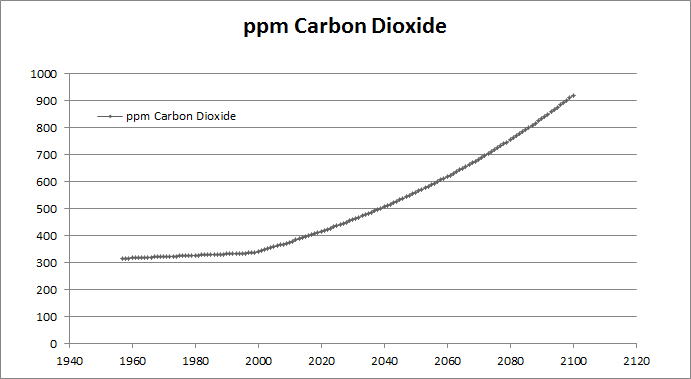
CO2 concentrations increase linearly from 1958 to 2000, and then exponentially until 2100, with a doubling of CO2 (with respect to 1958) around 2062. (This data was output as a spreadsheet, and I got Excel to generate the graph, so it looks nicer than the others.)

Global cloud cover held steady until around 2070, when it decreased. I can’t figure out why this would be, as the water vapour content of the air should be increasing with warming – wouldn’t there be more clouds forming, not less?

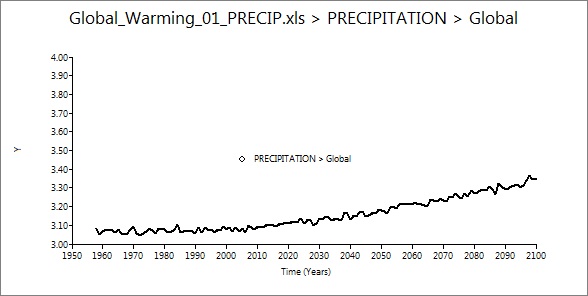
Global precipitation increased, as I expected. This is an instance where I wish the maps would have worked, because it would be neat to look at how precipitation amount varied by location. I’ve been pretty interested in subtropical drought recently.

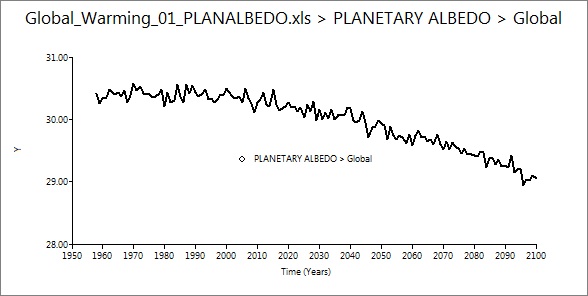
Albedo decreased about 1% – a nice example of the ice-albedo feedback (I presume) in action.

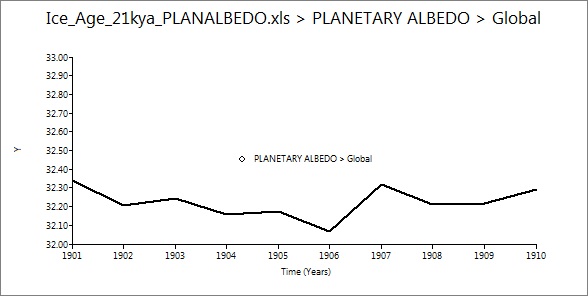
I also ran a simulation of the Last Glacial Maximum, from 21 thousand years ago. This run was much quicker than the first, as (since it was modeling a stable climate) it only simulated a decade, rather than 150 years. It took a few hours, and the same bugs in output were apparent. Time series graphs are less useful when studying stable conditions, but I found the albedo graph interesting:

Up a few percent from modern values, as expected.

It’s fairly expensive to purchase a licence for EdGCM, but they offer a free 30-day trial that I would recommend. I expect that it would run better on a  Mac, as that’s what they do most of the software development and testing on.

Now that I’ve played around with EdGCM, I’m working on porting CESM to a Linux machine. There’s been trial and error at every step, but everything went pretty smoothly until I reached the “build” phase, which requires the user to edit some of the scripts to suit the local machine (step 3 of the user guide). I’m still pretty new to Linux, so I’m having trouble working out the correct program paths, environment variables, modules, and so on. Oh well, the more difficult it is to get working, the more exciting it is when success finally comes!

I am also doing lots of background reading, as my project for the summer will probably be “some sort of written something-or-other” about climate models. Steve has a great collection of books about climate change, and keeps handing me interesting things to read. I’m really enjoying The Warming Papers, edited by David Archer and Ray Pierrehumbert. The book is a collection of landmark papers in climate science, with commentary from the editors. It’s pretty neat to read all the great works – from Fourier to Broecker to Hansen – in one place. Next on my list is A Vast Machine by Paul Edwards, which I’m very excited about.

A quick question, unrelated to my work – why do thunderstorms tend to happen at night? Perhaps it’s just a fluke, but we’ve had a lot of them recently, none of which have been in the daytime. Thoughts?

Quality, Transparency, and Rigour

The Intergovernmental Panel on Climate Change (IPCC) reports are likely the most cited documents on the subject of global warming. The organization, established by the United Nations, doesn’t do any original research – it simply summarizes the massive amount of scientific literature on the topic. Their reports, written and reviewed by volunteer scientists, and published approximately every six years, are a “one-stop shop” for credible information about climate change. When you have a question about climate science, it’s far easier to find the relevant section of the IPCC than it is to wade through thousands of results on Google Scholar.

The main problem with the IPCC, in my opinion, is that their reports are out of date as soon as they’re published, and then everyone has to wait another six years or so for the next version, which is subsequently out of date, and so on. Additionally, because there are so many authors, reviewers, and stakeholders involved in the IPCC, the reports come to reflect the lowest-common-denominator scientific understanding, rather than the median opinion of experts. In particular, government officials oversee the writing and reviewing of the Summary for Policymakers, to make sure that it’s relevant and clear. However, some governments are beginning to abuse their power in this process. The late Stephen Schneider, in his 2009 book Science as a Contact Sport, recounts his experiences with government representatives who absolutely refuse to allow certain conclusions to be published in the IPCC, regardless of their scientific backing.

The result is that the IPCC reports frequently underestimate the severity of climate change. For example, in the most recent report, the worst-case estimate of sea level rise by the end of this century was 0.59 m. Since then, scientists have revised this estimate to 1.9 m, but it won’t show up in the report until the next edition comes out around 2014.

Another example concerns Arctic sea ice: the worst-case scenario from the IPCC was an ice-free Arctic in the summer beginning around 2100. These estimates have come down so rapidly that there’s an outside chance the summer sea ice could be gone before the next IPCC report has a chance to correct it (presentation by Dr. David Barber, media coverage available here). It will more likely disappear around 2035, but that’s still a drastic change from what the IPCC said.

Despite this conservative stance, there are still some who think the IPCC is alarmist (this is usually paired with something about a New World Order and/or socialists using a carbon tax to take over the world). Naturally, the IPCC has become a favourite target of climate change deniers, who wish to obscure the reality of human-caused global warming. Last year, they claimed to have found all kinds of errors in the latest report, somehow proving that global warming wasn’t happening. In fact, most of these so-called “errors” were nothing of the sort, and the worst of the two real mistakes in the report involved a typo regarding which year certain glaicers were expected to disappear. Not bad, for a three-thousand-page document, but it created quite the media firestorm. Apparently scientists are expected to have 100% accuracy at all times, or else they are frauds.

Just a few weeks ago, the IPCC made some changes to their policies in response to these events. Their press release about the new policies featured the phrase “Boost Quality, Transparency and Rigour” in the title.

No, no, no. That’s not what the IPCC needs. These are very admirable goals, but they’re doing just fine as it is. Actions to “further minimize any possibility of errors in future reports” should not be their top priority. Further extending the review process will only further delay the publication of each report (making them even more out of date) and further enhance their lowest-common-denominator position. When you have an error rate on the order of 0.67 errors/1000 pages, should you spend your energy getting that all the way down to zero (a virtually impossible task) or on the real issues that need to be addressed?

I think the IPCC should adopt a continually-updating online version of their report. This would solve their chronic problem of being out of date, as well as help the organization adapt to the increasing role of the Internet in our world. Any future errors the deniers liked to yell about would be fixed immediately. Governments would be forming policies based on the best available evidence from today, not a decade ago. Everything would still be in one place, and version control would allow transparency to remain high.

The IPCC should also make it more clear when their estimates are too conservative. When a single sentence that didn’t even make it into the summary is shown to overestimate the problem, the climate science community ties itself up in knots trying to correct its tattered image. But prominent conclusions that underestimate the problem go unacknowledged for decades. If it were the other way around, can you imagine the field day deniers would have?

Luckily, the changes made to IPCC policy are not all aimed at appeasing the bullies. A long-overdue communications plan is in development: a rapid response team and Senior Communications Manager will develop formal strategies for public education and outreach. Hopefully, this will counteract the false claims and defamation the IPCC has been subject to since its creation.

Another new plan is to create an Executive Committee, composed of the Chair, Vice Chairs, Working Group Co-Chairs, and advisory members. This will “strengthen coordination and management of the IPCC” and allow for actions to be taken between reports, such as communication and responding to possible errors. A more structured administration will probably be helpful, given that the only people in the organization currently getting paid for their work are the office staff (even the Chair doesn’t make a cent). Coordinating overworked scientists who volunteer for a scientific undertaking that demands 100% accuracy can’t be an easy task.

Will the IPCC continue to be the best available source of credible information on climate change? Will its structure of endless review remain feasible in a world dominated by instant news? Should we continue to grant our governments control over the contents of scientific reports concerning an issue that they desperately want to avoid? Should we continue to play to the wants and needs of bullies? Or should we let scientists speak for themselves?

Tornadoes and Climate Change

Cross-posted from NextGen Journal

It has been a bad season for tornadoes in the United States. In fact, this April shattered the previous record for the most tornadoes ever. Even though the count isn’t finalized yet, nobody doubts that it will come out on top:

In a warming world, many questions are common, and quite reasonable. Is this a sign of climate change? Will we experience more, or stronger, tornadoes as the planet warms further?

In fact, these are very difficult questions to answer. First of all, attributing a specific weather event, or even a series of weather events, to a change in the climate is extremely difficult. Scientists can do statistical analysis to estimate the probability of the event with and without the extra energy available in a warming world, but this kind of study takes years. Even so, nobody can say for certain whether an event wasn’t just a fluke. The recent tornadoes very well might have been caused by climate change, but they also might have happened anyway.

Will tornadoes become more common in the future, as global warming progresses? Tornado formation is complicated, and forecasting them requires an awful lot of calculations. Many processes in the climate system are this way, so scientists simulate them using computer models, which can do detailed calculations at an increasingly impressive speed.

However, individual tornadoes are relatively small compared to other kinds of storms, such as hurricanes or regular rainstorms. They are, in fact, smaller than a single square in the highest-resolution climate models around today. Therefore, it’s just not possible to directly project them using mathematical models.

However, we can project the conditions necessary for tornadoes to form. They don’t always lead to a tornado, but they make one more likely. Two main factors exist: high wind shear and high convective available potential energy (CAPE). Climate change is making the atmosphere warmer, and increasing specific humidity (but not relative humidity): both of these contribute to CAPE, so that factor will increase the likelihood of conditions favourable to tornadoes. However, climate change warms the poles faster than the equator, which will decrease the temperature difference between them, subsequently lowering wind shear. That will make tornadoes less likely (Diffenbaugh et al, 2008). Which factor will win out? Is there another factor involved that climate change could impact? Will we get more tornadoes in some areas and less in others? Will we get weaker tornadoes or stronger tornadoes? It’s very difficult to tell.

In 2007, NASA scientists used a climate model to project changes in severe storms, including tornadoes. (Remember, even though an individual tornado can’t be represented on a model, the conditions likely to cause a tornado can.) They predicted that the future will bring fewer storms overall, but that the ones that do form will be stronger. A plausible solution to the question, although not a very comforting one.

With uncertain knowledge, how should we approach this issue? Should we focus on the comforting possibility that the devastation in the United States might have nothing to do with our species’ actions? Or should we acknowledge that we might bear responsibility? Dr. Kevin Trenberth, a top climate scientist at the National Center for Atmospheric Research (NCAR), thinks that ignoring this possibility until it’s proven is a bad idea. “It’s irresponsible not to mention climate change,” he writes.

Beautiful Things

This is what the last few days have taught me: even if the code for climate models can seem dense and confusing, the output is absolutely amazing.

Late yesterday I discovered a page of plots and animations from the Canadian Centre for Climate Modelling and Analysis. The most recent coupled global model represented on that page is CGCM3, so I looked at those animations. I noticed something very interesting: the North Atlantic, independent of the emissions scenario, was projected to cool slightly, while the world around it warmed up. Here is an example, from the A1B scenario. Don’t worry if the animation is already at the end, it will loop:

It turns out that this slight cooling is due to the North Atlantic circulation slowing down, as is very likely to happen from large additions of freshwater that change the salinity and density of the ocean (IPCC AR4 WG1, FAQ 10.2). This freshwater could come from either increased precipitation due to climate change, or meltwater from the Arctic ending up in the North Atlantic. Of course, we hear about this all the time – the unlikely prospect of the Gulf Stream completely shutting down and Europe going into an ice age, as displayed in The Day After Tomorrow – but, until now, I hadn’t realized that even a slight slowing of the circulation could cool the North Atlantic, while Europe remained unaffected.

Then, in chapter 8 of the IPCC, I read something that surprised me: climate models generate their own El Ninos and La Ninas. Scientists don’t understand quite what triggers the circulation patterns leading to these phenomena, so how can they be in the models? It turns out that the modellers don’t have to parameterize the ENSO cycles at all: they have done such a good job of reproducing global circulation from first principles that ENSO arises by itself, even though we don’t know why. How cool is that? (Thanks to Jim Prall and Things Break for their help with this puzzle.)

Jim Prall also pointed me to an HD animation of output from the UK-Japan Climate Collaboration. I can’t seem to embed the QuickTime movie (WordPress strips out some of the necessary HTML tags) so you will have to click on the link to watch it. It’s pretty long – almost 17 minutes – as it represents an entire year of the world’s climate system, in one-hour time steps. It shows 1978-79, starting from observational data, but from there it simulates its own circulation.

I am struck by the beauty of this output – the swirling cyclonic precipitation, the steady prevailing westerlies and trade winds, the subtropical high pressure belt clear from the relative absence of cloud cover in these regions. You can see storms sprinkling across the Amazon Basin, monsoons pounding South Asia, and sea ice at both poles advancing and retreating with the seasons. Scientists didn’t explicitly tell their models to do any of this. It all appeared from first principles.

Take 17 minutes out of your day to watch it – it’s an amazing stress reliever, sort of like meditation. Or maybe that’s just me…

One more quick observation: most of you are probably familiar with the naming conventions of IPCC reports. The First Assessment Report was FAR, the second was SAR, and so on, until the acronyms started to repeat themselves, so the Fourth Assessment Report was AR4. They’ll have to follow this alternate convention until the Eighth Annual Report, which will be EAR. Maybe they’ll stick with AR8, but that would be substantially less entertaining.

Learning Experiences

I apologize for my brief hiatus – it’s been almost two weeks since I’ve posted. I have been very busy recently, but for a very exciting reason: I got a job as a summer student of Dr. Steve Easterbrook! You can read more about Steve and his research on his faculty page and blog.

This job required me to move cities for the summer, so my mind has been consumed with thoughts such as “Where am I and how do I get home from this grocery store?” rather than “What am I going to write a post about this week?” However, I have had a few days on the job now, and as Steve encourages all of his students to blog about their research, I will use this outlet to periodically organize my thoughts.

I will be doing some sort of research project about climate modelling this summer – we’re not yet sure exactly what, so I am starting by taking a look at the code for some GCMs. The NCAR Community Earth System Model is one of the easiest to access, as it is largely an open source project. I’ve only read through a small piece of their atmosphere component, but I’ve already seen more physics calculations in one place than ever before.

I quickly learned that trying to understand every line of the code is a silly goal, as much as I may want to. Instead, I’m trying to get a broader picture of what the programs do. It’s really neat to have my knowledge about different subjects converge so completely. Multi-dimensional arrays, which I have previously only used to program games of Sudoku and tic-tac-toe, are now being used to represent the entire globe. Electric potential, a property I last studied in the circuitry unit of high school physics, somehow impacts atmospheric chemistry. The polar regions, which I was previously fascinated with mainly for their wildlife, also present interesting mathematical boundary cases for a climate model.

It’s also interesting to see how the collaborative nature of CESM, written by many different authors and designed for many different purposes, impacts its code. Some of the modules have nearly a thousand lines of code, and some have only a few dozen – it all depends on the programming style of the various authors. The commenting ranges from extensive to nonexistent. Every now and then one of the files will be written in an older version of Fortran, where EVERYTHING IS IN UPPER CASE.

I am bewildered by most of the variable names. They seem to be collections of abbreviations I’m not familiar with. Some examples are “mxsedfac”, “lndmaxjovrdmdni”, “fxdd”, and “vsc_knm_atm”.

When we get a Linux machine set up (I have heard too many horror stories to attempt a dual-boot with Windows) I am hoping to get a basic CESM simulation running, as well as EdGCM (this could theoretically run on my laptop, but I prefer to bring that home with me each evening, and the simulation will probably take over a day).

I am also doing some background reading on the topic of climate modelling, including this book, which led me to the story of PHONIAC. The first weather prediction done on a computer (the ENIAC machine) was recreated as a smartphone application, and ran approximately 3 million times faster. Unfortunately, I can’t find anyone with a smartphone that supports Java (argh, Apple!) so I haven’t been able to try it out.

I hope everyone is having a good summer so far. A more traditional article about tornadoes will be coming at the end of the week.

America’s Climate Choices

Cross-posted from NextGen Journal

A landmark report (summary available here) was published this week by the National Research Council in the United States, which is part of the National Academy of Sciences. The report, “America’s Climate Choices”, was requested by Congress several years ago. It focused on the observed impacts of climate change in the United States, as well as the policy choices most likely to be effective.

The report was created not just by scientists, but also by business executives and politicians. The diverse author committee is made apparent in the report’s message. Climate scientists tend to follow the IPCC mantra of “policy-relevant but policy-neutral” – they might discuss the potential ramifications of different policy choices, but they don’t recommend one over the other.

In contrast, this report includes phrases such as, “Current efforts of local, state, and private sector actors are important, but not likely to yield progress comparable to what could be achieved with the addition of strong federal policies that establish coherent national goals and incentives, and that promote strong U.S. engagement in international-level response efforts.” This is toeing the line of policy-prescriptive. It doesn’t hesitate to say that some policy options will be better than others for reducing global warming, and that the policy option of doing nothing would be foolish.

More specifically, the authors recommend a price on carbon, and describe a system similar to a carbon tax for the most effective option. They also name elements of what they see to be the best course of action for the United States:

  • “significantly reduce greenhouse gas emissions”
  • “begin mobilizing now for adaptation”
  • “invest in science, technology, and information systems”
  • “participate in international climate change response efforts”
  • “coordinate national response efforts”

These recommendations conflict with many postulates of the conservative American ideology. “Historically there’s only one thing Congress dislikes more than science and that’s international treaties,” writes Kevin Grandia, and this report recommends both. It’s no surprise, then, that Tea Party politicians are dismissing the report out of hand, as the New York Times reports. Apparently, Joe Barton thinks that doing nothing about climate change is a viable policy option. Fifty years from now, when civilizations and ecosystems worldwide are struggling to survive the impacts of climate change, what will history books say about Joe Barton?

The New York Times article illustrates much of what is wrong with mainstream climate journalism. It balances a massive report from the National Academy of Sciences with statements from an extremist politician. Additionally, it does a hilarious job of framing decades-old scientific findings as new and controversial, as if this report was the first to discuss them. “Not only is global warming real, but the effects are already becoming serious,” writes the New York Times. “Not only is the science behind the climate-change forecast solid, the report found, but the risks to future generations from further inaction are profound.”

If this is news to the New York Times, they need to catch up on their science. Right now, they’re stuck in the 1980s.

Thoughts

My presentation went very well. The church group was full of kind, educated, and passionate people. It was nice to have an audience that wasn’t full of high school students who thought science was boring!

After the presentation, a woman in the group shared something with me that she found at a conference in Australia just before the Copenhagen summit. I liked it so much that I thought I’d share it here, with her permission.

If the earth
were only a few feet in
diameter, floating a few feet above
a field somewhere, people would come
from everywhere to marvel at it. People would
walk around it marvelling at its big pools of water,
its little pools and the water flowing between the pools.
People would marvel at the bumps on it, and the holes in it,
and they would marvel at the very thin layer of gas surrounding
it and the water suspended in the gas. The people would
marvel at all the creatures walking around the surface of the ball
and at the creatures in the water. The people would declare it
as sacred because it was the only one and they would protect
it so that it would not be hurt. The ball would be the
greatest wonder known and people around would come to
pray to it, to be healed, to gain knowledge, to know
beauty and to wonder how it could be. People
would love it and defend it with their lives
because they would somehow know that
their lives, their own roundness, could
be nothing without it. If the
Earth were only a few
feet in diameter.

-Joe Miller

What Can One Person Do?

Next week, I will be giving a speech on climate change to the green committee of a local United Church. They are particularly interested in science and solutions, so I wrote the following script, drawing heavily from my previous presentations. I would really appreciate feedback and suggestions for this presentation.

Citations will be on the slides (which I haven’t made yet), so they’re not in the text of this script. Let me know if there’s a particular reference you’re wondering about, but they’re probably common knowledge within this community by now.

Enjoy!

Climate change is depressing. I know that really well, because I’ve been studying it for over two years. I’m quite practiced at keeping the scary stuff contained in the analytical part of my brain, and not thinking of the implications – because the implications make you feel powerless. I’m sure that all of us here wish we could stop global warming on our own. So we work hard to reduce our carbon footprints, and then we feel guilty every time we take the car out or buy something that was made in China or turn up the heat a degree.

The truth is, though, the infrastructure of our society doesn’t support a low-carbon lifestyle. Look at the quality of public transit in Winnipeg, or the price of local food. We can work all we want at changing our practices, but it’s an uphill battle. If we change the infrastructure, though – if we put a price on carbon so that sustainable practices are cheaper and easier than using fossil fuels – people everywhere will subsequently change their practices.

Currently, governments – particularly in North America – aren’t too interested in sustainable infrastructure, because they don’t think people care. Politicians only say what they think people want to hear. So, should we go dress up as polar bears and protest in front of Parliament to show them we care? That might work, but they will probably just see us as crazy environmentalists, a fringe group. We need a critical mass of people that care about climate change, understand the problem, and want to fix it. An effective solution requires top-down organization, but that won’t happen until there’s a bottom-up, grassroots movement of people who care.

I believe that the most effective action one person can take in the fight against global warming is to talk to others and educate others. I believe most people are good, and sane, and reasonable. They do the best they can, given their level of awareness. If we increase that awareness, we’ll gain political will for a solution. And so, in an effort to practice what I preach, I’m going to talk to you about the issue.

The science that led us to the modern concern about climate change began all the way back in 1824, when a man named Joseph Fourier discovered the greenhouse effect. Gases such as carbon dioxide make up less than one percent of the Earth’s atmosphere, but they trap enough heat to keep the Earth over 30 degrees Celsius warmer than it would be otherwise.

Without greenhouse gases, there could be no life on Earth, so they’re a very good thing – until their concentration changes. If you double the amount of CO2 in the air, the planet will warm, on average, somewhere around 3 degrees. The first person to realize that humans could cause this kind of a change, through the burning of fossil fuels releasing CO2, was Svante Arrhenius, in 1897. So this is not a new theory by any means.

For a long time, scientists assumed that any CO2 we emitted would just get absorbed by the oceans. In 1957, Roger Revelle showed that wasn’t true. The very next year, Charles Keeling decided to test this out, and started measuring the carbon dioxide content of the atmosphere. Now, Arrhenius had assumed that it would take thousands of years to double CO2 from the preindustrial value of 280 ppm (which we know from ice cores), but the way we’re going, we’ll get there in just a few decades. We’ve already reached 390 ppm. That might not seem like a lot, but 390 ppm of arsenic in your coffee would kill you. Small changes can have big effects.

Around the 1970s, scientists realized that people were exerting another influence on the climate. Many forms of air pollution, known as aerosols, have a cooling effect on the planet. In the 70s, the warming from greenhouse gases and the cooling from aerosols were cancelling each other out, and scientists were split as to which way it would go. There was one paper, by Stephen Schneider, which even said it could be possible to cause an ice age, if we put out enough aerosols and greenhouse gases stayed constant. However, as climate models improved, and governments started to regulate air pollution, a scientific consensus emerged that greenhouse gases would win out. Global warming was coming – it was just a question of when.

In 1988, James Hansen, who is arguably the top climate scientist in the world today, claimed it had arrived. In a famous testimony to the U.S. Congress, he said that “the greenhouse effect has been detected, and it is changing our climate now.” Many scientists weren’t so sure, and thought it was too early to make such a bold statement, but Hansen turned out to be right. Since about 1975, the world has been warming, more quickly than it has for at least the last 55 million years.

Over the past decade, scientists have even been able to rule out the possibility that the warming is caused by something else, like a natural cycle. Different causes of climate change have slightly different effects – like the pattern of warming in different layers of the atmosphere, the amount of warming in summer compared to winter, or at night compared to in the day, and so on. Ben Santer pioneered attribution studies: examining these effects in order to pinpoint a specific cause. And so far, nobody has been able to explain how the recent warming could not be caused by us.

Today, there is a remarkable amount of scientific agreement surrounding this issue. Between 97 and 98% of climate scientists, virtually 100% of peer-reviewed studies, and every scientific organization in the world agree that humans are causing the Earth to warm. The evidence for climate change is not a house of cards, where you take one piece out and the whole theory falls apart. It’s more like a mountain. Scrape a handful of pebbles off the top, but the mountain is still there.

However, if you take a step outside of the academic community, this convergence of evidence is more or less invisible. The majority of newspaper articles, from respected outlets like the New York Times or the Wall Street Journal, spend at least as much time arguing against this consensus as they do arguing for it. They present ideas such as “maybe it’s a natural cycle” or “CO2 has no effect on climate” that scientists disproved years ago. The media is stuck in the past. Some of them are only stuck in the 1980s, but others are stuck all the way back in 1800. Why is it like this?

Part of it comes from good, but misguided, intentions. When it comes to climate change, most journalists follow the rule of balance: presenting “two equal sides”, staying neutral, letting the reader form their own opinion. This works well when the so-called controversy is one of political or social nature, like tax levels or capital punishment. In these cases, there is no right answer, and people are usually split into two camps. But when the question at hand is one of science, there is a right answer – even if we haven’t found it yet – so some explanations are better than others, and some can be totally wrong. Would you let somebody form their own opinion on Newton’s Laws of Motion or the reality of photosynthesis? Sometimes scientists are split into two equal groups, but sometimes they’re split into three or four or even a dozen. How do you represent that as two equal sides? Sometimes, like we see with climate change, pretty much all the scientists are in agreement, and the two or three percent which aren’t don’t really publish, because they can’t back up their statements and nobody really takes them seriously. So framing these two groups as having equal weight in the scientific community is completely incorrect. It exaggerates the extreme minority, and suppresses everyone else. Being objective is not always the same as being neutral, and it’s particularly important to remember that when our future is at stake.

Another reason to frame climate science as controversial is that it makes for a much better story. Who really wants to read about scientists agreeing on everything? Journalists try to write stories that are exciting. Unfortunately, that goal can begin to overshadow accuracy.

Also, there are fewer journalists than there used to be, and there are almost no science journalists in the mainstream media – general reporters cover science issues instead. Also, a few decades ago, journalists used to get a week or two to write a story. Now they often have less than a day, because speed and availability of news has become more important than quality.

However, perhaps the most important – and disturbing – explanation for this inaccurate framing is that the media has been very compliant in spreading the message of climate change deniers. They call themselves skeptics, but I don’t think that’s accurate. A true skeptic will only accept a claim given sufficient evidence. That’s a good thing, and all scientists should be skeptics. But it’s easy to see that these people will never accept human-caused climate change, no matter what the evidence. At the same time, they blindly accept any shred of information that seems to support their cause, without applying any skepticism at all. That’s denial, so let’s not compliment them by calling them skeptics.

Climate change deniers will use whatever they can get – whether or not it’s legitimate, whether or not it’s honest – as proof that climate change is natural, or nonexistent, or a global conspiracy. They’ll tell you that volcanoes emit more CO2 than humans, but volcanoes actually emit about 1% of what we do. They’ll say that global warming has stopped because 2008 was cooler than 2007. If climatologists organize a public lecture in effort to communicate accurate scientific information, they’ll say that scientists are dogmatic and subscribe to censorship and will not allow any other opinions to be considered.

Some of these questionable sources are organizations, like a dozen or so lobby groups that have been paid a lot of money by oil companies to say that global warming is fake. Some of them are individuals, like US Senator James Inhofe, who was the environment chair under George W. Bush, and says that “global warming is the greatest hoax ever imposed upon the American people.” Some of them have financial motivations, and some of them have ideological motivations, but their motivations don’t really matter – all that matters is that they are saying things that are inaccurate, and misleading, and just plain wrong.

There has been a recent, and very disturbing, new tactic of deniers. Instead of attacking the science, they’ve begun to attack the integrity of individual scientists. In November 2009, they stole thirteen years of emails from a top climate research group in the UK, and spread stories all over the media that said scientists were caught fudging their data and censoring critics. Since then, they’ve been cleared of these charges by eight independent investigations, but you wouldn’t know it by reading the newspaper. For months, nearly every media outlet in the developed world spread what was, essentially, libel, and the only one that has formally apologized for its inaccurate coverage is the BBC.

In the meantime, there has been tremendous personal impact on the scientists involved. Many of them have received death threats, and Phil Jones, the director of the research group, was nearly driven to suicide. Another scientist, who wishes to remain anonymous, had a dead animal dumped on his doorstep and now travels with bodyguards. The Republican Party, which prides itself on fiscal responsibility, is pushing for more and more investigations, because they just can’t accept that the scientists are innocent…and James Inhofe, the “global warming is a hoax” guy, attempted to criminally prosecute seventeen researchers, most of whom had done nothing but occasionally correspond with the scientists who had their emails stolen. It’s McCarthyism all over again.

So this is where we are. Where are we going?

The Intergovernmental Panel on Climate Change, or IPCC, which collects and summarizes all the scientific literature about climate change, said in 2007 that under a business-as-usual scenario, where we keep going the way we’re going, the world will warm somewhere around 4 degrees Celsius by 2100. Unfortunately, this report was out of date almost as soon as it was published, and has widely been criticized for being too conservative. The British Meteorological Office published an updated figure in 2009 that estimated we will reach 4 degrees by the 2070s.

I will still be alive then (I hope!). I will likely have kids and even grandkids by then. I’ve spent a lot of time researching climate change, and the prospect of a 4 degree rise is terrifying to me. At 4 degrees, we will have lost control of the climate – even if we stop emitting greenhouse gases, positive feedbacks in the climate system will make sure the warming continues. We will have committed somewhere between 40 and 70 percent of the world’s species to extinction. Prehistoric records indicate that we can expect 40 to 80 metres of eventual sea level rise – it will take thousands of years to get there, but many coastal cities will be swamped within the first century. Countries – maybe even developed countries – will be at war over food and water. All this…within my lifetime.

And look at our current response. We seem to be spending more time attacking the scientists who discovered the problem than we are negotiating policy to fix it. We should have started reducing our greenhouse gas emissions twenty years ago, but if we start now, and work really hard, we do have a shot at stopping the warming at a point where we stay in control. Technically, we can do it. It’s going to take an unprecedented amount of political will and international communication

Everybody wants to know, “What can I do?” to fix the problem. Now, magazines everywhere are happy to tell you “10 easy ways to reduce your carbon footprint” – ride your bike, and compost, and buy organic spinach. That’s not really going to help. Say that enough people reduce their demand on fossil fuels: supply and demand dictates that the price will go down, and someone else will say, “Hey, gas is cheap!” and use more of it. Grassroots sentiment isn’t going to be enough. We need a price on carbon, whether it’s a carbon tax or cap-and-trade…but governments won’t do that until a critical mass of people demand it.

So what can you do? You can work on achieving that critical mass. Engage the apathetic. Educate people. Talk to them about climate change – it’s scary stuff, but suck it up. We’re all going to need to face it. Help them to understand and care about the problem. Don’t worry about the crazy people who shout about socialist conspiracies, they’re not worth your time. They’re very loud, but there’s not really very many of them. And in the end, we all get one vote.
Change

If you know what these colours mean, you probably share my surprise:

For those of you who aren’t familiar with Canadian politics, past and present, here’s a quick brush-up. (If parliamentary democracy or constitutional monarchy is new to you, Rick Mercer gives a great explanation.)

Liberal Party (Red Seats)

  • Politics: More liberal than the American Democrats, but not by a huge amount.
  • How they usually do: They’ve won elections so many times that they’re deemed “Canada’s natural government”. Whether it’s a majority or a minority, a Liberal government is the rule, rather than the exception.
  • What happened on Monday: 34 Liberal MPs were elected – only 11% of the available seats. The leader of the party, Michael Ignatieff, wasn’t even elected in his riding – a rare (but not unprecedented) occurrence.

Conservative Party (Dark Blue Seats)

  • Politics: Somewhere between American Republicans and Democrats. Canada’s most right-wing party that’s mainstream enough to win seats.
  • How they usually do: When it’s not a Liberal government, it’s a Conservative one. The last time they had a majority, it was under Brian Mulroney – an event that eventually led to the party’s collapse and division. The two halves of the party rejoined for the 2004 election, under Stephen Harper, the leader of the more right-wing of the two. Since 2006, he has held seemingly never-ending minorities. Again, Rick Mercer hits the nail on the head.
  • What happened on Monday: They got their first majority – 54% of the seats, but with only 40% of the popular vote.

Bloc Quebecois (Light Blue Seats)

  • Politics: Diverse, as the party’s sole platform is the intent to make Quebec a sovereign nation. These days, it’s pretty liberal.
  • How they usually do: Fifty-some seats in Quebec.
  • What happened on Monday: Only four Bloc were elected – most seats were lost to the NDP. The leader, Gilles Duceppe, lost the election in his riding. Now they don’t even have enough seats for party status.

New Democrat Party (Orange Seats)

  • Politics: The most liberal of the mainstream parties, they subscribe to social democracy. If Tea Partiers think Obama’s a socialist, I wonder what they’d say if the NDP swept the US Congress.
  • How they usually do: Twenty seats or so, scattered throughout the country, but rarely any from Quebec.
  • What happened on Monday: The NDP unexpectedly swept Quebec, and won 102 seats – for the first time, they’re the Official Opposition. Many of their MPs are brand new and never expected to get elected. Some are still university students. One spent her campaign in Las Vegas, but ended up winning the riding. Their growing popularity wasn’t limited to Quebec, but in many ridings – most notably some in Ontario – they split the vote with the Liberals, giving a lot of seats to the Conservatives.

Green Party (I’ll let you work out their colour of seats)

  • Politics: Not quite as left-wing as the NDP. They focus on environmental issues, climate change mitigation, and the legalization of marijuana.
  • How they usually do: Over the past few elections, they have held between 1 and 10% of the popular vote, but have never had an MP sit in Parliament. Once a Liberal MP switched to the Green Party, but Parliament was dissolved for an election before he got to sit in it as a member of the Greens.
  • What happened on Monday: Elizabeth May, the party leader, won the election in her riding, defeating a Conservative cabinet minister. She is the first elected Green and will be the first to sit in the House of Commons.

If that isn’t enough to convince you of what a massive change this election was, look at the diagrams on this page. Start at the bottom for the most recent Parliaments.

It is arguable that, although the Conservatives only have 40% of the popular vote, Stephen Harper has 100% of the power in the federal government. They hold a majority not only in the House of Commons, but also in the Senate – their five years of minorities have ensured that only Conservatives get appointed to the upper house. It is common for party leaders to demand that their caucus vote the party line on important issues, so Harper can pass pretty much any bill he wants. Also, unless his own party turns against him, he doesn’t have to call an election for another five years. Despite a more left-wing opposition that will be stronger on issues such as climate change (Elizabeth May, in particular, is a fabulous debater), they can’t actually sway results away from what Harper wants. Additionally, the new NDP MPs will have to prove their worth quickly if they want to be taken seriously.

But this is nothing new. It’s nothing specific to Harper. This concentration of power happened before with all the Liberal majority governments, as well as the Conservative exceptions such as Mulroney. This is the way majority governments in Canada work. They will pass a great deal of legislation in their favour, much of which will be undone when the opposing party eventually takes over. I am just worried because, given the Conservatives’ stance on climate change mitigation, we will likely move backwards on an issue where we don’t have time to waste. These decisions, or lack thereof, cannot be undone or reversed.

Thoughts?

Data from Elections Canada

More coverage from CBC News